


You wake up in Globe with a dry throat, stuffed sinuses, and dust settled on the return grille. The pleated filter in the hallway looks clean enough, so you replace it with a higher-rated model, expecting the problem to disappear. A few weeks later, the house still feels dusty, the bedroom still triggers congestion, and the air conditioner sounds like it's working harder.
That frustration usually comes from treating filter efficiency as the whole solution. In Arizona, the right filter must capture the particles that bother your household while allowing the blower, ducts, furnace, heat pump, and air conditioner to move enough air. The best air filters for allergies aren't automatically the filters with the highest MERV number. They're the filters your HVAC system can support, installed in a sealed system and maintained before dust, pollen, or smoke overloads the media.
Why Allergy Relief Starts with the Right Filter
A homeowner in Arizona can install a higher-rated filter and still wake up with congestion, dust on the return grille, and weak airflow. I have seen this repeatedly in attic duct systems. The latest filter may promise finer particle capture, yet the blower strains because the filter is too restrictive for the equipment and ductwork.
The issue is usually system performance, not effort. A dense filter can overload an already marginal return system, while gaps around the filter rack let unfiltered attic air enter the return path. Filtration also cannot remove allergens introduced through open doors, bedding, carpets, pets, or unsealed ducts.
The low and high ends both create trouble
A basic MERV 8 filter can capture larger dust and pollen, but it may leave more fine material circulating in homes affected by wildfire smoke, pet dander, or smaller allergen fragments. MERV 11 is often a practical whole-home choice when the air handler and duct system can handle the added resistance.
MERV 16 creates a different risk. Higher resistance can reduce airflow, increase blower noise, and limit heating or cooling performance. The filter rating has to match the system's available airflow and pressure capacity, not just the household's desire for cleaner air.
Practical rule: A filter that captures more particles but chokes the air handler can reduce comfort, increase noise, and leave the system moving less filtered air overall.
Start with the actual indoor problem
Dust storms, juniper and mesquite pollen, pet dander, mold spores, and wildfire smoke place different demands on filtration. A home with seasonal pollen exposure may need a different setup from one with pets, respiratory sensitivities, or smoke entering from outdoors.
Use three checks before choosing a filter:
- What are you trying to capture? Larger dust and pollen do not require the same fine-particle performance as smoke.
- Can the system support the filter? Check the filter slot, blower, duct design, and static pressure. A thicker filter may reduce resistance compared with a thin, dense one, but it still needs a properly sized cabinet.
- Where do symptoms occur? Whole-home filtration serves multiple rooms, while a portable purifier can concentrate cleaning in a bedroom or office.
The filter must also fit tightly. A small gap can let air bypass the media, reducing the benefit of a higher rating. In Arizona, replacement timing matters because desert dust and construction debris can load a filter faster than expected.
A properly fitted filter that the system can support, replaced before it becomes loaded, often outperforms a premium filter installed in a leaky, airflow-starved system. That is the practical starting point for allergy relief.
How Air Filters Are Rated
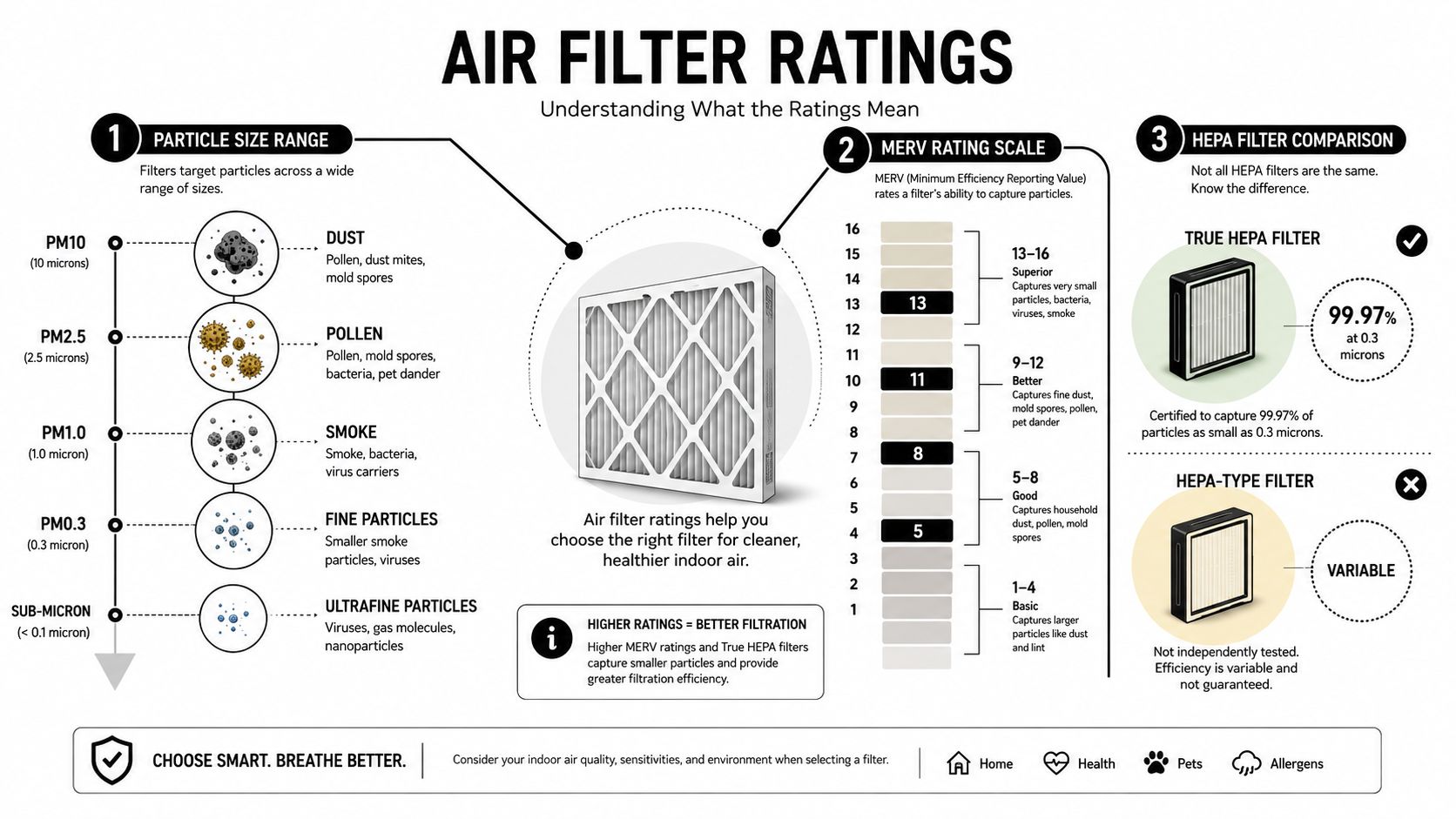
MERV, or Minimum Efficiency Reporting Value, measures how effectively an HVAC filter captures particles across tested size ranges. ASHRAE developed the MERV system in the 1980s, and the general HVAC scale runs from 1 to 16 for residential and commercial applications, as summarized in this overview of the MERV rating system.
Higher ratings target smaller particles, but denser media also creates more resistance to airflow. That resistance increases further as dust loads the filter. In Arizona, a rating only helps when the air handler, filter cabinet, and duct system can move air through it without excessive static pressure.
Particle size changes the decision
Particles are measured in microns. PM10 refers broadly to particles up to 10 microns, PM2.5 to particles up to 2.5 microns, and sub-micron particles are smaller still. Pollen fragments, pet dander, mold spores, household dust, and smoke-associated particles differ in size and behavior, so one rating does not address every indoor concern equally.
A MERV 11 filter is often a practical lower-resistance choice for whole-home allergy control. EPA technical guidance indicates that MERV 11 filters remove roughly 20% of particles in the 0.3 to 1 micron band, while MERV 13 typically reaches at least 50% removal in that smallest tested band, according to the ASHRAE filtration and disinfection FAQ. That gap matters when fine allergen fragments or wildfire smoke are part of the problem.
ASHRAE identifies MERV 13 as a recommended baseline and MERV 14 as preferred for stronger filtration. Its efficiency guidance lists MERV 13 at at least 85% for 1 to 3 micron particles and MERV 14 at at least 90% for the same band. Those ratings can improve fine-particle capture, but they should not be installed blindly in a system with a restrictive cabinet, weak blower, or marginal ductwork.
HEPA isn't the same as HEPA-type
True HEPA filters first became available in the 1950s. In the United States, a true HEPA filter is commonly defined as capturing 99.97% of particles at 0.3 microns, a test size commonly treated as a difficult benchmark for fine airborne particles. A product labeled “HEPA-type” does not necessarily meet that standard.
The label matters only alongside the test basis and airflow arrangement. A true HEPA portable purifier pairs dense media with its own fan. A standard central HVAC system may lack the blower capacity, cabinet depth, or duct design needed to accept HEPA media directly.
Match the rating to the particle size, then match the filter to the equipment. A higher MERV number cannot compensate for a filter that overloads the blower or forces air around the media.
Comparing the Main Filter Types for Allergies
Arizona homes face dust, pollen, and seasonal wildfire smoke, but the same filter does not handle every problem equally. A high-MERV pleated media filter is usually the most practical central HVAC option. True HEPA generally fits a portable purifier or a purpose-built air-cleaning cabinet better. Electrostatic and carbon products can help in narrower situations, yet no label removes the system's airflow limits.
| Filter Type | Fine Particle Capture | Pressure Drop | Odor/Gas Control | Best Fit |
|---|---|---|---|---|
| True HEPA | Very high when properly rated and supplied with adequate airflow | High in many HVAC applications | Limited without carbon | Portable bedroom or dedicated air-cleaning equipment |
| High-MERV pleated media | Strong, especially at MERV 13 to 16 | Moderate to high, depending on depth and system | Limited | Whole-home systems that can tolerate the resistance |
| Electrostatic washable | Variable with design, cleanliness, and condition | Often lower when clean | Little gas control | Basic dust control where frequent cleaning is realistic |
| Disposable electrostatic | Moderate to strong depending on rating | Varies by construction | Little gas control | Residential HVAC systems needing a replaceable pleated filter |
| Activated carbon | Limited particle capture by itself | Usually depends on the companion media | Stronger for selected odors and gases | Smoke odors and gaseous contaminants |
| Carbon-plus-media | Media handles particles, carbon addresses some odors | Moderate to high | Better than particle-only media | Homes facing mixed dust, allergen, and odor concerns |
True HEPA and high-MERV media
A true HEPA purifier can capture fine particles effectively in one room, provided its fan has enough capacity and the unit runs long enough. It is not automatically a substitute for the central filter. Dense HEPA media can create excessive resistance in a conventional return unless the air handler, cabinet, and ductwork were designed for it.
A MERV 13 pleated filter often gives a forced-air system a more workable balance of particle capture and airflow. MERV 16 can capture more fine particles, but the Department of Energy HVAC review notes that higher-resistance filtration can bring blower and noise penalties, particularly in systems with leaky ducts.
Before upgrading, check the filter cabinet, blower condition, and return duct size. A filter that starves the air handler can reduce circulation, increase operating strain, and leave rooms with poor air movement. In an attic system, a poorly sealed cabinet can also let dust bypass the media entirely.
Electrostatic and carbon options
Washable electrostatic filters reduce replacement purchases, but they require consistent cleaning. Dust buildup, damage, or incomplete drying can change their performance. They are not my first choice for wildfire smoke because particle capture and odor control are separate tasks.
Activated carbon is useful when smoke odor or other gases are part of the problem. Carbon alone does little for airborne particles, so a carbon-plus-media filter is more useful when a home needs both particle and odor control. Thin carbon coatings have limited capacity, while thicker assemblies can increase resistance and deserve an HVAC evaluation before installation.
The right choice follows the trigger and the equipment. Dust and pollen usually call for dependable pleated media. Smoke may require fine-particle filtration, carbon for odor, closed windows during poor outdoor conditions, and a portable purifier where occupants spend the most time. A filter that the blower cannot handle will not provide reliable allergy relief, regardless of its rating.
Whole-Home HVAC Filters Versus Portable Air Purifiers
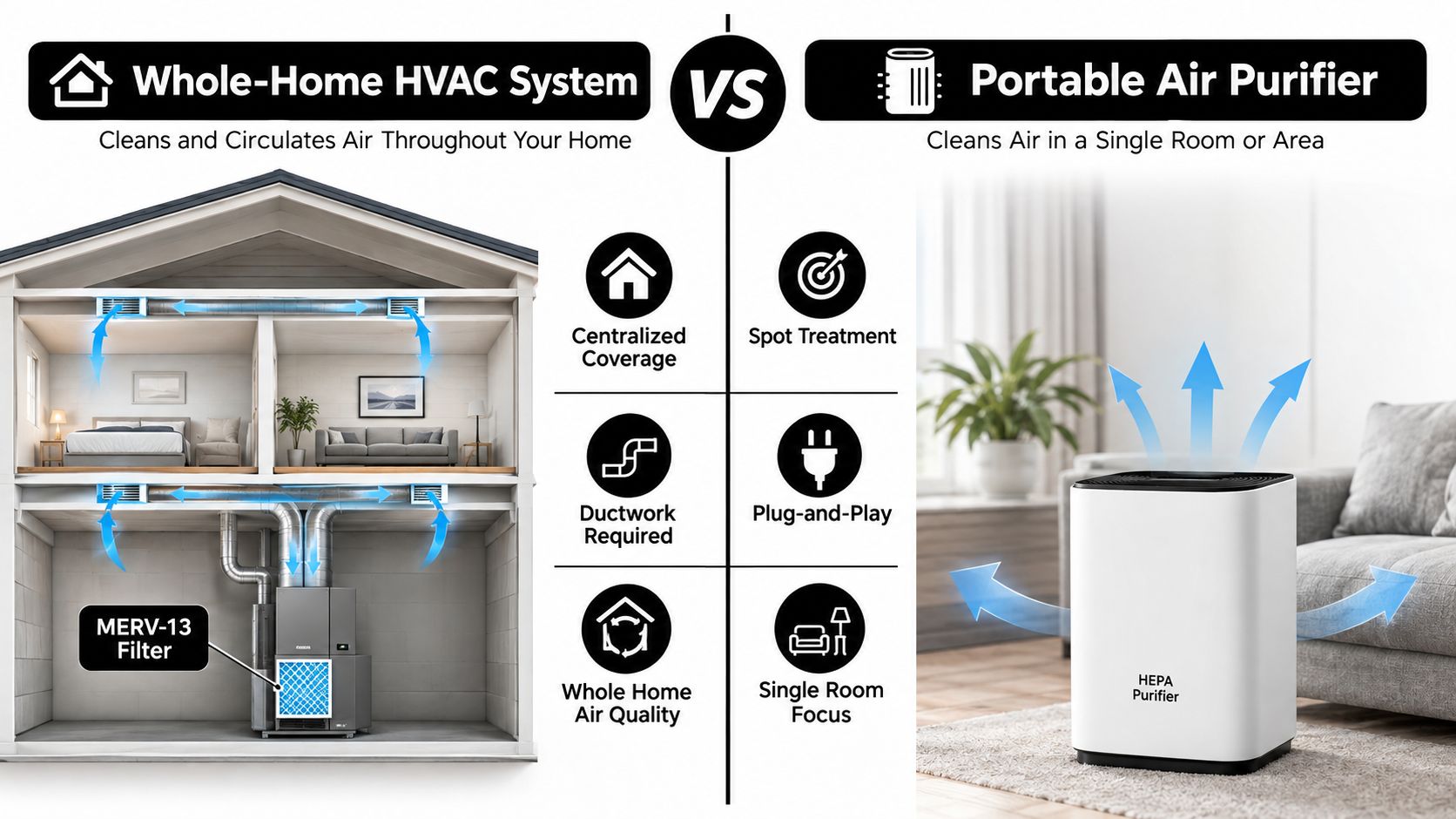
A central HVAC filter can reduce airborne particles across several rooms, but only while the system operates and the filter fits tightly. Leaky return ducts or a poorly sealed rack can pull untreated attic air around the media. A portable purifier cleans a defined room independently, which can be useful when the HVAC system cannot tolerate a higher-resistance filter.
The practical comparison is Clean Air Delivery Rate, or CADR. The EPA describes CADR as the amount of particle-free air delivered each minute. Use that rating to match a portable purifier to the room, as explained in this CDC-hosted indoor-air guidance document.
Size the purifier for the room
Allergy guidance commonly targets about 4 to 5 air changes per hour in the primary breathing space. Using a 5 ACH target, a 180-square-foot bedroom needs roughly 150 CFM minimum CADR, while a 300-square-foot room needs about 249 CFM.
A small purifier may work well beside the bed yet fall short in a large, open living area. A larger model can clean that space faster, but higher fan speeds bring more noise and electricity use. Check the rated CADR at the operating speed you can tolerate, not only the unit's highest setting.
Choose coverage based on how the home is used
A MERV 13 central filter can be a sensible first move when the air handler has enough capacity, the rack seals, and the household wants coverage throughout the home. In Arizona, that choice still depends on the equipment's pressure tolerance. Installing a dense filter in a restrictive cabinet can reduce airflow, strain the blower, and leave allergy symptoms unchanged.
A portable unit provides targeted control. It may make more sense when someone spends most of the night in one bedroom, the central system cannot accept a higher-MERV filter, or smoke affects one occupied zone. People spend about 90% of their time indoors, according to the same indoor-air guidance, so the bedroom is a practical priority when the budget cannot cover every room.
For room-based equipment, review this guide to air purifiers for allergies.
A layered setup often fits real homes: central filtration for baseline circulation, plus a properly sized portable purifier in the bedroom, nursery, or office. During extreme heat, avoid running the central fan continuously unless the system and controls are designed for that duty. Fan settings should support both indoor-air goals and cooling performance.
Matching the Filter to Your HVAC System
The filter's MERV rating tells you about particle capture. It doesn't tell you whether your blower can move air through that filter. That depends on static pressure, the resistance the fan must overcome, along with duct size, filter depth, coil condition, return capacity, and leakage.
ASHRAE duct references define total pressure as the sum of static pressure and velocity pressure. Static pressure represents the system's flow work, while velocity pressure represents the air's kinetic energy, as described in this duct system design guide.
Check the cabinet before the rating
A one-inch pleated filter has limited surface area. A four-inch deep pleated filter provides more media area and can reduce resistance compared with forcing a dense filter into a shallow slot, but the cabinet must physically accept it. The Department of Energy review recommends four-inch deep pleated filters in residential HVAC applications while warning that high-resistance media can penalize blower performance.
The filter must sit snugly. EPA guidance for ducted air-source heat pumps recommends MERV 13, or the highest rating the fan and filter slot can handle, with a tight fit so air doesn't bypass around the filter, as stated in the EPA heat-pump filtration guidance.
Before upgrading, inspect:
- Filter dimensions: Confirm the exact length, width, and depth printed on the existing filter.
- Rack condition: Look for bent rails, gaps, and crushed edges that allow air around the media.
- Return path: Check whether the return grille or duct seems undersized, noisy, or visibly disconnected.
- Blower behavior: Listen for whistling, strained airflow, unusual cycling, or weaker supply air after installation.
- Equipment limits: Review the air handler or furnace documentation, then have static pressure tested if MERV 13 or higher is under consideration.
A MERV 16 filter may be appropriate in a specially designed low-leakage system. It isn't a safe universal upgrade for an older Arizona furnace or heat pump.
For homeowners considering a dedicated approach, this HEPA filter HVAC system guide provides useful context. A qualified technician should evaluate duct design and equipment capacity before changing the filtration strategy.
Field check: If the new filter makes the return grille whistle or the supply registers feel noticeably weaker, remove the guesswork and test the system instead of buying an even denser filter.
Why a Better Filter Alone May Not Solve Symptoms
A filter removes airborne particles that pass through it. It doesn't clean dust trapped in bedding, stop a pet from entering a bedroom, seal a return leak in a hot attic, or replace outdoor air management during a smoke event. Those sources can keep symptoms active even when the filter media is doing its job.
A review of HEPA filtration and related trials found that HEPA systems can substantially reduce indoor PM2.5 and allergen exposure, but symptom improvements were inconsistent or modest in some studies, as discussed in this review of indoor air filtration and health outcomes. Particle reduction and symptom relief don't always move together.
Build a layered indoor-air plan
Start with the filter, then address the paths that keep adding pollutants:
- Seal return leaks: Unsealed return ducts can draw dusty attic air into the system before it reaches the filter.
- Control sources: Keep pets out of the bedroom if dander is a concern, clean dusty surfaces, and use local exhaust during cooking.
- Manage ventilation: During wildfire smoke, keep windows and exterior doors closed as appropriate and avoid bringing polluted outdoor air indoors.
- Protect the breathing zone: Run a properly sized portable purifier in the bedroom when that is where symptoms are strongest.
- Maintain equipment: Dirty coils, clogged filters, and poor airflow undermine both comfort and filtration.
Wildfire smoke adds a useful reality check. A policy review reports that HEPA-based setups can reduce indoor PM2.5 by roughly 48% to 78% in some configurations, making filtration a first line of defense during smoke events, as described in this wildfire smoke filtration policy brief. Results depend on the room, equipment, leakage, filter condition, and operating strategy.
The filter is one part of the system. Filtration, source control, ventilation, and duct integrity must work together if the household wants consistent relief rather than a temporary improvement after installation.
Maintenance Schedules That Work in Arizona
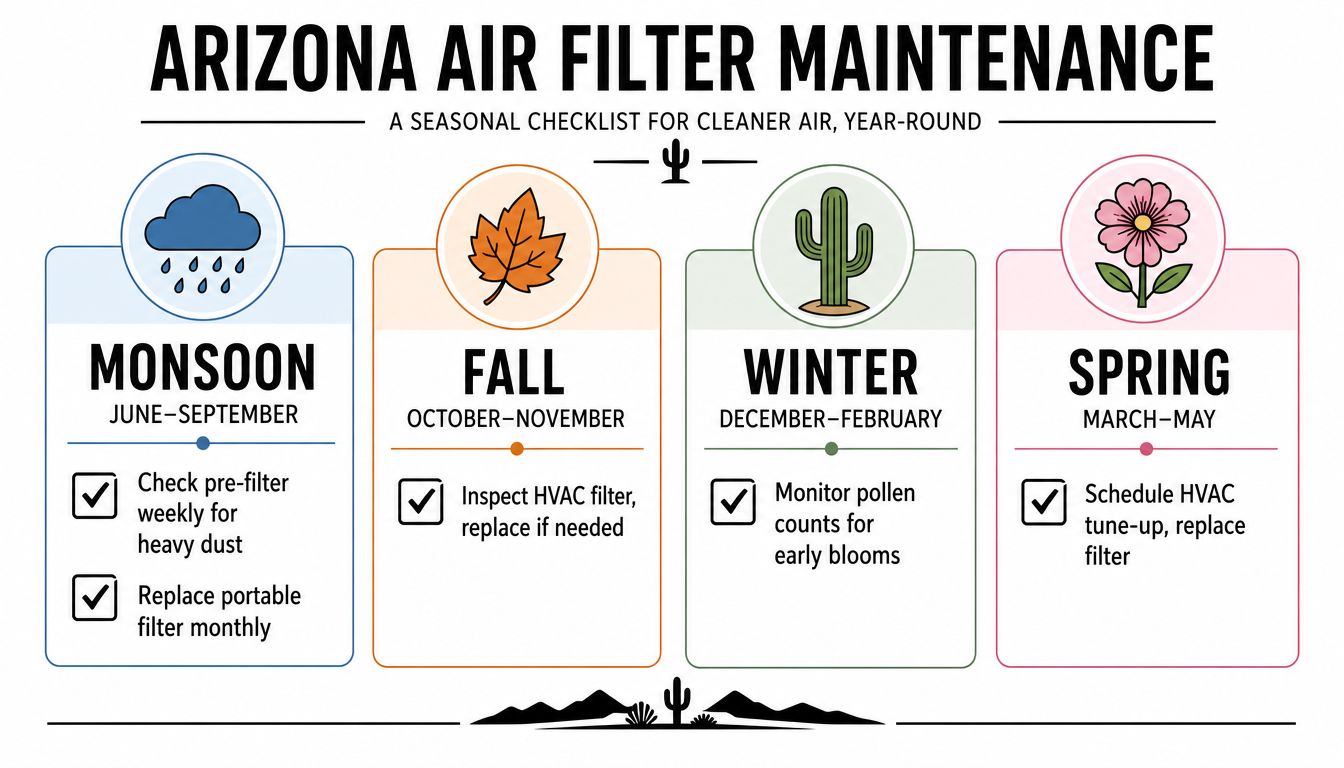
Arizona filters collect different material as the year changes. Summer air-conditioning runtime moves more air through the filter, monsoon storms can drive heavy dust indoors, and seasonal pollen may load the media sooner than a calendar reminder suggests. A high-rated filter that remains in service after it is visibly loaded can restrict airflow and undermine the system it is meant to help.
The EPA recommends checking the filter every month, particularly during heavier winter and summer use. Replace it when dirty, or at least every three months for central air conditioners, furnaces, and heat pumps, according to its air-filter maintenance guidance.
Use the calendar as a baseline, not a guarantee
Set a clean-filter baseline before seasonal demand rises, then adjust it for actual dust and runtime:
- Before monsoon season: Install a clean filter and inspect the rack, return grille, and cabinet seal.
- During dust events: Check the filter after a storm. Replace it early if pleats are coated or airflow drops.
- During peak cooling: Inspect monthly, since long air-conditioning cycles can load the media quickly.
- During pollen periods: Replace a filter with heavy buildup or one that coincides with worsening indoor symptoms.
- During wildfire smoke: Check the filter after the event. Smoke can load the media even when it looks only moderately dirty.
- At heating changeover: Confirm the arrow points toward the blower and that the cabinet closes without gaps.
Know when inspection beats replacement
A filter that becomes dirty soon after replacement points to a larger issue, such as excessive dust entry, return leakage, construction debris, or an airflow problem. A new high-MERV filter that causes whistling, weak supply airflow, or unusual blower noise may exceed what the system can handle. Check the filter size, cabinet, ductwork, and pressure drop instead of repeatedly buying denser media.
Record the installation date and filter rating on the cabinet. Use the EPA schedule as a floor, then shorten the interval when dust, pollen, pets, smoke, or system runtime demand it. This HVAC filter replacement guide can help establish a household routine, while persistent loading or airflow changes call for technician inspection.
Picking the Right Setup for Your Arizona Home
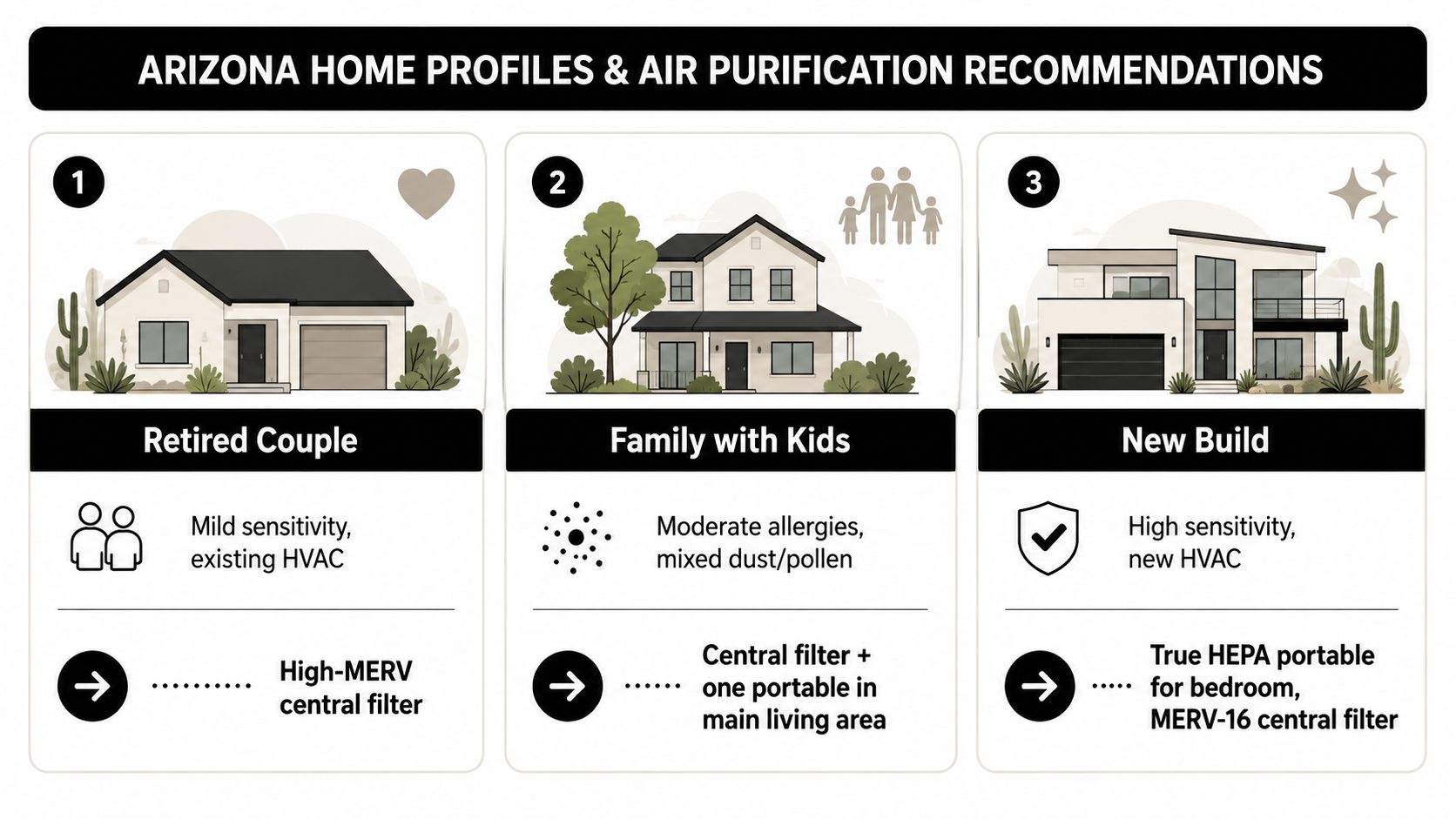
The right setup depends on allergen load, room use, and system tolerance. Globe, Miami, and Superior homes can face dry dust, seasonal pollen, and wildfire smoke, but each household experiences those conditions differently. A useful decision rule is simple: choose the highest practical filtration your system can support, then add room-based cleaning where people spend the most time.
A budget-conscious retired couple
For mild pollen sensitivity and a tight budget, a properly fitted MERV 11 pleated filter may be a reasonable starting point if the furnace or heat pump handles it without airflow trouble. The central filter provides broader coverage than a small bedroom unit, and disciplined monthly checks matter more than chasing an extreme rating.
If symptoms remain concentrated in one bedroom, a portable purifier sized to that room can add targeted support. There's no reason to install a dense central filter that strains an older blower when the household's main concern is one sleeping area.
A family with a pet and a child with asthma
This home needs stronger fine-particle control and better source management. MERV 13 is worth evaluating when the air handler, filter cabinet, and duct system can tolerate the pressure drop. A portable purifier in the main living area or the child's bedroom can supplement central filtration, particularly when the central system doesn't run continuously.
Keep the pet out of the sleeping space if dander is a trigger, clean surfaces regularly, and inspect the filter more often when it loads quickly. Better filtration won't solve a return leak or a source that keeps shedding particles into the room.
A remote worker near wildfire-prone terrain
A person working from home spends long periods in one breathing zone, so a high-CADR portable purifier in the office can provide more direct value than upgrading the entire central system without checking airflow. A MERV 13 central filter can provide baseline protection if the system supports it, while carbon-plus-media filtration may help with smoke odor.
MERV 16 belongs only in a system designed for its resistance. A new-build homeowner may have more flexibility, but the installer still needs to verify duct sizing, filter cabinet dimensions, air-handler capacity, and sealing. Good AC installation, heat-pump or furnace setup, duct design, and maintenance all affect whether an allergy filtration upgrade delivers real results.
Before buying a higher-rated filter, have the system evaluated when airflow is already weak, the filter rack leaks, the ducts are noisy, or the equipment is older. Cobre Valley Air LLC offers HVAC repair and installation, duct evaluation and design, indoor air quality solutions, filter and air-purifier installation, and airflow-focused diagnostics for homes in the Globe, Miami, Superior, and surrounding communities.
If your Arizona home still feels dusty after a filter upgrade, visit Cobre Valley Air LLC to schedule a diagnostic that checks airflow, duct condition, filter fit, and equipment capacity. A properly matched solution can support allergy control without sacrificing the performance of your air conditioner, heat pump, or furnace.