


Your house is closed up, the AC is running, and there's still a fine layer of Arizona dust on the furniture. Someone in the family wakes up congested, allergies flare every time the wind kicks up, and you start searching for a better filter. That usually leads to one question: should you put a HEPA filter in your HVAC system?
It's a fair question. In Globe, Miami, Superior, and nearby communities, we deal with a mix of fine dust, dry conditions, remodel debris, pet dander, and seasonal allergens. A HEPA filter HVAC system sounds like the strongest answer on paper. In some situations, it is. In many homes, though, the way people try to add HEPA creates a different problem: low airflow, high static pressure, and an AC system that struggles to do its real job.
That matters because indoor air quality isn't separate from air conditioning repairs, AC installation, AC maintenance, heat pumps, furnaces, or duct design. It's all the same system. If the filter is too restrictive for the blower and ductwork, you can end up with comfort problems, equipment strain, and poor performance even while trying to clean the air.
Is a HEPA Filter the Answer to Arizona Dust and Allergies
Arizona homeowners usually aren't asking for “medical-grade filtration.” They're asking for relief. Less dust on the floor. Fewer allergy flare-ups. Cleaner air in the bedroom. Less of that gritty feeling after a windy day or nearby construction work.
A HEPA filter can play a role in that, but the answer isn't as simple as swapping out the filter in the return grille or air handler. That's where a lot of online advice goes wrong. It treats filtration like a stand-alone product when it's really part of a moving-air system.
What homeowners are usually trying to fix
Most indoor air complaints fall into a few buckets:
- Visible dust: Fine particles settling on surfaces even when the home is cleaned regularly.
- Respiratory irritation: Sneezing, dry throat, sinus congestion, or allergy symptoms that feel worse indoors.
- Uneven comfort: Rooms that feel stuffy because airflow is already weak before any high-efficiency filter gets added.
- After-remodel contamination: Drywall dust, sawdust, and other debris that can overwhelm a filter strategy if the system isn't checked.
If that sounds familiar, start with the whole-home approach to reducing indoor air pollution, not just the most aggressive filter you can buy.
Clean air starts with matching the filtration to the blower, duct system, and actual conditions inside the home.
Why the idea of HEPA is so appealing
HEPA has a strong reputation for a reason. It's designed for very fine particles, and it's far more effective than standard basic filters. For homeowners with asthma, allergies, or a family member with higher sensitivity, that sounds like the obvious upgrade.
The catch is that what works inside a dedicated purifier doesn't always work inside an existing central HVAC system. In Arizona, where systems already work hard through long cooling seasons, airflow is not optional. Any filtration plan has to protect both air quality and equipment performance.
Decoding Air Filtration HEPA vs MERV Ratings
A lot of confusion starts with the labels on the box. HEPA and MERV aren't interchangeable, and they don't describe the same level of filtration.
What HEPA actually means
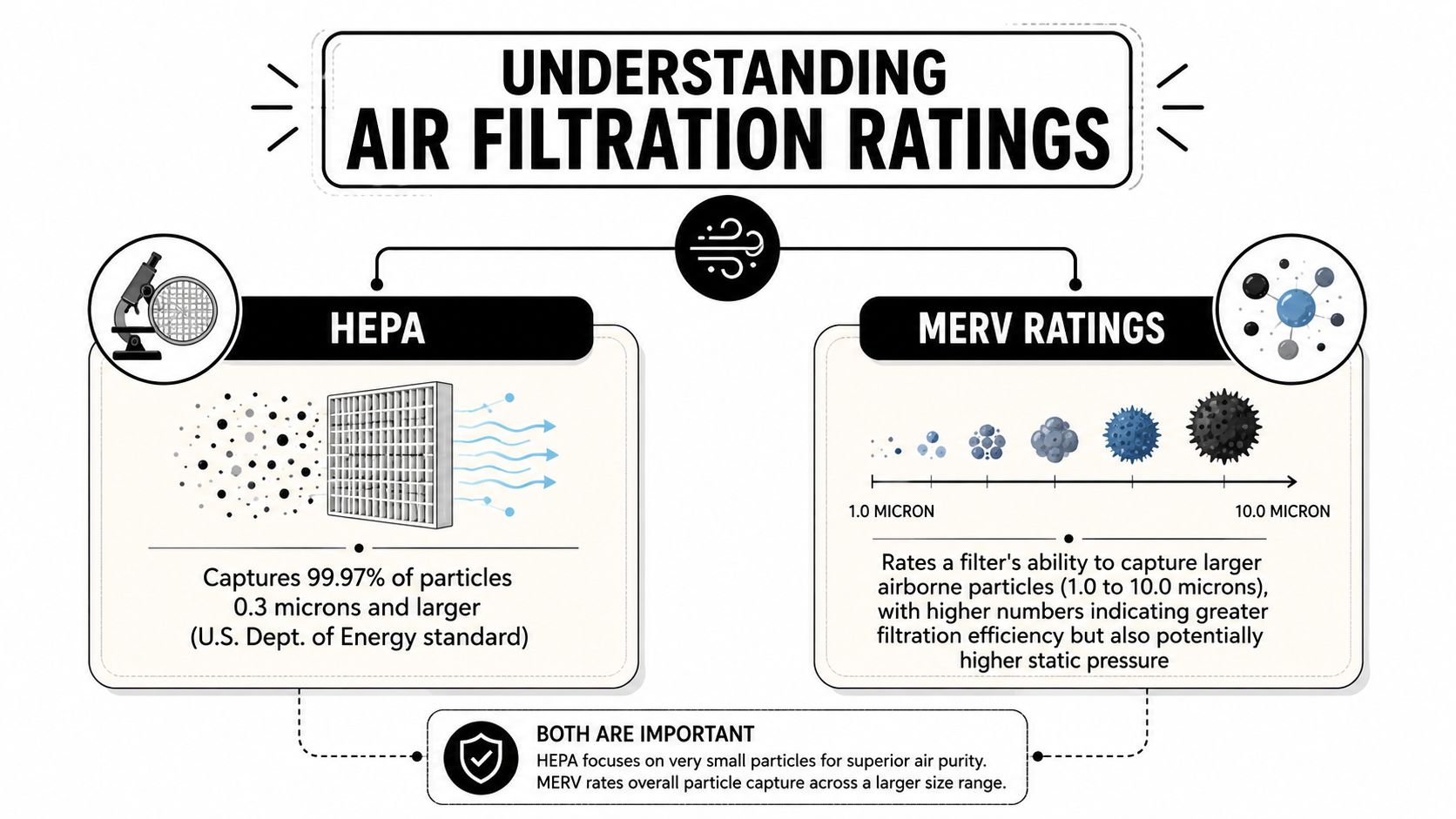
A true HEPA filter must remove at least 99.97% of airborne particles with a diameter of 0.3 microns, based on the standard described in this HEPA filtration in HVAC systems reference. That 0.3-micron size matters because it's treated as the most difficult size for a mechanical filter to catch.
Comparing a kitchen strainer to a very fine coffee filter helps illustrate the difference. A coarse strainer catches bigger material and lets finer material pass through. A true HEPA filter is built to trap extremely small particulate matter with a dense filter media.
What MERV tells you
MERV stands for Minimum Efficiency Reporting Value. It rates how well a standard HVAC filter captures particles across certain size ranges. In residential heating and cooling systems, MERV-rated filters are far more common than HEPA filters because they're designed with central airflow in mind.
A useful practical comparison:
| Filter type | Main role in a home HVAC system | Airflow impact |
|---|---|---|
| Standard lower-MERV filter | Basic protection for equipment and larger particles | Usually low restriction |
| Mid to higher MERV filter | Better particle capture with moderate resistance | Depends on filter size and system design |
| True HEPA filter | Very high particle capture | High resistance unless the system is built for it |
The trade-off most homeowners miss
The same source notes that a true HEPA filter creates a pressure drop of 0.5 to 1.5 inches water column (WC), while a standard MERV 13 filter is typically in the 0.1 to 0.3 inches WC range at rated airflow, which is why HEPA setups often need specialized blower fans in HVAC applications.
That's the whole story in one sentence: better filtration usually means more resistance to airflow.
Field reality: A filter can be excellent at catching particles and still be a bad choice for a specific AC or furnace if the blower can't move air through it.
For homeowners, the question isn't “Is HEPA better than MERV?” It is. The key question is whether your system can handle it without sacrificing cooling, heating, and equipment life.
The Critical Airflow and Static Pressure Challenge
The biggest mistake with a HEPA filter HVAC system is treating the filter like an isolated upgrade. It isn't. The blower, duct size, coil, return path, supply path, and filter cabinet all have to work together.
What static pressure feels like inside the system
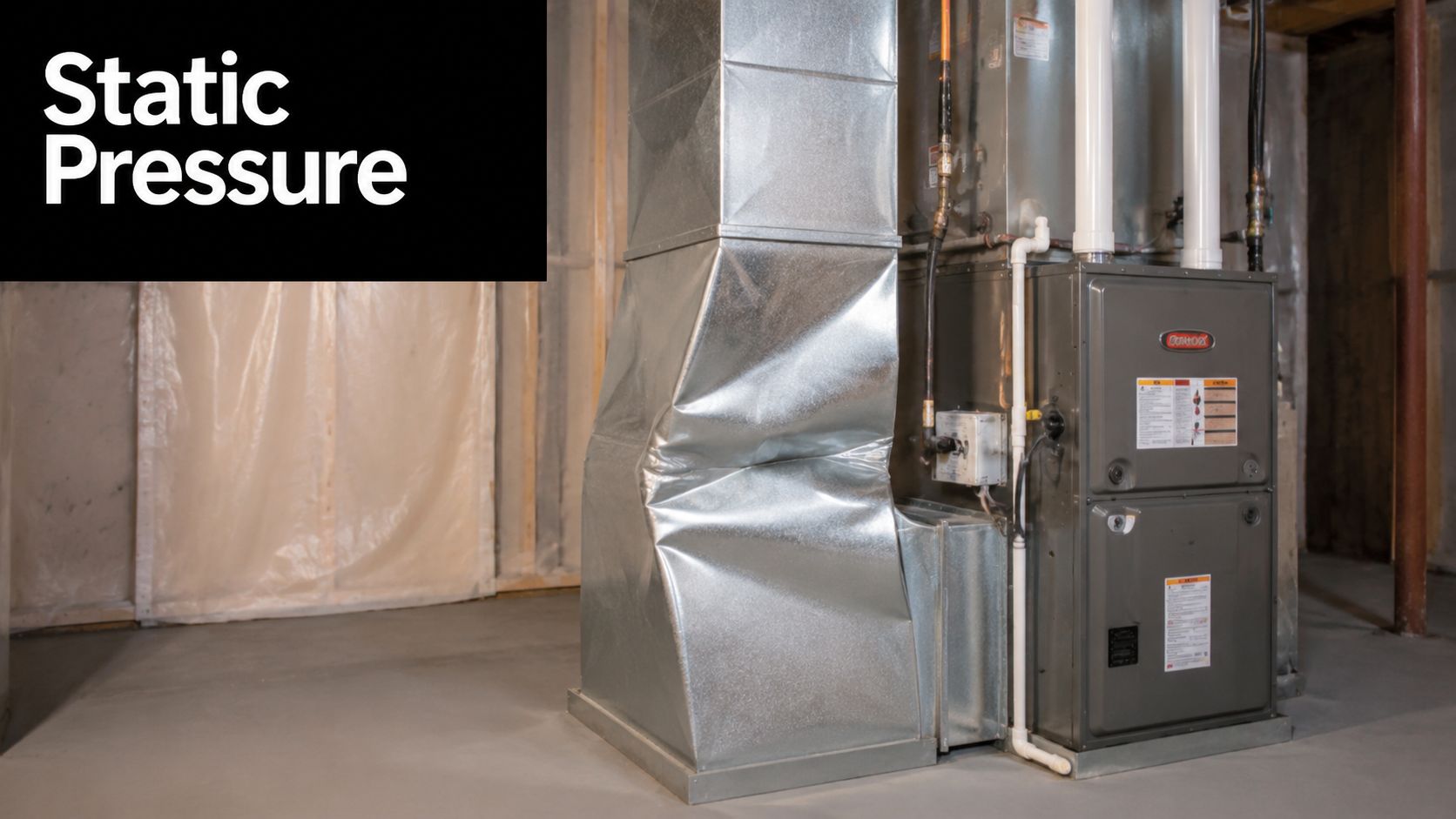
Static pressure is the resistance the blower has to push against. A simple way to think about it is breathing through a thicker and thicker mask. The denser the material, the harder you have to work to move the same amount of air.
When homeowners force a true HEPA filter into a system that wasn't designed for it, the blower often can't maintain target airflow. In cooling season, that can lead to low airflow across the evaporator coil. In heating season, a furnace can run hotter than it should because it isn't moving enough air across the heat exchanger.
Why airflow has to be measured, not guessed
For cooling, ACCA Standard 5 guidance says the correct airflow is 400 CFM per ton of cooling capacity, with an allowed tolerance of plus or minus 15%. For a 3-ton system, that means a target of 1,200 CFM and a verified operating range of 1,020 to 1,380 CFM.
That number isn't trivia. It's the line between a system that cools and dehumidifies properly and one that starts showing avoidable problems.
- Too little airflow: Coil freezing, weak cooling, longer runtimes, and added strain.
- Too much airflow: Reduced dehumidification and comfort issues.
- Unknown airflow: You're making filtration decisions blind.
Why Arizona homes need extra caution
In this climate, a lot of systems already fight high attic temperatures, dusty return paths, dirty coils, and restrictive duct runs. Add a filter with much higher resistance and you can tip a marginal system into failure mode.
Common warning signs include:
- Whistling returns or filter grilles
- Rooms with weak supply airflow
- An air handler or furnace cabinet that wasn't built for deeper media
- Repeated cooling complaints after a “better filter” was installed
- Older duct design with long, awkward runs
Here's a helpful overview of airflow in motion:
What should happen before any HEPA discussion
A real evaluation should include more than looking at the filter slot. It should examine:
- Total system airflow
- Static pressure across the system
- Return and supply duct restrictions
- Filter cabinet size and face area
- Condition of the evaporator coil and blower wheel
- Whether the home would be better served by a separate filtration device
If a technician recommends a true in-duct HEPA filter without discussing airflow, static pressure, and duct capacity, that's not a complete recommendation.
This is where quality air conditioning repairs, AC installation, and AC maintenance overlap with indoor air quality. The filter choice has to support the equipment. It can't work against it.
Practical HEPA Solutions for Your Arizona Home
For most existing homes, the best answer isn't “put a true HEPA in the central system and hope for the best.” A more practical answer is to choose the right filtration method for the house, the duct system, and the people living there.
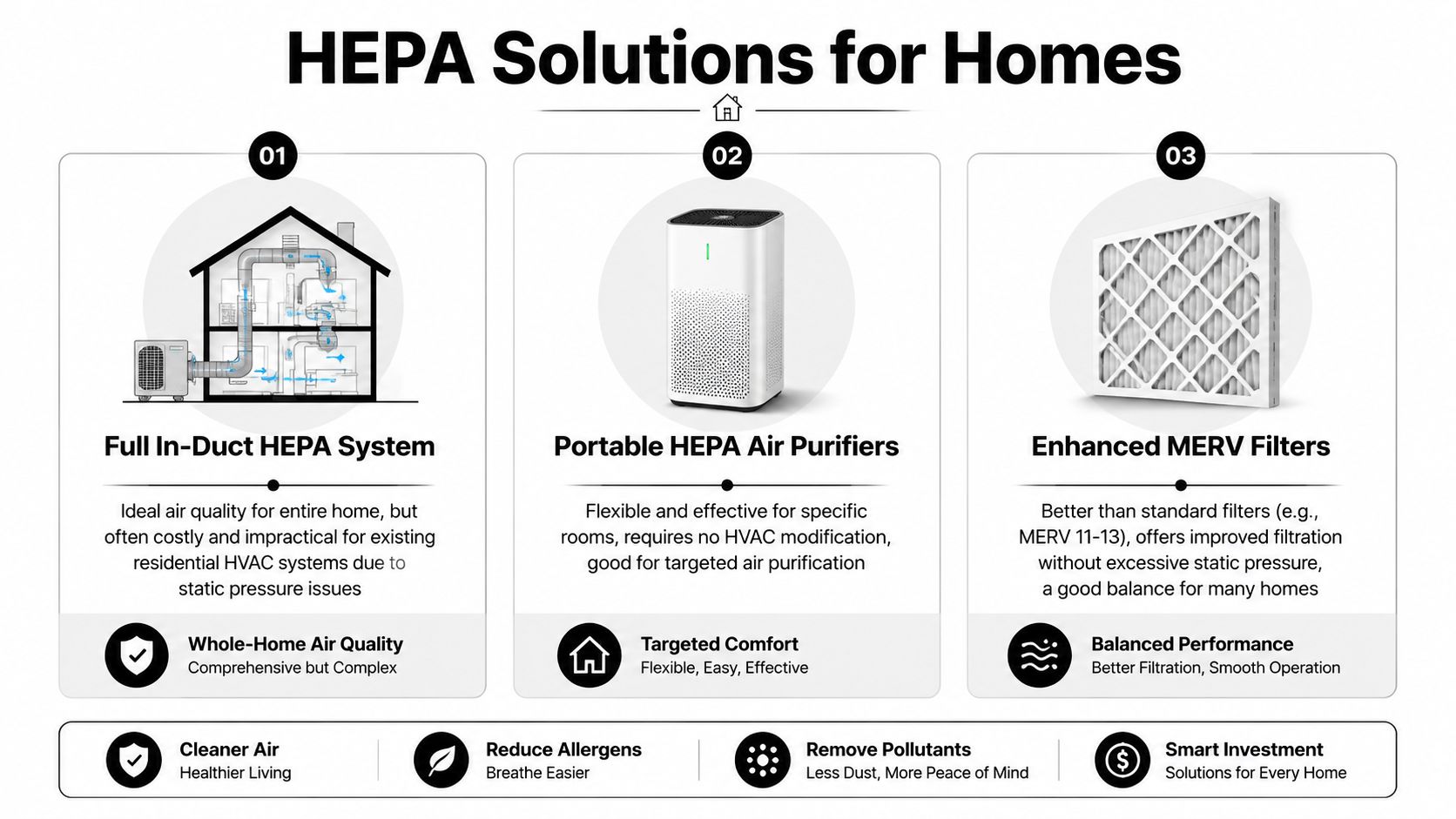
Most standard residential HVAC systems can't support the high static pressure of a true HEPA filter, and a Westlab explanation of HEPA in HVAC systems points to bypass HEPA systems or standalone purifiers as the more realistic alternatives because direct central installation can lead to blower motor damage and system failure.
Option comparison at a glance
| Solution | Best fit | Main advantage | Main limitation |
|---|---|---|---|
| Bypass HEPA system | Whole-home strategy where direct HEPA is too restrictive | HEPA-level treatment without choking the main airflow path | More complex installation and service |
| Higher-MERV media filter | Homes needing a practical upgrade in the central system | Better filtration with less resistance than true HEPA | Still needs airflow verification |
| Portable HEPA purifier | Bedrooms, nurseries, home offices, high-sensitivity occupants | No duct modification required | Treats individual spaces, not the whole house |
| Electronic air cleaner | Homes wanting added particle control with an IAQ package | Can complement filtration strategy | Needs proper application and maintenance |
Bypass HEPA systems
A bypass HEPA setup diverts part of the air through a separate HEPA section instead of forcing all of the system airflow through a dense HEPA filter. That matters because it avoids starving the main blower.
This is often the most overlooked option for homeowners who want stronger filtration without rebuilding the entire HVAC system. It can make sense when the household wants whole-home particle reduction but the existing equipment and ductwork don't support full in-line HEPA.
Good use case: a home with allergy concerns, decent mechanical space, and a homeowner who wants a built-in solution rather than multiple portable units.
Higher-MERV media filters
A properly sized media cabinet with a quality pleated filter is often the best balance between cleaner air and stable airflow. This is especially true during AC installation or major system replacement, when the filter cabinet and duct transitions can be designed correctly from the start.
For many homes, this route gives a meaningful upgrade over a basic 1-inch filter without creating the severe resistance of true HEPA. The key phrase is properly sized. A restrictive filter in a small slot can still cause trouble.
Practical rule: A better filter only helps if the system can still move the air it was designed to move.
Portable HEPA purifiers
These are often the smartest answer for one or two problem areas. A portable unit in the primary bedroom, a child's room, or a home office can deliver strong filtration where it matters most, with no changes to the furnace, heat pump, or AC ductwork.
They're especially useful when:
- One room is the priority: Sleeping areas matter more than the whole house.
- The existing duct system is limited: Older homes and tight closets often leave little room for large filtration upgrades.
- You want flexibility: A portable unit can move with your needs.
Electronic air cleaners and advanced IAQ add-ons
Some homes benefit from electronic air cleaners as part of a broader indoor air quality package. In practice, these are worth discussing when a homeowner wants more than a filter-only strategy, especially if the house has recurring dust complaints or occupants with increased sensitivity.
The important part is matching the technology to the home instead of chasing labels. In the field, the best results usually come from a combination of solid filtration, clean coils, sealed ductwork, and steady airflow.
What works best during repairs, maintenance, and replacements
Different situations call for different answers:
- During AC repairs: If airflow is already weak, fix the mechanical problem first. Don't use filtration as a bandage.
- During AC maintenance: Check filter loading, blower cleanliness, coil condition, and pressure before recommending a more restrictive filter.
- During AC installation: This is the best time to improve the filter cabinet, return sizing, and duct layout.
- For heat pumps and furnaces: Heating airflow matters too. A filtration upgrade has to support year-round operation, not just summer cooling.
- For duct design projects: New ductwork or major modifications create the best opportunity to build in cleaner-air options without guesswork.
Why Ductwork Integrity Is Essential for Clean Air
The best filter in the world can't fix leaky, dirty, poorly designed ductwork. If the ducts pull hot, dusty attic air into the system downstream of the filter, you've created a bypass path for contamination.
That's a common issue in Arizona homes. Ducts often run through harsh attic conditions, and any loose connection, damaged boot, disconnected section, or poorly sealed return can pull in dust that never passes through the intended filtration path.
Filtration only works when the air follows the path
A clean-air strategy depends on one thing: air has to go where the system designer intended. If return ducts leak, if joints aren't sealed well, or if the system has crushed or poorly routed sections, the filter loses part of its value.
The Building America duct design guide notes that duct systems should use the shortest and straightest routes possible, and that proper installation includes sealing duct joints with mastic or UL 181-verified tape, insulating ducts in unconditioned spaces, and commissioning for airflow, fan watt draw, duct leakage, and room-by-room airflow.
What to inspect before investing in premium filtration
A homeowner doesn't need to become a duct designer, but these are worth checking professionally:
- Return leaks: These can pull attic dust and insulation particles into the airstream.
- Loose supply connections: Conditioned air gets lost before it reaches the room.
- Poor duct layout: Long, convoluted runs increase resistance before the filter upgrade even begins.
- Undersized returns: A common source of high static pressure.
- Aging flex duct: Sagging or damaged sections can choke airflow.
If you're dealing with persistent dust or comfort issues, it helps to understand the basics of how to seal ductwork before deciding that the filter alone is the problem.
A filtration upgrade on a leaky duct system is like installing a better water filter on a pipe with holes in it.
Why this matters for new installs and replacements
Duct integrity is especially important during new construction, equipment replacement, or major duct renovation. That's when room-by-room airflow, return strategy, and filter cabinet placement can be corrected instead of worked around.
For homeowners, that means clean air often starts with duct repair and design, not just a more expensive filter.
Maintenance Costs and Long-Term Performance
High-efficiency filtration isn't a one-time decision. It's an ongoing maintenance item, and in Arizona's dusty conditions, neglect shows up fast.
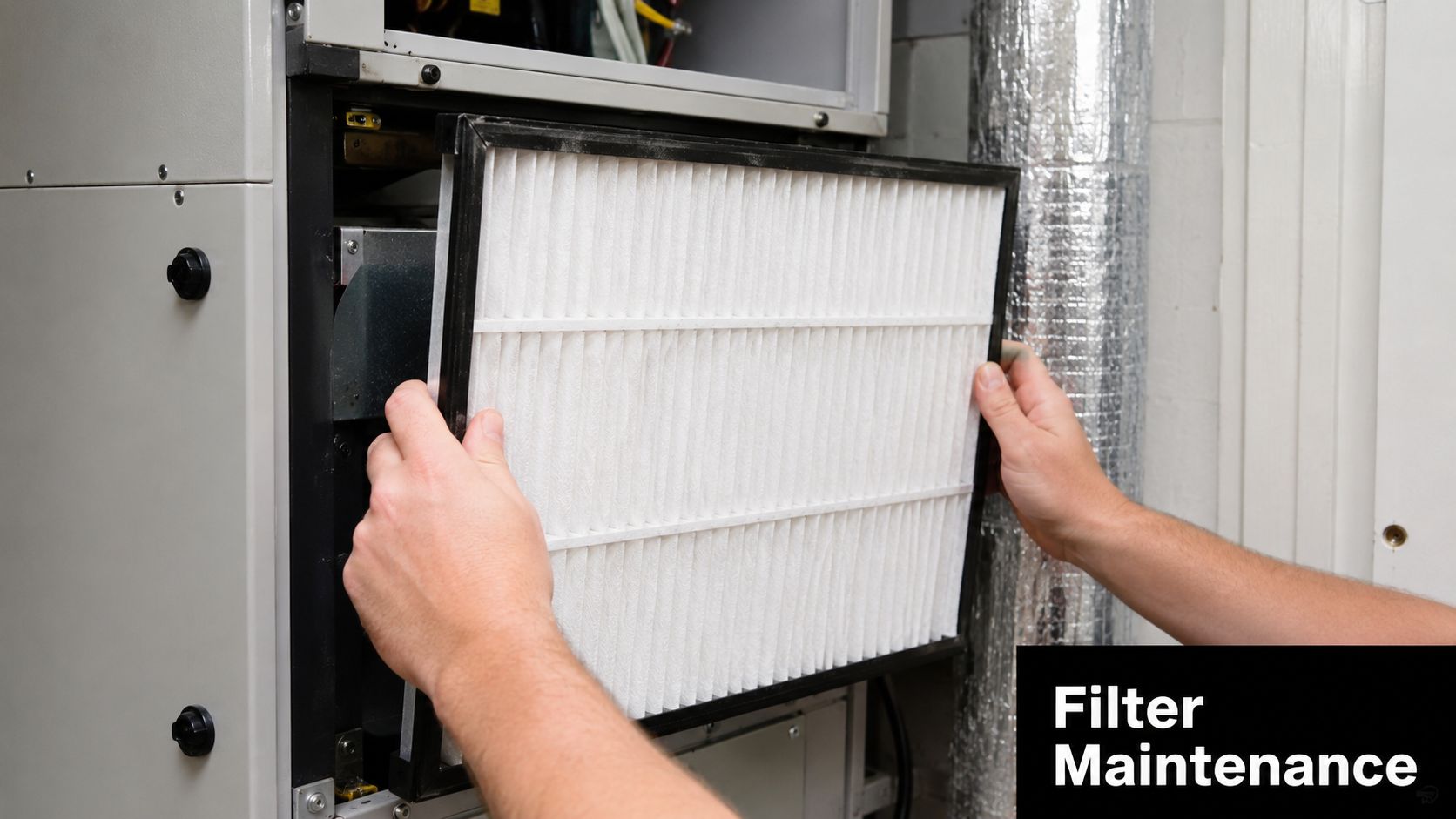
Replace by pressure, not guesswork
In high-particulate environments, research on filtration and airborne infection control notes that HEPA filters may need replacement every 6–9 months. It also states that best practice is to replace them when the pressure drop exceeds 120% of the initial baseline.
That's the technician's way of saying the calendar alone isn't enough. A filter might still have usable life left, or it might be overloaded sooner because of dust, pets, remodeling, or nearby construction.
What homeowners should expect
Long-term performance depends on several routine tasks:
- Filter checks: More often during monsoon dust, remodel work, or high-traffic seasons.
- Pre-filter service: If the setup includes one, it protects the more expensive filtration stage behind it.
- Static pressure verification: This confirms the system isn't being choked by a loaded filter.
- Blower and coil inspection: Dirt on either component reduces airflow and can mimic filter problems.
For general upkeep, it helps to review how often to replace an HVAC filter and then adjust that habit to your home's actual dust load.
The hidden cost of poor maintenance
When a high-efficiency filter stays in too long, the system pays for it. Airflow drops. Cooling performance falls off. Heating equipment works harder. Service calls become more likely.
The filter isn't just an air-quality component. It's part of system performance.
Benefits Limitations and When to Call Cobre Valley Air
A HEPA-based strategy can be a strong choice for households dealing with allergies, asthma, fine dust, or a family member who needs cleaner indoor air. In the right application, it captures particles at a very high level and can noticeably improve a room or a home's air quality.
But particle control is only part of indoor air quality. A myth-busting article from ASHRAE Journal makes an important point: HEPA and other particle filters do not remove VOCs, ozone, or other gaseous pollutants. If a home has odors, chemical off-gassing, or fumes from paints and cleaning products, the filtration plan often needs a second layer such as activated carbon.
A practical checklist
Call for a professional evaluation if any of these sound familiar:
- Your home is dusty even with regular filter changes
- You want cleaner air but don't know if your system can handle higher resistance
- One person in the home has more serious allergy or respiratory concerns
- You've had weak airflow, frozen coils, or recurring comfort issues
- You're planning AC installation, furnace replacement, heat pump upgrades, or duct redesign
- You want a real answer on bypass HEPA, portable HEPA, media filters, or electronic air cleaners
The right answer usually isn't the most aggressive filter. It's the setup that protects indoor air quality and keeps airflow where it needs to be.
If you want a straight answer on whether a HEPA filter HVAC system makes sense for your home, talk with Cobre Valley Air LLC. Their team serves Globe, Miami, Superior, and nearby Arizona communities with practical diagnostics, airflow-focused AC repairs, code-compliant AC installation, maintenance, duct design, and indoor air quality solutions that fit the system instead of fighting it.