



A Globe homeowner opens two replacement quotes on the kitchen table. One is for a 15 SEER heat pump, and the other carries a higher efficiency number with a noticeably larger price tag. The natural question is, “Which one will save me more?” The more useful question is, “Which complete system will deliver its rated performance in my house?”
That distinction matters in Globe, Miami, and Superior. Arizona heat puts heavy demands on cooling equipment, but the equipment label is only part of the result. Sizing, airflow, duct design, refrigerant charge, installation quality, and maintenance determine whether a 15 SEER heat pump provides dependable comfort or only looks efficient on a proposal.
Why a 15 SEER Heat Pump Deserves a Second Look in Arizona
The Globe homeowner comparing those quotes may assume the higher rating is automatically the better purchase. That assumption can lead to an expensive upgrade that the home's ducts, electrical service, or installation conditions can't support properly.
A 15 SEER heat pump is generally a mid-efficiency choice. It can make sense for an older home, an existing duct system, or a homeowner who wants reliable air conditioning and heating without paying for premium equipment. The rating also remains a useful reference point because federal efficiency standards have climbed steadily. The U.S. Department of Energy required 10 SEER and 6.8 HSPF beginning in 1992, raised the minimum to 13 SEER and 7.7 HSPF in 2006, and then moved to 15 SEER and 8.8 HSPF in 2023, according to Goodman's heat pump efficiency history. The same industry reference notes that many heat pumps were rated at 6 SEER or lower before 1980, which shows how far equipment has progressed.
The quote with the bigger number may not be the better system
A higher-efficiency heat pump may use less electricity during a long cooling season, particularly when the system runs frequently. But the financial advantage depends on the property. A well-insulated and shaded home may have a different operating profile from an older ranch house with attic ductwork, leaky boots, and an undersized return.
The installer should provide more than a model number. Ask for:
- A room-by-room load calculation, so the unit's capacity matches the home's actual cooling demand.
- A duct assessment, including airflow and static pressure checks.
- A matched equipment rating, rather than a rating taken from one component alone.
- A refrigerant and installation plan, including how the charge will be verified.
- A long-term operating comparison, based on your home and expected use.
Practical rule: A properly installed mid-tier system can outperform a higher-rated system that is oversized, starved for airflow, or connected to leaky ducts.
Arizona homeowners should also consider replacement priorities. If the electrical panel is limited, if the duct system needs repair, or if the existing air handler is badly mismatched, directing the budget toward quality AC installation, duct correction, and commissioning may produce more useful comfort than buying the highest rating available.
Cobre Valley Air can evaluate the complete installation for homeowners in Globe, Miami, and Superior, including whether a 15 SEER heat pump offers the right balance of upfront cost, comfort, and efficiency.
What SEER Measures and Why the Number Matters
A SEER rating is a useful comparison tool, but it cannot guarantee field performance. SEER means Seasonal Energy Efficiency Ratio, and the rating describes how much cooling a heat pump provides for the electricity it uses across a typical cooling season. A car's miles-per-gallon rating offers a practical analogy. MPG describes distance from a quantity of fuel, while SEER describes cooling output from electricity.
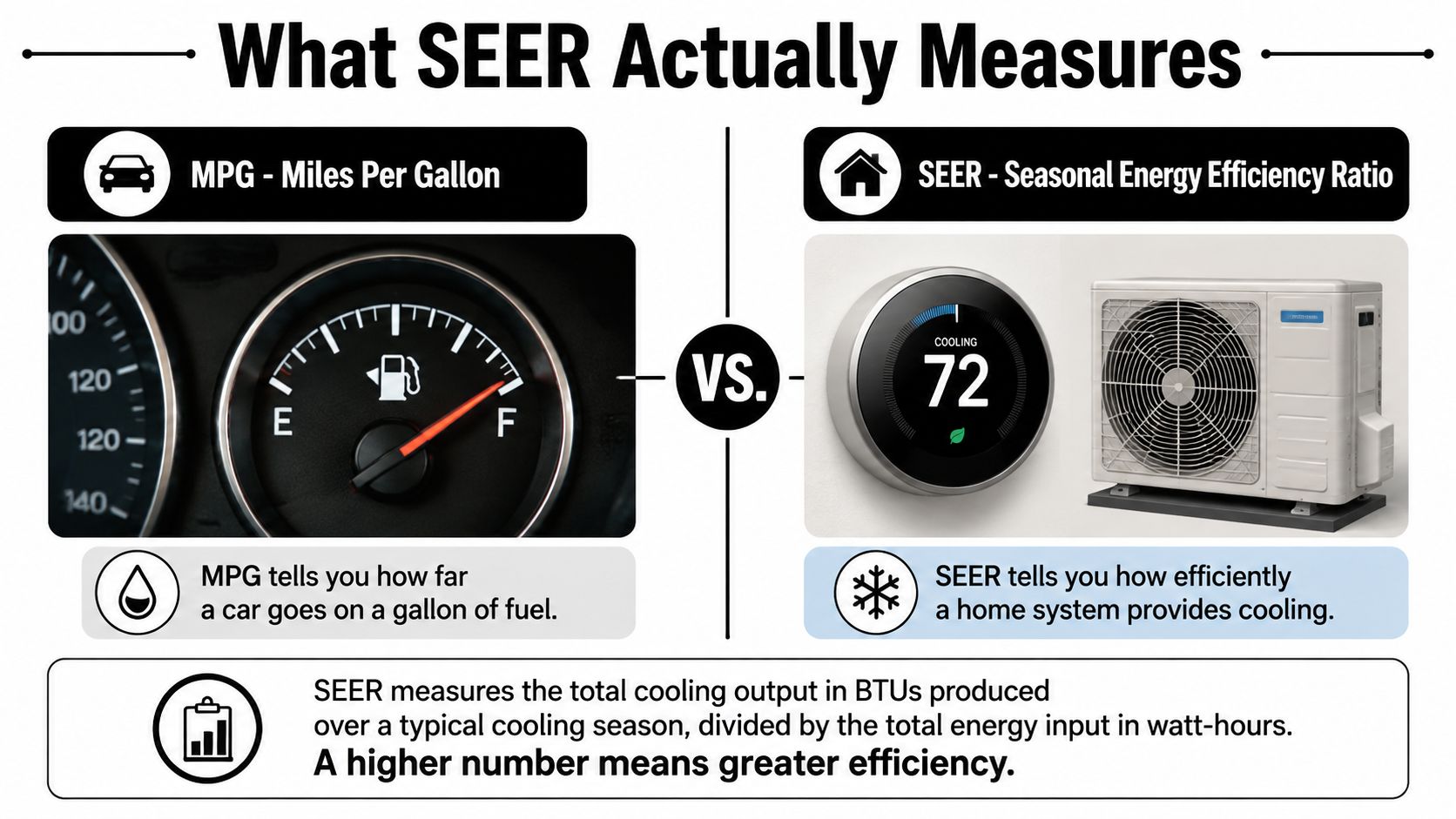
A 15 SEER rating means the system produces 15 British thermal units of cooling for each watt-hour of electricity under standardized test conditions. That makes 15 SEER a useful mid-tier benchmark for comparing equipment. It does not mean the unit will deliver that exact efficiency during every Arizona afternoon. Outdoor temperature, indoor conditions, airflow, duct losses, thermostat operation, equipment sizing, and installation quality all affect actual results.
SEER, EER, and HSPF answer different questions
SEER averages cooling performance across a season, so it helps estimate overall efficiency when a system runs for many hours through a hot Arizona summer.
EER measures a specific operating point, rather than a seasonal average. Manufacturer technical material commonly lists a 15.0 SEER combination with an EER around 12.5 and HSPF around 8.5, as shown in this 15 SEER split-system heat pump specification. EER helps show how equipment performs during a fixed high-temperature test condition, similar to a period of peak cooling demand.
HSPF measures heating efficiency. Because a heat pump moves heat in both directions, its cooling rating does not explain how efficiently it heats the home. HSPF matters during winter operation. A dual-fuel system adds a furnace, whose fuel-to-heat efficiency is measured with AFUE instead.
The rating remains only as useful as the system delivering it. Restricted return air, poorly designed supply ducts, an incorrect refrigerant charge, or equipment that is too large for the home can reduce comfort and raise operating costs. A thermostat near a supply register, sunny window, or another unusual heat source can also produce uneven temperature control.
For a clear explanation of the equipment's basic operation, see this plain-language guide to how a heat pump works. Once the heat-transfer process is clear, SEER is easier to interpret. You are buying a tested efficiency level, not a guarantee. Ducts, airflow, sizing, and installation determine whether a 15 SEER heat pump delivers its rated value on your property.
How 15 SEER Maps to Today's SEER2 Federal Standards
The biggest source of confusion is that SEER and SEER2 are not labels you can compare casually. SEER2 uses updated test procedures designed to better reflect installed operating conditions. The updated method generally produces lower numerical ratings, so a product with a lower SEER2 number isn't necessarily less efficient than an older product with a higher SEER number.
A 15 SEER split-system heat pump maps to approximately 14.3 SEER2 under the newer federal metric, according to this heat-pump performance transition reference. ENERGY STAR's current criteria list at least 15.2 SEER2, 7.8 HSPF2, and 11.0 EER2 for qualifying ducted heat pumps, while non-ducted split systems require at least 15.2 SEER2 and 8.5 HSPF2, as shown in the ENERGY STAR 2025 heat pump specification.
SEER and SEER2 standards at a glance
| Standard | What it measures | Buying implication |
|---|---|---|
| SEER | Seasonal cooling efficiency under the older test method | Useful for understanding existing equipment and older proposals |
| SEER2 | Seasonal cooling efficiency under updated test conditions | Use this metric when comparing current equipment |
| HSPF | Seasonal heating efficiency under the older method | Helps describe older heat-pump heating performance |
| HSPF2 | Heating efficiency under the updated method | Compare this value for current heat-pump heating operation |
| EER2 | Cooling efficiency at a fixed high-temperature condition | Useful for reviewing peak-heat performance |
What a 2026 buyer should ask
For a new installation in 2026, don't accept a proposal that only says “15 SEER” without clarification. Ask whether the number is SEER or SEER2, whether it applies to the complete matched system, and whether the proposed equipment meets the current federal requirements for its configuration and region.
ENERGY STAR's 2025 Most Efficient criteria moved to 16.0 SEER2, 11.0 EER2, and 8.0 HSPF2 for split systems, according to the ENERGY STAR Most Efficient heat pump criteria. That threshold is a recognition level, not a blanket statement that every home needs premium equipment.
An older 15 SEER heat pump can still provide useful service if it's safe, reliable, and maintained. A homeowner replacing equipment today needs current SEER2 documentation, an AHRI-matched combination, and a clear explanation of compliance. An informal conversion alone isn't enough.
Comparing 15 SEER to Lower and Higher Efficiency Tiers
Homeowners often see several efficiency classes on quotes, but the comparison becomes unreliable when sales material supplies savings estimates without verified equipment data, energy rates, home loads, and operating hours. The supplied technical information doesn't establish universal savings percentages or typical installed price differences for 14, 15, 16, 18, and 20-plus SEER systems, so those values shouldn't be invented.
The safe way to compare tiers is to separate what the rating tells you from what it can't tell you.
SEER tier comparison for Arizona homes
| SEER Rating | Cooling Energy Savings vs 14 SEER | Typical Added Cost for 3 to 5 Ton | Best Fit in Arizona |
|---|---|---|---|
| 14 SEER | No universal savings figure can be stated without matched equipment and usage data | No universal added-cost figure applies | Older specifications, existing equipment comparisons, or budget-focused evaluations |
| 15 SEER | Savings depend on the exact matched system and operating profile | Price varies by equipment, labor, electrical work, and duct corrections | Mid-efficiency replacement where dependable comfort and budget control matter |
| 16 SEER | May reduce seasonal electricity use compared with lower tiers, but the result depends on the home | Obtain a written, system-specific quote | Homes with substantial cooling demand and a longer ownership horizon |
| 18 SEER | Higher seasonal efficiency may lower cooling consumption, though payback depends on use and price difference | Requires model-specific pricing and operating analysis | Properties with heavy cooling use or homeowners prioritizing lower consumption |
| 20-plus SEER | Premium efficiency can provide greater seasonal efficiency, but no universal payback should be promised | Often requires premium equipment and compatible system components | Carefully evaluated retrofits and new installations where the complete design supports it |
A 15 SEER system should be compared with a 14 SEER system using the same capacity, matched indoor and outdoor components, duct condition, electricity rate, and expected runtime. Without those inputs, a percentage savings claim is only a guess.
The same caution applies to the jump from 15 to 20-plus SEER. Premium equipment may bring better modulation, quieter operation, or more precise comfort control, not just a higher seasonal number. Yet the added purchase price may not produce a simple payback in every Arizona retrofit, particularly when cooling demand varies across the year.
Read this 13 SEER versus 15 SEER comparison for additional context, then ask the installer to show the complete matched-system ratings. A sound decision compares the whole proposal, not just the badge on the condenser.
Sizing, Ducts, and Installation Variables That Decide Real Performance
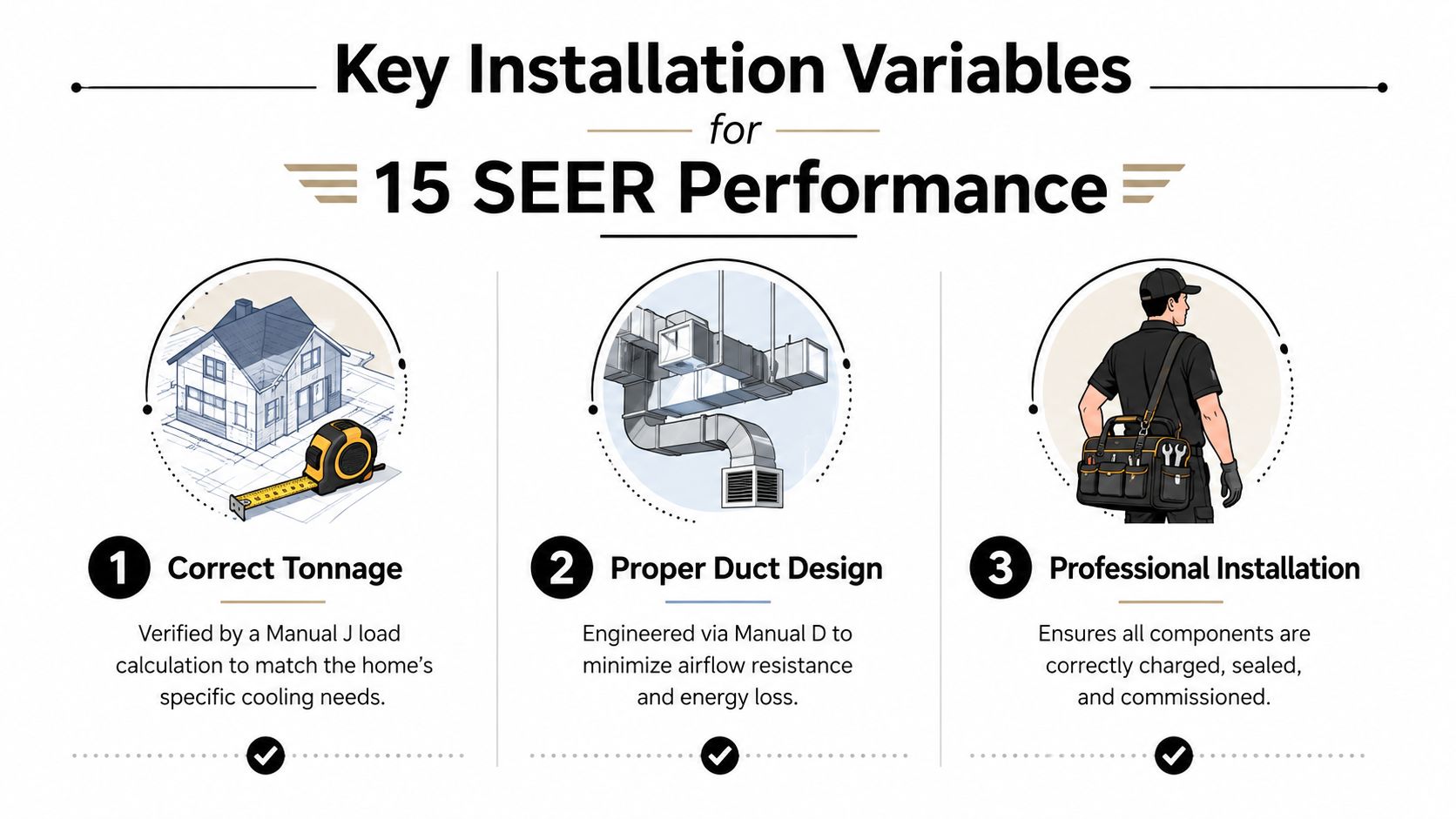
A 15 SEER heat pump only reaches its rated efficiency when the installation allows it to breathe, move refrigerant correctly, and run at the capacity the home requires. Three variables deserve special attention: correct tonnage, duct design, and commissioning.
The equipment size should come from a Manual J load calculation, not just the home's square footage or the size of the old unit. A load calculation accounts for insulation, windows, orientation, occupancy, and other building conditions. DOE guidance emphasizes using existing heating or cooling airflow and system requirements when selecting heat-pump capacity, as described in this housing-characteristic-based design guidance.
The duct system controls delivered airflow
Manual D provides the framework for residential duct design. ACCA says duct design should use a single ANSI-recognized calculation method across duct materials, as explained in the ACCA Manual D standard. A government training summary identifies a total external static pressure target of 0.8 inches of water column or less, a friction rate between 0.06 and 0.18, and total effective duct length at or below 550 feet.
An energy-code installation specification also calls for supply and return duct losses no greater than 0.10 and 0.08 inches per 100 feet, respectively. It says measured external static pressure above 0.8 inches of water column should trigger corrective action, as detailed in this heat-pump installation specification.
Arizona retrofit problems often include undersized return grilles in older ranch homes, attic duct leakage at boots, crushed flex duct, and supply runs that can't deliver the required airflow. Oversizing creates another problem. A unit that satisfies the thermostat too quickly may cycle inefficiently and provide uneven comfort.
For a practical example, consider a hypothetical 2-ton 15 SEER unit in an 1,800-square-foot Globe home with leaky ducts. It would be inaccurate to promise that the equipment will operate at a specific lower SEER in the field without measurements. The correct lesson is that leakage and airflow resistance can widen the gap between the laboratory rating and delivered performance.
Before approving an installation, ask the contractor:
- Load calculation: Is the Manual J calculation available for review?
- Duct verification: Were supply and return sizes checked using Manual D?
- Static pressure: Will the technician measure external static pressure at design airflow?
- Refrigerant charge: Will charge be verified using the manufacturer's required procedure, including superheat or subcool readings where applicable?
- Thermostat placement: Is the thermostat located away from direct sunlight, supply air, and other misleading temperature sources?
The following video provides a visual introduction to the installation variables that influence performance:
For homeowners who want to understand the sizing conversation before an estimate, this Manual J load calculation guide explains why square footage alone isn't enough.
Maintenance That Keeps a 15 SEER Heat Pump Delivering
A heat pump in Arizona works through dust, heat, cottonwood debris, and long cooling periods. Maintenance doesn't change the equipment's laboratory rating, but it helps preserve the airflow and heat transfer conditions needed for the system to operate as designed.
Start with the filter. Homeowners can inspect it regularly during heavy-use months and replace it when loaded with dust. The right filter type and replacement interval depend on the home, filter size, indoor air quality needs, and manufacturer instructions. A restrictive filter can reduce airflow, raise static pressure, and make the blower and compressor work harder.
What belongs on the homeowner's list
- Inspect the filter: Check it routinely and replace it when dirty or according to the equipment and filter requirements.
- Clear the outdoor unit: Keep leaves, cottonwood, grass, and other debris away from the coil and cabinet.
- Watch the registers: Weak airflow, uneven temperatures, or rooms that no longer cool properly deserve attention.
- Listen for changes: New grinding, buzzing, rattling, or repeated starts can signal a developing fault.
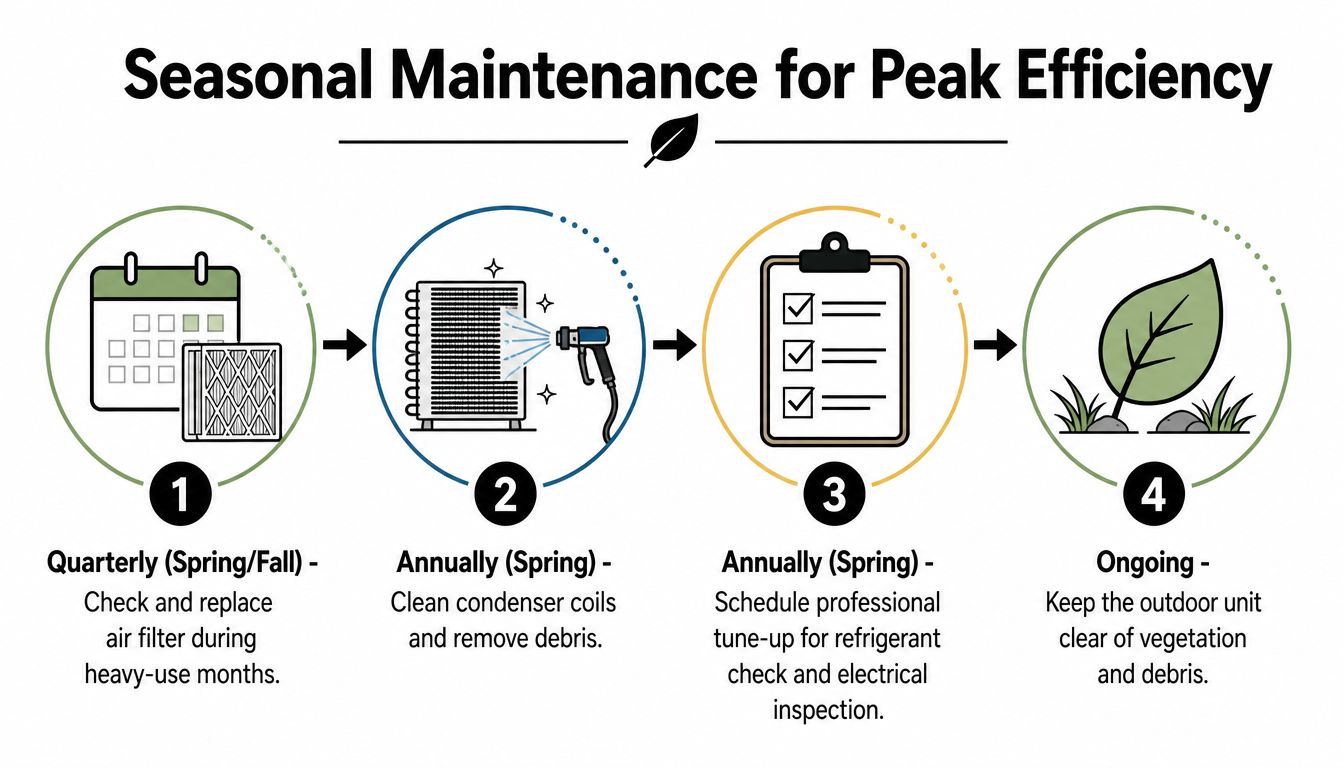
Coil cleaning, condensate flushing, electrical inspection, and refrigerant verification require appropriate tools and training. A technician can also check the blower, temperature split, wiring, controls, and operating pressures without turning a simple maintenance visit into a guess.
Short cycling, ice on the refrigerant line, and weak register airflow are warning signs. Don't keep lowering the thermostat to compensate. The system may have a dirty coil, restricted filter, duct leakage, blower problem, refrigerant issue, or capacity mismatch.
A clean filter helps, but it can't correct an undersized return or a leaking attic duct. Maintenance protects a sound design. It doesn't replace one.
Quality AC repairs also begin with diagnosis. A technician should identify why the heat pump is losing performance before replacing parts. That approach protects efficiency and reduces the chance of paying for a repair that doesn't address the underlying airflow or refrigerant problem.
Rebates, Tax Credits, and Financing Options for Arizona Homeowners
Incentives can change the purchase decision, but they're time-sensitive and equipment-specific. A homeowner should confirm the current requirements before signing a contract, particularly when comparing a legacy 15 SEER proposal with current SEER2 equipment.
The federal Energy Efficient Home Improvement Credit, commonly called Section 25C, may apply to qualifying heat pumps that meet the required ENERGY STAR and AHRI documentation conditions. Eligibility depends on the current tax rules, the equipment, and the taxpayer's situation. The IRS Form 5695 instructions and current federal guidance should control the filing, not a contractor's verbal estimate.
Utility incentives may also be available through providers such as APS and Tucson Electric Power. Availability, qualifying equipment, application timing, and installation requirements can change, so Globe and Miami homeowners should verify the offer directly with the utility before treating it as part of the budget.
Arizona heat pump incentive stack for 2026
| Incentive Source | Typical Value | Eligibility Notes | Claim Method |
|---|---|---|---|
| Federal Section 25C credit | Varies by current law and qualifying equipment | Confirm ENERGY STAR, AHRI, tax, and installation requirements | Retain records and use the applicable IRS filing process |
| APS rebate | Varies by current program | Confirm service territory, approved equipment, and program terms | Follow APS application instructions |
| Tucson Electric Power rebate | Varies by current program | Confirm service territory and qualifying system details | Follow utility claim requirements |
| Manufacturer promotion | Varies by promotion | May depend on brand, model, dealer, and installation period | Use the manufacturer or participating contractor process |
| Wisetack financing | Financing terms vary by approval | Review the offered terms and total repayment | Apply through the contractor's financing process |
| OPTIMUS HVAC financing | Financing terms vary by approval | Compare term length, payment, and total cost | Review the lender's agreement |
A practical calculation starts with the installed price. Subtract only incentives you've confirmed in writing, then compare the remaining cost with your expected monthly budget and projected cooling use. Don't treat a rebate as guaranteed until the equipment model, AHRI certificate, service address, and application timing have been accepted.
Keep the AHRI certificate, itemized receipts, signed contract, commissioning report, and applicable tax documents. Ask the contractor whether the proposal includes the paperwork you'll need. Financing can spread the purchase over time, but compare the monthly payment and total repayment rather than focusing only on approval speed.
Choosing a 15 SEER Heat Pump With Cobre Valley Air LLC
The right heat pump depends on the home, not the brochure. A homeowner in Globe may need a different capacity, duct correction, control strategy, or electrical plan from a homeowner in Miami or Superior, even when both properties appear similar from the street.
Cobre Valley Air LLC's evaluation approach begins with the building and existing system. The company can review the cooling load, inspect ductwork, evaluate airflow, and examine the refrigerant lines before recommending equipment. That matters because a higher efficiency tier only makes sense when the air handler, ducts, electrical service, thermostat, and installation plan can support it.
When mid-tier equipment is a sensible choice
A 15 SEER-class heat pump can be a reasonable option for a home with a limited replacement budget, an older duct system that needs targeted repair, or electrical constraints that make a premium upgrade more complicated. The installer should still provide an AHRI-matched combination and explain what work is needed to achieve acceptable airflow and comfort.
A higher tier may deserve consideration when the home has heavy cooling demand, the owner expects to stay for many years, and the complete system can take advantage of the equipment. The decision should include installation quality, repair access, control compatibility, maintenance needs, and confirmed incentives.
Cobre Valley Air LLC offers HVAC repair and installation, duct design and inspection, heat-pump service, and airflow evaluation for homeowners in Globe, Miami, Superior, and nearby communities. The company also lists NATE-certified technicians, a two-year workmanship warranty, and participation in APS-approved contractor resources as part of its service offering. Verify current program status and warranty terms with the company when requesting an estimate.
Bring these questions to the consultation:
- What is the calculated load? Ask to see the Manual J result.
- What is the matched rating? Confirm SEER2, EER2, and HSPF2 for the complete combination.
- What will happen to the ducts? Request measurements, sealing recommendations, and static pressure testing.
- How will commissioning be documented? Ask for airflow, refrigerant, electrical, and control verification.
- Which incentives are confirmed? Get model-specific rebate and tax-credit documentation before signing.
A no-obligation assessment should leave you with more than a price. You should understand why the proposed size fits the home, whether the ducts can deliver the required airflow, what repairs are included, and how the equipment will be serviced after installation. A Globe address deserves Globe-specific guidance, not a generic replacement package.
Cobre Valley Air LLC provides heat pump repair, AC installation, maintenance, airflow evaluation, and duct design for homeowners in Globe, Miami, and Superior. Visit Cobre Valley Air LLC to request an in-home assessment, ask for an AHRI-matched 15 SEER or SEER2 quote, and discuss your rebate or financing paperwork before choosing equipment.