


A 2026 analysis found that typical home HVAC systems delivered only about 57% of their laboratory-rated heating and cooling capacity into living spaces, leaving roughly 43% lost through poor airflow, duct leakage, and installation problems. The analysis changes the question homeowners in Globe, Miami, and Superior should ask. It isn't, “What SEER rating does my air conditioner have?” The better question is, “How much of that rated performance reaches my rooms?”
A high-efficiency condenser can't overcome undersized ducts, excessive static pressure, a poorly matched indoor coil, or installation defects. Improving AC efficiency starts with the complete system, including repairs, installation, maintenance, duct design, controls, and the way the equipment handles Arizona's heat and seasonal humidity.
Why Your AC Is Not Delivering Its Rated Efficiency
Most homeowners treat the SEER number like a fuel-economy rating printed on a car window. It matters, but it describes equipment tested under defined conditions, not necessarily the performance of an entire house. The condenser, coil, blower, refrigerant charge, duct system, thermostat, and installation all influence what the occupants experience.
A system can use an efficient compressor while losing conditioned air in an attic. A blower can run continuously while delivering weak airflow because the return is restrictive. A new unit can also perform poorly when the contractor replaces equipment without checking whether the existing ductwork and indoor coil match the new design.
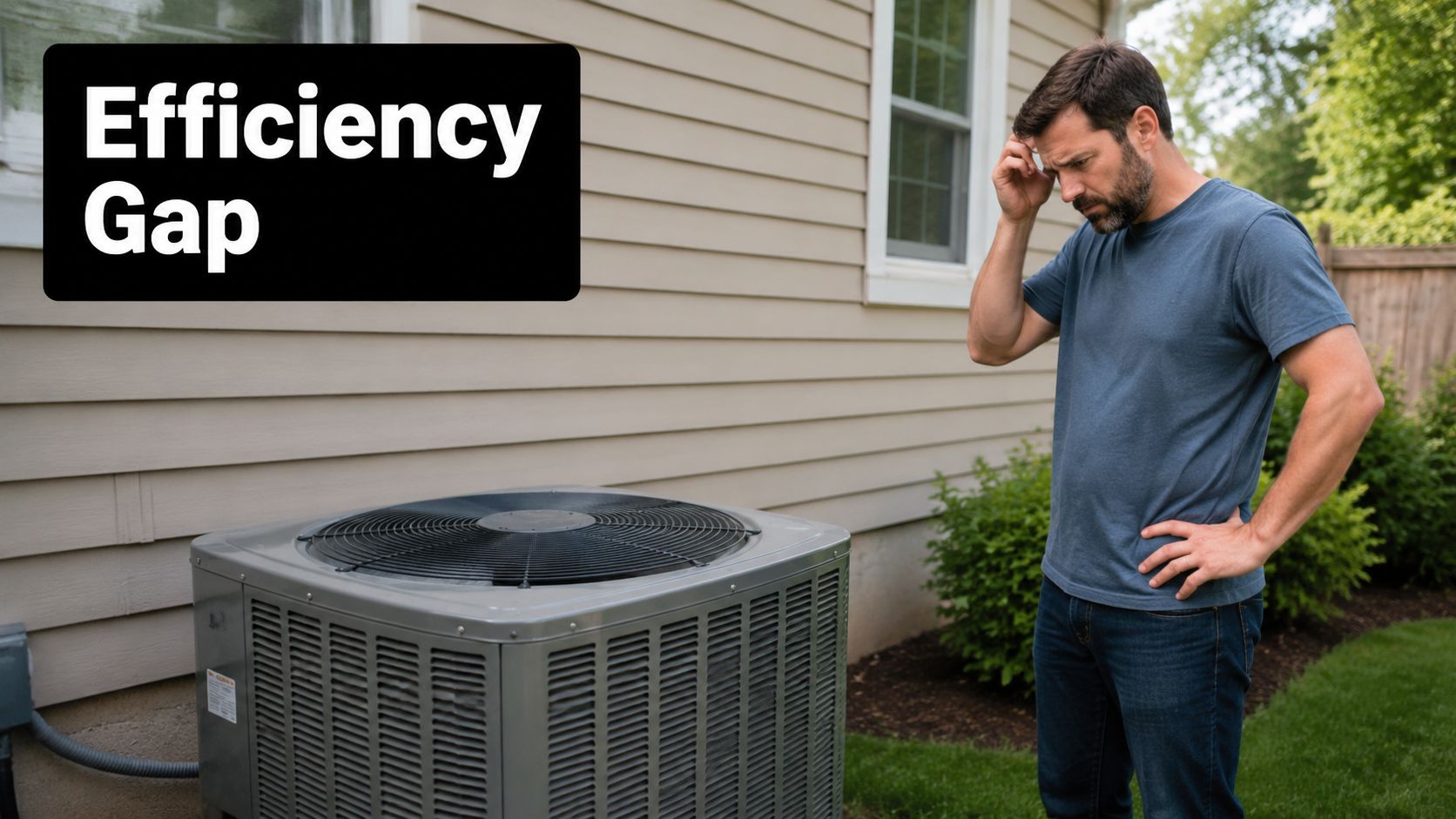
Ratings changed because efficiency standards changed
The U.S. Department of Energy established the first SEER requirements for HVAC equipment in 1979, with a minimum rating of 6.0. The national minimum later increased from 10 to 13 in 2006, and 2023 rules shifted residential equipment to SEER2 and EER2 metrics. This history of AC efficiency standards shows why ratings are meaningful. Higher minimums require new equipment to provide more cooling for each unit of electricity.
SEER measures total seasonal cooling output divided by total electric energy input. That makes it a useful equipment metric, but it doesn't measure whether the duct system preserves that cooling or whether the installation allows the equipment to operate correctly.
The delivery path determines comfort
In Arizona homes, ducts often pass through attics, garages, crawlspaces, or other spaces that aren't conditioned. A leak in the supply side can discharge cooled air before it reaches a bedroom. A poorly insulated duct can also gain heat along the route, so the air arriving at the register isn't as cool as the air leaving the coil.
Airflow problems create a second penalty. When the return path is too small or a filter rack restricts air, the blower works against higher resistance. Rooms become uneven, the coil may not exchange heat properly, and the equipment can run longer without producing the comfort its rating suggests.
Practical rule: Treat the rating as the starting point. Treat delivered airflow, duct integrity, refrigerant performance, and room comfort as the final test.
High-Impact DIY Maintenance Tasks You Can Do Today
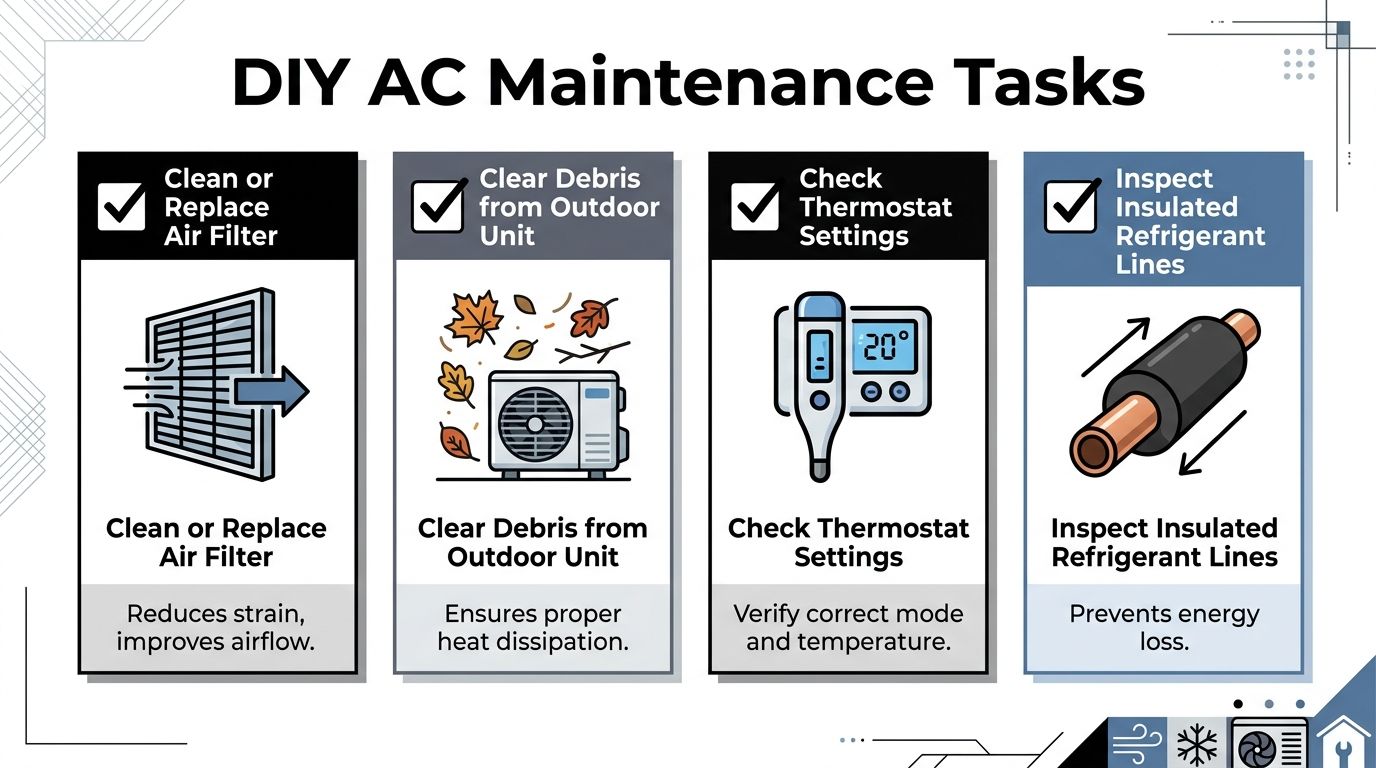
Homeowners can handle several safe maintenance tasks, provided the power is off where appropriate and the work doesn't involve refrigerant, electrical panels, gas components, or sealed equipment. These jobs won't correct a bad duct design or an incorrect system size, but they can remove common restrictions and prevent avoidable strain.
Start with airflow and outdoor heat rejection
- Inspect the filter: Use the filter size and type specified for the return grille or air handler. A visibly loaded filter restricts return airflow, while an overly restrictive filter can create a similar problem even when it looks clean. If you're unsure about timing, use this HVAC filter replacement guide to establish a practical inspection routine.
- Clear the condenser: Turn off the disconnect or thermostat before removing leaves, grass, and other debris around the outdoor unit. Keep the coil face open so the condenser can release heat. Don't bend the fins with a pressure washer, and don't spray electrical components.
- Check the thermostat: Confirm the system is in cooling mode, the fan setting matches your preference, and the programmed schedule hasn't been overridden. If the thermostat calls for cooling but the outdoor unit doesn't start, stop there and call a technician rather than opening the equipment.
- Inspect visible insulation: Look at the insulated refrigerant line near the outdoor unit and air handler. Damaged or missing insulation can reduce thermal performance, but refrigerant work itself requires professional tools and training.
Keep condensate drainage from becoming a cooling problem
A clogged condensate drain can shut down cooling equipment, cause water damage, or create conditions that affect indoor air quality. If your system has an accessible drain opening, inspect it for standing water and visible blockage. Don't pour chemicals into a drain connected to equipment unless the manufacturer or technician specifically recommends that product.
A weak, dirty filter, blocked condenser, or full drain pan is a maintenance issue. Ice on the refrigerant line, repeated breaker trips, grinding sounds, burning odors, water around the air handler, or a system that runs without lowering the indoor temperature points to a deeper fault.
This short video offers a visual maintenance reference:
DIY care works best as prevention. It doesn't replace static-pressure testing, temperature measurements, electrical checks, refrigerant diagnostics, or a complete commissioning process.
Ductwork and Airflow Problems That Waste Energy
A properly rated air conditioner can still deliver weak efficiency if its duct system loses air, restricts airflow, or allows conditioned air to escape before it reaches the rooms. The equipment may run normally while living spaces remain uneven, warm, or slow to cool.
ENERGY STAR reports that sealing and insulating ducts can improve heating and cooling efficiency by as much as 20 percent, and sometimes much more. ENERGY STAR's heating and cooling guidance also reinforces the practical limit of equipment ratings. Efficiency at the coil does not prevent losses after air enters the duct system.
Sealing is only one part of the job
A field study found that raising delivery efficiency from 64% to 76% produced an average 18% reduction in HVAC energy use. The same research measured supply leakage averaging 18% of fan flow before retrofit. The duct retrofit research connects the savings to improved delivery efficiency, not to sealant alone.
A contractor can seal accessible joints and still leave a restrictive return, crushed flex duct, disconnected branch, or poorly balanced register. Effective work starts with measurements, corrects the duct system, and verifies airflow and energy performance afterward.
What a real duct evaluation includes
A useful evaluation may cover visual inspection, total leakage testing, outside leakage testing, supply and return temperature measurements, room-by-room airflow checks, and static-pressure testing. The technician needs to locate the actual loss or restriction instead of applying sealant only where access is easiest.
Commissioning research in California homes found that duct leakage testing and sealing reduced thermal distribution losses by 25% to 30% in existing homes. The study reported average space-conditioning duct leakage to outside at 28% of system fan flow before retrofit. Unretrofitted duct efficiency generally measured 78% to 85%, while commissioned efficiency reached about 93% to 94%. The commissioning research supports testing, repair, and retesting rather than assuming a repair worked.
Duct routing also affects fan performance. ASHRAE duct design materials explain that static pressure represents the static energy of moving air, while fitting data help determine pressure-loss coefficients. ASHRAE's duct design guide notes that routing changes may require pressure-loss calculations and fan selection changes.
Ask whether the contractor will measure airflow and static pressure, inspect the return system, evaluate insulation, and document results after repairs. Duct sealing and repair services are most useful as part of that measured process, not as a standalone promise.
Thermostat Optimization and Smart Operating Habits
The thermostat controls runtime, but operating habits determine how often the system chases an empty house or an unrealistic setpoint. Build the schedule around occupancy, sleeping hours, and how well the home holds comfort. That reduces wasted runtime without pretending a control setting can correct leaking ducts, poor airflow, or a failing compressor.
ENERGY STAR guidance indicates that raising the thermostat 10 to 15 degrees during an absence may reduce energy bills by 5 to 15 percent. Even a 1 to 2°F increase can reduce energy use by up to 10 percent. Those figures are practical reference points, not guarantees. Arizona weather, insulation, internal heat, humidity, and equipment condition all affect the result.
Use the schedule instead of constant manual changes
Program setbacks for predictable absences, and let the system restore comfort before occupants return. A smart thermostat can automate that schedule and show runtime trends, which helps identify unusual operation. It cannot make an incorrectly sized system efficient.
Placement matters. Keep the thermostat away from a supply register, cooking area, sunny window, or other location that reads warmer or cooler than the home's occupied areas. A misleading temperature reading can cause unnecessary cycling or leave rooms uncomfortable.
Set the target temperature you want. Dropping the thermostat far below that setting does not make the compressor cool faster. It extends the cooling call, and a system with restricted airflow may run continuously while still missing the target.
Account for humidity during monsoon weather
Arizona comfort depends on moisture as well as dry-bulb temperature. During humid weather, a home may feel uncomfortable even when the thermostat shows the expected temperature. Equipment selected mainly for sensible cooling can satisfy the thermostat before removing enough moisture, especially when short cycles limit dehumidification.
RMI reported that the industry is evaluating updated testing methods, including draft work for ISO 21280 with a sensible heat ratio requirement covering temperature and humidity performance. RMI's cooling standards analysis explains why load-based testing and humidity-aware metrics matter in occupied homes.
Use moderate settings, keep doors and windows closed while cooling, and request humidity diagnostics if the house feels clammy. Smart controls help most when installation quality, airflow, duct integrity, and moisture control support the equipment's rated performance.
When to Repair Versus Upgrade Your Cooling System
Repairing a system makes sense when the equipment is otherwise sound, the fault is identifiable, and the duct and airflow conditions support continued operation. Replacing a contactor, capacitor, drain component, or failed control can restore reliable cooling without disturbing a system that still fits the home.
An upgrade deserves serious consideration when repairs keep recurring, parts are difficult to source, the system can't maintain comfort, or a diagnostic evaluation reveals that the existing equipment is mismatched. A new condenser won't solve undersized ducts, and a higher rating isn't valuable if the installation can't deliver the required airflow.
Compare the decision, not just the equipment price
| Factor | Lean Toward Repair | Lean Toward Upgrade |
|---|---|---|
| Fault pattern | One isolated, diagnosable failure | Repeated failures or several connected problems |
| Airflow | Ducts and blower can support the existing system | Duct restrictions or design problems require a broader redesign |
| Comfort | The system cools rooms evenly after repair | Persistent hot spots, humidity, or poor delivery remain |
| Efficiency path | Maintenance and correction can restore operation | Equipment and installation no longer align with current needs |
| Planning | Repair buys practical service life | Replacement can be designed before an emergency failure |
Look beyond SEER2
For cooling equipment, SEER2 and EER2 describe seasonal and rating-condition efficiency. For furnaces, AFUE is the standard seasonal measure. Heat pumps require attention to both cooling and heating performance, because SEER2 measures seasonal cooling efficiency while HSPF2 measures seasonal heating efficiency.
As of January 1, 2023, DOE minimums for split-system heat pumps are 14.3 SEER2 and 7.5 HSPF2. Single-packaged heat pumps must meet 13.4 SEER2 and 6.7 HSPF2. The DOE-linked heat-pump efficiency summary shows why an installer must verify both sides of the rating.
A heat pump may suit a home that needs both heating and cooling, while a ductless mini split can address an addition, workshop, or isolated room without extending a problematic central duct branch. Furnaces still require proper sizing and airflow, and the relevant seasonal measure is AFUE, not SEER2. The right choice depends on load, duct design, humidity, operating priorities, and installation quality.
Don't select the highest advertised rating by default. A properly sized, properly commissioned system with sound ducts can outperform a more expensive rating that never reaches the rooms.
Working with a Licensed HVAC Professional in Arizona
DIY maintenance ends when the work involves refrigerant, combustion, high-voltage components, sealed electrical compartments, equipment sizing, or measurements that require specialized instruments. A professional efficiency evaluation should connect the symptoms to test results instead of treating every complaint as a filter or thermostat issue.
For a home in Globe, Miami, or Superior, ask the contractor to document the diagnostic path:
- Airflow testing: Verify blower operation, supply delivery, return capacity, and static pressure.
- Duct evaluation: Check leakage, insulation, layout, connections, and room balance.
- Equipment diagnostics: Confirm refrigerant performance, coil condition, electrical operation, and temperature change.
- Sizing and design: For replacement or new construction, perform a load calculation and select equipment and ducts around the actual building load.
- Commissioning: Test the completed installation, correct deficiencies, and record the final operating condition.
A quick tune-up may clean accessible parts and identify obvious faults. It won't automatically prove that the system is right-sized, that ducts deliver the designed airflow, or that humidity performance is acceptable. Ask whether the proposal includes measurements before and after work, what equipment will be installed, and how the contractor will handle duct modifications.
Verify the company's license, insurance, manufacturer training, and experience with the type of system being considered. A licensed HVAC technician should be able to explain the findings in plain language and distinguish an urgent repair from a recommended improvement.
Cobre Valley Air LLC serves Globe, Miami, Superior, and nearby Arizona communities with HVAC repair, maintenance, duct inspection and design, code-compliant installation, ductless mini splits, indoor air quality work, and commercial HVAC service. Its replacement process includes airflow and duct evaluations, while new construction work includes load calculations, sizing, and airflow planning. Financing is available through Wisetack and OPTIMUS, and the company provides 24/7 emergency response.
Schedule an efficiency-focused evaluation with Cobre Valley Air LLC to check the airflow, duct integrity, equipment condition, and installation quality behind your comfort problems. Whether you need a precise AC repair, preventive maintenance, duct correction, or a properly sized replacement, ask the team to measure what reaches your living spaces.