


An Arizona summer afternoon can expose a weak air-conditioning system quickly. The vents may start blowing air that feels merely less cool, then the indoor temperature keeps climbing while the equipment runs without stopping. By the time ice appears on the refrigerant line, water reaches the ceiling below the air handler, or the outdoor unit begins grinding, a manageable repair may have become compressor damage or property damage.
The visible symptom doesn't always identify the failed component. Warm air can come from a thermostat setting, restricted airflow, a refrigerant problem, or a compressor that can't complete the cooling cycle. That's why the most useful approach combines safe homeowner checks with professional diagnostics. You need to know what you can inspect, when to shut the system off, how urgently to request service, and whether the problem is the equipment, the ductwork, the installation, or the system design.
The following signs your AC needs repair also connect to preventive maintenance, airflow testing, duct design, heat pumps, and furnaces. The same blower, controls, drainage, and airflow principles affect several HVAC systems, even when the heating or cooling cycle differs.
1. Warm Air Blowing from AC Vents
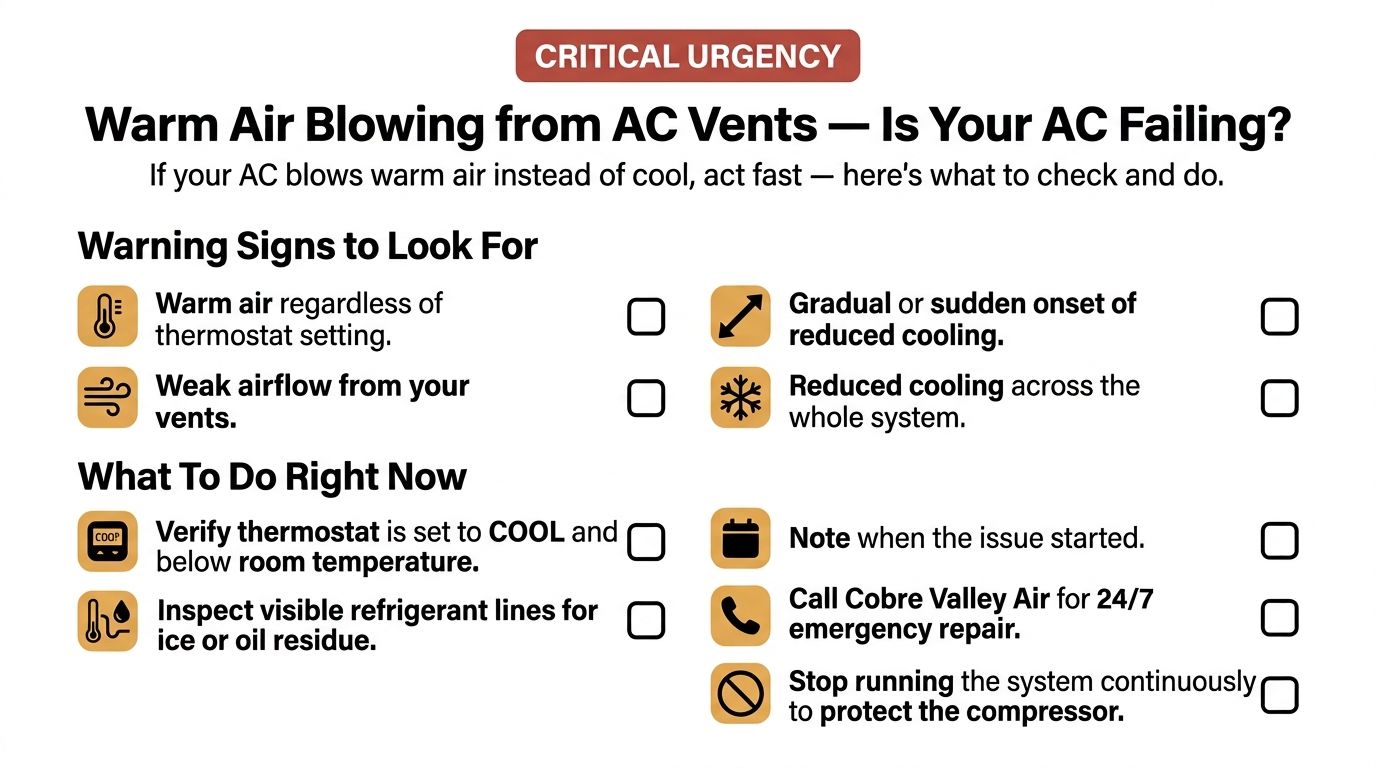
Warm air from a running air conditioner is one of the clearest signs that cooling has failed or isn't transferring heat correctly. Possible causes include a low refrigerant charge from a leak, a compressor problem, an expansion valve fault, restricted airflow, or an incorrect thermostat setting. A recently installed system that starts blowing warm air after a short period may have an installation defect, such as a leaking connection or control problem. A multi-year-old unit that gradually loses cooling may be developing a slow refrigerant leak.
Start with checks that don't require opening the equipment:
- Confirm the mode: Set the thermostat to “cool” and make sure the target temperature is below the room temperature.
- Check the filter: A severely restricted filter can reduce airflow enough to affect cooling performance.
- Observe the pattern: Note whether every register feels warm or only certain rooms do.
- Record the timeline: Tell the technician whether the problem appeared suddenly or developed over several weeks.
- Look, don't dismantle: Ice or oily residue around accessible refrigerant lines deserves professional attention. Don't handle the sealed system.
The U.S. Department of Energy has documented widespread HVAC faults in real buildings, including improper refrigerant charge and airflow problems, so poor cooling isn't an unusual edge case. Its report found significant defects in more than half of installed AC systems and cited earlier field work involving 65% of 8,873 tested systems requiring repairs, 72% of 4,168 systems with improper refrigerant charge, and 44% with improper airflow (DOE technical report).
Arizona safety rule: If the indoor temperature is rising during dangerous heat, don't keep running a system that isn't cooling. Protect vulnerable household members and request emergency service.
2. Weak Airflow from Vents
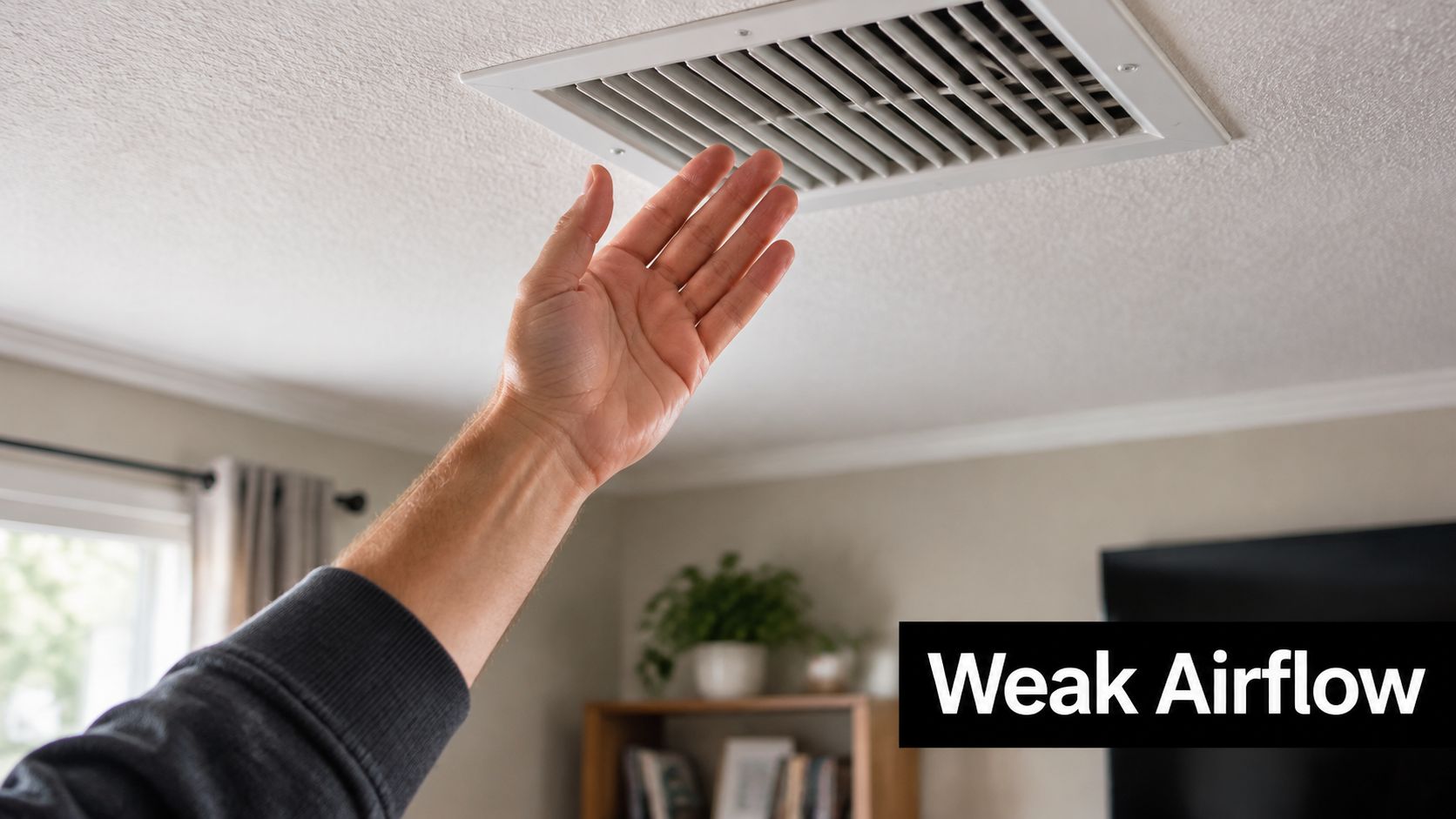
Weak airflow can be a simple filter problem, but it can also reveal a failing blower motor, a dirty evaporator coil, blocked returns, disconnected ductwork, or poor duct design. Compare several registers. If airflow is weak everywhere, investigate the filter, blower, coil, and main duct paths. If one room or one floor is affected, the restriction or leakage may be local.
A new home can have a correctly sized air conditioner and still feel uncomfortable if the supply and return ducts are undersized, poorly routed, or badly balanced. ASHRAE describes duct systems as pressure systems where total pressure combines static and velocity pressure, with losses affected by friction, fittings, and layout (ASHRAE duct-system guidance). That makes airflow evaluation part of quality AC installation, not an optional add-on after occupants complain.
Check the filter, confirm that supply registers and return grilles aren't blocked by furniture, and inspect accessible ductwork for obvious disconnections or crushed sections. Don't enter an unsafe attic or attempt to modify a pressurized duct system without proper training. Mastic and approved metal tape are appropriate for accessible duct repairs, while ordinary cloth duct tape isn't a durable solution for many HVAC applications.
A professional evaluation can measure total airflow, airflow per ton, static pressure, temperature split, and electrical draw. Benchmarking these values against the system's baseline can expose coil fouling, duct restrictions, or blower problems before the system fails (HVAC performance benchmarking guidance).
3. Strange Noises from the System
A new grinding, squealing, rattling, or metallic sound deserves attention because the sound often changes before the component stops completely. Grinding may point to severe motor or compressor wear. Squealing can come from a bearing or belt-related problem. Rattling may indicate a loose panel, mounting bracket, fan blade, or debris.
The timing matters as much as the tone. A noise only at startup suggests a different diagnostic path from a sound that continues throughout the cooling cycle or appears during shutdown. Record a short video from a safe location, note whether the sound comes from the indoor air handler, furnace cabinet, ductwork, or outdoor condenser, and tell the technician what changed.
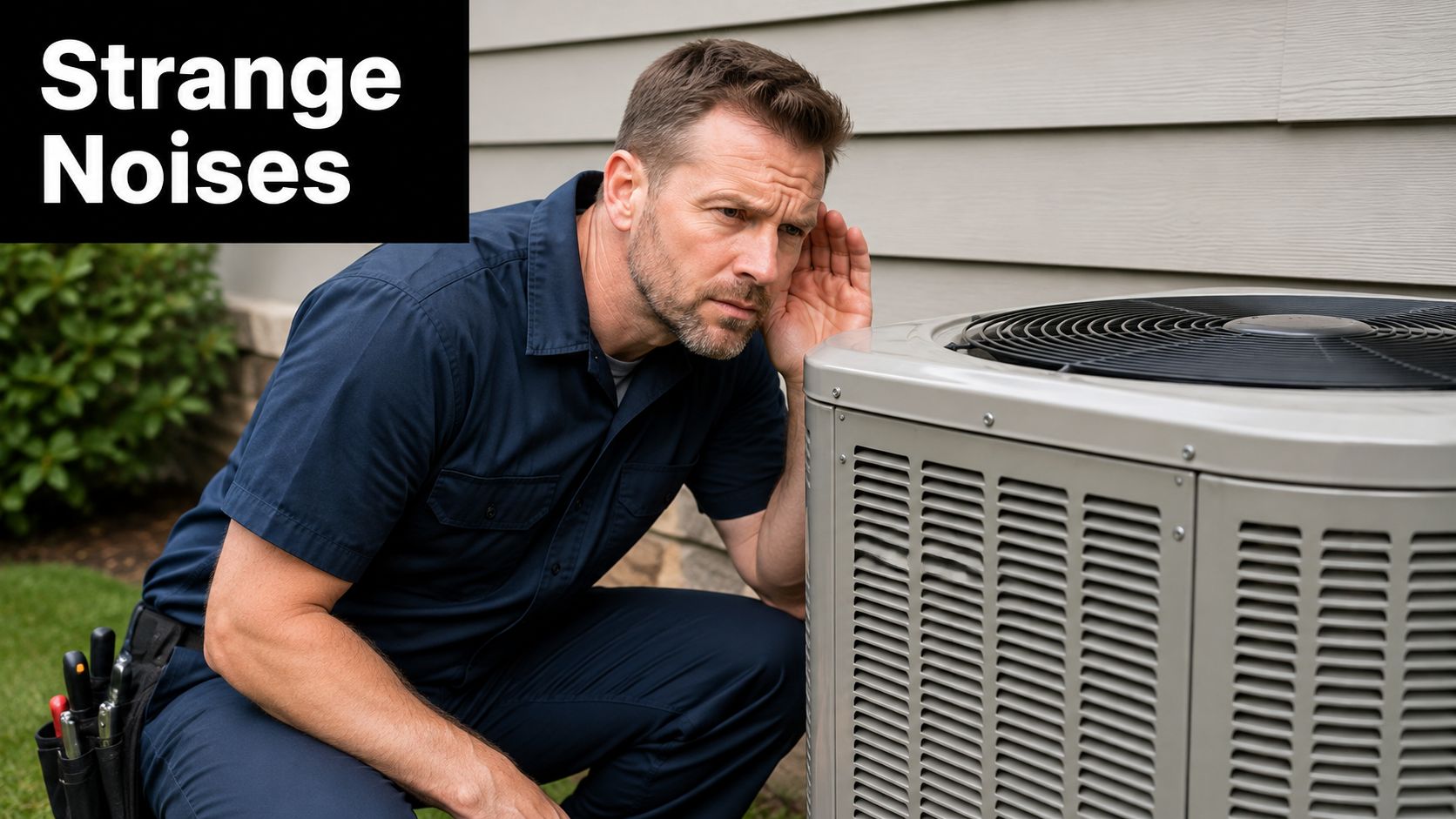
You can remove leaves near the outdoor cabinet and check whether an exterior panel is visibly loose, but don't remove electrical covers or reach near moving components. Stop the system if you hear metal-on-metal grinding, loud banging, or a sound accompanied by burning odor, breaker trips, or loss of cooling. Continuing to run a damaged compressor or motor can turn a localized repair into a larger failure.
Heat pumps and furnaces can produce similar warning noises. A furnace blower bearing, heat-pump fan motor, or loose ductless mini-split bracket may need attention even though the equipment isn't operating in conventional cooling mode. For more guidance on identifying unusual sounds, see this AC noise troubleshooting resource.
4. Refrigerant Leaks with Oil Stains or Hissing
Refrigerant leaks can show up as reduced cooling, warm air, icing, hissing, or oily residue near the outdoor unit, coil, or refrigerant connections. Refrigerant carries heat through the cooling circuit. When the charge falls because refrigerant escapes, the system may run longer while delivering less cooling, and the compressor can operate under damaging conditions.
A leak can begin at a connection on a new installation, develop in a coil, or form in a heat-pump line from vibration and corrosion. A slow leak may look like a system that needs repeated seasonal recharging. Recharging without finding and repairing the leak only postpones the problem and can leave the compressor exposed to continued poor operating conditions.
Homeowners should not connect gauges, add refrigerant, or open the sealed circuit. Refrigerant handling requires the appropriate certified technician, and a proper service call should include leak detection, repair, and verification. Ask whether the technician will pressure-test the circuit after the repair and inspect the rest of the refrigerant path rather than stopping at the first visible sign.
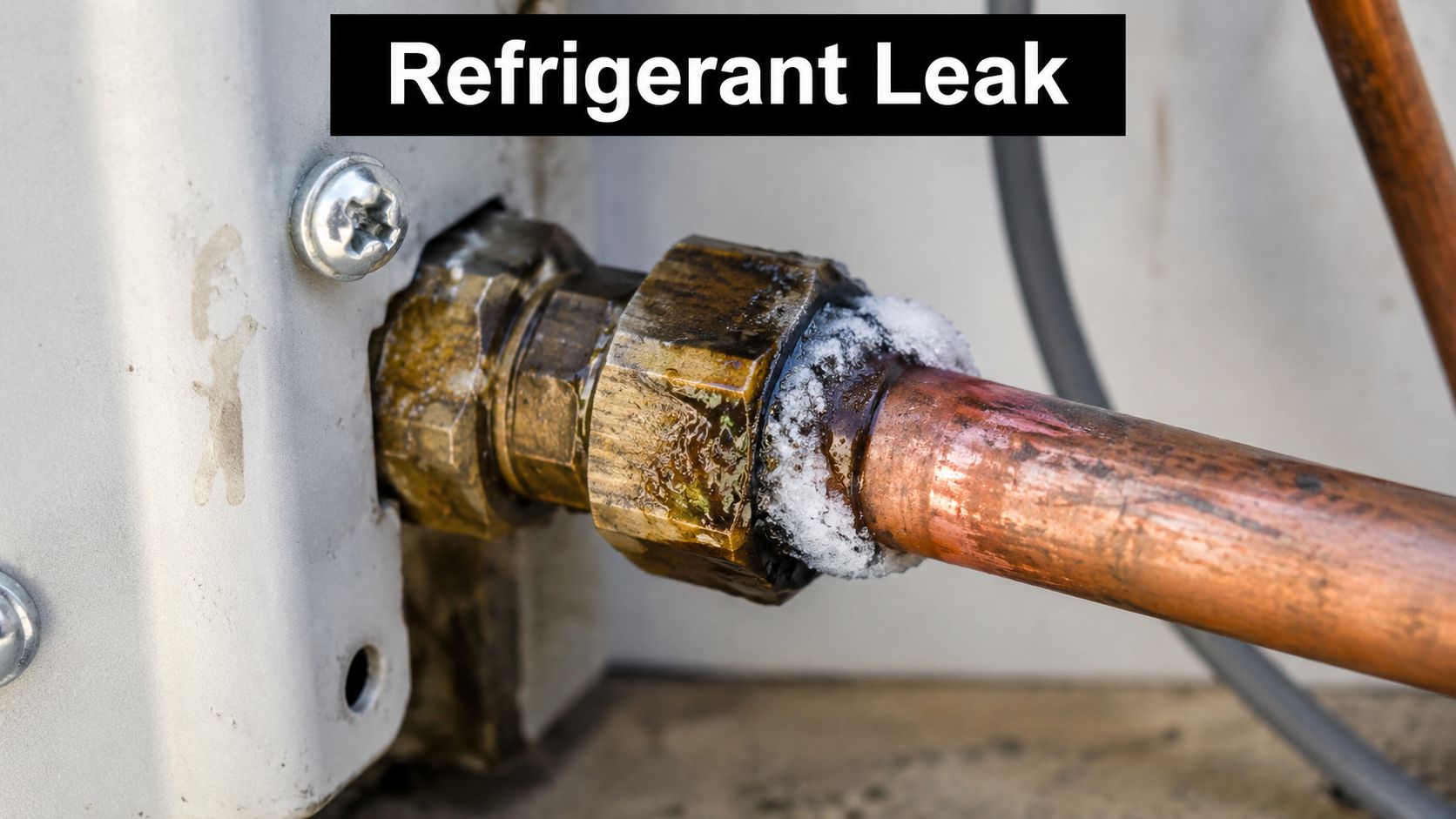
Turn the system off if you suspect a significant leak, especially when cooling has dropped sharply or the compressor is making unusual sounds. A technician can explain whether the repair makes sense for the equipment's condition, refrigerant requirements, and future parts availability. Review this guide to repairing a refrigerant leak in an air conditioner before scheduling service.
5. Frequent On-Off Cycling
An air conditioner that starts and stops repeatedly isn't operating normally. Short cycling can result from a clogged filter, refrigerant or pressure problems, a thermostat fault, an overcharged system, or equipment that is too large for the building's cooling load. An oversized system can reach the thermostat setting quickly, but it may not run long enough to distribute comfort evenly or manage humidity properly.
Check the filter first and make sure the thermostat isn't exposed to direct sunlight, a nearby appliance, a supply register, or a draft. Note how often the system starts, whether the house temperature swings, and whether the outdoor unit shuts down while the indoor blower continues. Don't adjust refrigerant, pressure controls, or electrical components yourself.
Sizing and installation quality deserve special attention in new construction. ASHRAE duct-design procedures call for planned outlet distribution, consideration of duct leakage and heat gain, pressure-loss calculations, fan selection, and recalculation when routing changes (ASHRAE duct-design procedure). A load calculation and airflow plan can distinguish an equipment fault from a design problem.
Heat pumps and furnaces can short cycle too. In commercial operations, a rising reactive-work ratio and longer mean time to repair often signal recurring faults rather than an isolated complaint. HVAC KPI references describe healthy programs as keeping reactive work under 20%, while typical environments run 30–45%, with MTTR around 3–6 hours and world-class targets below 90 minutes (HVAC maintenance KPI reference). Request a full diagnosis instead of repeatedly resetting the system. This short-cycling guide can help you prepare useful details for the service call.
6. Thermostat Malfunctions
Sometimes the air conditioner isn't the first component to blame. A thermostat with depleted batteries, an incorrect mode, poor placement, dust around its sensing openings, or an electronic failure can prevent cooling, cause continuous operation, or trigger abnormal cycling.
Start at the wall control. Confirm that it's in cooling mode and set below the current room temperature. Replace the batteries if the model uses them, even when the display still appears active. Check that the thermostat sits on an interior wall away from sunlight, drafts, registers, and heat-producing appliances. A thermostat mounted on an exterior wall can read a temperature that doesn't represent the living space.
A thermostat check is useful because it's quick and low risk. It isn't a substitute for testing the equipment when the settings are correct and the problem persists.
Smart thermostats add convenience but also introduce compatibility questions. A model designed for a conventional furnace and AC may not be configured correctly for a heat pump, auxiliary heat, variable-speed equipment, or a communicating control system. If the problem began after an upgrade, have the wiring, programming, and calibration checked rather than assuming the new thermostat is compatible.
Dust can be removed from accessible exterior openings with a soft brush. Don't pull wires, bridge terminals, or open the control unless you're qualified to work safely around HVAC electrical circuits. When a thermostat replacement is appropriate, professional setup can verify that the control matches the AC, heat pump, or furnace and accurately represents the temperature in the occupied area.
7. Moisture Leaks or Drainage Issues
Condensation is a normal part of air conditioning, but water pooling around the indoor unit, staining a ceiling, or appearing inside ductwork isn't normal. A clogged condensate line, cracked drain pan, incorrect slope, or installation defect can let water escape into an attic, wall, furnace area, or finished room.
Look for the first visible point of water, not just the lowest spot where it collects. Water from an attic air handler may travel along framing before it reaches the ceiling. A drain line that appears accessible should discharge freely, but don't climb into an unsafe space or remove panels around energized equipment. If water is near electrical components, shut the system off and arrange service.
A safety switch on the condensate line can stop the equipment when the drain backs up. Annual maintenance should include inspecting the drain pan, clearing the line, checking the float switch, and confirming that the drain has the correct slope. Duct installation also matters. Poorly supported or incorrectly routed ducts can allow condensation to collect where it shouldn't, while leakage and inadequate insulation can worsen moisture problems.
Some basic maintenance procedures, such as clearing an accessible drain with a method approved for your system, may be reasonable for a homeowner. Don't pour chemicals into the drain or use aggressive pressure when you don't know how the line is configured. A professional duct and drainage evaluation is the safer choice when moisture appears inside ducts, below a furnace, or near insulation.
The same concern applies to heat pumps and furnaces with cooling coils. Heating equipment may be operating correctly while its attached evaporator coil or condensate system creates the leak, so the diagnosis should cover the complete air handler assembly.
8. Rising Energy Bills Without Increased Usage
A higher cooling bill with no meaningful change in thermostat settings, occupancy, or weather can be one of the quieter signs your AC needs repair. Possible causes include a refrigerant leak, dirty filter or coil, duct leakage, compressor wear, thermostat error, and equipment that was poorly sized for the building.
Compare usage with the same season from a previous year, accounting for weather and occupancy. A utility review can show whether the increase comes from air conditioning or another appliance. A smart thermostat may improve scheduling, but it cannot seal leaking ducts, clear a blocked coil, correct refrigerant charge, or restore a weak compressor.
Persistent increases deserve performance testing rather than guesswork. A technician can check airflow, temperature split, static pressure, and electrical draw against the system's expected baseline. If duct leakage or poor distribution is driving long runtimes, replacing the outdoor unit may leave hot rooms and wasted energy unchanged. As noted in the duct-design guidance above, pressure loss, outlet placement, duct heat gain, leakage, and routing all affect how efficiently conditioned air reaches each room.
Repair-versus-replacement decisions also depend on efficiency requirements and installation quality. The DOE's 2023 efficiency transition introduced SEER2 and HSPF2, with testing at 0.5 inches of water column external static pressure instead of the older 0.1 inches. For split-system heat pumps, the federal minimum HSPF2 is 7.5 (SEER2 and efficiency rating explanation). Ask for duct performance, airflow, and installation to be evaluated alongside the equipment label. Call promptly if rising consumption accompanies burning odors, electrical symptoms, or a system that cannot maintain temperature.
9. Frozen Evaporator Coil or Ice Buildup
Ice on the indoor evaporator coil or refrigerant line means the system needs immediate attention. Restricted airflow, low refrigerant, a dirty coil, or a control problem can let the coil temperature fall far enough for moisture to freeze. The ice then blocks airflow further, reduces cooling, and can create a large amount of water when it melts.
Turn the AC off and set the thermostat to fan-only mode if your system allows it. Let the ice melt naturally. Don't scrape it, break it with a tool, or use heat near the coil. Check and replace the filter, confirm that return grilles aren't blocked by furniture, and look for water around the drain pan as the ice thaws.
A frozen coil during an extreme Arizona heat wave can tempt homeowners to keep the system running because the house is uncomfortable. That usually worsens the underlying problem and can stress the compressor. If the coil refreezes after thawing and the filter is clean, the system needs professional testing for airflow, refrigerant charge, coil condition, and thermostat operation.
Heat pumps can also develop icing problems in their cooling or heating operation, depending on outdoor conditions and control sequence. A ductless mini-split that freezes repeatedly needs diagnosis rather than repeated manual defrosting. Call promptly if ice appears in the morning, cooling has stopped, the compressor sounds abnormal, or melting water threatens ceilings and electrical equipment.
9 Signs Your AC Needs Repair, Comparison
| Issue | Implementation Complexity 🔄 | Resource Requirements ⚡ | Expected Outcomes 📊 | Ideal Use Cases 💡 | Key Advantages ⭐ |
|---|---|---|---|---|---|
| Warm Air Blowing from AC Vents | High, multiple possible causes (refrigerant, compressor, expansion valve); professional diagnostics required | Certified technician, diagnostic gauges, possible refrigerant, compressor parts; same‑day service often recommended | Restored cooling if leak/valve fixed; possible compressor replacement; urgent downtime | Emergency response in extreme heat; units blowing warm regardless of thermostat | Clear, unmistakable failure signal; prevents further damage when addressed promptly, ⭐⭐⭐⭐ |
| Weak Airflow from Vents | Moderate, often filter/duct/fan issues; hidden duct leaks can increase complexity | Filter replacement, duct sealing/mastic, fan motor repair, thermal imaging for hidden leaks | Improved airflow and efficiency after cleaning/sealing; may require costly ductwork fixes | Uneven room temperatures; long runtime; routine maintenance and duct evaluations | Frequently solvable with low‑cost fixes; improves energy use and comfort, ⭐⭐⭐ |
| Strange Noises (Grinding, Squealing, Rattling) | Moderate–High, requires timed observation and skilled diagnosis to locate source | Technician labor, vibration mounts, motor or compressor parts, diagnostic tools | Identifies failing components; can prevent catastrophic failure if addressed quickly; may lead to expensive replacement | Any unit emitting grinding/squealing/rattling, especially outdoors at startup | Early audible warning; some issues are inexpensive to remedy if caught early, ⭐⭐⭐⭐ |
| Refrigerant Leaks (Oil Stains or Hissing) | High, must locate leak and follow EPA regulations; certified handling required | EPA‑certified tech, electronic leak detectors, refrigerant (costly), pressure testing, possible coil/line replacement | Restored efficiency when sealed; legal compliance required before recharge; risk mitigation for compressor | Visible oil, hissing sounds, frost on coils, gradual loss of cooling | Prevents compressor damage and restores performance; regulatory compliance, ⭐⭐⭐ |
| Frequent On‑Off Cycling (Short Cycling) | Moderate, multiple root causes (oversizing, thermostat, airflow, refrigerant) | Thermostat calibration/replacement, filter changes, pressure testing, possible system resizing | Stabilized runtimes, better humidity control; may require replacement if system is oversized | Rapid on/off cycles, temperature swings, new builds with wrong sizing | Noticeable symptom prompting timely correction; preventable with proper sizing, ⭐⭐⭐ |
| Thermostat Malfunctions (Won't Turn On or Inaccurate) | Low, often simple fixes (batteries, settings); some smart thermostats need compatibility checks | Batteries, calibration tools, compatible smart thermostat, minor wiring checks | Restores control and accurate temperature reading; can enable energy savings with upgrades | Systems unresponsive, incorrect readings, or when upgrading to smart controls | Low cost, high impact; many fixes user‑serviceable or quick for techs, ⭐⭐⭐⭐ |
| Moisture Leaks or Drainage Issues | Low–Moderate, drain cleaning is simple; duct slope or pan replacement can be more complex | Drain cleaning tools, vinegar/air flush, safety switch, drain pan or ductwork repairs | Prevents water damage and mold; restores proper condensate removal | Visible pooling, musty odors, attic/ceiling water stains, monsoon season concerns | Often preventable via maintenance; inexpensive maintenance avoids major damage, ⭐⭐⭐ |
| Frozen Evaporator Coil or Ice Buildup | Moderate–High, thawing required before diagnosis; airflow or refrigerant issues often underlying | System shutdown/time to thaw, filter replacement, refrigerant check, technician diagnostics | Restored cooling after thaw and repair; urgent to avoid compressor damage and water issues | Visible ice on coil/lines, reduced cooling despite running | Highly visible urgent symptom; corrective steps often prevent compressor failure, ⭐⭐⭐ |
Know When a Check Becomes a Service Call
Homeowner checks are appropriate for simple, visible conditions. Confirm the thermostat mode, replace a dirty filter, clear leaves from around the outdoor cabinet, make sure supply and return vents are open, and observe where and when a symptom occurs. These steps give a technician useful information, but they won't confirm refrigerant charge, compressor health, static pressure, airflow volume, electrical safety, or duct leakage.
Schedule service promptly when weak airflow persists, the equipment cycles repeatedly, energy use rises without an obvious explanation, or new noise returns after a basic check. Those symptoms may come from a repairable component, but they can also point to poor installation, undersized or oversized equipment, restricted ductwork, or a system that has drifted away from its original performance baseline. A 2023 office-building fault-detection study found that on a given day, about 40% of air-handling units and 30% of air terminal units had at least one reported fault, with an average of three faults per AHU and one per ATU each month (HVAC fault-detection study). The lesson for homeowners and building managers is practical: recurring symptoms deserve trend-based diagnosis, not endless resets.
Shut the AC off and seek urgent help for visible ice, suspected refrigerant leaks, grinding or severe mechanical noise, major water leakage, burning odors, electrical concerns, or loss of cooling during dangerous heat. Don't open electrical compartments, alter refrigerant components, bypass safety controls, or keep operating equipment that is clearly damaging itself.
Repair estimates depend on the diagnosis, component condition, warranty coverage, refrigerant and parts availability, ductwork, installation quality, and whether the system is correctly sized. A low-cost component repair may be sensible when the rest of the system performs well. Repeated leaks, chronic airflow imbalance, poor load calculations, obsolete components, or a deteriorating compressor may justify discussing replacement or retrofit instead. Recent HVAC market coverage identifies refrigerant changes and SEER2 standards as significant industry issues, which makes the timing and future serviceability of an older system part of the conversation (HVAC industry trends and refrigerant changes). Don't accept a fixed price based only on a symptom. Request a documented evaluation and an explanation of the available repair and replacement paths.
Cobre Valley Air serves Globe, Miami, Superior, and surrounding Arizona communities with precise diagnostics, code-compliant AC installation, airflow and duct evaluations, maintenance, duct design and repair, indoor air quality support, ductless mini-split service, and heat-pump and furnace expertise. The company also supports commercial and restaurant HVAC needs, including rooftop units and walk-in coolers, with 24/7 emergency response. For homeowners, builders, property managers, and businesses, the right next step is a complete assessment of the equipment and the air-distribution system together.
Cobre Valley Air LLC provides AC repair, maintenance, code-compliant installation, airflow and duct evaluations, heat-pump and furnace service, and indoor air quality solutions for Globe, Miami, Superior, and nearby Arizona communities. If your system is showing any of these warning signs, visit Cobre Valley Air LLC to request a professional evaluation or 24/7 emergency response.