



If you live in Globe, Miami, Superior, or nearby parts of Arizona, you already know home comfort isn't a one-season job. Summer asks your system to fight relentless heat for months. Then winter nights show up with that dry desert chill that makes the tile floor feel like ice. Most homeowners just want one thing: a system that keeps the house comfortable without turning HVAC into a constant headache.
That's where heat pumps make sense. They can cool your home in summer and heat it in winter with the same basic equipment. If you've ever asked how does a heat pump work, the short answer is simple. It doesn't make heat the way a furnace does. It moves heat from one place to another.
That idea sounds strange at first, especially when it's hot outside or cold at night. But once you see the cycle in plain language, it starts to click. And in Arizona, where sizing, airflow, duct design, and installation quality matter just as much as the equipment itself, that understanding can save you from buying the wrong system.
Your All-in-One Comfort Solution for Arizona
A lot of Arizona homes were built around the idea that cooling is the main event. That makes sense. In July, nobody is thinking about a cold morning in January. They're thinking about whether the AC can keep up by late afternoon.
But desert living asks more from your HVAC than people expect.
One system for two jobs
A traditional setup often splits the work. You might have an air conditioner for cooling and a furnace for heating. A heat pump combines those jobs into one system. It cools during hot weather and switches roles when your house needs heat.
For homeowners, that can mean a simpler path when it's time to replace aging equipment. Instead of managing separate heating and cooling pieces, you're looking at one matched comfort system that handles both seasons.
A heat pump makes the most sense when you want steady cooling through long Arizona summers and dependable heat on cold desert nights without maintaining two separate systems.
Why Arizona homeowners look at heat pumps differently
In places like Globe and Miami, comfort isn't only about temperature. It's also about airflow, dust, duct leakage, sun exposure, insulation, and how your rooms heat up at different times of day.
That's why two houses on the same street can feel completely different.
A home with poor return airflow may have hot bedrooms even when the system is running nonstop. A house with undersized ducts may feel loud, uneven, or muggy. A unit that's too large can cool quickly but leave comfort gaps because it doesn't run the way the house needs it to.
A familiar example
Say your current AC is getting older. It cools okay in the morning, but by evening the living room is warm, the back bedrooms lag behind, and your utility bill never feels low enough to justify the discomfort. Then winter comes, and your heating setup feels like an afterthought.
That's the moment many homeowners start asking better questions. Not just “What brand should I buy?” but “What type of system fits this house?” and “Is there a way to improve both cooling and heating at the same time?”
A heat pump often enters the conversation there. Not as a trendy upgrade, but as a practical all-in-one option for homes that need reliable cooling first and useful heating second.
The local piece that matters
In Arizona, the equipment is only part of the answer. The house itself decides a lot. Roof heat, attic conditions, window orientation, existing duct layout, and room-by-room airflow all affect whether a heat pump will feel great or frustrating.
That's why local HVAC work has to go beyond swapping boxes. If the system is right but the duct design is wrong, the homeowner still loses.
The Magic Behind the Machine How a Heat Pump Moves Heat
The easiest way to understand a heat pump is to think about your refrigerator. A refrigerator doesn't create cold out of nowhere. It pulls heat from inside the fridge and dumps that heat somewhere else. A heat pump uses the same basic idea, just on a whole-house scale.
According to the U.S. Department of Energy explanation of heat pump systems, a heat pump uses electricity to transfer heat from a cool space to a warm space. In heating mode, it moves heat from the cool outdoors into the home. In cooling mode, it moves indoor heat outdoors.
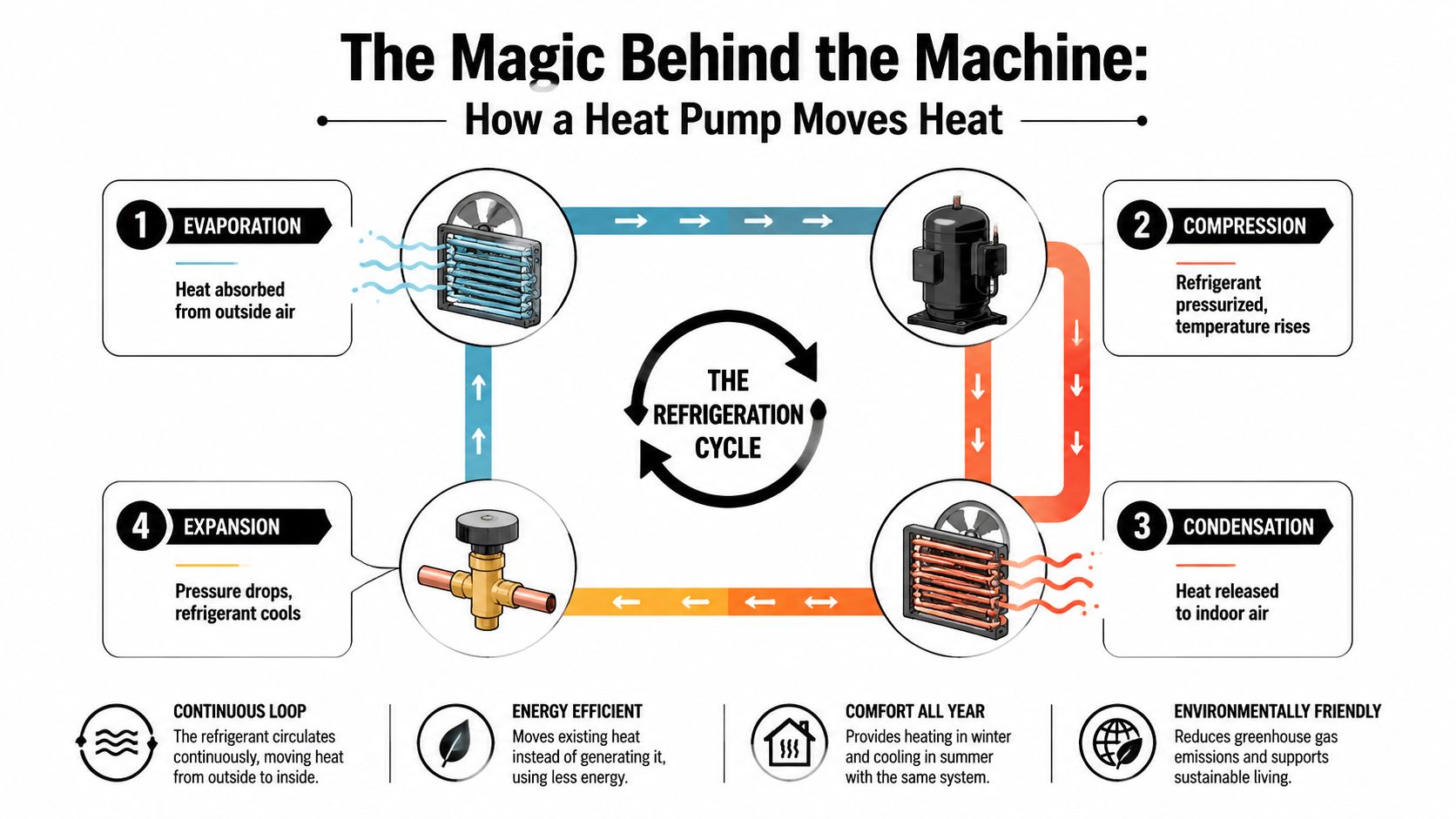
Here's a visual that helps make the cycle easier to follow:
The four parts doing the work
The same Department of Energy page says the core cycle uses a closed refrigerant loop with four main components: evaporator, compressor, condenser, and expansion valve. Each part has one job in the sequence.
Evaporator
The refrigerant passes through a coil and absorbs heat. In cooling mode, it absorbs heat from indoor air. In heating mode, it absorbs heat from outdoor air.Compressor
The compressor squeezes the refrigerant. That raises its temperature and pressure.Condenser
The hot refrigerant moves to another coil and releases heat where you want it. That may be indoors during heating season or outdoors during cooling season.Expansion valve
This part drops the pressure so the refrigerant cools down and gets ready to absorb heat again.
If that sounds abstract, the system operates much like a shuttle carrying heat. The refrigerant picks heat up, the compressor intensifies it, the system drops it off in the needed location, and then the cycle resets.
Why this confuses people
Most homeowners hear “heating” and assume the machine must be creating heat like a space heater or furnace. That's the part that throws people off. A heat pump usually isn't making heat in that direct way. It's relocating heat.
That's why the system can be so effective with the same core hardware handling both jobs.
Practical rule: If you understand that a heat pump is moving heat, not manufacturing it like a toaster, the rest of the system starts making sense.
A technical reference from Heat Pumping Technologies on how a heat pump works describes it as a refrigerant-based vapor-compression machine. The refrigerant absorbs low-temperature heat in the evaporator, the compressor raises pressure and temperature, the condenser releases that heat indoors or outdoors depending on mode, and an expansion valve lowers pressure so the cycle can repeat.
The part that flips summer to winter
There's one more piece homeowners should know about. The reversing valve.
This is the component that changes the direction of heat flow between seasons. In summer, the system pulls heat from inside your house and sends it outside. In winter, it flips the path and pulls heat from outdoors to bring it inside.
That's the reason one system can act like an air conditioner in July and a heater in January.
To see the concept in motion, this short video is useful:
What that means in daily life
When your thermostat is set to cool, the system is removing heat from your living space. When it's set to heat, it's gathering heat and bringing it indoors. The blower, coils, refrigerant, and compressor all work together to make that happen.
For an Arizona homeowner, the big takeaway is simple:
- Summer mode: the heat pump acts like central AC
- Winter mode: the same system provides heat
- Same core machine: one refrigeration cycle, reversed when needed
Once you see it as heat movement instead of heat creation, “How does a heat pump work?” stops sounding like an engineering mystery and starts sounding like a very practical piece of HVAC design.
Exploring Your Options Types of Heat Pump Systems
Not every heat pump looks the same in the field. The right choice depends on the house, the ductwork, the rooms you need to condition, and how much renovation you're willing to take on.
For Arizona homeowners, three categories come up most often: air-source heat pumps, ductless mini-splits, and geothermal systems.
Air-source systems for whole-home comfort
A conventional air-source heat pump is the type commonly referred to when replacing a central AC or furnace. It uses an outdoor unit and an indoor coil or air handler, then pushes conditioned air through ductwork.
This option fits homes that already have usable ducts or homes where new ductwork can be designed properly. It feels familiar because it works a lot like a standard central air system from the homeowner's point of view. You use a thermostat, air moves through supply vents, and the system serves the whole house.
A practical advantage is the efficiency profile. A widely used educational source notes that heat pumps are typically 2 to 3 times more energy efficient than fossil-fuel furnaces, boilers, or resistance baseboards, and can produce up to three times more heat than an electric baseboard heater because they move heat instead of generating it, as summarized in this heat pump overview.
Ductless mini-splits for targeted rooms and older homes
A ductless mini-split heat pump skips traditional ductwork. It uses an outdoor unit connected to one or more indoor heads that condition specific rooms or zones.
This setup makes sense in several Arizona situations:
- Older homes without ducts
- Room additions or converted garages
- Hot back bedrooms that never cool evenly
- Casitas, workshops, and detached spaces
If you want a deeper look at where these systems fit, this guide on what a ductless mini-split system is lays out the basics.
Mini-splits can solve comfort problems that central systems struggle with, especially when the issue is zoning. If one part of the house gets hammered by afternoon sun while another stays comfortable, independent room control can help.
Geothermal systems for long-term planning
A geothermal, or ground-source, heat pump moves heat using underground piping rather than outdoor air. The idea is straightforward. Underground temperatures are more stable than above-ground air, so the system uses the earth as its heat exchange environment.
That can be attractive from an efficiency standpoint, but it's a much bigger installation decision. It usually makes the most sense when a homeowner is building, doing major site work, or planning around a long-term property investment.
For many existing Arizona homes, geothermal is less common because installation is more involved than a standard air-source or ductless setup.
Heat Pump Comparison for Arizona Homes
| System Type | Best For | Typical Upfront Cost | Energy Efficiency | Installation Notes |
|---|---|---|---|---|
| Air-source heat pump | Homes with existing ductwork or planned duct upgrades | Varies by size, efficiency, and duct condition | Strong practical efficiency when properly installed | Works best when ducts are sized, sealed, and balanced correctly |
| Ductless mini-split | Older homes, additions, single rooms, zoned comfort | Varies by number of indoor units and layout | Efficient because it avoids duct losses | Requires indoor wall or ceiling units and refrigerant line routing |
| Geothermal heat pump | Major remodels, custom homes, long-term ownership plans | Usually the highest due to site work and ground loop installation | Often attractive for long-term efficiency goals | Installation is more complex and depends on property conditions |
How to choose without guessing
A simple way to narrow it down is to ask these questions:
Do you already have ductwork, and is it worth keeping?
If yes, a central air-source heat pump may be the cleanest path.Are certain rooms the main problem?
If yes, ductless may solve the issue more directly.Are you building or doing major site work?
If yes, geothermal may be worth discussing.Do you want one thermostat for the whole home or room-by-room control?
That answer often points clearly toward central ducted or ductless.
The best heat pump type usually isn't the one with the fanciest brochure. It's the one that matches the way your home is built and the way your family actually uses each room.
Performance in Arizona Decoding Efficiency and Sizing
Arizona homeowners usually ask the most important question first. Will it cool the house when the heat gets brutal?
That question matters more than marketing terms. A heat pump can be an excellent fit here, but only when the system is selected for the home and installed to deliver airflow where it counts.
What efficiency labels are trying to tell you
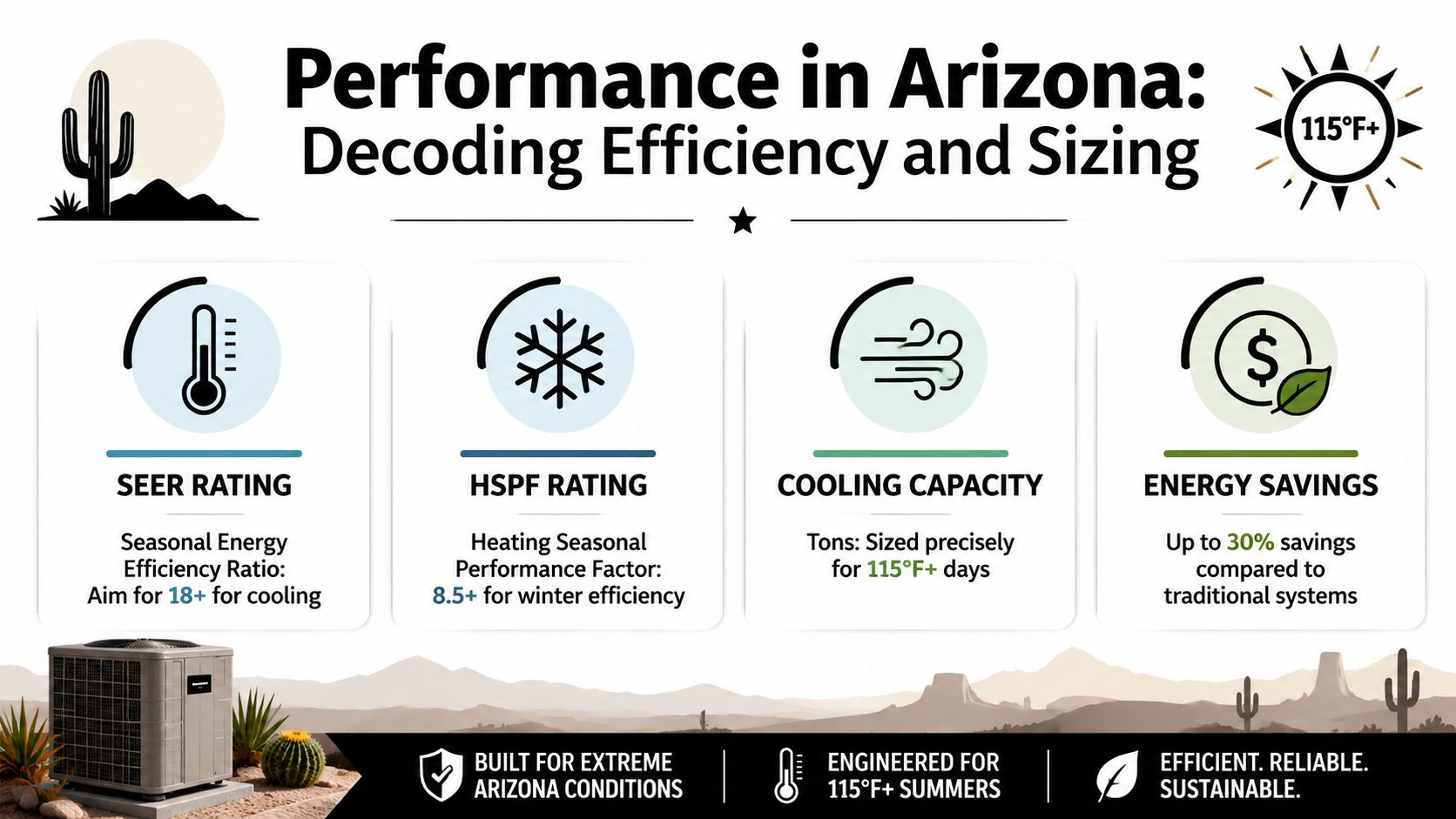
When you shop for equipment, you'll see ratings like SEER2, EER2, and HSPF2. Those labels are meant to describe cooling or heating efficiency under test conditions.
For a homeowner, the practical reading is simpler:
- SEER2 helps you compare seasonal cooling efficiency
- EER2 helps you think about performance during hotter operating conditions
- HSPF2 relates to heating efficiency over a season
Those numbers are useful for comparison, but they don't tell you how your house will feel by themselves. A high-efficiency unit installed on poor ductwork can still leave rooms uncomfortable.
This visual highlights the performance factors Arizona homeowners should pay attention to first:
Why sizing matters more than many people realize
A lot of homeowners assume bigger means safer. In HVAC, that can backfire.
An oversized system may cool a house too quickly near the thermostat and shut off before air is distributed evenly. A too-small system can run for long stretches and still struggle in peak conditions. Neither problem is solved by brand alone.
The right approach is load-based sizing. That means looking at the home itself:
- Square footage
- Insulation levels
- Window area and sun exposure
- Ceiling height
- Duct layout
- Air leakage
- Room-by-room heat gain
This is why a rule-of-thumb estimate is risky. If you want to understand what proper sizing involves, this breakdown of how to size an HVAC system is a useful starting point.
Duct design decides whether the system can deliver
In Arizona, ducts often run through harsh attic conditions. That matters. If the duct system leaks, is poorly insulated, or is undersized, the equipment can't deliver what the homeowner paid for.
Common duct-related problems include:
- Weak airflow to back rooms
- Hot and cold spots
- Noisy vents
- High static pressure
- Poor return air movement
Those issues aren't minor details. They shape whether the system feels calm and even or stressed and uneven.
A heat pump should be chosen as a complete home-comfort system, not as a box sitting outside. The outdoor unit, indoor unit, duct design, returns, and airflow all have to work together.
What Arizona homeowners should prioritize
If cooling performance is your top concern, focus on these decision points:
Accurate load calculation
Don't size by guesswork.Duct inspection or redesign if needed
Old duct systems often hold back new equipment.Airflow verification
Every room needs the right delivery and return path.Real discussion about how you use the house
Occupancy patterns matter. So do sun-heavy rooms and additions.
This is one area where Cobre Valley Air LLC's stated approach is relevant. The company notes that replacements include airflow and duct evaluations, and that new construction work includes load calculations, sizing, and airflow planning. Those are exactly the steps that matter when a homeowner wants a heat pump to perform well in Arizona conditions.
Keeping Your System Healthy Common Problems and Maintenance
Once a heat pump is installed, most homeowners don't think about it much until something feels off. That's normal. The problem is that small issues often show up first as comfort changes, not dramatic breakdowns.
You may notice one room getting stuffy, the outdoor unit sounding different, or the system taking longer to hit temperature. Those clues matter.
Common symptoms and what they often mean

Some problems are simple. Others need a technician with meters, gauges, and electrical diagnostic tools.
Here are a few issues homeowners run into:
Weak airflow from vents
A dirty filter is the first thing to check. If the filter is clean, the issue may involve the blower, duct restrictions, or a coil that needs service.System won't switch from cooling to heating, or back again
That can point to thermostat setup, control wiring, or a reversing valve problem.Outdoor unit covered in debris
Leaves, cottonwood fluff, dust, or overgrown plants can block airflow around the coil and make the system work harder.Uneven temperatures around the house
This may not be an equipment failure at all. Duct imbalance, blocked returns, or room-specific airflow issues are common causes.Ice or frost where it doesn't seem normal
That can mean airflow trouble, refrigerant issues, or a control problem. It's not something to ignore.
What you can handle yourself
A homeowner can do a lot to keep a heat pump running better between professional visits.
Change or clean the filter
Check it regularly, especially during heavy cooling season and dusty periods.Keep the outdoor unit clear
Maintain open space around it so air can move freely.Check vents and returns
Don't block them with furniture, rugs, or boxes.Watch for new noises
Rattling, buzzing, or repeated clicking should be noted early.Look at thermostat settings
Mode mistakes happen more often than people think, especially during seasonal changes.
For a practical routine, this HVAC maintenance checklist template gives homeowners a simple way to stay organized.
When to call a technician
Some signs deserve professional service right away:
- Breaker trips repeatedly
- The system runs but doesn't heat or cool properly
- You smell burning or notice electrical issues
- The unit short cycles
- Ice keeps coming back
- Airflow drops suddenly with no obvious filter problem
A technician can test voltage, capacitors, sensors, motors, control boards, refrigerant behavior, and airflow conditions. That's where precision matters. Replacing parts without diagnosing the root cause is how homeowners waste money.
If the symptom involves refrigerant, electrical components, or repeated shutdowns, it's time for service. Those aren't filter-level problems.
Maintenance protects more than the machine
Routine maintenance isn't only about preventing breakdowns. It also protects comfort. A clean coil, proper airflow, tight electrical connections, and a verified operating sequence all help the system do its job without strain.
For Arizona homes, seasonal dust and long cooling hours make that even more important. Heat pumps are dependable machines, but they still need basic care if you want steady performance when the weather turns extreme.
Is a Heat Pump Right for You Cost ROI and Making the Switch
A lot of homeowners start asking about heat pumps at the same moment. The AC is getting older, the summer electric bills are hard to ignore, and the house still has rooms that never seem to cool evenly in Globe or Miami.
That starting point makes sense. Replacing HVAC equipment is partly a budget decision, but it is also a comfort decision that affects the house every day.
When a switch makes sense
A heat pump deserves a close look if your current system is wearing out or your home needs both cooling and heating help at the same time. In Arizona, that often happens when an older air conditioner is still limping along through long summers and the winter heating setup is basic, expensive to run, or uneven from room to room.
A switch often makes sense in situations like these:
- Your current AC is close to replacement age
- You have separate heating and cooling equipment, and one system is failing
- A major repair is coming on an older unit
- You want one system to handle summer cooling and winter heating
- You are remodeling and already planning duct or airflow changes
For many homes, the bigger question is not "heat pump or not." It is whether the new system will fit the house.
That matters a lot in Arizona. A high-performance unit will still struggle if it is oversized, undersized, or connected to ductwork that cannot move air properly. Cobre Valley Air focuses heavily on sizing and duct design for that reason. Homeowners feel the difference in bedrooms, back additions, and other rooms that usually expose airflow problems first.
What affects the installed cost
Installed price depends on the full job, not just the outdoor unit. Two homes with similar square footage can land at very different price points if one needs duct repairs, electrical work, or a different indoor setup.
Common cost factors include:
- System capacity
- Efficiency tier
- Condition and size of the duct system
- Duct sealing or duct replacement needs
- Electrical upgrades
- Indoor air handler or coil configuration
- Thermostat and control compatibility
- Installation access
Here is a simple way to look at it. The equipment is the engine, but the ducts are the road. If the road is too narrow, full of leaks, or badly laid out, the trip still goes badly.
That is why a lower-priced quote is not always the lower-cost decision over time. If comfort problems are really airflow problems, replacing equipment alone may leave the same hot and cold spots in place.
Thinking in ROI instead of sticker price
Return on investment is broader than monthly energy savings. Homeowners usually feel the payoff in a few different ways at once.
A heat pump can improve the overall value of the upgrade by giving you:
- One system for heating and cooling
- Lower operating costs than less efficient electric heat in some homes
- More even comfort when the equipment and ducts are matched correctly
- A cleaner replacement path when older equipment is outdated
- Fewer compromises between summer cooling and winter heating
In Arizona, comfort ROI matters more than people expect. If your current system runs for long stretches, cools unevenly, or leaves parts of the home muggy, the benefit of a properly sized heat pump is not just efficiency on paper. It is a house that feels more stable during extreme weather.
Making the switch without guessing
The best replacement decisions usually come from a full evaluation, not from choosing a brand or tonnage off a price sheet. A contractor should look at the home's cooling load, heating needs, duct layout, airflow restrictions, insulation realities, and how the family uses the space.
That is especially important in older homes around Globe and Miami, where additions, aging ducts, and room-by-room comfort issues are common. A heat pump can be a very good fit here, but only if the design matches local conditions and the way the home is built.
Financing can also affect the timing of a replacement. The publisher states that financing is available through Wisetack and OPTIMUS, which may help homeowners choose a long-term equipment solution instead of paying for another temporary repair.
Your Next Step to Year-Round Comfort with Cobre Valley Air
By this point, the important part is clear. A heat pump isn't mysterious once you break it down. It's a system that moves heat, flips direction with the season, and can handle both cooling and heating in one setup.
What determines the result in your home isn't just the equipment nameplate. It's whether the system is sized correctly, whether the ducts can support it, and whether the airflow has been thought through room by room.
Match the next step to your situation
If your current system is acting up, the first need is diagnosis. Weak airflow, poor cooling, strange mode changes, and uneven comfort all need proper testing before anyone talks about replacement.
If you're replacing old equipment, the priority shifts. You need load calculations, equipment matching, duct review, and installation details that fit the house instead of relying on shortcuts.
If you already own a heat pump, maintenance matters. Filters, coils, electrical components, and airflow checks keep small issues from turning into larger service calls.
This snapshot of the company's service site gives a quick view of the types of HVAC support available:

What homeowners in Globe and nearby communities should keep in mind
The Arizona version of this decision is practical. You need cooling that holds up in long summer heat, heating that works on cold nights, and ductwork that delivers air where your family lives.
That means your next step should fit your current problem:
- Existing unit struggling means diagnostic service
- Old AC or furnace nearing replacement means full sizing and replacement planning
- New build or remodel means duct design and airflow planning from the start
- Current system working but aging means maintenance and inspection before peak season
When those pieces line up, a heat pump can be a very sensible comfort system for this area.
If you want help deciding whether a heat pump fits your home, or you need repair, replacement planning, duct evaluation, or maintenance, contact Cobre Valley Air LLC for a no-pressure conversation about your options.