



Spring in Globe or a windy week in Superior can turn a clean house into an allergy trap fast. Dust rides in on shoes, pollen slips through door gaps, and every time the air conditioner kicks on, you may wonder whether it's helping or just stirring everything back up. A lot of homeowners end up in the same spot. They're sneezing indoors, waking up congested, and shopping for the best air purifiers for allergies because they want one clear answer.
Portable air purifiers can absolutely help. They're one of the most practical first steps for a bedroom, nursery, home office, or living room where symptoms are worst. But after years of working around HVAC systems, ductwork, airflow problems, and indoor air quality complaints, I can tell you this much: the purifier itself is rarely the whole story. If the filter is wrong, the room size is mismatched, or the HVAC system is neglected, even a good unit won't deliver what the box seems to promise.
That's where people get frustrated. They buy a sleek machine, plug it in, and expect the house to feel different by the next morning. Sometimes it does. Often it helps one room and exposes a bigger issue everywhere else.
Your Home Should Be a Haven Not an Allergy Trigger
A lot of Arizona homeowners assume the problem is outside. That's only half right. Yes, outdoor dust and seasonal plant matter are constant irritants in our area, but modern homes also hold contaminants in once they get inside. Better sealing helps with cooling efficiency. It can also mean airborne particles linger longer if the home doesn't have the right filtration and ventilation strategy.
I've seen the pattern many times. A family starts with one room because that's where symptoms are most obvious. The main bedroom feels stuffy. A child wakes up with a dry throat. The den where the dog spends most of the day seems harder to keep clean. A portable purifier becomes the quick fix because it's easy to buy and easy to move.
That instinct makes sense.
A purifier is often the first useful step, not the final solution.
The catch is that allergy relief usually depends on more than one device. If return ducts are pulling dust from gaps, if the AC filter is overdue, or if the system's airflow is off, the house keeps feeding particles back into the air. That's why homeowners who want lasting improvement should think beyond the appliance aisle and look at the full indoor environment, including ways to reduce indoor air pollution throughout the home.
Why indoor air can keep bothering you
A house can look clean and still irritate sensitive lungs. Many allergy triggers are too fine to notice in sunlight or on furniture until they build up.
Common contributors include:
- Dust from daily living: Foot traffic, bedding, fabric furniture, and attic leakage all add particles to the air.
- Pet shedding and dander: Even well-groomed pets continuously contribute material that circulates through rooms.
- HVAC recirculation: Heating and cooling systems move air constantly. If filtration and maintenance aren't right, they can spread what's already inside.
- Moisture issues: Bathrooms, laundry areas, or hidden leaks can support conditions that make allergies worse.
What a purifier can and can't do
A portable purifier can clean the air in the room where it operates. That matters, especially at night when symptom relief can improve sleep. But it won't fix leaky ducts, dirty coils, pressure imbalances, or filtration problems at the central system.
That's why the best air purifiers for allergies should be chosen as part of a larger comfort strategy. Pick the right machine for the room. Then ask the harder question. Is the room the problem, or is the house feeding the room?
Decoding Air Purifier Technology for Allergy Relief
The air purifier market is packed with terms that sound impressive and don't always mean much in practice. If your goal is allergy relief, you need to separate core filtration from add-on features. The most important filter type is easy to identify once you know what matters.
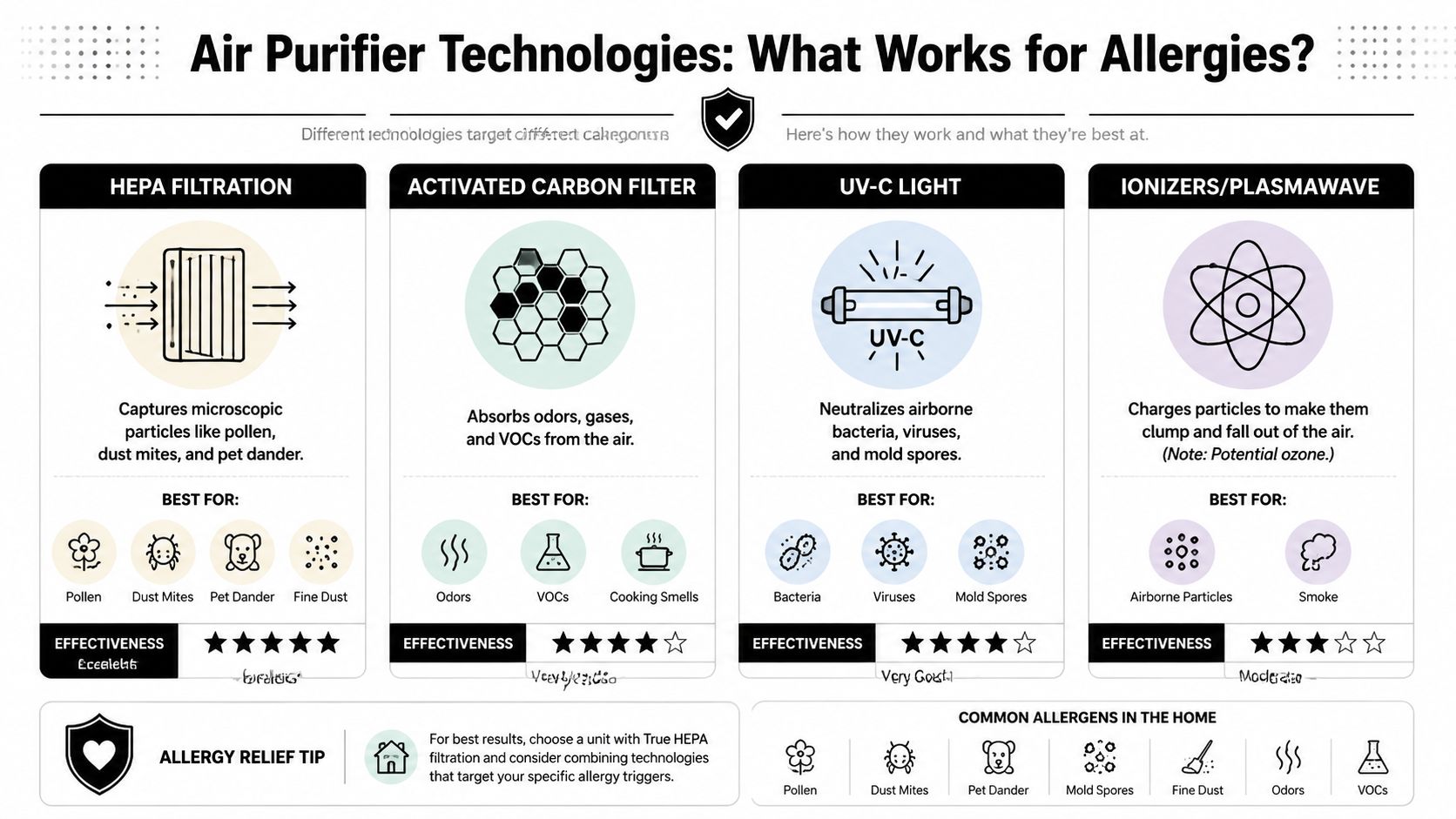
The strongest baseline for allergy shoppers is True HEPA. For this use case, that's the specification that deserves your attention first. True HEPA is specified to capture 99.97% of particles at 0.3 microns, which is why it's the most defensible starting point when comparing the best air purifiers for allergies, especially in bedrooms and living areas where continuous operation matters. Guidance tied to that same baseline also warns against undersizing the unit, because a purifier that can't keep up leaves allergen levels too high for meaningful symptom relief, as noted in this allergy-season air purifier guidance.
True HEPA is the main event
Think of a True HEPA purifier as the part of the machine that does the heavy lifting for pollen, dust, and pet-related particulates. For allergy sufferers, that's the feature worth paying for. Marketing language like “HEPA-type” or “HEPA-style” doesn't automatically mean the same thing.
What you want from the unit:
- A real True HEPA filter: This is the key feature for airborne particulate capture.
- Enough airflow for the room: A high-quality filter doesn't help if the unit is too weak for the space.
- Continuous operation: Allergy relief usually comes from steady cleaning, not occasional use.
If you're comparing models and one has app controls, colored lights, and voice integration while another has stronger filtration and better airflow, choose the one built around filtration.
Activated carbon helps, but for a different reason
Activated carbon is useful. It just solves a different problem. Carbon is there for odors, smoke, gases, and VOC-related concerns, not the core particulate load that usually drives allergy complaints.
That matters in Arizona homes where cooking smells, wildfire smoke drift, garage odors, and household chemical sensitivity can overlap with allergies. A purifier with both True HEPA and a meaningful carbon stage is more versatile than one that relies on particle capture alone.
Here's a simple explanation:
| Filter type | Best at handling | What it won't do well alone |
|---|---|---|
| True HEPA | Dust, pollen, pet dander, airborne particulates | Odors and gases |
| Activated carbon | Smells, smoke-related odors, VOCs | Fine particulate allergy control |
UV and ionizers need a reality check
Buyers often get pulled into feature creep. UV-C and ionizing technologies are often marketed as advanced upgrades. In some applications, they have a role. But for an allergy-focused purchase, they are not the first thing to prioritize.
UV-based features are generally discussed around microorganisms, not as the core answer for dust or pollen. Ionizers and similar technologies may cause particles to clump or settle, but that isn't the same as mechanically removing those particles through strong filtration. Some homeowners also prefer to avoid technologies that raise concerns about ozone production.
Practical rule: Buy for proven particle capture first. Treat extra technologies as secondary, not as a substitute for filtration.
What usually works better than marketing extras
For most homes, a solid purifier setup looks boring on paper. That's usually a good sign.
Focus on this short list:
- True HEPA first: If it isn't the filtration backbone, move on.
- Carbon second: Add it when odors, smoke, or chemical sensitivity are part of the problem.
- Simple maintenance access: If the filter is hard to reach, owners tend to delay service.
- Published room performance specs: You need usable sizing information, not vague “large room” claims.
Homeowners trying to sort through options often benefit from reviewing how air purifiers fit into indoor comfort planning. The big takeaway is simple. The best machine for allergies is usually not the one with the longest feature list. It's the one with real filtration, enough airflow, and a setup you'll maintain.
How to Match a Purifier to Your Room and Your Needs
The most common mistake isn't buying a cheap purifier. It's buying an undersized one. A unit can have a good filter and still disappoint if it can't move enough air through the room often enough.
That's where CADR and ACH matter. They sound technical, but they're useful once you tie them to your room.
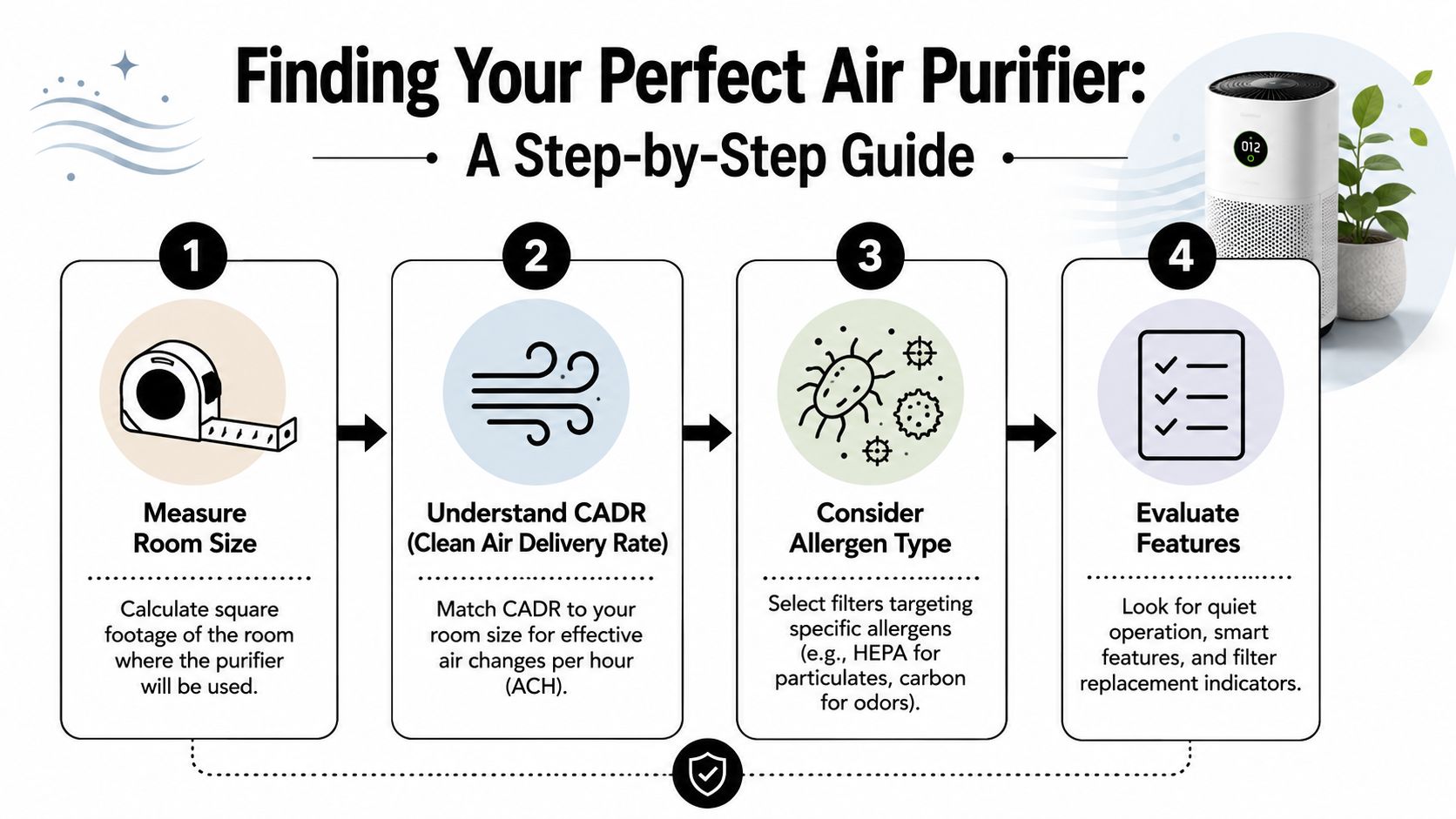
A key benchmark is air changes per hour, or ACH. Allergy guidance commonly recommends 3 to 4 ACH for symptom relief, meaning the purifier should process the room's air multiple times each hour. The practical workflow is to calculate room volume, match purifier output to that target, and verify that the unit is quiet enough for overnight use, as explained in this ACH-focused air purifier guide.
Start with room volume, not guesswork
Many people shop by label. Small room. Medium room. Large room. That isn't enough. Ceiling height, open doorways, and connected spaces all affect performance.
Use this approach:
- Measure the room length and width.
- Multiply them to get square footage.
- Account for ceiling height to estimate room volume.
- Compare the purifier's output to the room, aiming for the ACH target above.
A closed bedroom is easier to treat than a bedroom that opens into a hallway and bathroom with no doors shut at night. An open living room connected to the kitchen needs more performance than the floor dimensions alone might suggest.
CADR tells you whether the unit can keep up
CADR stands for Clean Air Delivery Rate. In plain terms, it helps you compare how much cleaned air a purifier can deliver. For allergy shoppers, this is one of the most useful specs because it gets closer to real operating performance than broad marketing language.
When I help people think through a purifier purchase, I tell them to treat CADR like horsepower. The number alone doesn't tell you everything, but it tells you a lot more than the paint color and the touchscreen.
Keep these points in mind:
- Higher CADR generally means better particle removal capacity
- Open layouts need more output than enclosed rooms
- Bedrooms need quiet performance, not just peak performance
- A purifier only works on the air it can pull through itself
Here's the trap. Some units list an impressive maximum room size, but they reach that rating under conditions that won't match typical allergy use. If your goal is symptom control, buy with margin instead of buying at the absolute edge of the spec.
A helpful visual can make the buying process easier:
A practical bedroom example
Take a typical primary bedroom in an Arizona home. You've got the sleeping area, maybe a dresser wall, maybe an attached bath, and often a ceiling fan circulating everything around at night. If allergy symptoms are strongest in that room, don't choose a purifier based only on daytime square footage. Think about the way you use the space.
A bedroom purifier should be able to run all night without becoming annoying. That means you need enough airflow at a tolerable sound level, not a unit that only performs on its loudest setting.
Don't buy a purifier that only works if you hate hearing it.
Match the machine to the problem
The best air purifiers for allergies aren't all built for the same household.
One home may need a bedroom unit focused on dust and pollen. Another may need a living room unit that combines particle capture with odor control because pets, cooking, or smoke are in the mix. A home office may need a compact, quieter model because the user is sitting next to it all day.
A smart buying checklist looks like this:
- Bedroom use: Prioritize low-noise operation and enough airflow for overnight cleaning.
- Pet-heavy spaces: Stick with strong particulate filtration and easy pre-filter cleaning.
- Odor concerns: Add meaningful carbon, not just a thin token layer.
- Open common areas: Size up rather than down.
If you're trying to choose between two models, ignore cosmetic features for a minute and ask one question. Which one can clean this room consistently, at a noise level I'll live with?
The Hidden Costs and Realities of Purifier Ownership
A purifier isn't a one-time purchase. It's an ongoing operating decision. That's where a lot of online roundups fall short. They compare list prices and skip the part that affects daily life: replacement filters, energy use, and noise.
Those three factors decide whether the unit stays in service or gets pushed into a corner after a few months.
Filters are the real ownership commitment
Every purifier depends on maintenance. Pre-filters collect larger debris. Main filters do the finer work. Carbon stages lose effectiveness over time. If replacement parts are expensive, unavailable, or difficult to install, the machine becomes less practical no matter how good it looked on day one.
Before buying, check:
- How often the manufacturer says filters need service
- Whether replacement filters are easy to find
- If third-party filters affect fit or performance
- How many filter stages the unit uses
A purifier with multiple stages may offer broader air treatment, but it also means more upkeep. Some homeowners are fine with that. Others do better with a simpler machine they're more likely to maintain correctly.
Energy use matters because allergy control is rarely part-time
For allergies, intermittent use usually isn't enough. Steady operation in the rooms where sufferers sleep or spend the most time generally offers more relief. That means the unit may run for long stretches every day, especially during dusty or high-pollen periods.
You don't need to overcomplicate the math. Just understand the trade-off. A more powerful unit that keeps up with the room may use more electricity than a weaker one. But a weaker one that never catches up is wasted power too.
What matters is value from operation:
| Ownership factor | What to look for | Common mistake |
|---|---|---|
| Filter upkeep | Easy access and clear schedule | Buying a unit with hard-to-find replacements |
| Power use | Efficient continuous operation | Running a too-small unit nonstop with poor results |
| Noise | Comfortable low-speed overnight use | Choosing based only on maximum performance |
Noise can ruin a good buying decision
This is one of the biggest real-world issues. A purifier may perform well on paper, but if it's too loud on the setting needed for useful cleaning, owners turn it down or shut it off. Then symptoms come back and the machine gets blamed.
Bedrooms are where this shows up first. Some people can sleep through a steady fan sound. Others can't. Home offices are another problem area. A purifier with an irritating motor tone or aggressive fan profile can become a distraction all day long.
A few practical observations help here:
- Listen for tone, not just volume: A smoother fan sound is easier to live with than a whiny motor.
- Assume overnight use matters: If the room is for sleeping, quiet operation isn't optional.
- Test realistic settings: The lowest speed may be nearly silent but not powerful enough to help much.
The best purifier is one that cleans the room well enough and stays on long enough to matter.
The total cost is more than the receipt
Shoppers often ask which purifier is “worth it.” The honest answer depends on how long you'll use it, where you'll run it, and whether it fits the room correctly. A lower-priced model can cost more over time if it needs frequent filter changes or if you end up buying two more units to cover the rest of the house.
That's why I tell homeowners to think in operating years, not just purchase day. A purifier is a tool. If it's easy to maintain, quiet enough to tolerate, and correctly sized, you're more likely to get real value from it.
Portable Purifiers vs Whole-Home IAQ Systems
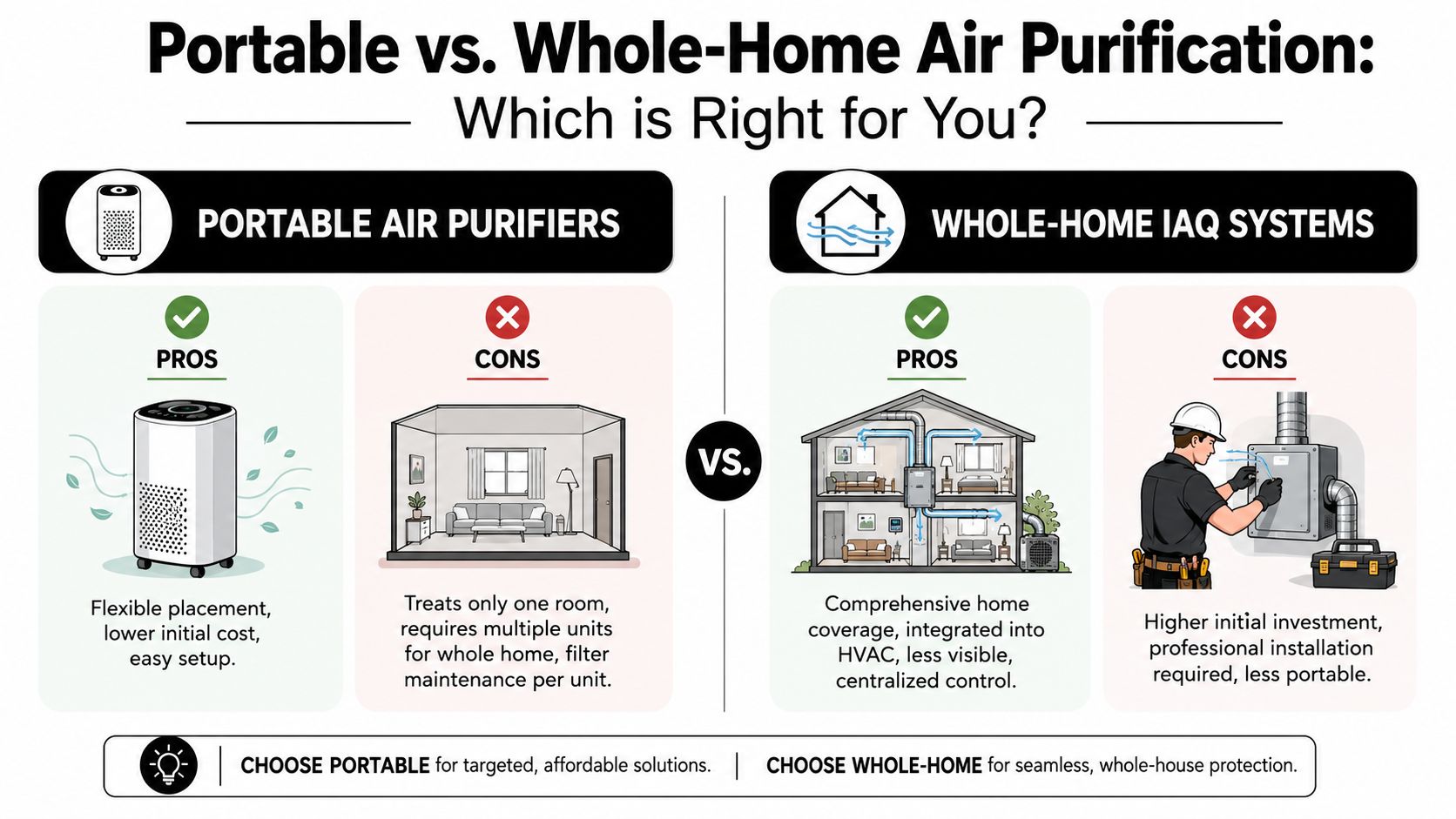
Portable purifiers are useful. I recommend them often for targeted areas, especially bedrooms and other rooms where symptoms hit hardest. But they solve a room problem. They don't solve a house problem.
That distinction matters when homeowners are trying to decide whether to keep adding portable units or step back and improve the entire system that moves air through the home every day.
Clinical evidence supports looking beyond the standalone appliance. In allergic respiratory disease research, interventions such as HVAC servicing with improved air filtration showed statistically significant symptom improvement with p < 0.05, and one study found air cleaning systems reduced particulate matter by 30% to 70% depending on conditions while the treatment group had a 26% reduction in morning symptoms after 10 weeks with p = 0.025. Some purifiers also carry Asthma & Allergy Friendly® certification for removing up to 99.9% of airborne allergens, as summarized in this clinical review and certification reference.
Where portable units make the most sense
A portable purifier is often the right call when symptoms are concentrated in one or two areas. If a child's bedroom is the priority, or if one family member works from home and needs relief in a specific office, a dedicated room unit is efficient and straightforward.
Portable purifiers are usually the better fit when:
- You need relief in one main room
- You rent and can't modify the central system
- You want a fast, low-commitment starting point
- You're testing whether localized filtration helps your symptoms
That flexibility is real. You can place the unit where it matters most and adjust as needed. The downside is coverage. One machine won't follow you from the bedroom to the living room to the hallway.
Where whole-home systems change the equation
A whole-home indoor air quality setup works through the HVAC system. Instead of cleaning only the air near one appliance, it treats the air circulating through the house. That can include upgraded media filtration, duct-mounted UV components, duct sealing, airflow corrections, and other measures chosen to fit the home.
If the problem is widespread, this approach is usually more rational than stacking multiple portable machines around the house.
Here's the side-by-side reality:
| Option | Best use case | Main limitation |
|---|---|---|
| Portable purifier | Single rooms and symptom hot spots | Limited coverage |
| Whole-home IAQ system | Housewide air treatment through HVAC | Requires system evaluation and installation |
Whole-home upgrades also force an important conversation that portable units can hide for a while. Is the home moving air correctly? Are the ducts sealed? Is the filter rack appropriate? Is the equipment being maintained well enough to support better air quality?
HVAC maintenance is part of allergy control
This is the piece most “best of” lists ignore. Air quality and HVAC performance are connected. If the central system is dirty, neglected, or poorly designed, portable units end up fighting the symptoms of a bigger airflow problem.
For homeowners who want broader solutions, whole-home indoor air quality services can include filtration upgrades, UV options, purifier installation, and duct-related corrections. Cobre Valley Air also installs IAQ solutions within larger HVAC service work where airflow, filtration, and system condition all need to be addressed together.
If the HVAC system is the lungs of the house, air quality upgrades work best when those lungs are clean, sealed, and moving air correctly.
Which investment makes sense for your home
The right answer depends on your goal.
Choose a portable purifier first if you want focused relief in a bedroom or office, need a simpler entry point, or aren't ready to modify the central system. Choose a broader HVAC-based approach when complaints are housewide, when multiple rooms need help, or when the home already has signs of airflow and dust distribution problems.
A practical rule of thumb:
- One room problem: Start portable.
- Whole house frustration: Evaluate the HVAC system.
- Recurring dust and uneven comfort: Look at ducts, filtration, and equipment condition together.
This isn't an either-or decision forever. Many homes benefit from both. A whole-home system handles the baseline. A portable purifier adds extra support where a sensitive sleeper or allergy-prone family member needs it most.
Building Your Ultimate Home Allergy Defense Strategy
The best air purifiers for allergies are part of a system, not a miracle purchase. If you want better results, treat allergy control the same way you'd treat heating and cooling performance. Start with the room symptoms you can feel, then trace them back to the equipment and airflow conditions causing them.
A smart home allergy strategy begins with habits, then moves to equipment.
Get the portable basics right
A good purifier can underperform because of placement alone. Shoving it behind furniture, pinning it against a wall, or placing it where doors stay open all day reduces what it can pull in and clean.
Use a portable unit more effectively by doing the simple things well:
- Place it with breathing room: Keep intake and discharge areas clear.
- Run it where people spend time: Bedrooms usually come first.
- Keep windows and exterior doors closed during heavy dust periods: Open-house habits can overwhelm any purifier.
- Stay on top of filter service: Delayed maintenance weakens performance.
These aren't glamorous steps, but they matter.
Fix the house, not just the symptom
If the home always seems dusty, if one room never feels fresh, or if filters clog faster than expected, the purifier may be compensating for central HVAC issues. That's where long-term relief usually comes from inspection and correction.
A solid whole-home plan often includes:
- AC maintenance that keeps airflow components, coils, and filtration paths in working order.
- Heating system checks for homes using furnaces or heat pumps during cooler months.
- Duct inspection and design review to identify leakage, poor returns, or airflow imbalance.
- Filtration and IAQ upgrades matched to how the home operates.
This is especially important in Arizona, where cooling systems run hard and duct leakage or poor filter fit can keep circulating fine dust through living spaces.
Don't ignore airflow and ductwork
Homeowners often focus on what they can buy online. The bigger gains sometimes come from what they can't see. Return-side leaks, undersized ducts, poor filter rack sealing, and neglected maintenance all affect how much particulate matter moves through the house.
That's why a comfort strategy should look at:
- Airflow balance: Rooms should receive and return air properly.
- Duct condition: Leaks can pull dust from undesirable spaces.
- Filter fit: Even a good filter performs poorly if air bypasses it.
- System sizing and runtime: Short cycling and poor air movement can hurt overall comfort and air cleaning potential.
A house with strong central airflow design and clean filtration gives any additional purifier a better chance to succeed.
Build layers that work together
The homeowners who get the best results usually stop searching for one product and start building layers.
One layer is room-level purification. Another is routine HVAC maintenance. Another is duct integrity. Another is a filtration upgrade at the central system. Put those together and the home gets more predictable. Dust settles less aggressively. Bedrooms feel cleaner. The AC system supports the air quality plan instead of fighting it.
Good allergy control comes from combining source control, filtration, airflow, and maintenance.
For some households, a portable purifier in the bedroom is enough. For others, especially those dealing with persistent dust, pet load, or uneven airflow, the next step should be a professional indoor air quality assessment. That kind of visit should look at the whole picture: how the system is maintained, whether the ducts are performing correctly, and whether a whole-home purifier, UV component, or duct sealing upgrade makes practical sense.
The long-term goal isn't just cleaner air on a spec sheet. It's a home that feels calmer, sleeps better, and stops triggering symptoms every time the system runs.
If you're weighing portable units against bigger HVAC and air quality upgrades, Cobre Valley Air LLC can assess the full system, including airflow, duct condition, filtration, AC maintenance needs, and whole-home IAQ options, so you can choose a solution that fits the house instead of guessing from product packaging alone.