


A deferred rooftop unit startup can turn into a mid-summer compressor failure fast. One maintenance guide reports that 68% of compressor failures occur during the first 30 days of cooling season when preseason preventive maintenance is deferred. In Arizona, where rooftop equipment works through intense heat, dust, and long cooling periods, that failure pattern deserves immediate attention, not a calendar reminder after the season has already started.
Rooftop unit maintenance isn't just filter replacement. It includes electrical testing, refrigerant diagnostics, coil care, economizer operation, condensate management, duct design, and airflow verification. It also requires a clear decision about whether an aging unit deserves another repair or belongs on a replacement plan.
Why Rooftop Unit Maintenance Matters in Arizona
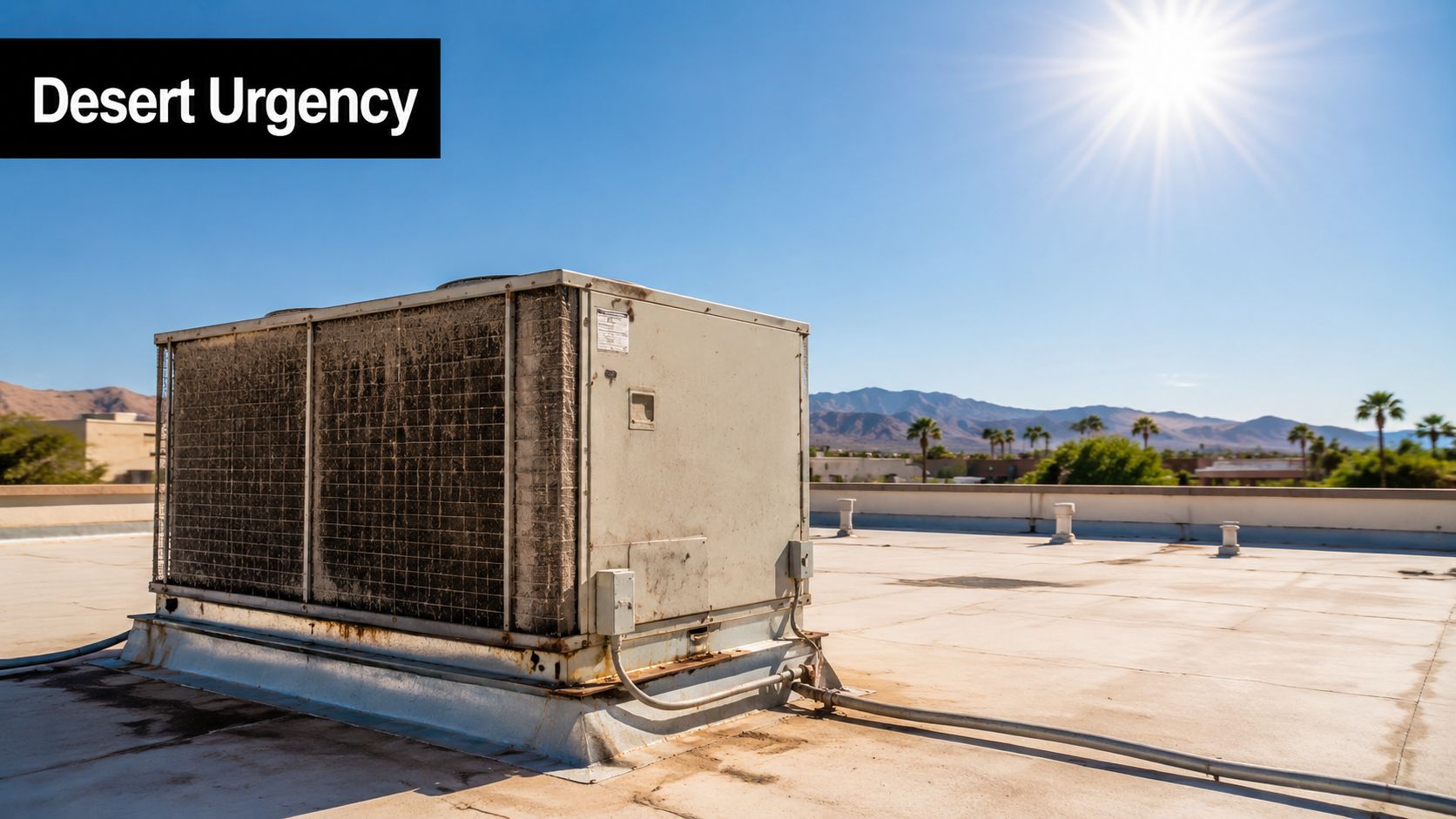
Arizona rooftops are hostile equipment environments. Direct sun heats the cabinet, airborne dust loads filters and coils, and extended cooling demand keeps compressors, blower motors, capacitors, and controls under sustained stress. A unit can still deliver cool air while operating inefficiently, until a dirty coil, weak capacitor, restricted filter, or low refrigerant charge pushes it past its limit.
The first failure often begins before occupants notice a comfort problem. A loaded filter reduces airflow. Restricted airflow changes coil conditions and makes the compressor work under abnormal operating conditions. That's why preseason inspection matters. The NREL Rooftop Unit Maintenance Guide treats recurring preventive tasks, including cleaning or replacing filters, as a core part of RTU care.
The cost of letting an RTU coast
Older, inefficient commercial rooftop units can waste about $1,000 to $3,700 per unit each year, depending on building size and type, according to estimates cited by the U.S. Department of Energy in the New Buildings Institute RTU primer. That waste doesn't come from one dramatic defect. It usually builds through fouled heat-transfer surfaces, poor airflow, deteriorated controls, leaking ducts, and equipment that never receives a proper performance check.
The same primer reports that advanced control retrofits can deliver energy savings of up to 35% and cost savings of up to 38%. Those figures don't mean every Arizona building will achieve the maximum result. They do show that maintenance, controls, and tune-ups can affect operating costs materially.
Desert maintenance needs a measured approach
A standard seasonal visit may be inadequate for a dusty warehouse, busy restaurant, or building that runs continuously. Hospitals, data centers, and 24/7 retail facilities need more frequent filter checks and coil cleaning, while standard commercial RTUs should be inspected at least quarterly. Dusty or high-load properties may also need quarterly visits even when a general plan calls for semiannual service.
Field rule: If the roof environment is dusty, the building runs hard, or comfort complaints appear between scheduled visits, increase inspection frequency instead of waiting for the next generic service date.
Good maintenance protects more than comfort. It supports indoor air quality, prevents avoidable electrical and mechanical damage, and gives the owner usable trend information for repair and replacement decisions.
Safety Preparations and Code Considerations
A rooftop service call starts before the technician touches the unit. The roof itself presents fall, heat, access, and surface hazards. Add energized electrical equipment, rotating components, refrigerant pressure, and gas-fired heating sections, and casual inspection becomes a poor risk calculation.
Secure the work area first
Verify safe roof access, identify the unit and its service disconnect, and keep unauthorized people away from the work zone. A technician should assess roof edges, access paths, ladders, fragile surfaces, wet areas, and conditions that could make footing unreliable. Hot roof membranes can also affect tools, gloves, and exposed skin, so appropriate protective equipment and hydration planning matter in Arizona.
Lockout/tagout must happen before opening panels or working on energized components. The technician should isolate the equipment, apply the required lock and tag, verify that power is absent with an appropriate meter, and account for stored electrical energy. A disconnect that appears open isn't a substitute for verification.
Treat electrical and refrigerant work as professional tasks
Rooftop units contain capacitors that can retain a charge after disconnecting power. Contactors, compressors, fan motors, and control boards can fail dangerously when someone guesses instead of testing. Refrigerant circuits also require proper recovery, measurement, leak diagnosis, and documentation.
Code compliance belongs in the planning conversation, especially for commercial properties, restaurants, replacement work, gas heat, electrical modifications, curb changes, and new installations. Permit requirements can vary by jurisdiction and project scope across Arizona, so the property owner should confirm requirements with the local authority having jurisdiction and the contractor before work begins.
A code-compliant installation also depends on correct equipment selection and airflow. Permits and inspections aren't paperwork detached from performance. They help verify that electrical, structural, combustion, ventilation, and mechanical work receives appropriate review.
Document before and after
Record the unit model, serial number, refrigerant type, nameplate voltage, existing defects, and any safety concerns before service. Afterward, retain readings, parts replaced, repairs recommended, and unresolved risks. This record helps the next technician work safely and helps the owner distinguish a manageable repair from a deteriorating system.
Complete Rooftop Unit Maintenance Checklist
A useful checklist is a living document. It should reflect runtime, occupancy, dust, outdoor-air exposure, cooking loads, and the consequences of downtime. A restaurant rooftop unit and a lightly occupied office unit shouldn't automatically receive identical service intervals.
Start with a consistent inspection sequence
The technician should verify roof access and lockout/tagout, then record nameplate data before testing the equipment. The structured RTU maintenance workflow recommends checking electrical supply within ±10% of rated voltage, inspecting capacitor tolerance against the nameplate, checking refrigerant pressures with subcooling and superheat, measuring filter pressure drop, examining coil fouling, and confirming full-stroke economizer damper operation.
Use the following schedule as a practical starting point:
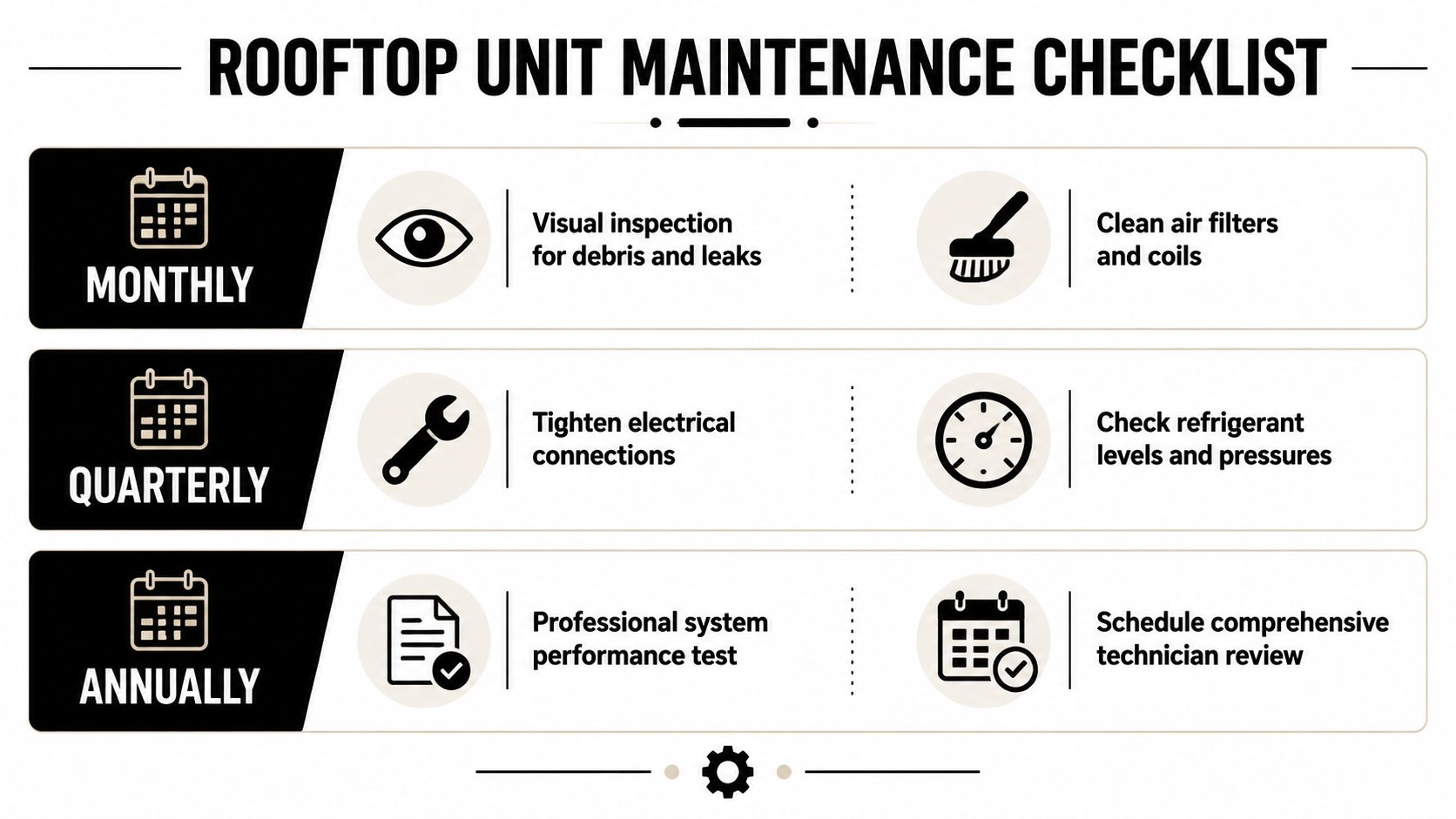
- Monthly checks: Inspect filters, filter fit, visible coil condition, cabinet damage, drain areas, unusual sounds, leaks, and debris around the unit. Check thermostat or building automation alarms and record operating complaints.
- Quarterly service: Inspect standard commercial RTUs at least quarterly. Check electrical connections, belts, blower operation, refrigerant readings, filter pressure drop, condensate drainage, coil condition, and economizer movement.
- Seasonal preparation: Before the main cooling period, clean condenser coils, verify refrigerant circuit performance, test capacitors, inspect belts, check controls, and confirm that the unit can move design airflow. Before heating demand, inspect the furnace section, heat exchanger, ignition components, and combustion safety.
- Annual deep service: Complete a professional performance review, deep-clean accessible coils, inspect cabinet and curb seals, evaluate duct connections, confirm drain performance, and compare readings with earlier records.
A dirty filter should be replaced at the established pressure threshold. One industry checklist uses 0.5 inches water gauge as a filter pressure-drop trigger, as described in the seasonal RTU maintenance checklist. Don't wait for a filter to look completely blocked if measured pressure has already reached the service limit.
Adjust the frequency to the building
| Facility Type | Filter Inspection | Coil Cleaning | Full Service |
|---|---|---|---|
| Hospital | Monthly | Monthly or based on measured fouling | Quarterly and before major demand periods |
| Data center | Monthly or more often based on conditions | Monthly or based on measured fouling | Quarterly with documented performance review |
| 24/7 retail | Monthly | Monthly or based on dust and load | Quarterly |
| Restaurant | Frequent visual checks and scheduled replacement | Based on grease, dust, and outdoor conditions | Quarterly or more often when conditions require |
| Standard commercial building | At least quarterly | Based on fouling and environment | At least quarterly |
| Dusty or high-load facility | Monthly checks with quarterly service as a practical baseline | Quarterly or condition-based | Quarterly |
Use the HVAC maintenance checklist template to document unit identification, readings, filter condition, repairs, and follow-up dates.
The video below can supplement a written checklist, but it doesn't replace lockout/tagout, measured diagnostics, or code-compliant service.
Documentation is where many maintenance programs fail. Record voltage, capacitor condition, pressure readings, superheat, subcooling, filter pressure drop, temperature complaints, economizer position, and repair recommendations. Trends reveal deterioration earlier than a single visual inspection.
DIY Maintenance and When to Call a Licensed Professional
Property managers can handle a limited set of rooftop tasks. Keep the boundary clear: routine observation and filter service are reasonable, while electrical, refrigerant, and component repairs require qualified service.
Reasonable owner-level work
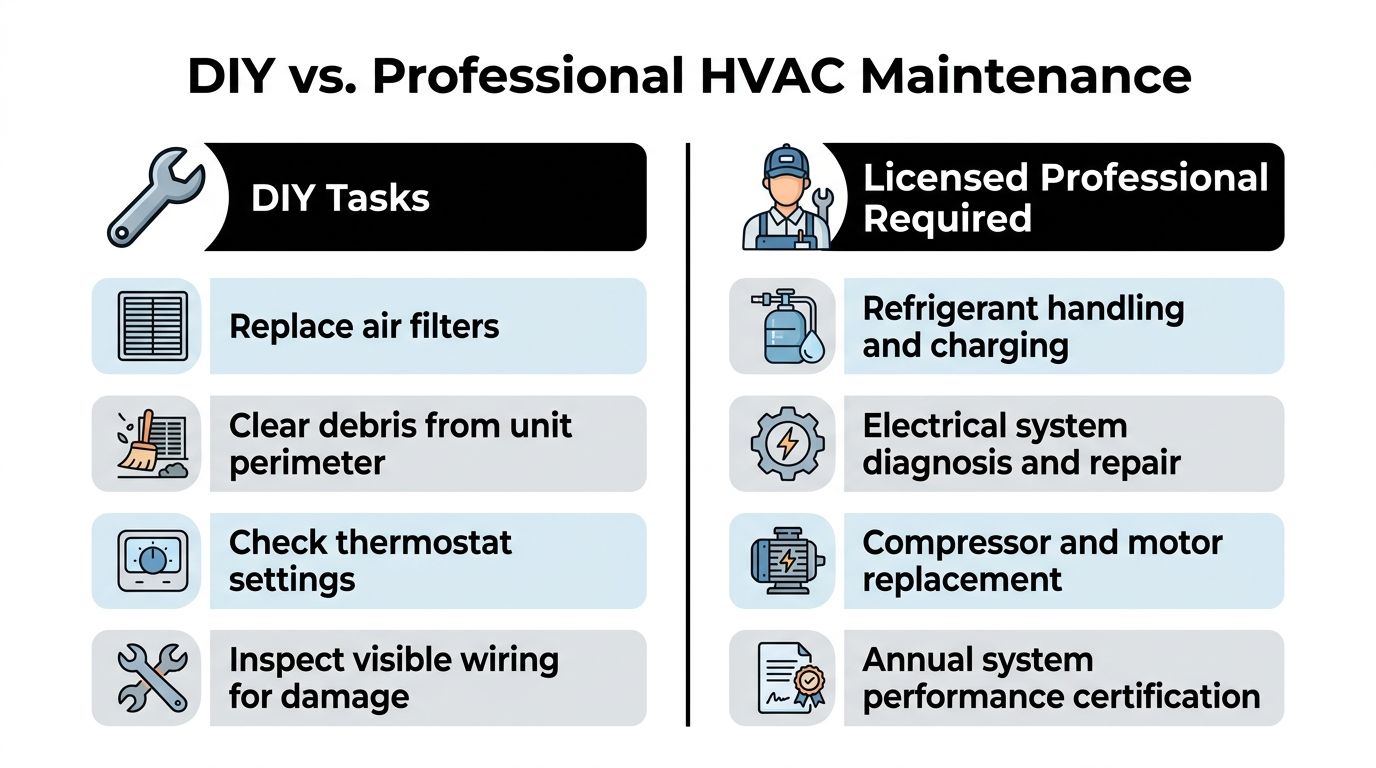
Replace filters only when the correct size, rating, airflow direction, and access procedure are known. Owners can remove leaves and trash from the unit perimeter, check visible cabinet damage, confirm thermostat settings, and look for standing water near accessible drain areas. Perform visual checks with panels closed. Leave power on only when no component access is needed.
The EPA ventilation checklist directs technicians to verify proper filter fit and airflow orientation. A loose or reversed filter lets air bypass the media, reducing filtration and increasing coil contamination. In Arizona dust, that airflow bypass can turn a manageable maintenance issue into restricted airflow and added compressor strain.
Stop before the work becomes hazardous
Refrigerant charging, recovery, leak testing, capacitor replacement, compressor-circuit work, control-board diagnosis, motor replacement, and electrical troubleshooting belong with a qualified professional. Adding refrigerant is not a harmless top-off. A low charge usually points to a leak or another fault, and incorrect handling can damage the unit, create safety hazards, violate EPA Section 608 requirements, and complicate warranty coverage.
A professional visit should include measured electrical checks, refrigerant diagnostics, airflow evaluation, coil and filter inspection, economizer testing, drain review, and written findings. Use this guide to learn more about licensed HVAC technicians, then ask for license information, insurance, relevant commercial experience, permit procedures, and a clear explanation of whether the recommendation is repair, monitoring, or replacement.
A good contractor doesn't just say that a unit is low on refrigerant. They explain why, show the measured condition, and identify the repair path.
Service agreements make sense for restaurants, property managers, and facilities where an unexpected shutdown affects tenants, inventory, or operations. Require the agreement to state visit frequency, included tasks, documentation, emergency response terms, and the process for approving repairs. As older 2000-2010 rooftop fleets approach replacement, good records also help separate a repair worth making from a unit nearing a refrigerant or equipment transition.
Common Rooftop Unit Problems and Practical Fixes
Start with the simplest cause, then move toward measured diagnosis. A warm building doesn't automatically mean a failed compressor, and a noisy unit doesn't automatically need replacement.
Match the symptom to the first inspection
Weak airflow usually warrants a filter fit and pressure-drop check first. Inspect filter orientation, blower operation, belt condition where applicable, blocked grilles, closed dampers, and duct restrictions. ASHRAE-based guidance says duct leakage belongs in design air quantities, and balancing dampers should be included in the system layout, not added as an afterthought. The ASHRAE duct-system design guide supports treating airflow planning as a mechanical design task.
Noisy operation can point to a loose panel, worn belt, failing bearing, damaged fan wheel, or electrical component cycling abnormally. Shut the unit down if the sound suggests mechanical contact, burning insulation, or repeated hard starts.
Poor cooling requires checking airflow, coil fouling, outdoor conditions, refrigerant pressures, superheat, subcooling, capacitor performance, and compressor operation. Don't authorize a refrigerant charge based only on a sight glass or a complaint of warm air.
Unusual odors may come from dirty filters, wet insulation, drain problems, biological growth, or electrical overheating. Burning smells require immediate shutdown and professional diagnosis.
| Problem | Likely Cause | Recommended Action |
|---|---|---|
| Weak or uneven airflow | Loaded filter, bypass, duct leakage, restricted damper, blower issue | Check filter fit and pressure drop, then test airflow and duct performance |
| Warm supply air | Fouled coil, low charge, capacitor problem, economizer fault | Inspect airflow first, then use measured electrical and refrigerant diagnostics |
| Loud condenser | Loose panel, fan issue, bearing wear, debris | Shut down for unsafe noise and schedule mechanical inspection |
| Water near the unit | Blocked drain, damaged pan, poor slope, condensate issue | Clear only accessible debris; use professional service for persistent drainage |
| Stale or burning odor | Filter, moisture, contamination, or electrical fault | Replace an accessible filter, but shut down for electrical odor |
| Outdoor air damper not moving | Failed actuator, linkage, control signal, or obstruction | Confirm full-stroke operation and have controls diagnosed |
Duct design can also create chronic stress. The NREL air-distribution guidance states that total duct pressure drop must match the equipment's available static pressure. If the system resistance exceeds available static pressure, airflow falls even when the rooftop unit itself appears operational.
Recognizing When Replacement Makes More Sense
Maintenance should preserve a sound asset, not disguise an asset that has reached the end of its useful economic life. Replacement becomes the stronger choice when repairs recur, efficiency keeps declining, major components deteriorate, and the unit can't reliably meet the building's load after proper diagnosis.
A current replacement decision also has a fleet-planning dimension. Industry coverage identifies tens of thousands of commercial rooftop units installed between 2000 and 2010 as reaching or passing a 15 to 20 year design life, while delayed replacement, degraded efficiency, and the R-410A refrigerant transition are converging into a projected replacement wave in 2026. See the 2026 HVAC maintenance and operations outlook for that industry projection.
Use maintenance records as capital-planning evidence
Review the unit's repair history, measured performance, recurring fault types, refrigerant concerns, cabinet and curb condition, and ability to maintain comfort during peak demand. A compressor replacement may be reasonable on a well-maintained unit with a sound heat exchanger, cabinet, duct system, and controls. Repeated repairs across several subsystems point to a different conclusion.
Don't choose new equipment by tonnage alone. A replacement assessment should include load calculations, electrical capacity, curb compatibility, controls, refrigerant strategy, duct condition, static pressure, and delivered airflow. ASHRAE duct design guidance requires pressure-loss calculations and fan selection as a matched process, with recalculation when routing or fittings change. That makes duct evaluation essential during replacement planning.
Plan early enough to compare repair, replacement, and phased fleet options. A rushed rooftop replacement limits equipment choices and can force the building to absorb avoidable downtime.
Keep Your Rooftop Unit Running Efficiently
Reliable rooftop unit maintenance combines clean heat-transfer surfaces, correct filters, sound electrical components, verified refrigerant performance, working economizers, and documented airflow. It also includes the ducts. A unit can be mechanically healthy and still underperform if duct leakage, excessive pressure drop, poor balancing, or improper sizing prevents design airflow from reaching occupied spaces.
The same principle applies to AC repairs, AC installation, heat pumps, furnaces, and new construction HVAC. Good equipment selection won't compensate for poor airflow planning. During a replacement or installation, require load calculations, proper sizing, duct inspection, and static-pressure verification before approving the final setup.
Commercial owners and restaurant managers can use a commercial HVAC preventive maintenance plan to organize recurring service, while homeowners and builders should request the same discipline during equipment replacement or new construction.
If you're managing a rooftop fleet, operating a restaurant, or planning HVAC work in Globe, Miami, Superior, and nearby Arizona communities, schedule a documented inspection before the next period of extreme demand. Ask the technician to evaluate the unit, ducts, airflow, controls, and replacement outlook together.
Cobre Valley Air LLC provides rooftop unit maintenance, quality AC repairs, code-compliant AC installation, duct design and airflow evaluations, heat pump and furnace service, and new-construction HVAC planning for Arizona homes and businesses. Visit Cobre Valley Air LLC to request practical guidance for keeping your equipment reliable, efficient, and ready for the desert heat.