


Americans spend approximately 90% of their time indoors, and concentrations of some pollutants indoors are often 2 to 5 times higher than typical outdoor levels, according to the EPA's indoor air quality report. That catches a lot of homeowners off guard. It's often assumed that bad air is an outdoor problem, but the air inside the house often deserves the closer look.
In Arizona, that matters even more because your HVAC system runs hard for long stretches. If you've got rooms that stay dusty, stale odors that won't leave, allergy flare-ups at home, or one part of the house that never feels quite right, those aren't always “just part of living in the desert.” They can be signs that the house isn't moving, filtering, or diluting air the way it should.
A real answer starts with indoor air quality testing. But the test alone isn't the finish line. The useful part is connecting what shows up in the report to airflow, duct design, equipment sizing, air conditioning repairs, AC installation, AC maintenance, heat pumps, furnaces, and the way the whole system operates.
Why Your Home's Air Might Be Unhealthier Than You Think
A house can smell fine, look clean, and still circulate air that irritates your eyes, dries your throat, and keeps dust moving room to room. I see that in Arizona homes all the time. The problem is rarely one surface issue. It is usually a whole-house airflow issue tied to filtration, return air, duct leakage, pressure balance, or equipment operation.
That matters because many indoor air complaints start with symptoms homeowners can feel, but cannot easily trace. A bedroom stays stuffy. The house gets dusty again right after cleaning. Odors hang around too long. Someone feels better after leaving for work, then worse again at home that evening. Those patterns point to air quality problems, but they do not tell you whether the root cause is particles, chemical exposure, moisture, poor ventilation, or an HVAC system that is not moving air the way it should.

Common warning signs homeowners miss
Arizona homeowners often describe a familiar set of problems:
- Morning irritation: You wake up congested, dry-throated, or with irritated eyes, then feel better after spending time away from the house.
- Persistent dust: You change filters and clean regularly, but dust keeps settling fast on furniture and vents.
- Uneven comfort: One room feels stale or stuffy while another gets too much air, which often points to duct or return-air problems.
- Lingering odors: Cooking smells, pet odors, or musty smells stay trapped longer than they should.
One symptom by itself does not confirm the cause. Several of them together usually mean the house needs testing and a mechanical evaluation, not another guess from the hardware store.
Why testing matters more than guessing
Testing helps identify what is in the air. The part many companies skip is connecting those results to the system that moves that air through the home.
That diagnostic-to-remediation gap is where homeowners waste money.
A test may show high particulates, increased biological material, or signs of poor ventilation. If nobody checks static pressure, filter fit, blower performance, duct leakage, return design, and where the system is pulling air from, the report does not solve much. You end up with a number on paper and the same air problem a month later.
In Arizona, that gap shows up fast because cooling systems run long hours and ductwork often sits in harsh attic conditions. Leaky ducts can pull in dust. Poor return airflow can leave bedrooms stagnant. An oversized or short-cycling system can hurt filtration and humidity control inside the house, even in a dry climate. Real improvement comes from matching the test findings to HVAC corrections.
For homeowners who want practical habits that help day to day, this guide on how to reduce indoor air pollution is a good starting point. Lasting results usually require more than habits alone. They require checking how the equipment and duct system are handling the air in your home.
What's Really in the Air You Breathe
Indoor air quality testing looks for patterns, not just one bad reading. In homes, contaminants usually fall into three groups: particulate, chemical, and biological. Each behaves differently, and each points to different corrective work.
Particulate, chemical, and biological pollutants
Particulates are the solids and droplets floating in the air. That includes ordinary dust, pet dander, and fine airborne particles. These can aggravate breathing problems, settle into ductwork, and recirculate when filtration or airflow is weak.
Chemical pollutants include gases and vapors released from materials or household products. Paints, cleaners, furnishings, adhesives, and some building materials can all contribute. These are the pollutants that often produce headaches, throat irritation, or that “new house” or “chemical” smell that doesn't seem to go away.
Biological pollutants come from living sources or organic growth. Mold spores, bacteria, and other biological material often show up where moisture, poor airflow, or dirty components create the right conditions.
Here's a practical breakdown.
Common Indoor Contaminants and Their Sources
| Contaminant Type | Examples | Common Sources | Health Effects |
|---|---|---|---|
| Particulate | Dust, pet dander, fine particles | Dirty return air paths, leaky ducts, carpets, pets, outdoor dust pulled indoors | Irritated eyes, sneezing, coughing, asthma aggravation, respiratory irritation |
| Chemical | VOCs, formaldehyde, combustion byproducts | Paints, cleaners, furniture, cabinetry, attached garages, fuel-burning appliances | Headaches, throat irritation, odors, discomfort, longer-term concern depending on pollutant |
| Biological | Mold spores, bacteria, other organic contaminants | Wet coils, drain issues, damp insulation, hidden leaks, poorly ventilated rooms | Allergy symptoms, respiratory irritation, musty odors, health concerns for sensitive occupants |
What a contaminant list doesn't tell you on its own
A table helps identify likely suspects, but it doesn't tell you why they're lingering. That's where homeowners often get stuck. Dust might mean poor filtration, but it can also mean duct leakage, bad return placement, or an oversized system that doesn't run long enough to manage the air properly. A musty smell might point to mold, but it can also point to an evaporator coil, insulation, or a dead-air zone in the duct layout.
A pollutant reading without a building and HVAC interpretation is only half a diagnosis.
That's why experienced techs don't just ask, “What's in the air?” We ask where it's coming from, how it's moving, and why the system isn't controlling it. In homes with heat pumps, furnaces, or newer AC systems, the answer often sits in the relationship between equipment, duct design, filtration, and room-by-room delivery.
The Professional's Toolkit for IAQ Diagnostics
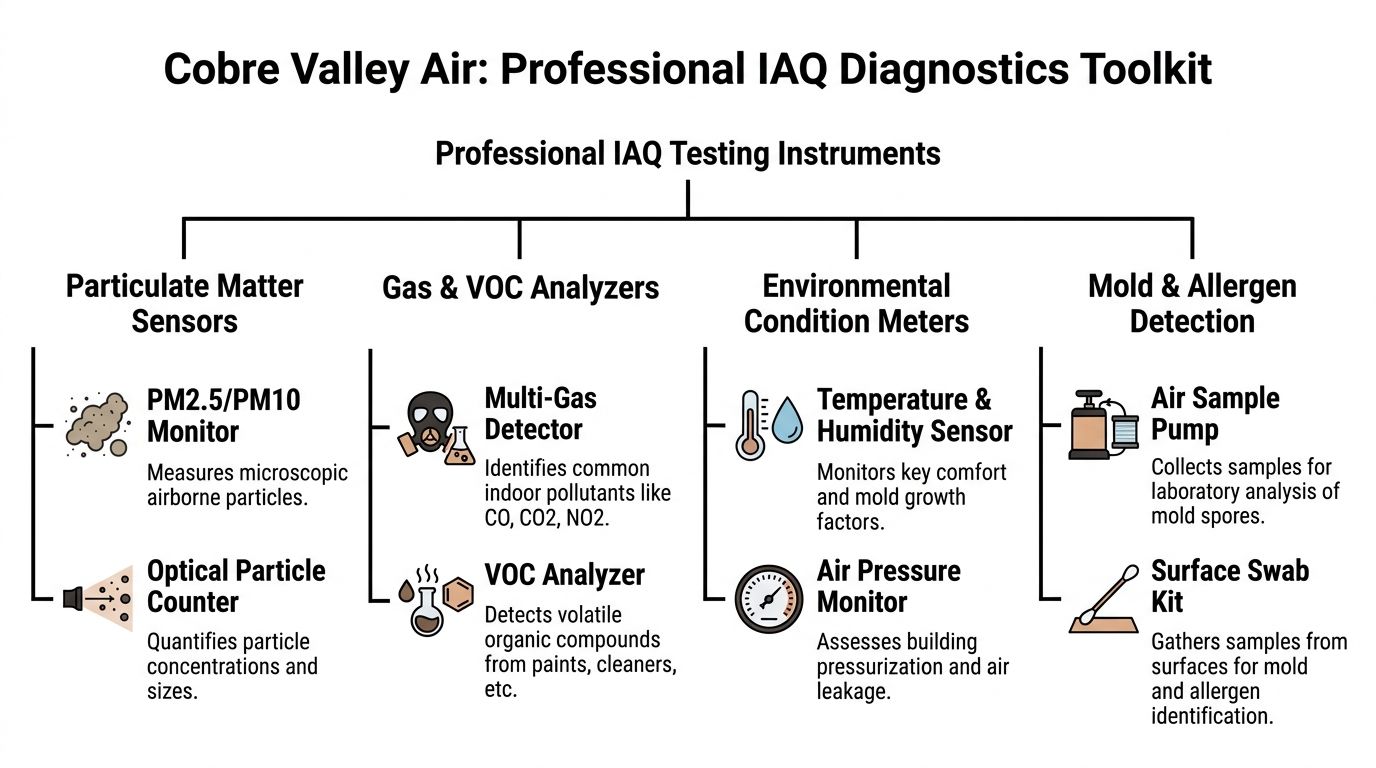
A real indoor air quality test isn't a single handheld reading taken in the middle of the living room. It's a set of measurements that builds a reliable picture of the house. That means using different tools for different problems and tying those readings back to HVAC operation.
Instruments that reveal what the house is doing
Professional testing often includes tools such as:
- Particle counters: These help identify airborne particle levels and can show whether the house has a dust problem, a filtration problem, or both.
- VOC analyzers: These are used when chemical odors, new materials, cleaners, or off-gassing are part of the complaint.
- Carbon monoxide and combustion testing tools: These are critical when gas appliances, attached garages, or combustion concerns are involved.
- Moisture meters and infrared cameras: These help track hidden dampness behind walls, near supply boots, around coils, or anywhere mold conditions may develop.
- Air sampling pumps and collection media: These gather samples for situations where mold or biological contamination needs deeper analysis.
Each tool answers a different question. The job isn't just collecting numbers. The job is determining what those numbers mean in that particular home.
Ventilation data matters
One of the most useful indicators in a home is carbon dioxide as a ventilation clue. Advanced protocols use the Ventilation Rate Procedure to calculate the forced air supply needed to maintain acceptable CO₂ levels, and levels in the 400 to 800 ppm range are treated as the target band in the Spacewell overview of indoor air quality measurement. When levels rise above that range, it often points to inadequate dilution of indoor air.
That doesn't automatically mean a bad sensor reading or a bad filter. It can mean the home isn't bringing in or distributing fresh air effectively. In practice, that sends a technician toward return air design, system runtime, fan performance, and whether the air delivery strategy matches how the home is occupied.
Protocols matter more than gadgets
Good equipment matters. Good method matters more.
The EPA guidance used for compliant IAQ testing describes a structured approach that includes at least one sampling location per 25,000 square feet of contiguous floor area served by a separate ventilation system, sampling on three consecutive days, and averaging those results, with simultaneous outdoor sampling for formaldehyde and TVOCs in baseline testing, as outlined in the EPA indoor air quality testing protocol document. That same document notes thresholds such as TVOCs below 200 micrograms per cubic meter and carbon monoxide not exceeding 9 ppm for the referenced framework.
Most homes don't need a commercial-style testing program at that scale, but the lesson still applies. A single snapshot can miss the pattern. Occupancy, cooking, cleaning, HVAC runtime, and outdoor conditions all change readings. That's why experienced testing looks at timing, system operation, and the relationship between indoor and outdoor conditions, not just a quick number on a screen.
Beyond The Test Why Your HVAC System Is Key
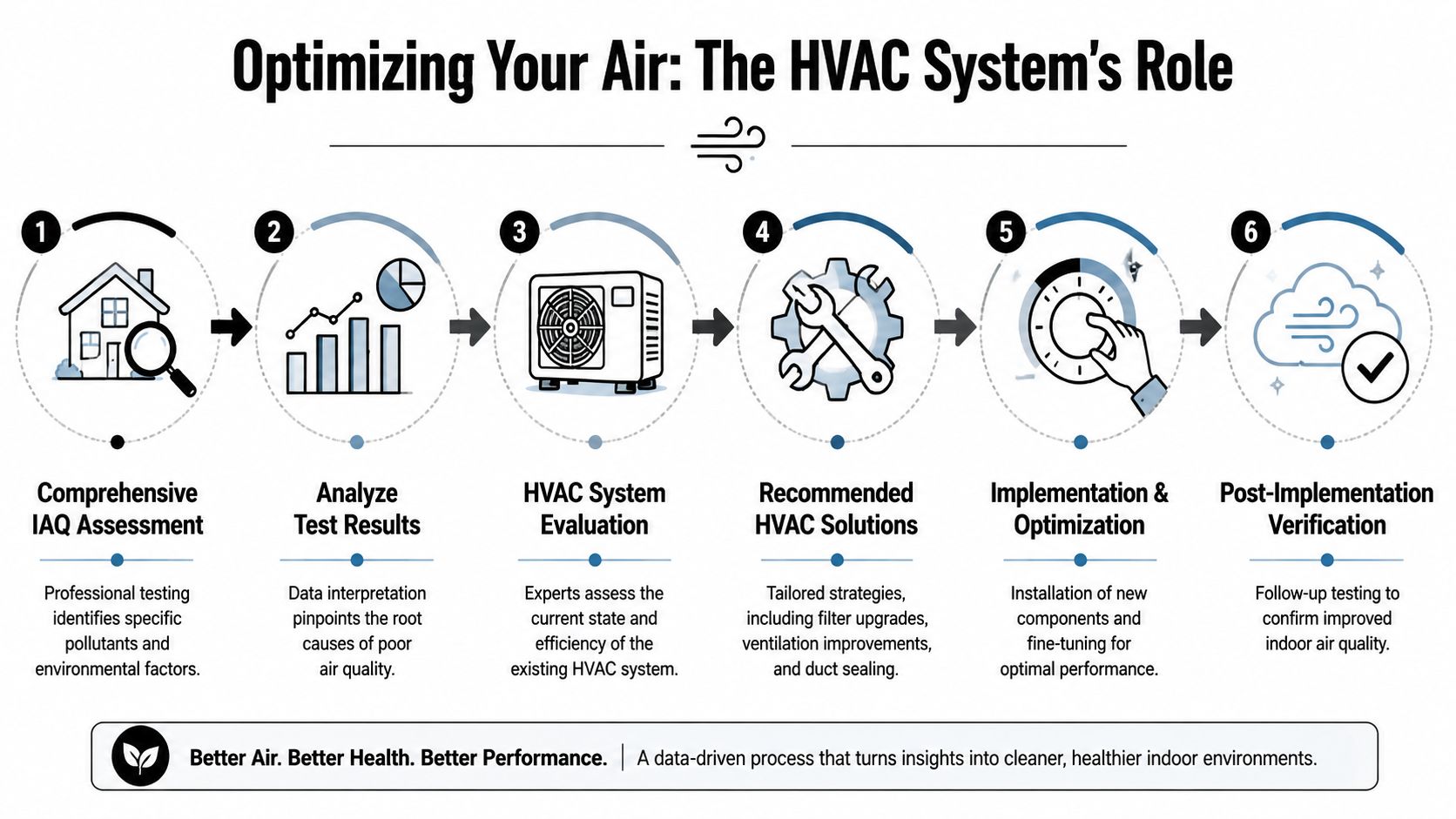
Most homeowners assume air quality problems start with pollutants. In the field, the bigger issue is often how the house handles air after those pollutants show up. Your HVAC system is the delivery system, the filter rack, the circulation engine, and in many homes the only thing moving air consistently from one part of the house to another.
That's why the test report by itself doesn't fix anything.
Ventilation and airflow are often the real problem
The Canadian Committee on Indoor Air Quality reports that 60% of IAQ issues stem from inadequate ventilation and airflow distribution, not just pollutant sources, as summarized by the Canadian Centre for Occupational Health and Safety indoor air quality overview. That lines up with what technicians see in Arizona homes all the time.
A house can have decent filters and still have bad air because:
- Supply air isn't balanced: Some rooms get too much air, others not enough.
- Returns are inadequate: Air can't circulate back to the system properly.
- Duct design is restrictive: The system can't move the volume of air it was supposed to move.
- Equipment is oversized or poorly matched: The system satisfies temperature too quickly and doesn't manage the air well.
Why AC installation and duct design affect air quality
Indoor air quality isn't separate from air conditioning repairs, AC installation, and AC maintenance. It's tied to all three.
The U.S. Department of Energy notes that system capacity needs to match the home's load calculation, and a mismatch of more than 10 to 15% can reduce efficiency by up to 20%. The example given is a 3-ton (36,000 BTU) unit installed where a 2.5-ton capacity is needed, which can lead to short cycling, according to the EPA indoor air quality page that references proper HVAC sizing and comfort. Short cycling doesn't just waste performance. It often means poor moisture management, inconsistent filtration time, and uneven room conditions.
Ductwork has the same kind of impact. ACCA guidance cited in the University of Maryland Eastern Shore indoor air quality policy page specifies duct friction rates between 0.05 and 0.10 inches per 100 feet of duct length. That same reference notes that restricting airflow by 20% in a heat pump system can cause a 15% drop in heating efficiency, and improper furnace duct layout can result in up to 30% of generated heat being lost before reaching living spaces.
Field takeaway: If the report says the air is bad, the next question should be whether the HVAC system can actually move, dilute, and filter air the way the home needs.
That's the diagnostic-to-remediation gap. Plenty of companies will test. Fewer will trace the result back to blower performance, duct friction, return sizing, filter pressure drop, supply balance, or whether the original installation was right in the first place.
What usually works better than “just cleaning”
If airflow is the root issue, surface-level fixes won't hold. The correction often looks more like this:
- Airflow rebalancing: Adjusting delivery so rooms don't turn into stagnant zones.
- Duct repair or redesign: Especially when certain runs are too restrictive or poorly routed.
- Right-sized replacement equipment: Important in homes where old systems were oversized from day one.
- Filter strategy changes: Better filtration only works if the system can handle it without starving airflow.
Homeowners who are unsure where to begin should at least stay current on maintenance basics such as how often to replace an HVAC filter. But when the air still feels off after normal upkeep, that usually means the house needs deeper mechanical evaluation, not another retail air freshener.
DIY Air Quality Monitors vs Professional Testing
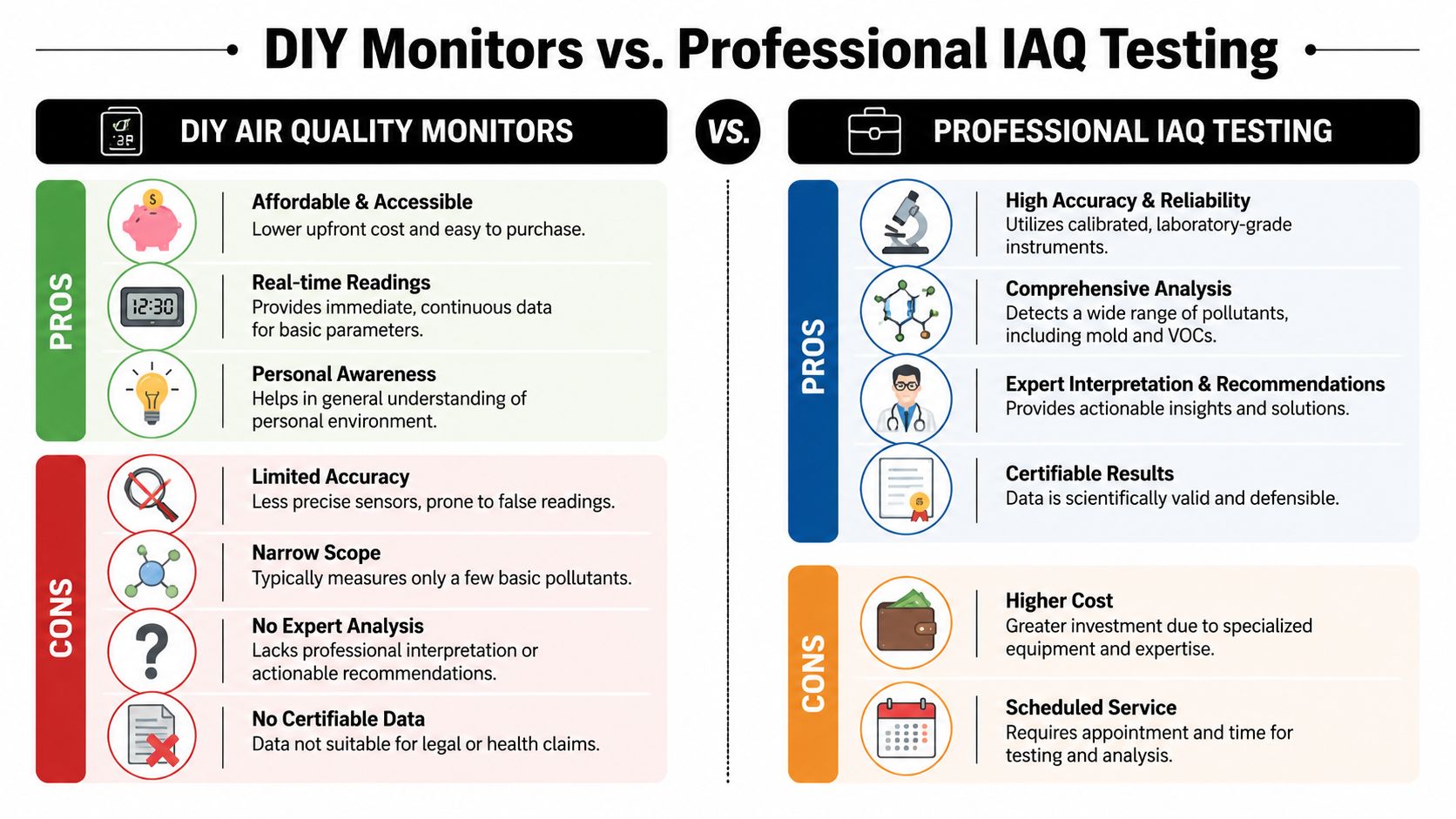
DIY monitors have a place. They can alert you to changing conditions and help you notice trends. But they don't replace a full diagnosis any more than a bathroom scale replaces a medical exam.
Where DIY monitors help
A consumer monitor is useful when you want general awareness. It can show whether particulate levels rise while cooking, whether a room gets stuffy overnight, or whether one area of the house behaves differently from another. That kind of information can be valuable.
DIY devices are strongest when used for observation:
- Spotting trends: You notice patterns tied to occupancy, cooking, or cleaning.
- Comparing rooms: One bedroom may consistently feel different for a reason.
- Tracking change after improvements: If a filter change or duct repair helps, a monitor may reflect that over time.
Where they fall short
Most consumer devices don't answer the questions that matter most. They may show a problem, but they usually can't tell you whether the issue is source-related, ventilation-related, duct-related, or equipment-related. They also don't inspect blower performance, pressure problems, return design, or hidden moisture.
Professional testing distinguishes itself here. A technician doesn't just gather readings. A technician interprets those readings in context.
A helpful way to understand this is:
| Option | Best For | Main Limitation |
|---|---|---|
| DIY monitor | Awareness and trend watching | Limited scope and no mechanical diagnosis |
| Professional testing | Root-cause diagnosis and action plan | Requires scheduling and a higher upfront investment |
A lot of online content also skips an important point in new construction. The “test” often isn't really a reactive test at all. It's proactive design work. A source discussing IAQ test pricing also highlights that in new construction, the service is often better understood as load calculation and airflow planning, and it states that new homes' IAQ problems are 40% more likely due to poor ventilation design in the cited context of the Mold Assist discussion of air quality testing cost and scope. That's exactly why a proper design process matters before drywall ever goes up.
For homeowners considering add-on solutions after testing, it also helps to understand the benefits of an air purifier. Purification can be a good part of the plan. It just shouldn't be mistaken for a complete fix when the underlying issue is poor airflow or bad system design.
A quick visual overview can help frame that difference before making a decision.
Professional testing tells you what to fix first. That priority order is where most of the value sits.
Taking Action From Test Results to a Healthier Home
Once the data is in, the next step is turning it into work that improves the house. At this stage, many homeowners get disappointed. They paid for testing, got a report, and still don't know what to do Monday morning.
A useful report should lead to a ranked action plan. Not every issue deserves the same urgency, and not every reading means you need a product. Some homes need source control. Others need duct repair, blower adjustments, return modifications, coil cleaning, drain corrections, or a full replacement because the original installation was wrong.
How to prepare for indoor air quality testing
Before testing, keep conditions normal. Don't deep clean the house the hour before. Don't run extra air fresheners or try to “fix” the symptoms temporarily. The goal is to measure the home as you normally live in it.
A few practical steps help:
- Use the house normally: Cook, shower, occupy rooms, and run the HVAC system as usual unless your technician gives different instructions.
- Write down patterns: Note which rooms smell stale, where dust builds fastest, and when symptoms are worst.
- List recent changes: New flooring, furniture, paint, remodeling, or equipment replacement can all matter.
What a good remediation plan should include
The best next step depends on what the testing and mechanical review found. In many Arizona homes, the corrective work falls into one or more of these categories:
- Airflow correction: Rebalancing supply and return air so rooms don't stay stagnant.
- Duct sealing or redesign: Important when leakage or restrictive layouts undermine performance.
- Equipment correction: That can mean targeted air conditioning repairs, major AC maintenance, or a properly planned AC installation if the current system is oversized, failing, or poorly matched.
- Filtration and purification upgrades: Whole-home media filters or RGF-certified purification can help when they're matched to the actual system and problem.
- Heat pump or furnace evaluation: Heating equipment matters too, especially when winter airflow, combustion, or duct distribution issues affect overall indoor conditions.
A solid IAQ plan fixes the cause first and adds products second.
That's the difference between spending money and solving the problem. If the system can't deliver air correctly, no accessory will make the house perform the way it should.
Homeowners in Globe, Miami, Superior, and nearby communities usually don't need more guessing. They need a diagnosis that connects the air in the house to the equipment, ductwork, and airflow behind the walls. That's how you move from symptoms to a healthier home.
If your home still feels dusty, stale, or uneven after filter changes and routine upkeep, Cobre Valley Air LLC can help you get a real answer. Their licensed team serves Globe, Miami, Superior, and surrounding Arizona communities with diagnostics-first HVAC service, including air conditioning repairs, AC installation, AC maintenance, heat pumps, furnaces, duct design, and indoor air quality solutions that go beyond a basic test report.