


Your old system always seems to wait for the worst week of June to act up. The house gets sticky by mid-afternoon, the outdoor unit sounds rough, and the power bill lands with a thud. Around Globe, Miami, and Superior, that usually starts the same conversation: replace it with another central AC, or switch to a heat pump?
A lot of Arizona homeowners come into that decision with one bad assumption. They've heard a heat pump is “more efficient,” so they expect better cooling too. For summer-only performance, that's not how it works. In real homes, heat pump vs AC efficiency for cooling comes down more to the equipment tier, the SEER2 rating, the installation, the duct system, and whether the unit is sized correctly for brutal desert afternoons.
Quality air conditioning repairs, ac installation, and ac maintenance matter. So do heat pumps, furnaces, and duct design. A good unit on bad ductwork will disappoint you. A properly designed system with careful airflow setup will usually beat a fancier box installed in a hurry.
Choosing Your Cooling System in the Arizona Heat
A common local scenario goes like this. A homeowner has an older split system that still runs, but it struggles after lunch and never quite catches up before sunset. The bedrooms farthest from the air handler stay warmer, the system runs long cycles, and the question stops being “Can I get one more year out of it?” and turns into “What am I replacing this with?”
That decision isn't small. If you already have a gas furnace, swapping only the outdoor condenser and indoor coil may make sense. If the furnace is old too, a heat pump starts looking a lot more practical because it can handle both heating and cooling in one setup. If you're building or remodeling, duct design should be part of the conversation before anyone talks brand names.
Early on, the cleanest way to compare options is side by side.
| System choice | Best fit in Arizona | Main advantage | Main drawback |
|---|---|---|---|
| Central AC with furnace | Homes with a solid existing furnace | Straightforward cooling replacement | Separate heating equipment still needed |
| Heat pump | Full-system replacements, electrification, all-in-one comfort | Cooling and heating from one system | Cooling alone isn't automatically better |
| AC or heat pump with poor duct design | Never a good fit | None | Wasted comfort and uneven airflow |
Shop-floor reality: Most comfort complaints blamed on “the unit” turn out to be airflow, sizing, maintenance, or duct problems.
In Arizona's extreme heat, the system type matters, but not as much as people think when the complaint is strictly cooling. The outdoor unit could be a heat pump or an AC condenser. If both are matched properly and carry similar cooling ratings, summer performance is going to be close. What separates a good result from a bad one is whether the installer checked static pressure, airflow, return capacity, duct layout, and load.
That's why this choice should be treated like a full HVAC decision, not a box swap.
Understanding HVAC Efficiency Ratings SEER2 HSPF2 and COP
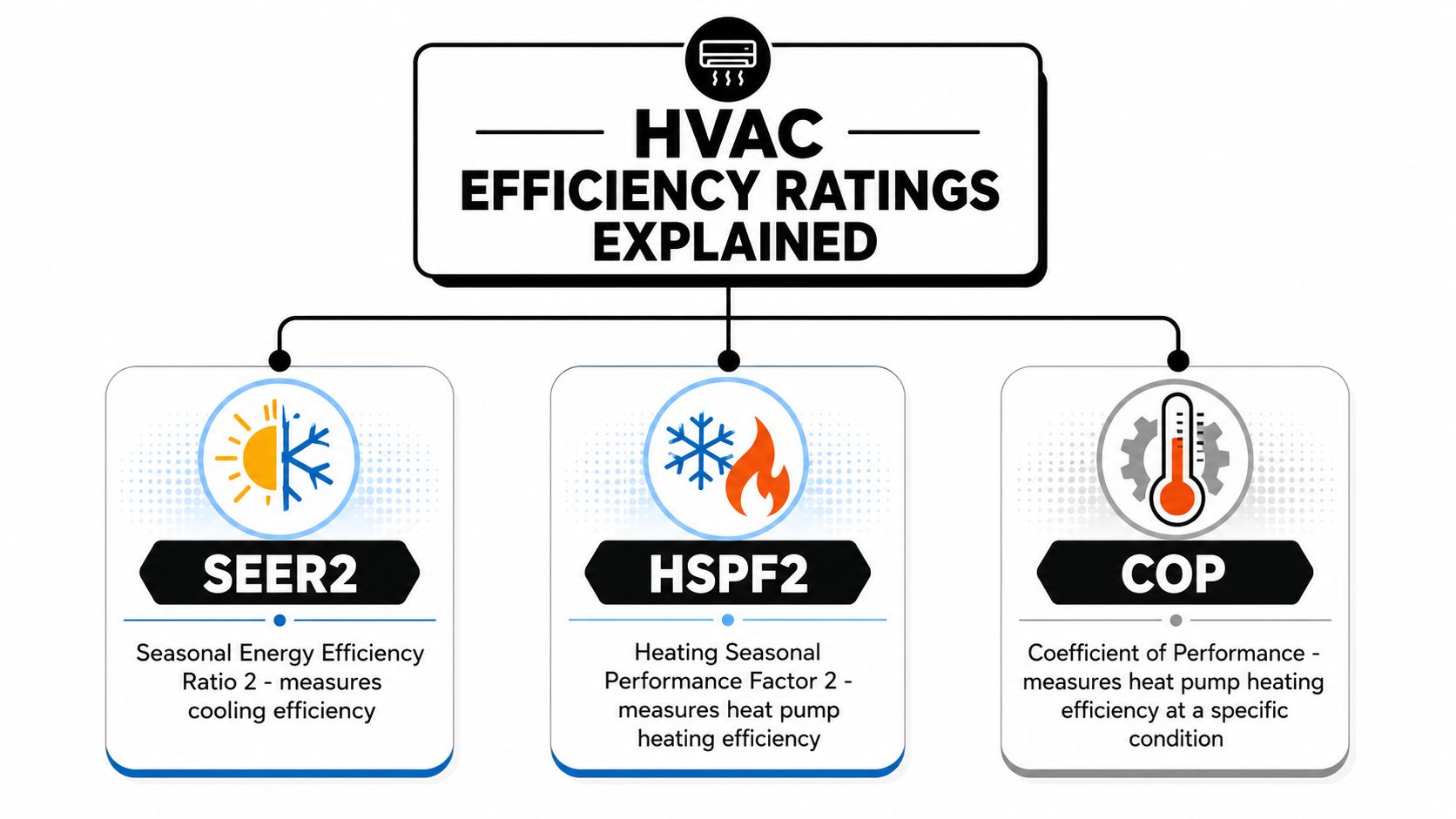
Efficiency labels confuse a lot of homeowners because the terms sound more technical than they need to be. The easiest way to think about them is this: one rating tells you how a system cools over a season, another tells you how a heat pump heats over a season, and one gives a quick snapshot of heating performance at a given condition.
SEER2 is your cooling mileage
SEER2 works a lot like miles per gallon for cooling. It tells you how efficiently a system handles an entire cooling season, not just one perfect test day. If two systems have the same SEER2, their summer operating cost is in the same ballpark.
That matters because heat pumps and air conditioners share identical cooling mechanisms, so their cooling efficiency is measured by SEER2. A heat pump with the same SEER2 rating as an AC costs the same to run in summer according to EnergySage's heat pump and AC comparison.
If you want more background on lower and higher cooling ratings, this quick comparison of 13 SEER vs 15 SEER systems helps show why the number on the label matters, but only when the rest of the system is matched correctly.
HSPF2 and COP explain heating
HSPF2 is the heating-season version of SEER2 for a heat pump. It gives you a broader picture of how the unit performs across a heating season. In plain language, higher HSPF2 usually means the heat pump does more heating for the electricity it uses.
COP, or coefficient of performance, is more like a spot reading. It answers a simpler question: at a given moment and condition, how much heat is the unit moving compared with the electricity it's using?
Here's the practical takeaway:
- SEER2: Use it to compare cooling efficiency.
- HSPF2: Use it to compare heat pump heating efficiency.
- COP: Use it when you want a snapshot of heating performance under a specific condition.
A furnace creates heat. A heat pump moves heat. That's why the cooling side can look the same between systems while the heating side looks completely different.
For Arizona homeowners, this clears up the big misunderstanding. If your goal is better summer cooling only, don't assume a heat pump beats an AC just because it's called “high efficiency.” On cooling, the label you want to compare first is SEER2.
Cooling Efficiency Faceoff AC vs Heat Pump in Summer
The most important point in this whole discussion is simple. A heat pump is not automatically better at cooling your house just because it can also heat it.
Cooling performance is nearly the same
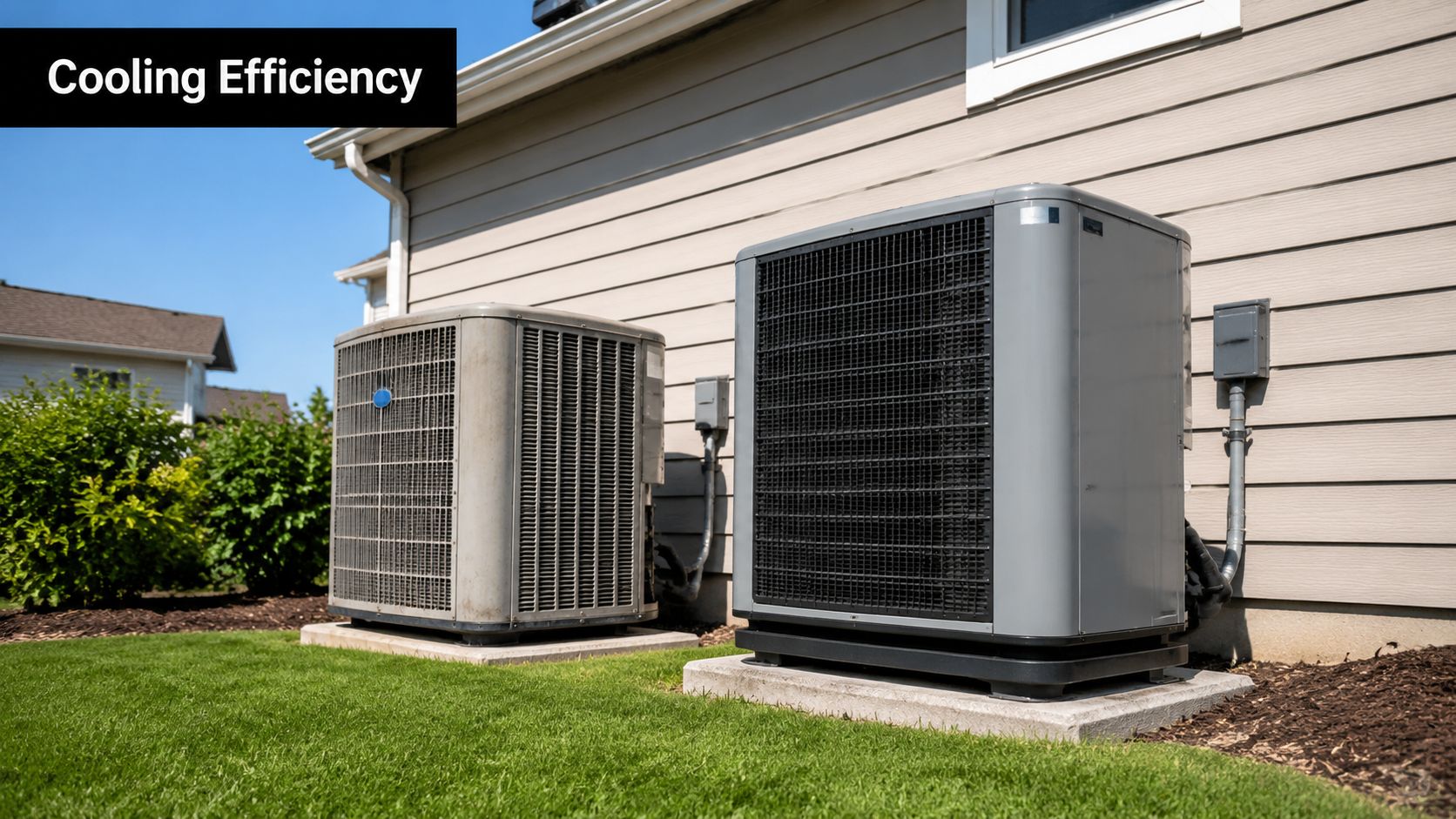
For cooling, the equipment is working off the same refrigeration principles. The outdoor unit rejects heat. The indoor coil absorbs heat. The blower moves air across that coil. If a heat pump and a central AC are built at the same efficiency tier, you should expect very similar summer performance.
A useful benchmark comes from this cooling efficiency guide on heat pumps and air conditioners, which states that in cooling mode, heat pumps and air conditioners perform virtually identically with SEER2 ratings from 13.4 to 26, resulting in less than 5% performance difference. The same source notes that modern variable-speed heat pumps achieve SEER2 ratings up to 24+, slightly exceeding top-tier ACs that max out around 21-22 SEER.
That sounds like a win for heat pumps, but there's a catch. In real Arizona homes, the small difference at the top end often matters less than these field conditions:
- Sizing: A unit that's too big can short cycle and leave rooms uneven.
- Airflow: Bad static pressure can choke performance no matter what the badge says.
- Duct design: Long runs, poor returns, or undersized branches can starve rooms.
- Maintenance: Dirty coils and filters drag down any system.
What 100°F plus weather does to both systems
The question many homeowners care about is this: what happens when it's brutally hot for weeks?
Both systems have to work harder. That's true for a heat pump and a standard AC. Head pressure rises, run times get longer, and every weakness in the installation starts to show up. If the system is dirty, low on airflow, or poorly charged, Arizona heat exposes it fast.
That's why the practical answer in extreme summer weather is not “buy a heat pump for stronger cooling.” The better answer is:
- Choose the right efficiency tier for your budget.
- Match the indoor and outdoor equipment correctly.
- Make sure the duct system can carry the airflow.
- Keep up with service before the hottest stretch of the year.
Filterbuy also points out that, in cooling mode, the difference is minor and claims of dramatic heat pump superiority for cooling alone are overstated in its discussion of heat pump versus air conditioner cost and efficiency by climate.
A quick visual can help if you want to see the equipment differences discussed in plain language.
Variable-speed matters more than the label on the box
If comfort is your priority, variable-speed equipment deserves attention. A variable-speed system can adjust output in smaller steps instead of blasting on and off at full tilt all the time. That usually means steadier temperatures and better humidity control.
For hot Arizona conditions, that's often a bigger quality-of-life improvement than arguing over whether the outdoor unit is technically a heat pump or a straight cool condenser. The biggest wins usually come from better airflow, better staging, and fewer installation shortcuts.
When homeowners say, “I want the most efficient cooling,” what they usually mean is, “I want lower bills and fewer hot rooms.” Those aren't always solved by changing system type.
Heating Efficiency Where the Heat Pump Shines
Cooling is the close contest. Heating isn't.
A gas furnace burns fuel to make heat. A heat pump doesn't create heat that way. It moves heat from outside to inside. That difference changes the math completely.
Why the heating numbers are so different
According to the U.S. Department of Energy's overview of air-source heat pumps, air-source heat pumps deliver 2 to 4 times more heat energy than the electrical energy they consume, translating to 200% to 400% heating efficiency, whereas gas furnaces max out at about 98% efficiency because they cannot produce more heat than the fuel burned.
That's the reason heat pumps get so much attention. Not because they cool miles better than ACs, but because they can heat very efficiently.
For a lot of homes in this part of Arizona, winter demand is moderate enough that a heat pump makes practical sense as the primary heating source. If you want a simple walkthrough of the process, this article on how a heat pump works lays out the basics.
Heat pump versus furnace in a mild winter area
Here's the side-by-side idea:
| Heating option | How it works | Practical takeaway |
|---|---|---|
| Gas furnace | Burns fuel to create heat | Strong traditional heating, but capped by combustion efficiency |
| Heat pump | Transfers outdoor heat indoors | Strong fit where winters are mild and electrification matters |
Field advice: If you're replacing both heating and cooling equipment, this is where a heat pump starts making a stronger case than a simple AC replacement.
This doesn't mean every home should rip out a furnace tomorrow. If a furnace is newer and the cooling side failed, replacing the AC can still be the sensible move. But if you're looking at the whole system, the heating side is where a heat pump earns its reputation.
Comparing Lifetime Costs Installation and Operation
A lot of Arizona homeowners ask the wrong cost question first. They ask which unit is cheaper to buy, then get surprised later by the heating setup, electrical work, or operating costs that were left out of the original quote.
Upfront cost depends on the whole system, not just the outdoor unit
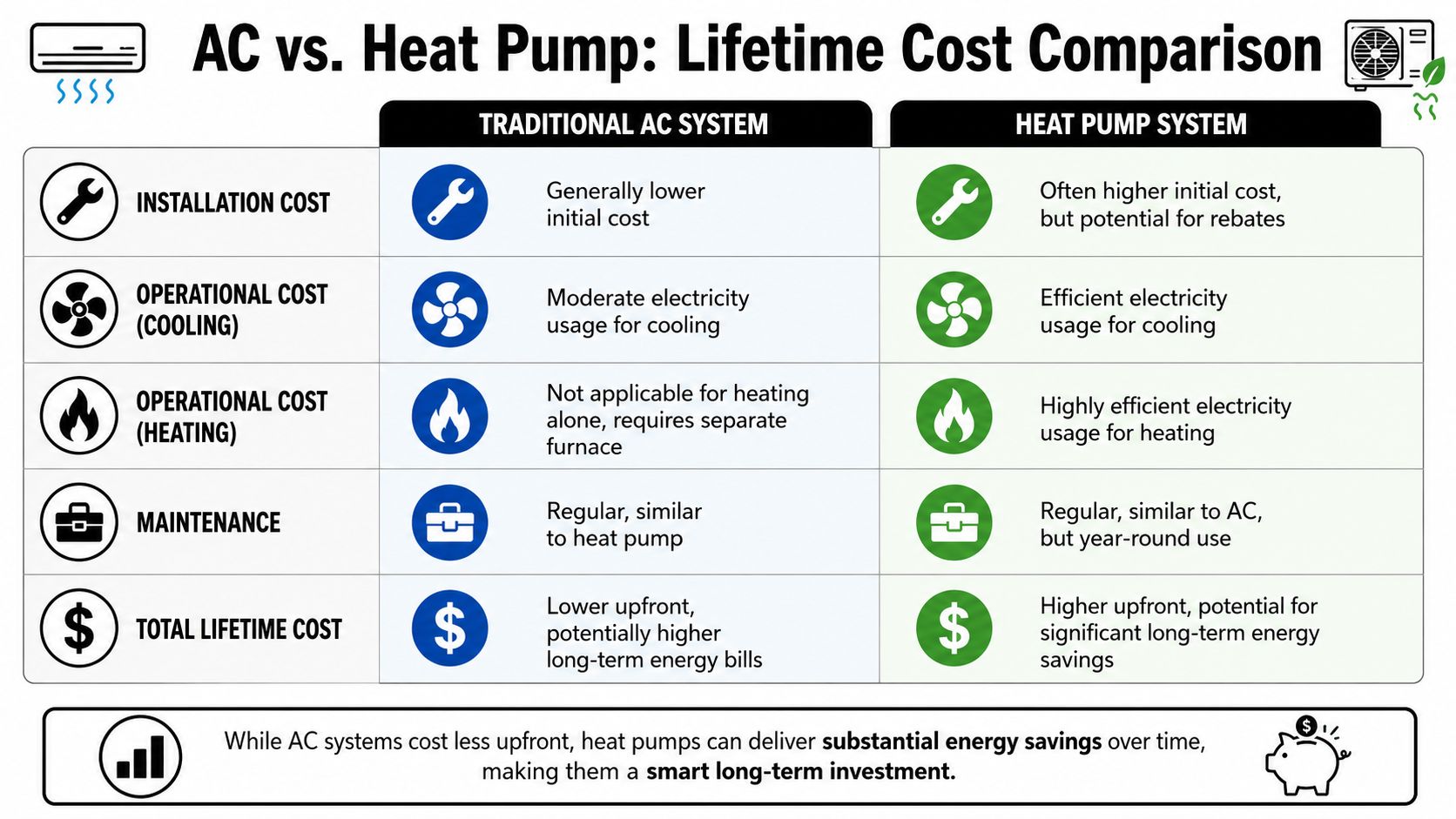
A heat pump and an AC can look similar sitting on a pad outside. The full price difference shows up when you count everything attached to that choice. If the house still needs a furnace, gas hookup, venting, or separate heating equipment, an AC-only comparison misses part of the bill.
That matters in Cobre Valley homes. If the furnace is still solid and the cooling side failed, replacing the AC can be the lower-cost move. If both pieces are old, a heat pump often gets much closer in installed price than people expect because it handles heating and cooling in one system.
Installation cost also changes fast if the equipment size was wrong to begin with. A proper Manual J load calculation for the home helps prevent oversizing, short cycling, and paying for capacity the house does not need.
Operating costs in Arizona need a different lens
In summer, a heat pump does not get a free pass just because it can also heat. In 100°F plus weather, both systems are working hard, and the day-to-day cooling cost usually comes down to the efficiency rating, installation quality, airflow, and how well the refrigerant charge was set. A poorly installed high-efficiency system will often cost more to run than a properly installed mid-tier one.
The heating season is where the operating-cost difference usually shows up. Airtron explains in its review of heat pump versus air conditioner efficiency and comfort that heat pumps can lower heating costs in the right conditions because they move heat instead of creating it through electric resistance or combustion.
That does not mean every Arizona house gets the same savings. Utility rates, duct leakage, insulation, thermostat settings, and backup heat strategy all change the math. In a tighter home with an aging gas furnace, a heat pump can make good financial sense. In a house with cheap gas and a newer furnace, the payback can be slower.
Where the money usually goes
Here is the practical version I use when talking with homeowners:
- Replace cooling only: A new AC often makes sense if the furnace is newer and working well.
- Replace both heating and cooling: A heat pump deserves a real quote because it may reduce equipment count and improve winter efficiency.
- Build or remodel around all-electric equipment: A heat pump can simplify the plan and avoid adding gas components.
- Own a home with high summer usage and light winter demand: Do not assume a heat pump saves big money on cooling. Focus on correct sizing, duct performance, and realistic heating use.
The best choice usually comes down to what already exists in the house, what shape it is in, and how long you plan to stay there. In Arizona, the smartest system on paper is not always the cheapest one to own. The winner is the one that was sized right, installed right, and matched to how the home handles extreme heat.
The Importance of Ductwork Sizing and Lifespan
Homeowners love efficiency ratings because they're easy to compare. The problem is that the sticker doesn't tell you what the house will feel like if the duct system is wrong.
Duct design decides whether rated efficiency shows up in real life
A high-efficiency unit still needs proper return air, balanced supply runs, and airflow that matches the equipment. In Arizona homes, the usual trouble spots are undersized returns, long branch runs to back bedrooms, and replacement jobs where the equipment got upgraded but the duct layout never got corrected.
That's why load calculations and airflow planning matter more than sales language. The right starting point is a Manual J load calculation, followed by duct evaluation and equipment matching. Without that, heat pump vs AC efficiency turns into a paper exercise.
Here's what usually hurts performance in the field:
- Undersized ductwork: The blower can't move what the equipment needs.
- Poor return design: Rooms feel stale, noisy, or slow to cool.
- Leaky connections: Conditioned air ends up in the attic or crawlspace instead of the living space.
- Bad equipment matchups: The indoor coil, blower, and outdoor unit don't perform as a system.
Good installation makes average equipment look better. Bad installation makes premium equipment look disappointing.
Lifespan is part of the value equation
There's also the wear-and-tear side of the choice. According to Jarboe's comparison of air conditioner and heat pump lifespan, air conditioners typically provide 10 to 15 years of service life, while air-source heat pumps have a slightly shorter lifespan of 10 to 12 years due to the added operational stress of reversing functions for both heating and cooling.
That doesn't mean a heat pump is a bad investment. It means expectations should be honest. A heat pump works year-round, so maintenance matters even more. Coils need to stay clean, refrigerant charge needs to be correct, electrical components need inspection, and airflow problems need to get fixed before they wear the system down.
For homeowners deciding between repair and replacement, quality air conditioning repairs and ac maintenance provide real value. Good service protects either system. Neglected service shortens the life of both.
Making the Right Choice for Your Cobre Valley Home
If your current setup has a solid furnace and the cooling side failed, a high-efficiency AC often makes the most sense. You keep the heating equipment that still has useful life, and you focus your money on the cooling system, installation quality, and duct corrections.
If both the furnace and AC are getting old, a heat pump becomes much more attractive. You get one system that cools in summer and handles heating in winter, and that all-in-one approach can be a strong fit for Arizona homes.
If you're building new, don't start with brand brochures. Start with load calculations, room-by-room duct planning, return-air strategy, and realistic expectations for how the house will be used. Builders and owners who get that part right usually avoid the callback headaches that come from oversized equipment and weak airflow.

The simplest way to think about heat pump vs AC efficiency in Arizona is this:
- For cooling alone: They're very close when equipment quality and SEER2 are comparable.
- For heating: The heat pump has the clear efficiency edge.
- For comfort and reliability: Installation, duct design, and maintenance often matter more than the label on the outdoor unit.
That's true for homeowners, but it also applies to commercial spaces, rental properties, and restaurant buildings with demanding runtime. The right answer depends on the whole system, not just the condenser sitting outside.
If you want a no-pressure recommendation for your home or building, Cobre Valley Air LLC can inspect the equipment you have, evaluate your ductwork and airflow, and give you a practical path forward based on repair condition, installation needs, and long-term comfort.