


Your old system usually doesn't fail on a calm, convenient day. It quits when the summer AC is already struggling, or when a cold snap rolls through Globe, Miami, or Superior and the house never quite warms up. At that point, most homeowners ask the same question: should I replace this setup with a furnace, a heat pump, or some combination of both?
That's a fair question, and the honest answer is that there isn't one universal winner. In Arizona, the right answer depends on your home's ductwork, your electrical service, whether you already have gas available, how the house is insulated, and how you want the home to feel on the coldest mornings and hottest afternoons.
A lot of online guides skip the parts that matter most in real houses. They talk about equipment boxes and ratings, but not the return duct that's too small, the attic duct runs that leak, the panel that may not support a new electric load, or the oversized system that short-cycles all summer. Those details decide whether you get a comfortable home or an expensive headache.
An Arizona Homeowner's HVAC Crossroads
If your system is nearing the end, you're probably not shopping for HVAC because it sounds fun. You're dealing with a unit that's limping through service calls, rooms that won't stay even, or utility bills that feel out of line with the comfort you're getting. In our part of Arizona, that decision gets more stressful because the equipment has to handle long cooling seasons and still respond when winter nights turn sharp.
The furnace vs heat pump decision usually comes up when one of these situations happens:
- Your AC is failing too: A furnace only handles heat. If the cooling side is also worn out, you're really comparing a furnace plus AC against a heat pump that can do both jobs.
- Your heating is weak in winter: Some homeowners care most about fast morning warm-up and the feel of the air coming from the vents.
- Your home is older: In Globe, Miami, and Superior, older homes often have duct, insulation, and electrical issues that change the answer.
- You want to avoid a bad replacement: Swapping equipment without checking airflow, duct sizing, and load calculations is how people end up paying for new equipment and still living with old comfort problems.
That's why the best starting point isn't the brand badge on the cabinet. It's the house.
Practical rule: Don't pick the equipment first. Pick the system that fits the house, the power available, the duct layout, and the way your family actually uses the home.
For some homes, a heat pump is the clear fit. For others, a gas furnace still makes more sense. In some cases, a dual-fuel approach gives the best mix of comfort and operating control. The goal should be long-term comfort and dependable AC performance, not a quick sale built around whatever unit is easiest to install this week.
How Furnaces and Heat Pumps Actually Work
A lot of confusion goes away once you understand one basic difference. A furnace creates heat. A heat pump moves heat.
A furnace makes heat
A gas furnace works like a controlled fire inside a metal cabinet. It burns fuel, the heat exchanger gets hot, and the blower pushes air across that exchanger and into the duct system. That's why furnaces can deliver that strong blast of warm air people often associate with “real heat.”
A furnace only does one job. It heats. If you choose a furnace, you still need a separate air conditioner for cooling season.
A heat pump moves heat
A heat pump doesn't create heat by burning fuel. It uses refrigeration to move heat from one place to another. In winter, it pulls heat from outdoor air and brings it inside. In summer, it reverses direction and pushes indoor heat outside, which means it cools the home the same way a central air conditioner does.
That operating difference is why Carrier's heat pump overview notes that heat pumps are generally more energy-efficient than furnaces because they transfer existing heat from the outside air indoors using electricity, rather than burning fuel like natural gas, propane, or oil to generate heat, which makes them ideal for moderate climates with long cooling seasons and mild winters.
If you want a deeper plain-English walkthrough, this guide on how a heat pump works breaks the cycle down clearly.
Why this matters in Arizona
In Globe, Miami, and Superior, cooling matters for much more of the year than heating. That changes the conversation. A heat pump isn't just a heater. It's also your AC system. For many Arizona homes, that makes it a serious option because you're paying for one matched system instead of treating heating and cooling like separate worlds.
Here's the simple way to understand it:
| System | Main heating method | Cooling included | Best fit mindset |
|---|---|---|---|
| Furnace | Burns fuel to create heat | No | Strong winter heat, separate AC needed |
| Heat pump | Moves heat with electricity | Yes | One system for heating and cooling |
Once that distinction is clear, the comparison gets easier. The question stops being “Which one is better?” and becomes “Which one fits this house, this climate, and this budget better?”
A Head-to-Head Comparison for Arizona Homes
| Category | Furnace | Heat pump |
|---|---|---|
| Heating approach | Creates heat by burning fuel | Moves heat from outdoors to indoors |
| Cooling | Needs separate AC | Included in the same system |
| Best climate fit | Strong option where winter heating feel is top priority | Strong option in Arizona-style cooling-heavy climates |
| Comfort feel | Hotter supply air, quicker warm-up | Gentler supply air, longer runtimes |
| Infrastructure concerns | Gas line and venting matter | Electrical capacity and duct setup matter |
| Big homeowner mistake | Replacing furnace without addressing old AC or duct issues | Installing one without checking panel capacity and airflow |
Efficiency and operating costs
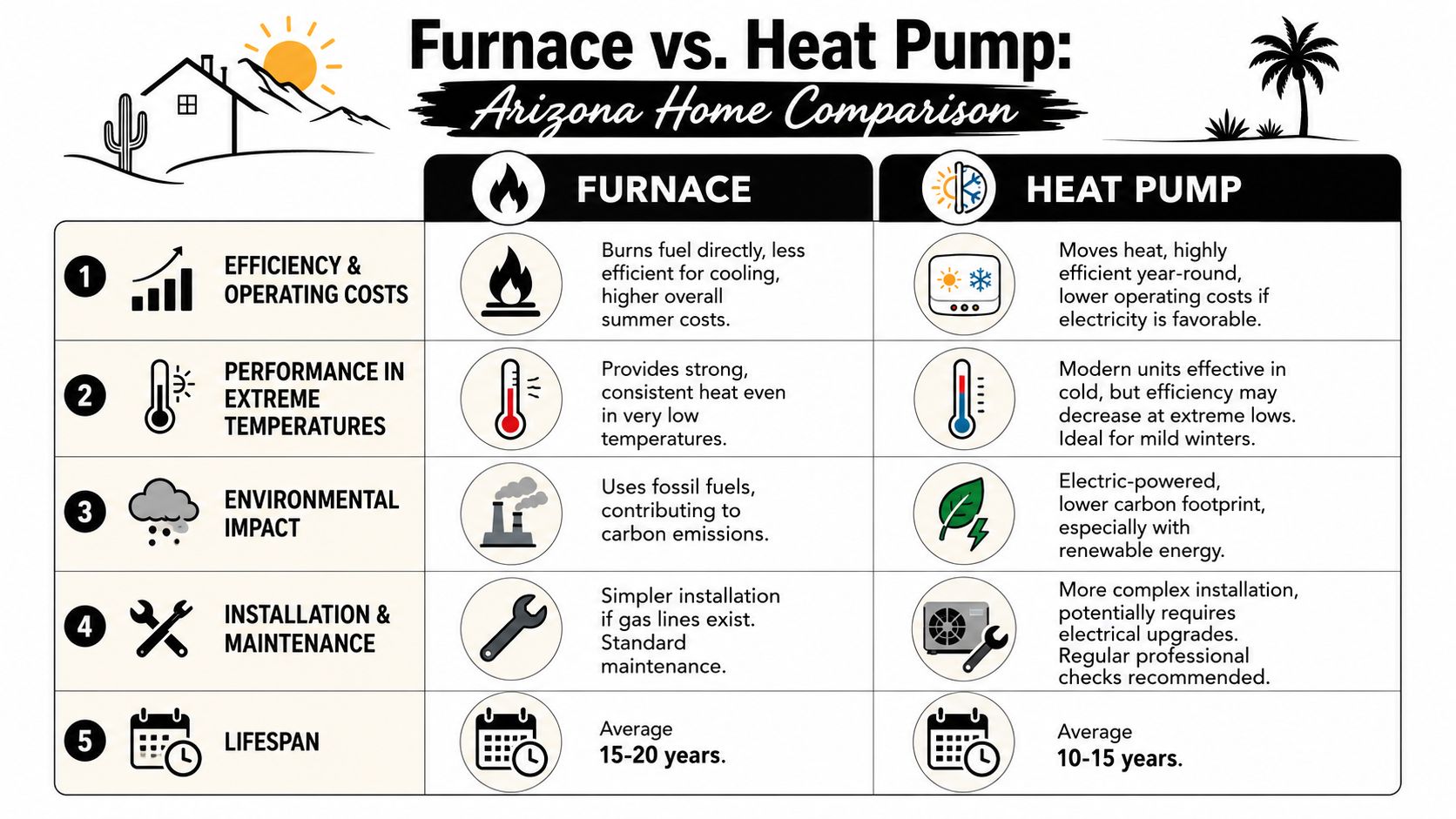
In Arizona, cooling performance matters every bit as much as winter heat. That's one reason heat pumps get serious attention here. They cool the home just like a central AC in summer, while also handling heating in winter.
For heating, Filterbuy's efficiency comparison notes that in moderate climates above 30°F, heat pumps deliver 2 to 3 units of heat per unit of electricity, with a COP of 2.5 to 4.0, surpassing even high-efficiency gas furnaces. However, in sustained extreme cold below 20°F, high-efficiency gas furnaces can become more reliable and cost-effective as heat pump performance drops.
That lines up with what matters locally. Most homeowners in Globe, Miami, and Superior spend far more time worrying about AC operation, summer comfort, and year-round efficiency than about extended deep-freeze conditions. In that setting, a properly selected heat pump can make a lot of sense.
But operating cost isn't just about equipment efficiency. Utility pricing changes the answer. Verified cost comparisons show that natural gas is more affordable than electricity in many states, and in some places even a less efficient gas furnace can still be cheaper to run than a very efficient heat pump. That's why broad national claims don't help much. You need a house-specific and utility-specific comparison.
Performance and comfort feel
Many online articles often become too abstract. Homeowners don't live inside efficiency charts. They live inside rooms.
A gas furnace typically gives you hotter air at the vents and faster temperature recovery. A heat pump usually delivers a milder stream of warm air and runs longer. Both can keep a house comfortable when designed correctly, but they don't feel the same.
Gas heat tends to feel fast and intense. Heat pump heat tends to feel steady and even.
That difference matters on a cold morning in Superior when someone wants the house to warm up quickly before work or school. It also matters in larger homes where the far bedrooms already struggle with airflow. If the duct design is weak, the gentler discharge temperature of a heat pump won't hide it. It may expose it.
Climate fit in Globe, Miami, and Superior
Arizona isn't one climate. Your local elevation, sun exposure, insulation levels, and duct routing all matter.
Where heat pumps fit well
Heat pumps are a natural fit for homes that:
- Need both heating and cooling replacement: One system can cover both jobs.
- Live mostly in mild winter conditions: That's where heat pump efficiency shines.
- Have good duct design: Balanced airflow helps heat pumps maintain comfort.
- Want lower source energy use in warmer conditions: Verified data shows heat pumps in warmer climates often use less source energy than furnaces.
Where furnaces still make sense
A furnace can still be the better answer when:
- You already have natural gas service and a good AC system
- You want stronger warm-air delivery during winter mornings
- Your home sees colder overnight conditions and comfort response matters more than all-in-one design
- Electrical upgrades would make a heat pump project much more expensive
Upfront cost and long-term value
Verified installation ranges show that new heat pumps typically cost between $2,500 and $10,000 to install, while natural gas furnaces range from $700 to $3,300. Those are broad equipment-and-install ranges, and they don't tell the full project story.
A furnace often looks cheaper at first glance. But that comparison can be misleading if the home also needs AC installation. A furnace doesn't cool. A heat pump does both. In moderate climates, verified data also shows heat pumps can lead to lower lifetime operating costs despite a higher initial investment.
Field advice: Don't compare a furnace by itself to a heat pump by itself if your cooling equipment is also near the end. Compare the full replacement path.
There's also a comfort angle that doesn't show up on a quote sheet. Verified data notes that heat pumps can provide gentler airflow with higher humidity levels compared to the hotter, drier air from gas furnaces. Some homeowners prefer that. Others prefer the faster punch of furnace heat. Neither preference is wrong.
A final option worth mentioning is dual fuel. Verified data shows that dual-fuel systems pair a gas furnace with an electric heat pump and switch between them based on outdoor temperature. For some Arizona homes, that can be a smart middle ground when you want efficient cooling and milder-weather heating from the heat pump, plus furnace backup when temperatures drop.
Installation Realities and Ductwork Considerations
The equipment matters. The house matters more.
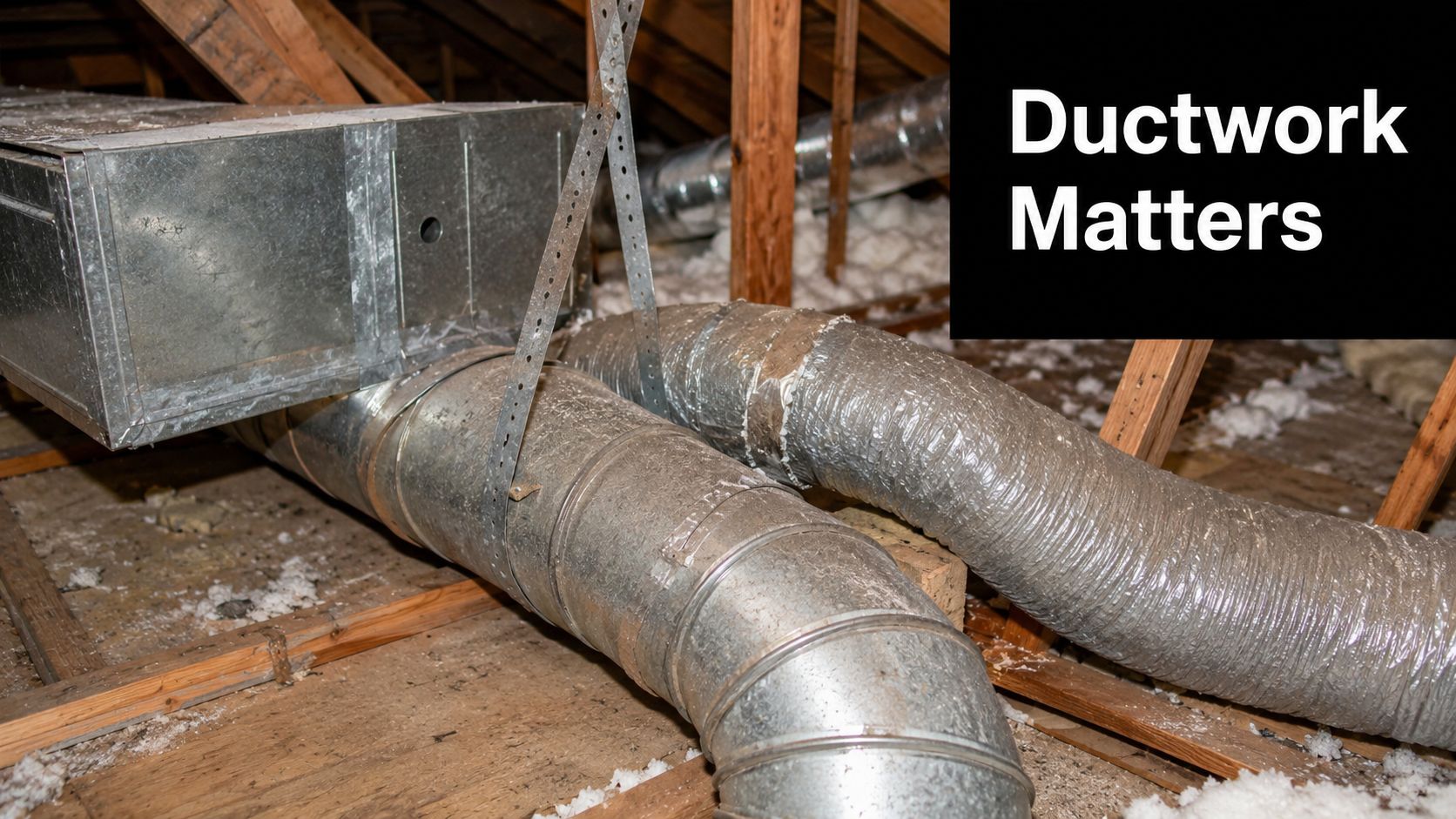
A furnace or heat pump can only perform as well as the air distribution system attached to it. If the return is undersized, the attic ducts leak, the supply branches are badly laid out, or the system was never matched to the actual load of the house, you won't get the comfort you paid for.
Why duct design changes the answer
Heat pumps are especially sensitive to airflow quality because they often run longer cycles with lower discharge temperatures. That isn't a flaw. It's how they're designed to operate. But if the duct system is poorly designed, the house may feel uneven, especially in far rooms or spaces with high solar gain.
Furnaces can also suffer from bad ductwork, but the hotter supply air can sometimes mask problems for a while. Homeowners may still have pressure imbalance, noise, hot and cold rooms, or high static pressure. They just don't always realize the duct system is the reason.
A proper evaluation should include:
- Supply and return airflow review: Not just a glance at the equipment closet.
- Duct condition check: Leaks, crushed flex, poor insulation, and bad transitions all matter.
- Load calculation: The home should decide the equipment size, not the old unit tag.
- Room-by-room comfort concerns: The back bedroom, addition, Arizona room, or garage conversion often reveals the full story.
The hidden electrical cost with heat pumps
This is the part many homeowners don't hear until late in the process. A heat pump may require more electrical capacity than the home currently has available for HVAC equipment.
According to the American Gas Association's location-based comparison, 41% of US households may face a separate electrical rewiring cost of $2 to $4 per square foot to support a new heat pump's load capacity, and that's especially relevant for homes with older electrical panels in communities like Globe and Miami.
That doesn't mean every home needs a panel upgrade. It does mean you shouldn't assume the sticker price of the heat pump is the whole price.
A heat pump quote without an electrical review can be incomplete. In older Arizona homes, that's not a minor detail.
Furnace installation has its own realities
Furnaces aren't “simple” just because they may look familiar. Gas access, venting, combustion safety, and equipment matching still matter. If the home doesn't already have the right gas infrastructure or venting path, the project changes quickly.
That's why box-swap thinking causes trouble. Good installation work isn't about dropping in a new machine. It's about making sure the blower, duct system, controls, power, venting, refrigerant side, and load of the home all work together.
Advanced HVAC Tech Cold-Climate and Ductless Options
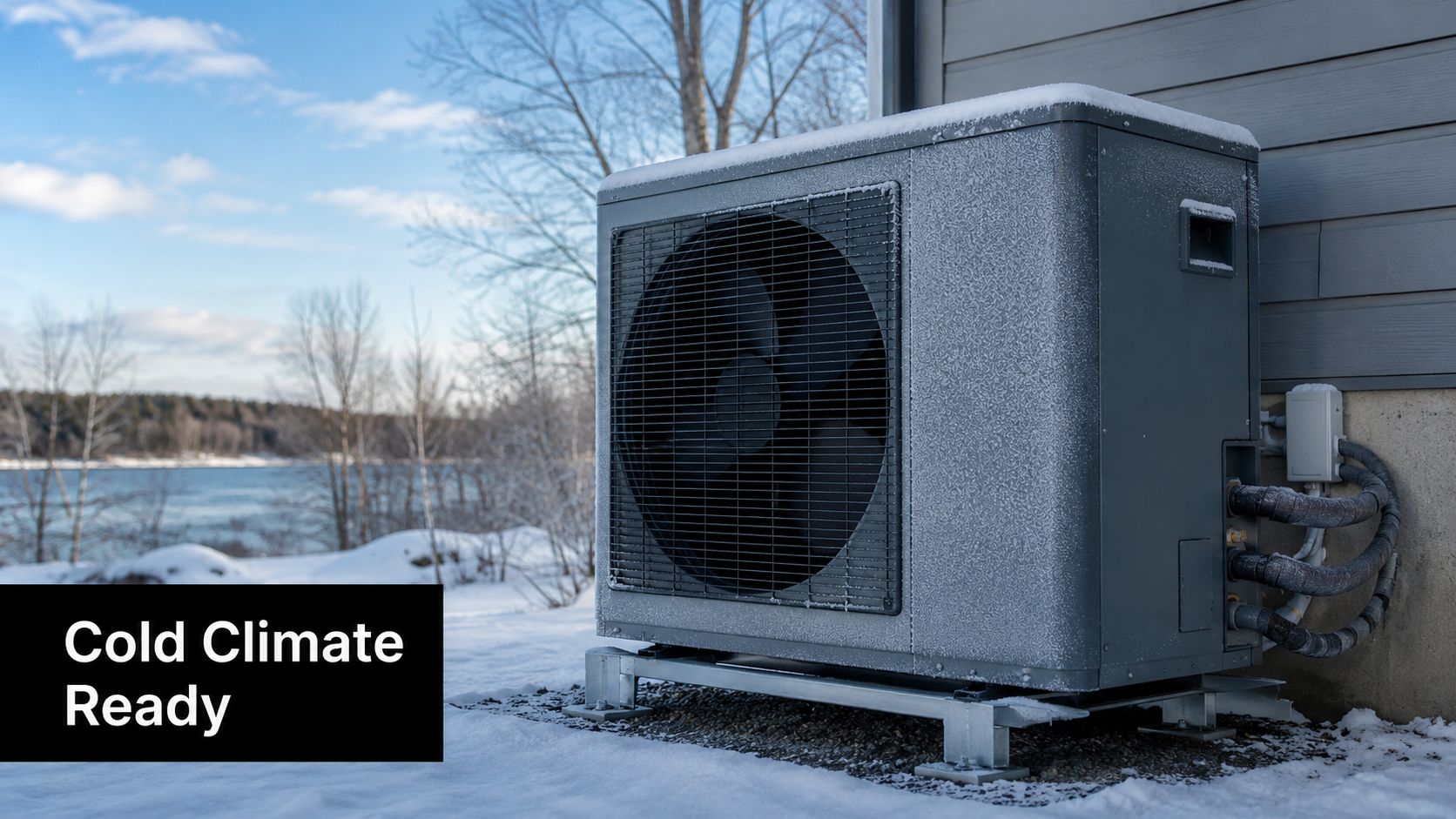
Heat pump technology has moved well past the old idea that these systems only make sense where winters are barely cool. Modern equipment has widened the range of homes where a heat pump can work well, especially when the system is sized properly and the duct system is right.
What modern heat pumps can do
Daikin Seattle's efficiency guide notes that modern split-system heat pumps must meet DOE minimums of 14.3 SEER2 and 7.5 HSPF2, with high-efficiency models reaching up to 22 SEER2 and 10.5 HSPF2, translating to 300% to 500% more energy transferred than consumed.
That matters in Arizona because cooling efficiency isn't a side issue. It's central to how happy you'll be with the system for most of the year. Better variable-speed heat pump equipment can also help with longer, steadier runtimes that support more even indoor temperatures.
Cold-weather performance in real homes
The old complaint that “heat pumps don't work in cold weather” is too broad to be useful. Some homes will still be better served by a furnace or a dual-fuel setup. But some modern heat pumps can absolutely handle colder conditions than many homeowners expect.
The more important question is whether the equipment was matched to the house and climate. A high-performance unit installed on poor ductwork or without proper load calculations can still disappoint. Good equipment can't rescue bad design.
Here's a useful overview for homeowners who want to see the category in action:
Ductless mini-splits for hard-to-condition spaces
Some homes don't need one more argument about central equipment. They need a targeted fix.
Ductless mini-split heat pumps can be a strong option for:
- Older homes without usable ductwork
- Room additions
- Garage workshops
- Arizona rooms
- Areas that never stay comfortable on the main system
If you're comparing options for a problem room or an older property, this page on ductless mini-split systems is worth reading.
Mini-splits don't replace every central system conversation, but they solve specific comfort problems very well. In some homes, the smartest move isn't choosing furnace vs heat pump for the whole house. It's combining a central solution with a ductless zone where the original design never worked right.
Your Personal Furnace vs Heat Pump Checklist
If you're stuck between options, stop trying to find a universal answer online. Use a house-by-house checklist instead. That will tell you far more than a generic “best system” ranking.
Start with the house, not the equipment
Ask these first:
- Do you already have natural gas available? If yes, a furnace may be a straightforward path. If not, adding gas changes the project.
- Is your cooling equipment also aging? If your AC installation is coming soon anyway, a heat pump deserves a serious look because it handles cooling too.
- What shape are the ducts in? Leaks, bad airflow, weak returns, or poor room balance can sabotage either option.
- How well is the home insulated and sealed? The tighter the house, the more flexibility you usually have with equipment strategy.
If you haven't had a true sizing review done, start there. This guide on how to size an HVAC system explains why that step matters.
Decide what kind of comfort you prefer
This question gets ignored too often. It shouldn't.
Verified comfort data shows that gas furnaces deliver 120°F+ discharge air creating rapid warming, while heat pumps operate at 90–100°F, requiring longer runtimes. That winter comfort discussion matters because some homeowners care as much about the feel of the heat as they do about efficiency.
If you want fast morning warm-up and hotter air from the vents, a furnace often feels more familiar. If you prefer steadier operation, a heat pump may feel better.
Neither answer is more “correct.” It's a preference and a design issue.
Check your budget the right way
Don't just ask, “What's the cheapest install?” Ask better questions:
- What's the full installed path? That includes equipment, labor, duct corrections, controls, and any electrical or venting work.
- What else needs replacement soon? A furnace quote may look cheaper until the old AC fails not long after.
- Can the electrical panel support a heat pump? If not, the budget needs to reflect that before you decide.
- Will this solve room comfort issues? A new system that leaves the same hot back room isn't a real upgrade.
Think about how long you'll stay in the home
If this is a long-term house, year-round efficiency, AC performance, duct improvements, and maintainability should carry more weight. If you need the simplest short-term replacement because one part of the system failed and the rest is still sound, that can point you a different direction.
The right furnace vs heat pump decision usually becomes clear once you answer these questions. Not emotionally, and not based on a sales pitch.
Get the Right System for Your Home with Cobre Valley Air
By the time most homeowners reach this point, they've figured out something important. The furnace vs heat pump decision isn't really about picking a winner from a chart. It's about choosing the system that matches the home, the climate, and the way the family lives in the house.
That's where professional evaluation matters. A real visit should look at duct layout, return sizing, airflow, insulation conditions, electrical service, equipment matching, and the actual heating and cooling load of the home. Without that, you're still guessing, even if the equipment brand is solid.
What good HVAC work should include
A quality replacement or upgrade should cover more than the box in the closet or outside pad.
- Load calculations: Proper sizing keeps systems from running too hard, short-cycling, or leaving rooms uneven.
- Duct design and repair: Leaky or undersized ducts can waste the performance of a new system.
- AC installation quality: Refrigerant charge, airflow, controls, and commissioning matter just as much as brand selection.
- AC maintenance planning: The best equipment still needs service if you want reliable summer performance.
- Repair honesty: Sometimes the right move is a targeted repair, not a full replacement.
Why local experience changes the outcome
Homes in Globe, Miami, and Superior aren't all built the same, and they don't all fail the same way. Some have aging ducts in the attic. Some have older panels that complicate a heat pump conversion. Some need better return air before any new equipment will work the way it should.
That's why a local contractor should be looking at the whole system. Not just the condenser, not just the furnace cabinet, and not just the thermostat.
Cobre Valley Air LLC was built around that kind of service-first approach. The company serves Globe, Miami, Superior, and nearby communities with quality AC repairs, AC installation, AC maintenance, heat pumps, furnaces, and duct design. The team also handles duct repair, inspections, indoor air quality work, ductless mini-split installs, and new construction HVAC planning with proper load calculations and airflow design from the start.
They work with equipment from Goodman, Amana, and Daikin, and financing is available through Wisetack and OPTIMUS. Just as important, the company focuses on no-pressure guidance and code-compliant work that prioritizes long-term comfort over a rushed sale.
The most reliable next step
If you're deciding between a furnace, a heat pump, or a dual-fuel setup, the smartest next move is an on-site evaluation with an accurate quote based on your actual home. That gives you a real answer on comfort, installation needs, duct corrections, and whether electrical upgrades are part of the project.
That's the difference between replacing equipment and solving the problem.
If you want clear advice on furnace vs heat pump options in Globe, Miami, Superior, or nearby areas, Cobre Valley Air LLC can inspect the full system, explain the trade-offs, and provide a no-pressure recommendation built around your home's ductwork, load, comfort goals, and budget.