



Most advice about the best indoor air quality monitor for mold starts in the wrong place. It treats a shelf-sized consumer monitor like a mold detector, when most of these devices don't identify mold directly at all.
That doesn't make them useless. It makes them useful in a different way. A good monitor helps you catch the conditions that let mold grow, then fix those conditions through ventilation, filtration, moisture control, AC maintenance, heat pump performance, furnace operation, and sound duct design. That's the primary homeowner win.
If you think like an HVAC and indoor air quality technician, the question changes from “Which monitor finds mold?” to “Which monitor helps me spot moisture problems early enough to prevent mold?” That's a better question, and it leads to better buying decisions.
Why Your Air Quality Monitor Won't Find Mold Directly
Here's the part many product pages blur. A consumer air quality monitor usually does not identify mold spores the way a lab test, air sample, or qualified mold inspection can.
What it does is still useful. It tracks the indoor conditions that often show up before mold becomes visible or starts spreading. That means humidity staying high, temperatures creating cold surfaces, poor airflow, and HVAC performance problems that leave parts of the house damp.
An HVAC technician's perspective shifts the question. Stop asking, “Which monitor finds mold?” Ask, “Which monitor helps me catch moisture trouble early enough to prevent mold?” That is the question these devices are much better at answering.
What homeowners often expect
A lot of homeowners expect a monitor to behave like a smoke alarm. Mold appears, the device alerts, and you know exactly what happened and where. Consumer IAQ monitors are not built for that job.
They usually measure relative humidity, temperature, VOCs, carbon dioxide, or airborne particles. Those readings can point to a mold-friendly environment, but they do not confirm that the particles are mold or prove hidden growth behind drywall, under flooring, or inside ductwork.
Practical rule: A consumer IAQ monitor is usually a risk monitor, not a mold test.
That distinction matters because it changes how you use the device. If you expect proof, you will probably be disappointed. If you use it as an early warning tool, it can help you catch the house drifting toward trouble before stains, odors, or damage become obvious.
Why the difference matters in a real home
Say a basement feels only slightly clammy, or a bedroom over the garage always seems cooler than the rest of the house. A monitor may show a pattern you would otherwise miss. Humidity stays high for hours. Temperature drops near an outside wall. The HVAC system satisfies the thermostat quickly, but it does not run long enough to remove much moisture.
Those are risk clues.
They do not mean mold is definitely present. They do mean the house is giving mold a better chance to grow.
That is the gap many buyers miss. The monitor is not a mold hunter. It is more like a dashboard warning light for moisture conditions. You still have to inspect, correct the cause, and call for professional help if the signs point to an active problem.
How to use the monitor the right way
The best monitor for mold concerns helps you answer practical questions about your house:
- Is this room staying humid for too long? Basements, bathrooms, laundry areas, and closed bedrooms are common trouble spots.
- Is my AC controlling moisture, not just temperature? A house can feel cool and still be too damp.
- Is weak airflow creating isolated problem areas? One poorly supplied room can behave very differently from the rest of the home.
- Are cold spots causing condensation risk? Exterior walls, window areas, and underinsulated spaces often show this first.
- Does the pattern line up with an HVAC issue? Short cycling, poor return air design, dirty coils, disconnected ducts, and weak exhaust fans can all push humidity in the wrong direction.
This is why monitor data matters most when you connect it to the building and the HVAC system. Air conditioners, heat pumps, furnaces, bath fans, and ductwork all affect moisture control. If those parts are underperforming, the monitor may show the symptoms early. It still will not certify that mold is present, and that is exactly why homeowners need the right expectation from the start.
Understanding the Sensors That Signal Mold Risk
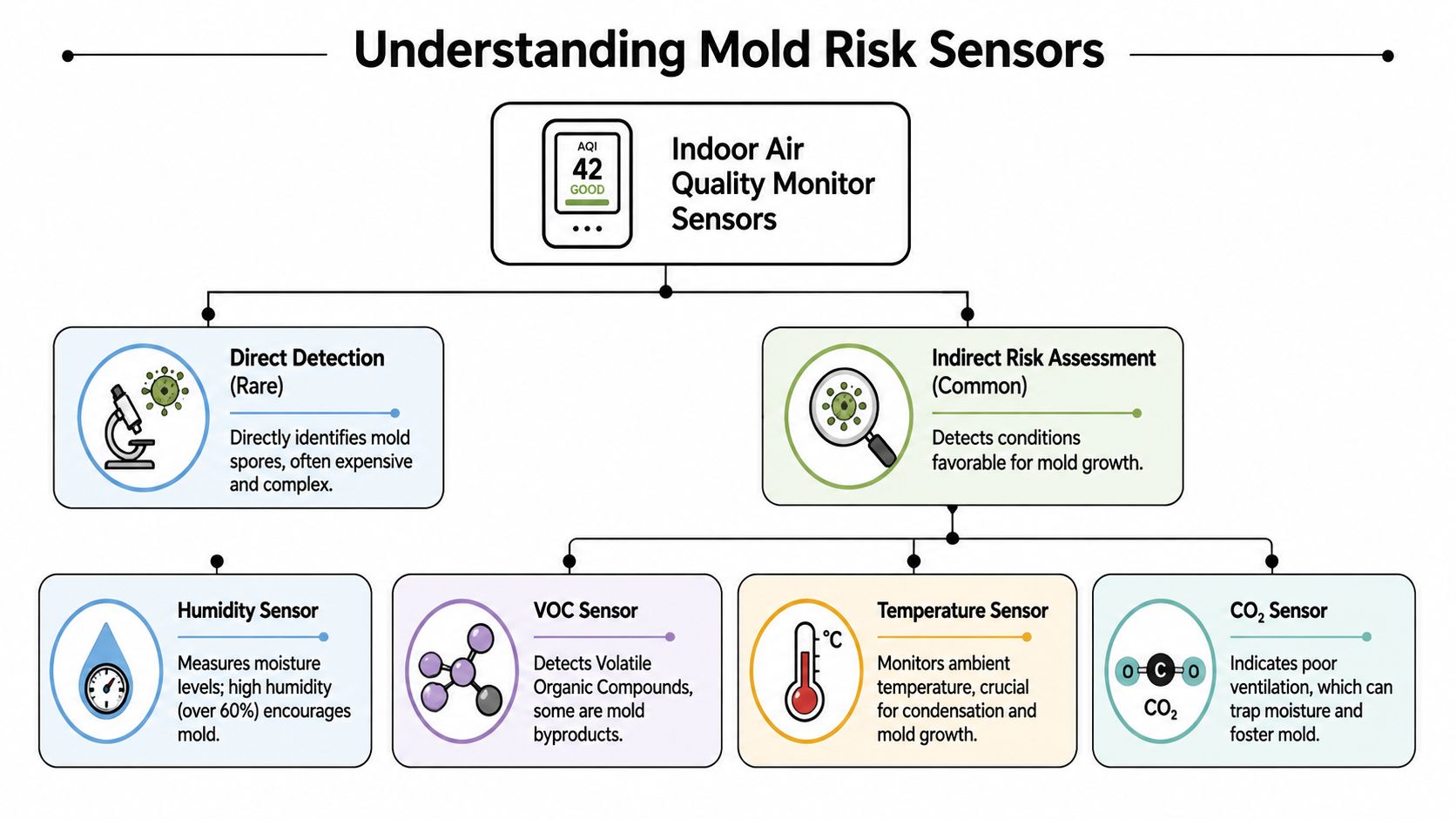
The easiest way to understand a monitor is to compare it to a weather forecast. It doesn't tell you “there is mold in this wall cavity.” It tells you whether conditions in your home are becoming favorable for trouble.
Humidity and temperature sensors
These are the core sensors for mold prevention. If moisture remains high, mold risk rises. Temperature matters because surfaces can fall below room-air temperature and collect condensation.
A monitor that tracks both gives you context. A damp guest room with weak airflow, a cool exterior wall, or a supply register that barely pushes air can become a problem area even if the rest of the house seems comfortable.
The HVAC angle matters here. Poor AC installation can leave equipment oversized and short cycling. That cools fast but may not run long enough to remove moisture effectively. Weak return design, crushed flex duct, or unbalanced airflow can create isolated high-humidity zones.
Particle sensors
Particle sensors sound more definitive than they are. They count airborne particles, but they don't identify what those particles are.
According to Kaiterra, particle detectors measure particles without distinguishing mold spores from other pollutants. Dust, smoke, cooking particles, pet dander, and possible spores can all raise the reading.
That means a PM spike can be useful, but not conclusive. If the reading jumps every time you fry food, that's not a mold signal. If particles trend up in a damp room with poor ventilation, that's a clue worth investigating.
VOC sensors
VOCs are gases from many indoor sources. Paint, cleaners, furniture, and adhesives can all raise them. Some mold-related compounds may also contribute, which is why homeowners get confused.
A VOC sensor is best treated as a prompt to ask better questions:
- Did someone just clean the room?
- Is there new furniture or flooring?
- Is there a hidden damp area producing odors?
- Is the HVAC system moving stale air instead of bringing fresh air through proper ventilation strategy?
A VOC alert should start an investigation, not end one.
The sensor mix that helps most
If you want the best indoor air quality monitor for mold prevention, focus on a device that combines environmental readings and long-term history. The combination matters more than any flashy single metric.
| Sensor | What it tells you | What it doesn't tell you |
|---|---|---|
| Humidity | Whether the air stays damp enough to support growth | Whether mold is already present |
| Temperature | Whether rooms or surfaces may encourage condensation | Which material is affected |
| Particles | Whether airborne particulate levels are changing | Whether those particles are mold |
| VOCs | Whether gases from indoor sources are rising | Whether the source is definitely mold |
A smart homeowner reads the whole pattern. Humidity plus temperature plus poor ventilation plus musty smell is more meaningful than one random high number.
Key Features in a Monitor for Mold Prevention
The best indoor air quality monitor for mold prevention usually looks less dramatic than buyers expect. The most useful unit is often the one that keeps a steady watch on moisture conditions, stores a clear history, and warns you before a damp room becomes a repeat problem.
That gap matters. Many homeowners shop for a device that can say, "there is mold in this wall." What helps in real houses is a monitor that says, "this room keeps staying wet long enough for mold to become more likely." One is a lab finding. The other is an early warning system.
A good monitor works like a smoke alarm for moisture risk. It does not identify the exact material growing behind drywall. It helps you catch the pattern that often shows up first.
Features that actually help prevent problems
Start with a humidity sensor you can trust. If the readings drift, lag badly, or jump around from one check to the next, the rest of the monitor is less useful because mold risk starts with moisture.
Next, look for long-term data logging. A single reading is like checking one frame from a security camera. You need the full recording to see whether a bathroom stays damp every morning, a closet rises at night, or a basement never really dries out.
Graphing matters for the same reason. A simple chart helps you spot patterns that raw numbers hide. If you also want practical ways to improve conditions, this guide on how to reduce indoor air pollution at home pairs well with monitor data because it connects readings to airflow, filtration, and moisture control decisions.
Alerts are worth paying for if the problem area is easy to miss. That includes guest rooms, utility rooms, laundry spaces, closets on exterior walls, and homes that sit vacant for part of the year. An alert will not confirm mold. It can tell you a room has been living in the danger zone long enough that you should inspect it.
The features that separate a helpful monitor from a flashy one
Some extras sound impressive but do little for the decision you need to make at home. Focus on features that answer practical questions.
- Clear trend history: Lets you compare rooms and see whether your fix did lower moisture risk.
- Simple app design: If you cannot find the graph, alert history, or room comparison quickly, you will stop checking it.
- Custom alert thresholds: Useful when one room has different needs than the rest of the house.
- Multiple readings in one device: Humidity, temperature, and other air signals give context that one number cannot.
- Reliable connectivity: Continuous records beat occasional spot checks.
Sensor Guide for Mold Risk Assessment
| Sensor Type | What It Measures | How It Relates to Mold Risk |
|---|---|---|
| Humidity sensor | Relative humidity in the room | Persistent moisture raises mold risk |
| Temperature sensor | Room air temperature | Helps explain condensation conditions and cool spots |
| VOC sensor | Airborne chemical gases | May indicate hidden moisture issues, but also many non-mold sources |
| Particle sensor | Total airborne particulate matter | Can show changing air conditions, but can't confirm spores |
Nice to have, and what you can skip
A mold-risk score can help if you treat it as a summary, not a verdict. It rolls several readings into one easier-to-read signal. That can be handy for a homeowner who wants a quick check before digging into graphs.
What matters more is whether the monitor helps you act. If a back bedroom stays humid because supply airflow is weak, the right answer may be better duct balance, longer cooling cycles, or a dedicated dehumidifier. A monitor with strong logging helps you prove the pattern. A bigger screen does not.
Buy for diagnosis support, not gadget appeal.
For many homes, the monitor is only half of the solution. If your AC is oversized, your ducts leak, your filter is overdue, or your heat pump is not moving enough air, the monitor may keep warning you because the house conditions never really changed.
Interpreting Your Monitor's Data and Taking Action
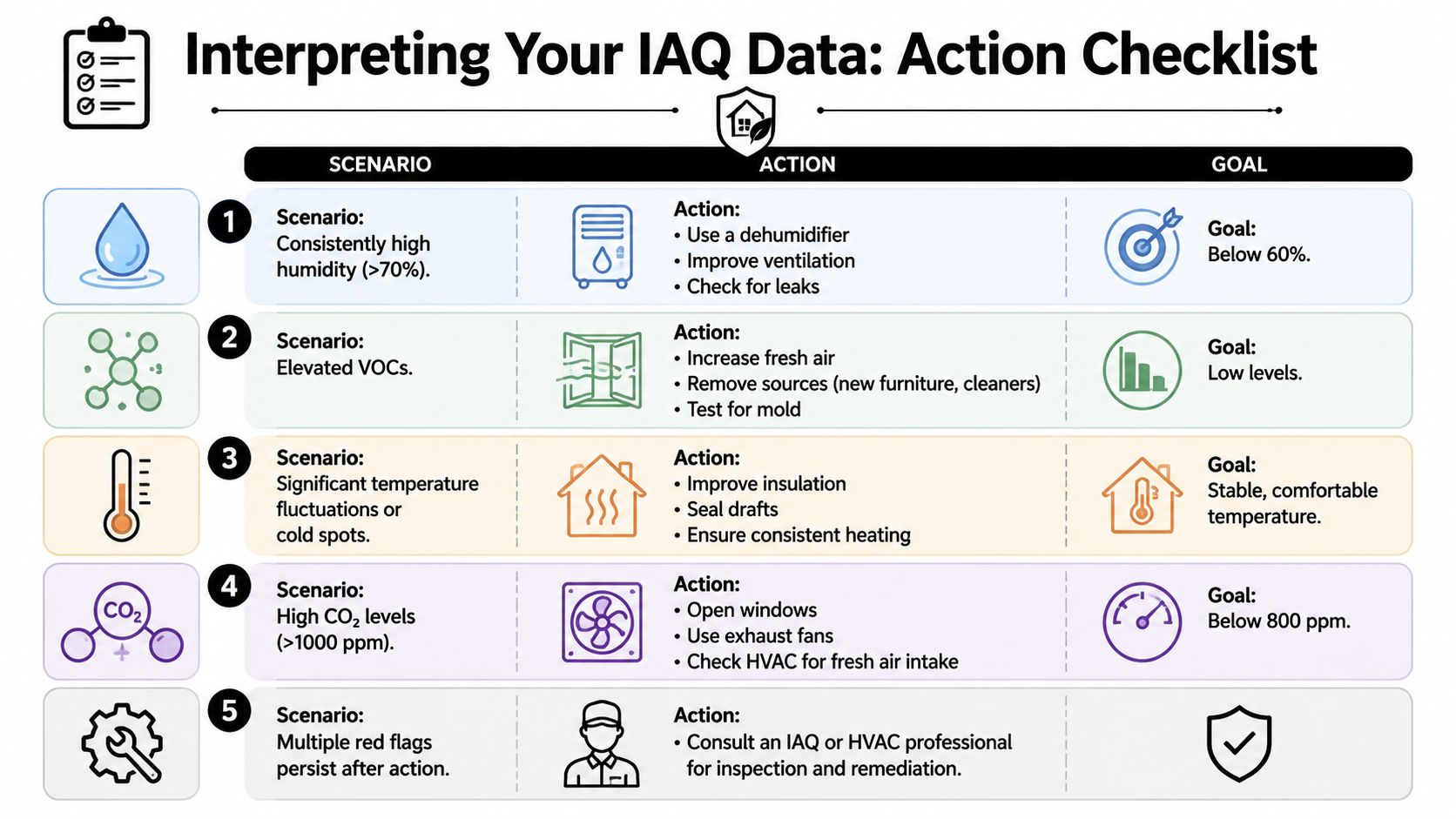
Raw numbers confuse people because they feel precise without being obvious. A monitor becomes useful when you connect a reading to a specific action in the house.
Watch trends, not moments
Mold-risk detection doesn't work like an instant warning light. It requires 7 to 14 days of continuous humidity and temperature logging, and Airthings states that its algorithm uses 10-day rolling averages, so immediate mold presence won't trigger an alert in real time, as explained in the Airthings Wave Mini documentation.
That matters because homeowners often react to one high reading and miss the overall trend. A shower can spike humidity. Cooking can spike particles and VOCs. What matters is whether the room recovers or remains high day after day.
Scenario one: the basement stays damp
Your monitor shows humidity staying high in the basement. The reading doesn't fall much, even after the AC runs.
Start with the obvious checks:
- Look for moisture entry. Check walls, slab edges, windows, and plumbing lines.
- Improve air movement. Stale corners often stay wetter than the center of the room.
- Evaluate dehumidification. Your AC may cool the upper floor while doing little for the basement.
- Review the duct system. A poorly designed or leaky duct layout can starve lower levels of conditioned air.
Scenario two: VOCs rise in one room
A bedroom or office keeps showing high VOCs compared with the rest of the house. There's no recent painting, no obvious cleaning product use, and the room feels stale.
That's when you inspect hidden causes. Look for a slow plumbing leak, a closet against an exterior wall, or furniture pressed tight to a cool surface. Also consider whether the room has weak supply airflow or no effective return path.
If you want practical next steps for the whole house, this guide on reducing indoor air pollution is a useful companion to your monitor data.
Scenario three: one part of the house runs cooler
This is common in homes with duct issues. A room may feel cool enough, but that cool surface temperature can support condensation when humid air drifts in.
Look at the house as a system:
- Airflow imbalance: One room gets less supply air than it needs.
- Insulation gaps: A wall or ceiling surface stays colder.
- Filter neglect: Restricted airflow can hurt system performance.
- Equipment setup: AC sizing or blower settings may not support good moisture removal.
If one room keeps showing different trends than the rest of the house, don't blame the monitor first. Check airflow, insulation, and moisture sources.
The best response is usually boring and effective. Improve ventilation, correct airflow, fix leaks, maintain the AC, and keep heat pumps or furnaces operating steadily. Mold prevention is usually built from those fundamentals.
Proper Placement and Use for Accurate Readings
A good monitor in the wrong location gives you bad information. That's one of the most common reasons homeowners think their device is broken.

Where to place it
Put the monitor in a room important to you, at a normal breathing-zone height, away from direct blasts of supply air, open windows, or direct sun. A shelf in a living area, bedroom, office, or basement is usually more useful than a random corner.
Avoid putting it where short-term events dominate the reading. Right next to a shower, stovetop, humidifier, or supply register, the numbers may reflect one source instead of the room.
Common placement mistakes
These show up all the time in homes with AC and heat pump complaints:
- Too close to a vent: The monitor reads conditioned air, not the room.
- Next to a window: Outdoor swings distort indoor trends.
- In a bathroom full time: Shower spikes can make the home look worse than it is.
- Near the kitchen: Cooking particles and VOCs can overwhelm the pattern.
- Hidden in a cabinet: Air stagnates and the reading becomes unrepresentative.
A filter issue can also make readings look strange because reduced airflow changes how well the system mixes and conditions indoor air. If you haven't checked yours lately, this article on how often to replace an HVAC filter can help.
Use it long enough to trust it
Don't move the monitor every few hours chasing the “worst” reading. Leave it in one useful location long enough to learn the room's pattern.
Then compare rooms one at a time. A basement for a week. A bedroom for a week. A utility room after that. That method gives you cleaner information than hopping from shelf to shelf.
For a quick visual refresher on smart placement and indoor air readings, this walkthrough is useful:
When to Call an IAQ and HVAC Professional
Some monitor readings point to a simple homeowner fix. Others point to a house-system problem. That's where indoor air quality and HVAC work overlap.

Red flags you shouldn't ignore
An indoor air quality monitor designed for mold concerns typically relies on indirect humidity and temperature calculations. Fluke notes that when relative humidity exceeds 70% and temperatures are above 20°C (68°F), fungal germination can accelerate within 48 to 72 hours in those conditions, as described in Fluke's indoor air quality monitor guide.
That doesn't mean every humid room has mold. It does mean the house is moving into a risk zone that deserves real attention.
Call a professional if you have any of these patterns:
- Humidity stays high after basic fixes: You've ventilated, cleaned, and adjusted habits, but the room still trends damp.
- You smell mustiness: Odor plus monitor trends often points to hidden moisture.
- You see recurring staining or visible growth: A monitor can support the suspicion, but it can't inspect behind finishes.
- One room always behaves differently: That often signals duct, insulation, or airflow defects.
- The HVAC system isn't controlling comfort evenly: Poor humidity control often traces back to AC sizing, blower setup, heat pump performance, furnace operation, or duct design.
What a professional can check that a monitor can't
A technician can inspect things your monitor only hints at:
| Professional check | Why it matters |
|---|---|
| Duct inspection | Finds leakage, poor routing, restrictions, and imbalance |
| Airflow analysis | Shows whether rooms are actually getting the air they need |
| Equipment evaluation | Confirms whether the AC, heat pump, or furnace is operating correctly |
| Moisture-source investigation | Helps separate HVAC issues from building leaks or insulation failures |
| IAQ testing | Provides a deeper look when a consumer monitor leaves uncertainty |
If your readings, comfort complaints, and house conditions all point to a deeper issue, scheduling indoor air quality testing is the logical next step.
Why HVAC work is part of mold prevention
Homeowners often separate mold prevention from heating and cooling. In practice, they're tied together.
A bad AC installation can short cycle and leave moisture behind. Skipped AC maintenance can reduce performance right when humidity control matters most. A heat pump with airflow problems can leave one zone damp and another overcooled. A furnace with poor circulation can create cold rooms and condensation issues during cooler weather. Weak duct design can sabotage everything else by moving the wrong amount of air to the wrong place.
Mold prevention often looks like moisture control, and moisture control often depends on HVAC performance.
That's why the best indoor air quality monitor for mold isn't the one that promises certainty. It's the one that helps you see when the house is drifting off target, so you can fix the root cause before it turns into a bigger problem.
If your monitor keeps showing damp conditions, stale air, or uneven room performance, Cobre Valley Air LLC can help you move from guesswork to real answers. Their team serves Globe, Miami, Superior, and nearby Arizona communities with indoor air quality solutions, duct evaluation, AC repairs, AC installation, AC maintenance, heat pump and furnace service, and airflow-focused system design that addresses the moisture problems monitors often reveal.