


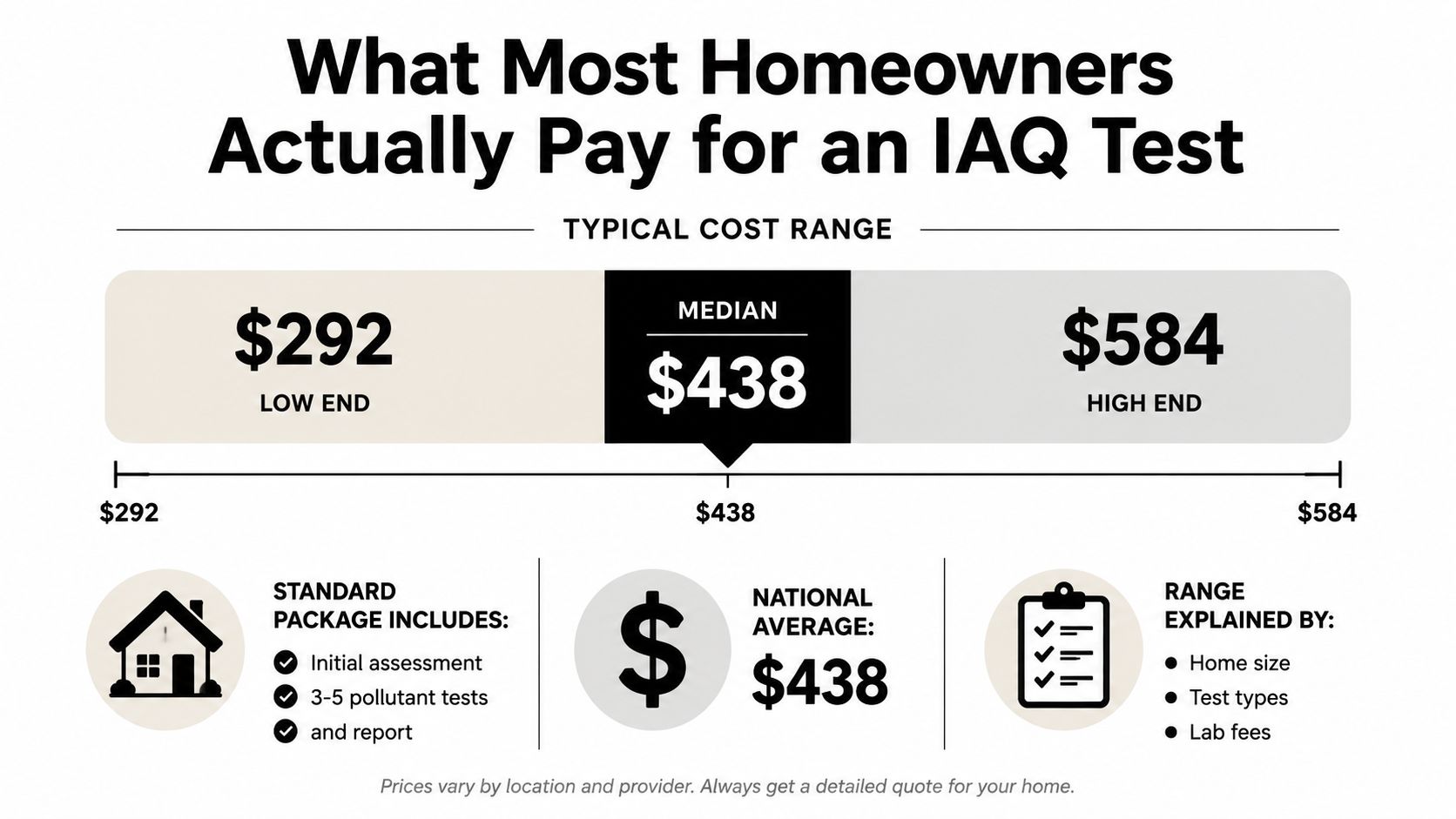
A standard indoor air quality test usually runs $292 to $584, with most homeowners landing around $437. That number climbs fast once you add mold panels, lab analysis, or HVAC duct diagnostics.
You're usually calling because the house feels off. Maybe the vents smell musty, the bedrooms feel stuffy, or the AC keeps running but nobody feels comfortable. Indoor air quality testing cost makes sense only when you treat it as part of the HVAC system, not a mystery bill tacked onto the side.
What Most Homeowners Actually Pay for an IAQ Test
The baseline number to keep in your head is $437 on average, with most standard residential assessments falling between $292 and $584 (Angi). That's the normal homeowner price band for a professional visit, not a lab-heavy investigation or a full commercial diagnostic. HomeAdvisor's broader range, $303 to $609, matches that same reality, and its low and high ends, $150 and $1,098, show how much the scope can change (HomeAdvisor).
A basic residential IAQ appointment usually includes a visual inspection, limited sample collection, and some level of reporting. In plain English, the technician looks at the house, collects a few samples if needed, and tells you whether the problem looks like dust, moisture, stale ventilation, or a specific contaminant. That's why a single average can be misleading. A quick spot check and a multi-room investigation are both “IAQ testing,” but they are not the same job.
What a standard visit usually includes
A reasonable baseline test should give you enough information to decide whether the problem is in the air, in the ductwork, or in the HVAC equipment itself. If the technician only waves a handheld meter around and leaves, that's not much value. You want a visit that connects the dots between the complaint and the system.
Practical rule: if the quote sounds cheap but doesn't mention reporting, sample collection, or a site diagnosis, you're probably not buying a real answer.
When the bill climbs
The price jumps when the technician has to test multiple rooms, multiple pollutants, or pair the air work with HVAC system diagnostics. A recurring odor, a moisture problem, or a house that never seems to ventilate properly usually pushes the job beyond a simple screening. That's the point where indoor air quality testing stops being a checkup and starts becoming an investigation.
Price Breakdown by Test Type
The fastest way to understand indoor air quality testing cost is to stop asking for a single price and start asking which test you need. Mold, VOCs, formaldehyde, particles, and ventilation problems all live in different price brackets because they require different tools and different levels of interpretation. A musty smell is not a VOC problem by default, and a stuffy room is not automatically mold.
| Typical Price Ranges by IAQ Test Type | Typical Cost | What It Detects |
|---|---|---|
| Mold air sampling | About $150 | Airborne mold spores and suspicious fungal loading |
| Formaldehyde badges | About $100 | Formaldehyde and similar off-gassing concerns |
| VOC canister testing | About $300 | Volatile organic compounds from finishes, furniture, and building materials |
| Pollutant measurements or source characterization | About $1,000 | Root-cause diagnostics rather than simple screening |
| Ventilation system evaluations | About $1,500 median typical cost | Airflow and system performance problems |
| Particle and multi-gas instruments | About $1,500 to $1,850 to deploy or own | Particulate matter and broader gas issues |
The lower-cost options are screening tools. The higher-cost options are diagnostic tools. That distinction matters because the cheap test tells you what's present, while the expensive test is meant to tell you why it's there.
Match the test to the symptom
If the house smells musty after a rainstorm, mold sampling makes sense. If you're dealing with headaches, chemical odors, or new carpet fumes, VOC or formaldehyde testing fits better. If rooms feel stale even when the AC runs, you're really talking about ventilation and carbon dioxide, not just “bad air.”
For a closer look at consumer-grade monitoring options, a homeowner can compare live monitors and test strategies through this guide to the best indoor air quality monitor for mold, but don't confuse a monitor with a proper diagnosis.
Why HVAC people care
Dusty supply vents, uneven temperatures, and unexplained odors often point to the duct system, the blower, the coil, or the return-air path. That's why a serious IAQ evaluation often gets bundled with HVAC inspection work. If the air test says the house is contaminated and the ducts are leaking or the coil is wet, the air sample only gives you half the story.
A good test doesn't just name the pollutant. It tells the technician where the fix belongs, in the ductwork, at the coil, or in the building shell.
What Drives the Price Up or Down
The quote changes because the job changes. Bigger homes, more sample points, deeper lab work, harder access, travel time, and how much the HVAC system has to be checked are the six things that move the price. Learn those six items and you can read almost any IAQ estimate without guessing.
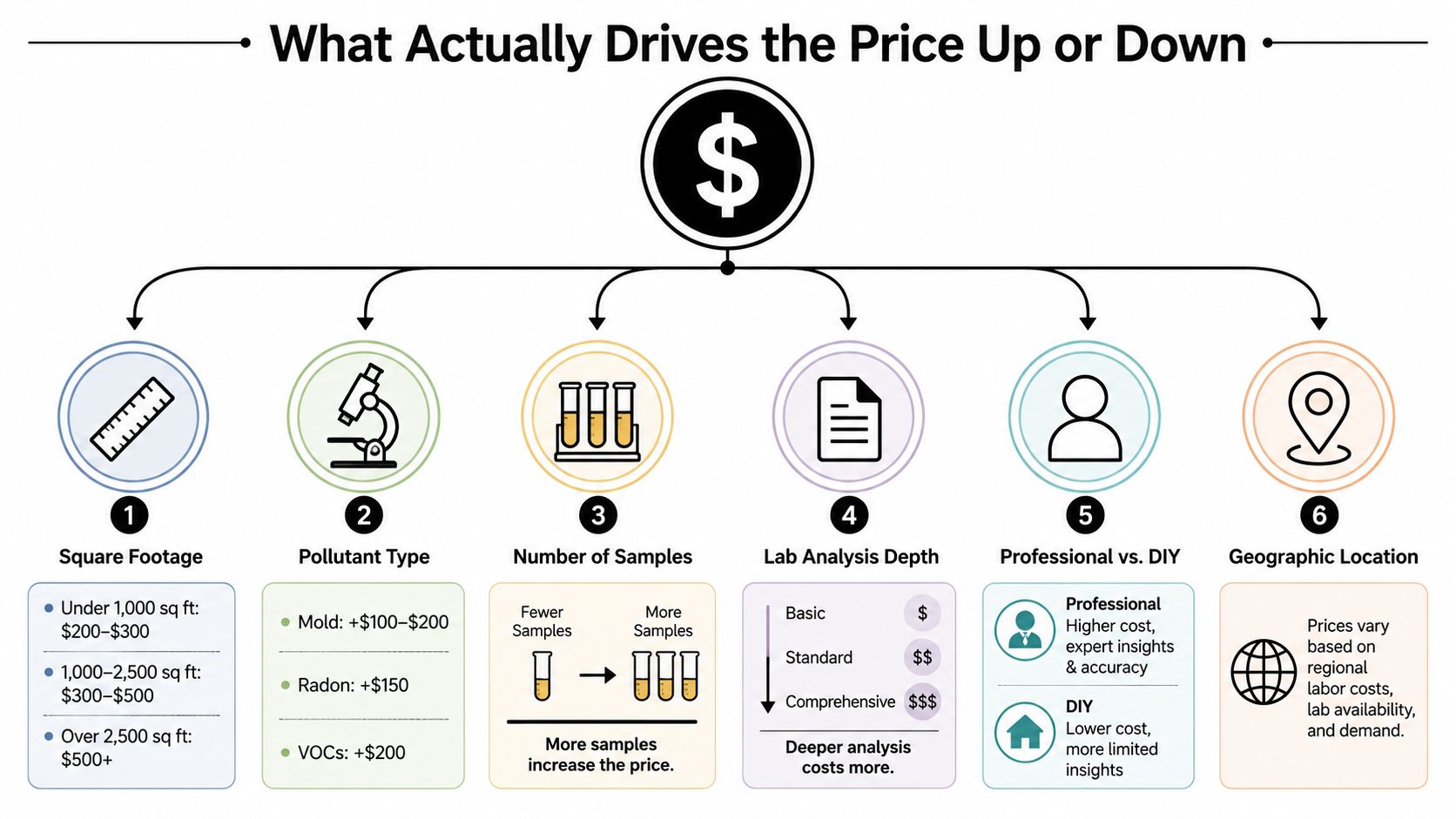
Square footage is the easiest factor to spot. One published pricing guide puts indoor air quality pricing at $200 to $300 for homes under 1,000 sq ft, $300 to $500 for homes from 1,000 to 2,500 sq ft, and $500 to $1,000 for homes above 2,500 sq ft (Ambient Edge). A larger home takes more sampling time, more room coverage, and more reporting, so the price climbs for a reason.
The six cost drivers to watch
- Square Footage: Bigger homes need more sampling points and more time on site.
- Pollutant Type: Mold, VOCs, and ventilation problems call for different tools and different follow-up.
- Number of Samples: More rooms and more samples mean more labor and more lab work.
- Lab Analysis Depth: A field reading costs less than a lab panel with formal documentation.
- Professional vs. DIY: A technician charges for judgment, not just the meter.
- Geographic Location: Travel and access matter, especially outside dense metro areas.
Those are the line items that push a quote from a few hundred dollars toward the low thousands. A basic visual check in a compact home is one thing. A multi-zone investigation with sample collection, lab handling, and HVAC evaluation is a different job.
The HVAC system can drive the bill up fast because it changes the scope. If the house has dust at the vents, uneven room temperatures, or odor complaints, the technician should be checking the ducts, the blower, the coil, and the return-air path at the same visit. That costs more up front, but it keeps you from paying for an air sample and then paying again for the equipment diagnosis.
Straight advice: do not pay for a stand-alone air test if the likely problem is in the return leaks, the supply ducts, or a dirty coil.
DIY Kits Versus Professional Testing
DIY kits look cheap because they are cheap. Basic indoor air quality screening often starts around $100 to $250, while multi-room testing with laboratory analysis can reach $1,200 to $1,600+ because extra samples, lab fees, and reporting add cost (Rising Sun Arts Centre). That spread tells you everything you need to know. The kit is for screening, the professional visit is for answering a real question.
DIY makes sense when you want a rough read on a house, you're shopping a property, or you just want peace of mind. It's not the right move when the situation is more serious, like an insurance dispute, a tenant complaint, or a suspected hidden moisture problem inside walls. A kit can tell you something is off. It usually can't tell you where the air problem started or which HVAC component is feeding it.
Where DIY is useful
A mail-in or in-home kit is fine for basic screening. It can help a homeowner decide whether a musty room deserves a deeper look. It can also be a decent first step when the goal is to decide whether to call a pro.
Where professional testing wins
Professional testing matters when you need chain-of-custody documentation, lab-grade reporting, or an on-site diagnosis that turns data into a repair plan. That last part is the big one. The contractor earns the fee by identifying whether the fix is duct sealing, moisture correction, coil service, or a full ventilation correction.
If you're dealing with odor, dust, or humidity and you want more than a number, this is the point where professional testing beats a kit every time. A meter alone doesn't repair the system.
Real-World Cost Scenarios for Homes and Businesses
A real quote is easier to understand when you can see the parts. The numbers below are not exotic, they're the kind of line items homeowners and small business owners run into when the HVAC system, the building, and the complaint all point in different directions.
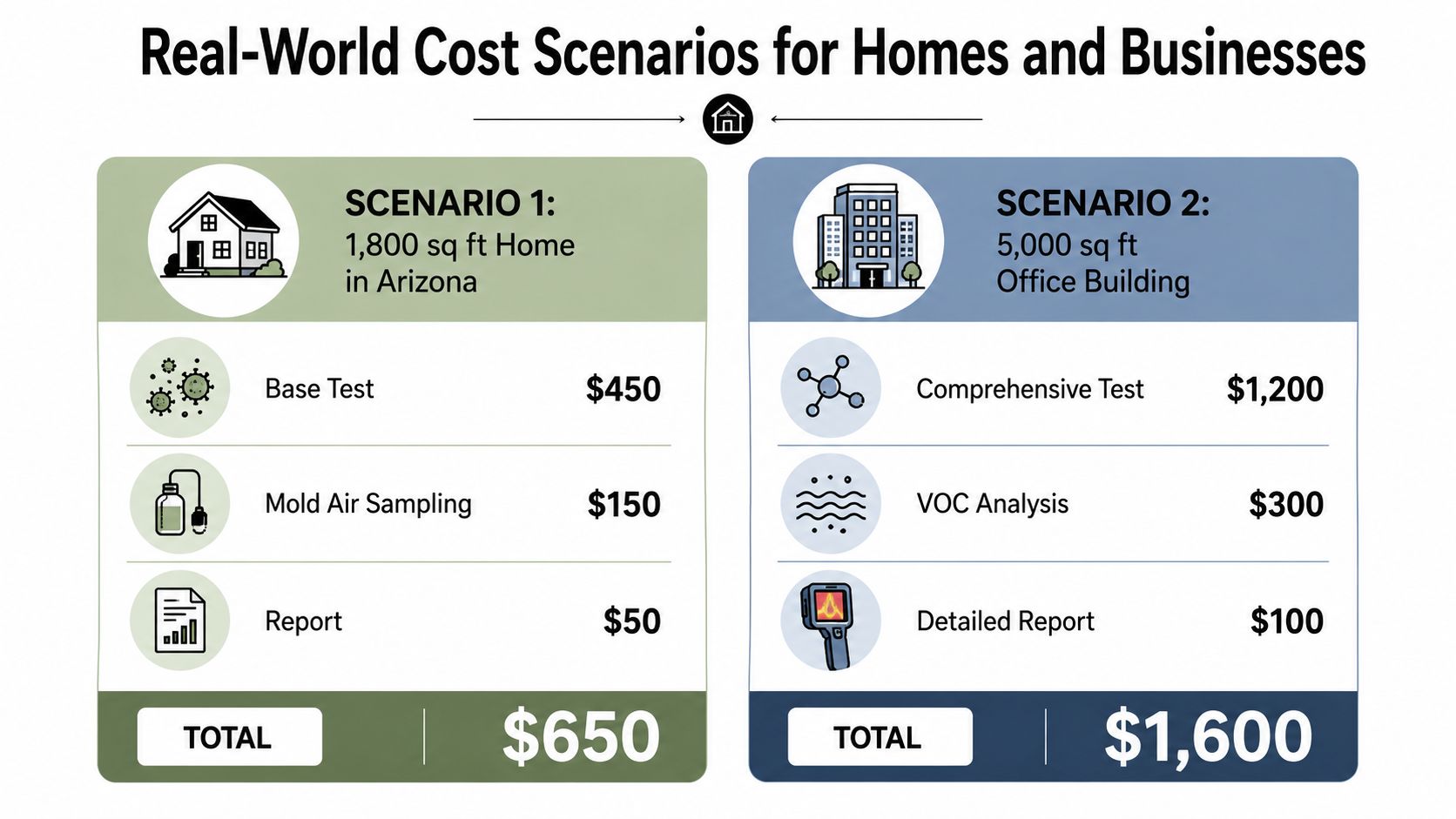
Scenario one, a 1,800 sq ft home with a musty smell
A homeowner notices a damp odor after the AC has been running for a while. The smart play is usually mold air sampling in two rooms, one VOC canister if there's a chemical edge to the smell, plus a visual inspection and report. That kind of job typically lands around $650 to $800, depending on how many samples the technician takes and whether the HVAC system needs closer inspection.
That's the right mindset for a home with a real smell problem. Don't ask for “a test.” Ask for the combination that matches the symptom. A musty odor, especially in a home with older ductwork, can point to moisture in the system, leakage in the return path, or contamination near the coil.
Scenario two, a small restaurant or office
Commercial work is built differently. Commercial IAQ assessments commonly run from $1,000 to $3,000, while industrial hygiene or OSHA-style studies can reach $1,000 to $5,000 (Swivl). That's because the owner usually needs documentation, not just a reading. Multi-zone particulate logging, CO2 tracking, microbial sampling, ventilation evaluation, and a written report all add time and cost.
The business question is rarely “Is the air bad?” It's usually “What do I need for the landlord, the inspector, or the file?” That's why commercial testing is priced more like consulting than a simple service call.
How to read these scenarios
If your situation looks like the home example, you probably need a targeted residential investigation. If it looks like the restaurant or office example, plan for documentation, more samples, and a much broader HVAC look.
How to Read Results and Turn Them Into Fixes
Lab reports look intimidating until you know what the numbers mean. You'll usually see spore counts per cubic meter, VOC concentration in micrograms per cubic meter, CO2 in parts per million, and particulate matter in PM2.5 and PM10. Those numbers matter only if they point to a fix.
Indoor CO2 above 1,000 ppm usually means the space isn't ventilating well enough. High Aspergillus or Penicillium spore counts combined with a moisture problem usually point toward active mold growth. That doesn't automatically mean the whole house is contaminated, but it does mean the building has a moisture or airflow problem that needs attention.
Practical rule: if the report identifies contamination but nobody talks about airflow, moisture, or duct leakage, the job isn't finished.
What each result usually pushes you toward
- CO2 issues: Check fresh air delivery, return-air balance, and ventilation pathways.
- Mold indicators: Find and stop the moisture source, then address affected materials and ducts.
- VOC concerns: Look at building materials, storage chemicals, and off-gassing sources.
- Particle loading: Inspect filtration, duct cleanliness, and source infiltration.
Where the HVAC fix comes in
A useful report should lead straight into a system-level repair. That can mean duct cleaning and sealing, replacing a failed drip pan, adjusting return-air layout, or adding an air purifier when the building needs help with fine particles. In some cases, a UV or RGF air treatment fits the problem, but only after the moisture and airflow story makes sense.
For a practical overview of source control and indoor pollutant reduction, this guide to how to reduce indoor air pollution is worth a look. The right fix always starts with the source, not the symptom.
Local Guidance for Globe, Miami, and Superior Arizona
In Globe, Miami, Superior, and the rest of Gila County, the air problem usually isn't abstract. Desert dust gets into return paths, monsoon moisture exposes weak spots, and older homes often have ductwork that was never designed for today's comfort expectations. Restaurants and small offices add rooftop units, grease, and occupancy swings to the mix.
That's why timing matters. Test after a flood, after remodeling dust, after a lingering odor starts showing up on every cycle, or after employees start complaining about stuffy rooms. If the issue is clearly mechanical, a duct inspection or AC tune-up may beat a stand-alone test. A dirty coil, a disconnected return, or a bad duct layout can mimic an air quality problem pretty convincingly.
When testing makes sense
- Post-water event: Moisture plus odor means you need data before damage spreads.
- After remodeling: Dust and off-gassing can overwhelm a weak filtration setup.
- After complaints: Headaches, stale air, or musty smells deserve a real diagnosis.
- Before buying or selling: Testing helps separate a comfort issue from a liability issue.
When to skip straight to HVAC work
If the home already has weak airflow, obvious duct leakage, or a system that's short-cycling, testing alone won't solve much. The same goes for buildings that haven't had the ducts checked in years. In those cases, the smartest move is to look at the equipment, the ducts, and the airflow path together.
Local owners in Globe, Miami, and Superior also need a contractor who can handle follow-up work without bouncing the problem around. A team with IAQ diagnostics, duct design, repair, AC installation, maintenance, heat pump and furnace work, ductless mini split solutions, RGF-certified indoor air quality options, 24/7 emergency response, and Arizona ROC 339078 licensing is the kind of setup that can test, explain, and fix the issue in one chain of work. If the testing uncovers a duct problem, that follow-up matters more than the report itself.
For duct-related follow-up, this local service page on duct cleaning services near me is the kind of resource homeowners should keep handy. Bundling testing with duct evaluation usually saves time, avoids repeat visits, and gives you a cleaner answer.
Your Quick Decision Checklist
If you want the short version, keep it practical. Basic residential testing usually lives in the $292 to $584 range, with a national average around $437. Targeted tests like mold air sampling, VOCs, and formaldehyde are for specific symptoms, while commercial work moves into the $1,000+ zone fast.
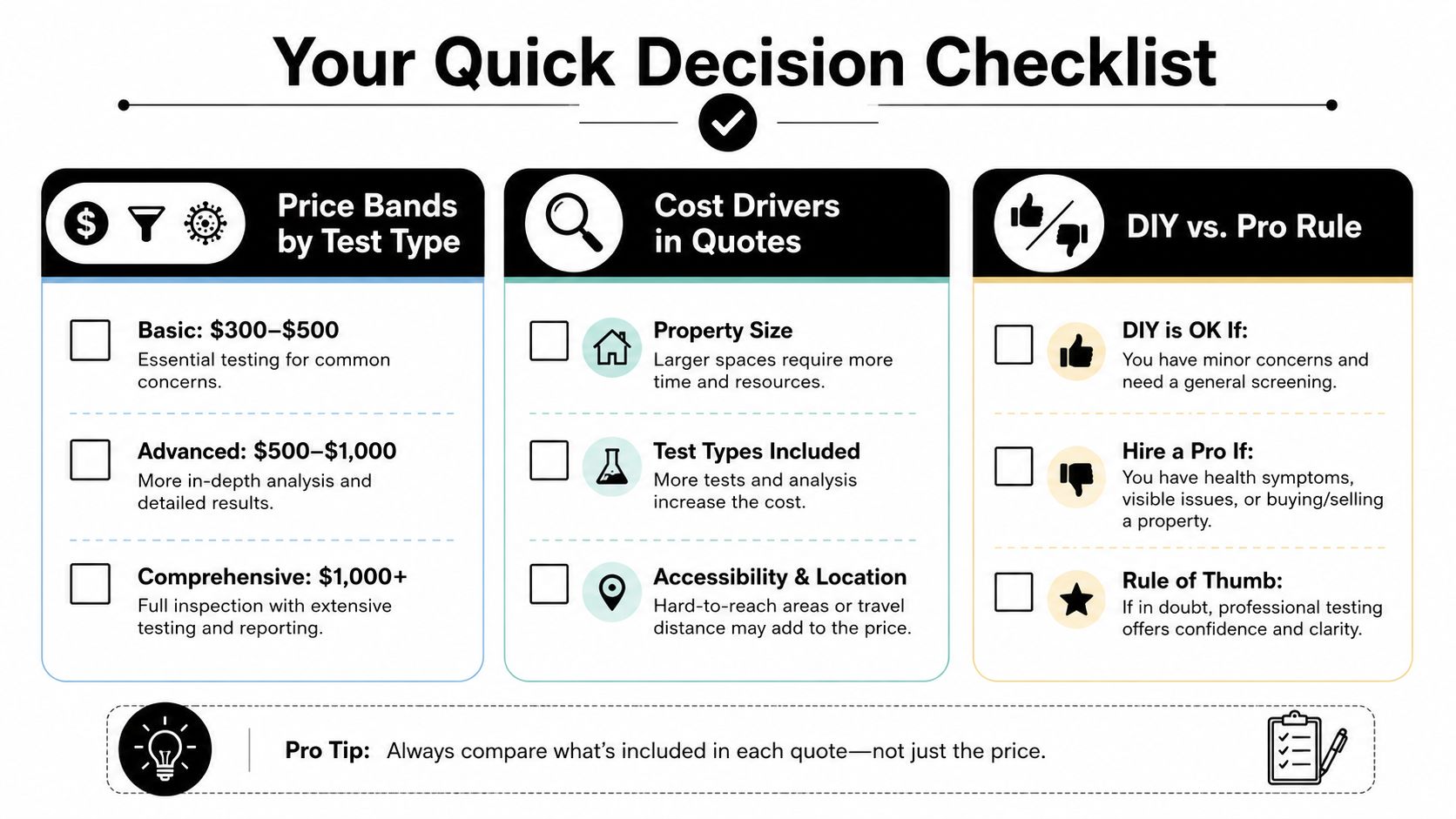
- Price Bands by Test Type: Basic screening, $300 to $500 style jobs fit simple complaints. Advanced or multi-room work belongs in the $500 to $1,000 zone. Investigations start at $1,000+.
- Cost Drivers in Quotes: Watch square footage, sample count, lab depth, and whether the quote includes HVAC evaluation.
- DIY vs. Pro Rule: DIY is fine for a first look. Hire a pro when the result needs to guide repairs, documentation, or tenant and insurance decisions.
- Bundle Smart: If the complaint smells like ductwork, moisture, or airflow, pair testing with HVAC service.
- Local Move: In Globe, Miami, and Superior, don't separate the air question from the system question.
If you're paying for the diagnosis, make sure it leads to the fix.
Cobre Valley Air LLC handles the HVAC side of this problem the right way, with indoor air quality testing, duct design and repair, AC installation and maintenance, and follow-through that connects the reading to the repair. If your home or business in Globe, Miami, or Superior needs a straight answer about the air, visit Cobre Valley Air LLC and ask for the kind of evaluation that leads to a fix.