


On a hot Arizona afternoon, a bedroom can feel stubbornly warmer than the rest of the house even when the thermostat says everything's fine. The filter looks clean, the AC keeps running, and the electric bill still climbs, so the problem starts to feel mysterious fast. In a lot of homes around Globe, Miami, and Superior, the issue is hiding in the ductwork, not in the thermostat or the outdoor unit.
That's where aerosol duct sealant enters the conversation. It's a specialized way to seal hard-to-reach duct leaks from the inside, and it can be a smart answer when the leaks are small, scattered, and buried in places a technician can't easily reach with mastic or tape. It's not a cure-all, though, and that's the part homeowners deserve to hear first.
Why Homeowners Start Asking About Aerosol Duct Sealant
A homeowner usually doesn't call about duct leakage by name. They call because one room stays hot, another room gets too much air, and the system seems to run forever without making the house feel even. In a July cooling season, that story is common enough that it starts to sound like the same complaint wearing different clothes.
The first suspects are usually the obvious ones. A flex run in the attic may be aging, a return may be starved for air, or a branch line may have loose joints that leak conditioned air before it reaches the room. If the filter looks clean, that doesn't rule any of that out. Clean filters don't seal ducts.
That's why duct leakage matters so much in hot-climate homes. When attic-installed ductwork leaks, the system can lose cooled air into the attic and pull in hot, dusty air from outside the conditioned space. Homeowners feel it as uneven temperatures, and the utility bill shows it as wasted cooling.
For a plain-language overview of the broader sealing picture, see what duct sealing means in practical terms. Aerosol duct sealant is one tool in that larger toolbox, useful when the leaks are hidden and the duct system itself is still basically intact.
Practical rule: if the comfort problem feels random, the duct system is worth checking before you blame the equipment.
How Aerosol Duct Sealant Actually Works
A mist that follows the leaks
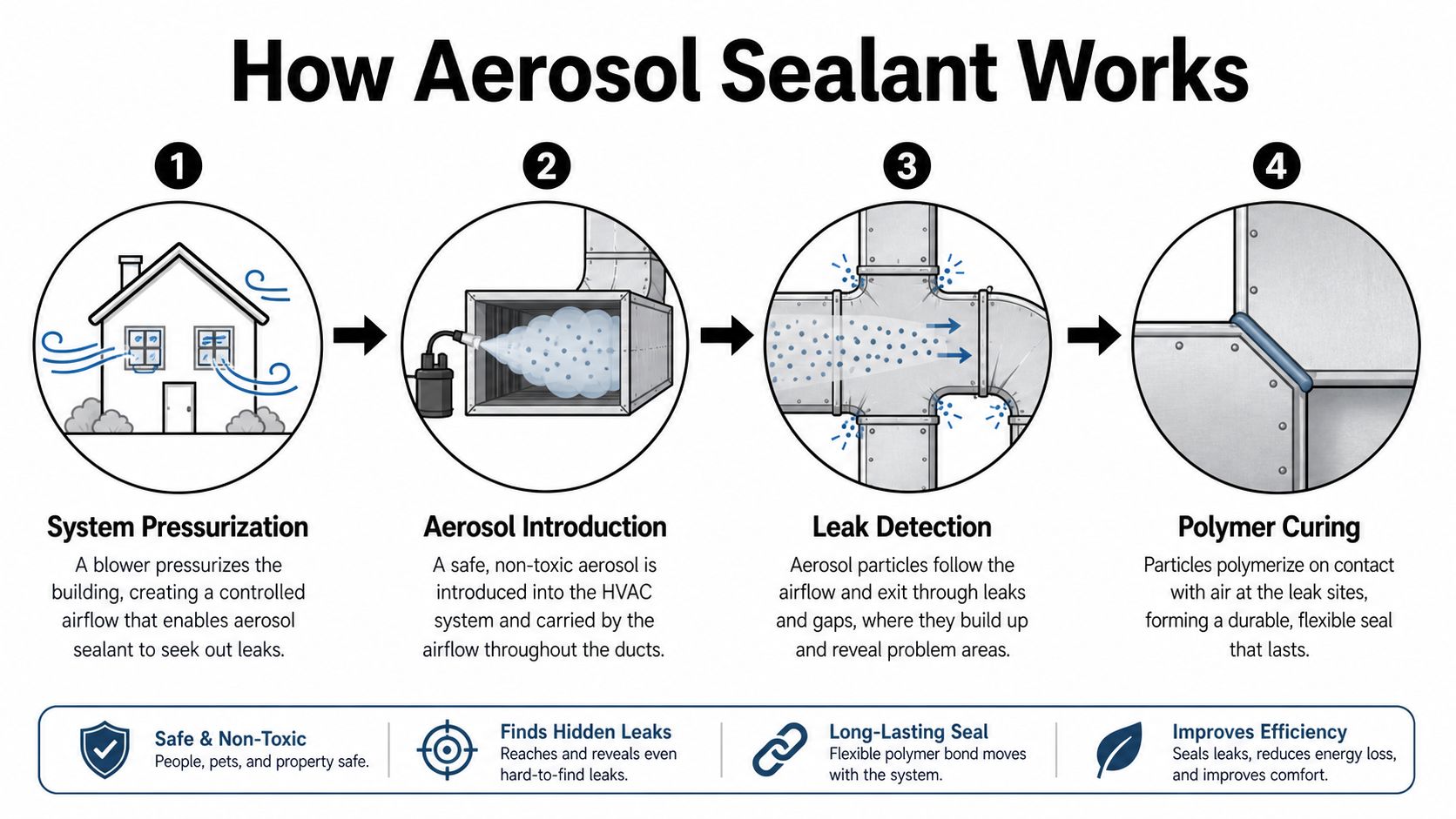
Like fog finding every drafty crack in a house, the technician seals the duct system, then a small fan pushes a mist made of tiny vinyl acetate polymer particles through the ducts. Those particles are measured in the 4 to 10 micron range, so they stay suspended in the airflow until they reach a leak edge, where the pressure drop and boundary-layer effects pull them out of the airstream and into the opening.
That matters because the seal happens from the inside. Hidden joints inside walls, chases, and attics can be difficult or impossible to brush by hand. The mist doesn't need direct access to the outside of the leak, it needs airflow and a pressure difference to guide the particles to the opening.
Why the seal stays usable
The cured material is designed to stay flexible rather than turn brittle. That flexibility matters in Arizona, where ducts heat up and cool down every day and expand a little as the attic temperature swings. A hard, brittle patch would crack sooner. A flexible seal is better suited to movement.
The materials are described in DOE and OSTI technical documents as nontoxic, non-flammable, and intended to remain in place for years with minimal cracking or delamination under service conditions (DOE and OSTI technical material). If you want the installation workflow in a more visual repair context, see how a technician approaches duct sealing from the inside.
The basic workflow
A job normally starts with a pre-test, so the technician can see how much leakage exists before anything is sealed. Then the ducts are pressurized and the sealant mist is introduced. After the sealing pass, a post-test confirms what changed. That verification matters because hidden leaks are easy to guess at and harder to prove without numbers.
The point isn't to make the ductwork perfect. The point is to close the small leaks that are scattered through places the hand can't reach.
What the Field Studies Show
Aerosol duct sealant gets taken seriously because field studies put real numbers behind it. In a 1996 residential test, the process sealed about 80% of the leakage it encountered, the retrofit took 5.5 person-hours, and the study estimated about 500 kWh in annual electricity savings, roughly 10% of average air-conditioning electricity use (ACEEE 1996 field test). That is a field result, not a promise of perfect ducts.
Other studies point in the same direction, with different homes and different duct layouts. An ACEEE comparison found aerosol-spray sealing was 16% to 60% more effective than best-practice duct sealing and cut labor time by about 30%, with average repair time of 98 minutes versus 147 minutes for best-practice homes. A HUD field test found aerosol-spray duct sealing was 50% more effective than the best-practice manual approach and could reduce labor time by 70%, or almost 4 crew-hours (HUD field test).
A homeowner looking at these results can read them the same way a technician would. Aerosol sealing is strongest where leaks are spread through hidden runs and the system is still a reasonable repair candidate. It is less relevant when the ductwork needs open-access repairs first.
| Study | Leak Reduction | Labor Time | Key Takeaway |
|---|---|---|---|
| 1996 residential field test | About 80% of leakage encountered | 5.5 person-hours | Strong sealing in a typical home setting |
| ACEEE comparison | 16% to 60% more effective than best-practice sealing | About 30% less labor, 98 minutes vs 147 minutes | Faster than manual sealing in many homes |
| HUD field test | 50% more effective than the best-practice manual approach | 70% less labor, almost 4 crew-hours saved | Useful when access is limited |
| LBNL commercial work | Leak class reductions from 653 to 103 and 40 to 3 | Within a few hours | Practical for large commercial systems |
The commercial studies point the same way, even though the job size changes. Lawrence Berkeley National Laboratory reported that aerosol sealing reduced ASHRAE leakage classes from 653 to 103 in one building and from 40 to 3 in another (LBNL commercial testing). A separate commercial field trial found 66% to 86% of duct leakage could be sealed within several hours.
That is why the inspection step matters before anyone starts sealing. A proper evaluation shows whether the leaks are the kind aerosol mist can reach, or whether the job needs hand repair first, which is why homeowners often begin with a ductwork inspection cost and scope check. The best results show up when the duct system is a good candidate, not when damage has already spread into sections that need conventional repair.
Aerosol Sealing vs Mastic and Tape
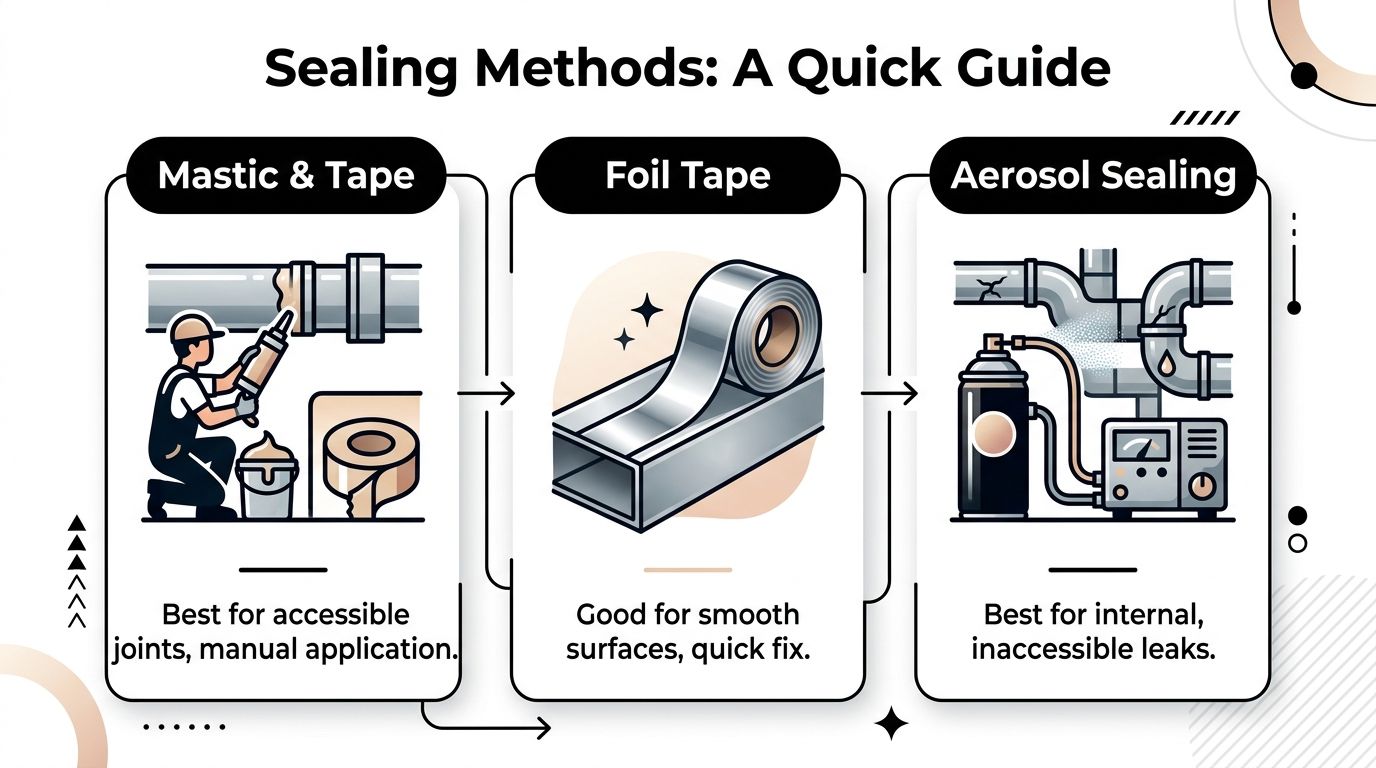
If a technician can see and reach the joint, mastic is usually the first place to start. It is the brush-on sealant used over accessible seams, so it works well on garage ductwork, basement trunks, and other spots where the leak is right in front of you. In many homes, that kind of direct repair should happen before anything more specialized.
Foil tape has a narrower job. It belongs on clean, smooth, accessible surfaces, where the adhesive can grip properly and the seam can be prepared the right way. The gray cloth tape many people call duct tape is not a permanent HVAC sealing solution, and anyone who has worked in a hot attic has seen how heat, dust, and age weaken poor adhesive quickly. Proper foil tape is better, but it still only helps where a hand can reach the seam.
Aerosol duct sealant handles a different kind of problem. It is the better option when leaks are hidden inside walls, chases, or long duct runs that would take major demolition to open up. That makes it especially useful in retrofit work where the system is mostly intact, but the trouble spots are buried inside the assembly.
| Method | Best Use | Main Strength | Main Limit |
|---|---|---|---|
| Mastic | Accessible joints and seams | Durable manual seal | Needs direct access |
| Foil tape | Smooth, visible seams | Quick on the right surface | Less forgiving in harsh conditions |
| Aerosol sealant | Hidden internal leaks | Reaches inaccessible openings | Not for major duct failure |
Choose the method that matches the leak you can actually reach. The strongest jobs often combine methods rather than betting on one alone.
The source PDF on aerosol sealing describes crack sealing up to about 1/2 inch, which helps explain why the process works as an internal leak-finder rather than a structural repair system (technical field guidance). If you are sorting through repair choices for your own home, a detailed look at duct sealing options for homeowners can help separate access problems from design problems.
When Aerosol Duct Sealant Is the Wrong Tool
The biggest mistake is treating aerosol sealing like a fix for every duct problem. It isn't. Neutral technical guidance says it's intended for small leaks, generally up to about 1/2 inch in diameter, and individual leakages larger than 1.5 cm are not guaranteed to seal completely (NREL technical guidance; MEZ-AEROSEAL FAQ).
What still needs conventional repair
A crushed flex duct needs physical replacement or rework. A disconnected run in an attic needs to be rejoined, not misted over. A sagging return or a return plenum that was never sized correctly is a duct design issue, not a leak-sealing issue. Aerosol sealing can't restore airflow to a duct that was built wrong in the first place.
That's why a real decision tree starts with the failure pattern. If the leak is small and hidden, aerosol sealing may fit. If the duct is broken, disconnected, or badly designed, the right answer is conventional repair first.
The homeowner test
A good candidate usually has intact duct runs with lots of small, scattered leaks. A poor candidate usually has obvious damage, crushed sections, or a system with major obstructions that prevent air from moving correctly. In those cases, sealing alone can hide the symptom while the underlying problem keeps draining comfort and efficiency.
Here's a simple way to consider it.
- Small hidden leaks: good match for aerosol sealing.
- Accessible seams and joints: better for mastic or foil tape.
- Disconnected, crushed, or collapsed ducts: needs repair or replacement.
- Bad duct design: needs a design fix, not just a seal.
If you're dealing with hot-climate duct losses in attic space, especially in Arizona, the diagnosis matters more than the sales pitch. A careful inspection should tell you whether sealing will solve the problem or just improve one part of it.
Hard rule: if the duct is structurally broken, sealant is the wrong first step.
Code, Safety, and Site Conditions to Get Right
Aerosol sealing works best when the job site is controlled, not chaotic. One of the most important conditions is humidity. MEZ-AEROSEAL says humidity should be below 40% for optimal results, which matters because the process needs predictable conditions to cure and verify properly (MEZ-AEROSEAL FAQ).
Systems that need to be isolated
Smoke alarms, fire alarms, and sprinkler systems should be switched off or isolated before sealing because the process can activate them. That's not a minor detail. A nuisance alarm can turn a routine sealing visit into a disruption for the whole building, and a sprinkler issue is a serious operational problem.
The same FAQ also notes that the process targets inaccessible leaks, which means verification is part of the job, not an optional add-on. You want proof that the sealing pass worked, not just a promise that it should have.
Specs that matter in the field
Commercial datasheets commonly list SMACNA Seal Class A compliance, operation at up to 10 inches water gauge, and service-temperature ranges around -20°F to 480°F depending on formulation (technical datasheet). Those numbers matter because they tell you the material is meant for real HVAC conditions, not a laboratory demo.
A good contractor should be able to tell you:
- What got isolated: alarms, sprinklers, or sensitive sensors.
- What the humidity was: and whether it was within the acceptable range.
- What the pre-test showed: before sealing started.
- What the post-test showed: after the system was sealed.
- Whether combustion equipment was evaluated: if the home has appliances that could be affected by pressure changes.
That last point matters in homes with furnaces or other combustion appliances, because sealing can change how air moves through a duct system. Duct design issues don't disappear just because leaks are smaller.
For homeowners who want the broader system checked, Cobre Valley Air LLC pairs duct sealing recommendations with airflow and duct evaluations, which is the right way to avoid treating a pressure problem like a simple leak problem.
Cost, ROI, and What a Real Quote Should Include
The money question comes up fast because homeowners don't want another vague HVAC upsell. The simplest way to judge value is to compare the job price to the leakage problem and the likely energy waste. In the OSTI review, the manufacturer reported an average household savings of $600 to $850 per year in energy costs after sealing (OSTI review).
What a legitimate quote should show
A good quote should separate the work into parts, not bury everything in one line item. Ask for the pre-test, the sealing pass, and the post-test as distinct pieces of the job. If the contractor gives you photos, a report, or a before-and-after leakage readout, that's even better because you can see what changed.
If a quote doesn't include verification, you're buying a promise instead of a measured result.
The best ROI usually shows up in homes with significant leakage, accessible equipment, and ductwork that runs through hot attics. Those are the houses where conditioned air is being lost before it ever reaches the room, so reducing leakage directly improves delivered comfort. The payback story gets weaker when the ducts are already tight or when the primary problem is damaged duct design.
Why this is usually not a DIY job
Aerosol sealing needs sealed access points, calibrated equipment, and the ability to interpret the test results correctly. That's why most homeowners hire a licensed HVAC technician instead of trying to improvise it. The process also needs enough system understanding to know when sealing should be paired with manual repair, not used by itself.
If you're comparing service proposals, the one that explains the test numbers is usually the one worth listening to. A low quote without diagnostics can leave you with a partial fix and the same comfort problem next summer.

Hiring a Licensed HVAC Technician in the Cobre Valley
A good technician doesn't just sell a sealing process. They look at the whole duct system, the airflow pattern, and the equipment that depends on it. In Globe, Miami, Superior, and nearby Arizona communities, that matters because cooling season exposes weak duct design fast.
What to ask before you sign anything
Look for an Arizona ROC license, EPA 608 certification, and training that covers duct diagnostics or the equipment being used. Ask for the pre- and post-leakage test results in writing, and ask who will verify the duct layout if the sealing pass uncovers a bigger design issue. A contractor who can answer those questions clearly is treating the system like a system.
You should also ask about the seal warranty and whether the job includes a follow-up check if the numbers don't come back where they should. That kind of conversation tells you whether the technician is focused on measurement or just selling a visit.
What a solid service call looks like
The technician should inspect for disconnected sections, crushed flex, oversized gaps, and airflow restrictions before deciding on aerosol sealing. If the ductwork needs manual repair first, that should be part of the plan. If the duct system is a good candidate for aerosol sealing, the technician should be able to explain why in plain language.
A reputable HVAC tech should be able to say what will be sealed, what will be repaired, and what won't be touched.
Cobre Valley Air LLC fits that model by pairing duct sealing recommendations with airflow and duct evaluation, rather than treating sealing as a stand-alone answer. That matters in hot-climate homes where comfort problems often come from a mix of leakage, poor duct design, and aging equipment.
For a homeowner, the next step is simple. Request a diagnostic, ask for the pre- and post-test numbers in writing, and only sign off when the result matches the promise.
If you're dealing with uneven rooms, duct leakage, or an HVAC system that's working harder than it should, Cobre Valley Air LLC can help you sort out whether sealing, repair, or a larger duct fix makes sense. Visit Cobre Valley Air LLC to ask for a diagnostic and get the ductwork checked the right way.