


Professional air duct sealing typically costs $1,000 to $2,500 for most homes, with a broader range of $500 to $4,000 depending on duct size, accessibility, and sealing method. If your house keeps one bedroom cold, another warm, and the AC never seems to quit, that price range is usually the cost of fixing the problem directly.
I see this all the time in Arizona homes. The dust keeps coming back after you clean, the thermostat says one thing, and the rooms tell you another. In places like Globe, Miami, and Superior, that usually means the duct system is leaking conditioned air somewhere you can't see.
Why Your Ducts Might Be Costing You Money
A homeowner calls because the front bedroom feels fine, the back hallway feels like an oven, and the utility bill keeps climbing every summer. The AC runs, the thermostat clicks, and nothing ever quite settles down. That's the kind of complaint that usually points to duct leakage before it points to a bad compressor.
The signs show up in ways people can feel. Uneven temperatures between rooms, excess dust, whistling vents, and an AC that seems to run nonstop without reaching the set temperature are all classic warning signs. In a desert climate, those problems get harder to ignore because the system is already fighting extreme heat and big temperature swings.
Why Arizona homes feel it faster
Older construction around rural Arizona often makes the problem worse. Attics get brutal, crawlspaces are tight, and duct runs can be long and awkward. That means more opportunities for leaks, more heat gain, and more wasted cooling before air reaches the rooms you're paying to condition.
Practical rule: If the house cools unevenly and the filter is clean, don't guess at the cause. Start with the ductwork.
The right price question comes after the right diagnosis. For most homes, professional air duct sealing still lands at $1,000 to $2,500, with a broader range of $500 to $4,000 depending on the duct layout, access, and method used, according to the consumer pricing guidance from Angi's duct sealing cost overview. That spread is the point. You're not just buying “sealing,” you're paying for how hard the ducts are to reach and how much of the system needs attention.
If your house is in Globe, Miami, or Superior, the climate pushes a marginal duct system into a real problem faster than it would in a milder place. That's why I tell homeowners not to wait for a dramatic failure. A leaky duct system rarely quits all at once, it drains comfort and cash.
What Drives the Price of Duct Sealing
Homeowners often want a simple answer on duct sealing cost. There isn't one. Labor dominates the total cost, while sealant materials are usually a small part of the bill, so two homes with the same square footage can still get very different quotes.
Key cost drivers
A duct run hanging open in a garage is straightforward. Ducts buried in an attic, boxed into a tight chase, or spread through a crawlspace are not. Every extra minute a technician spends reaching a leak adds to the bill, and that is before the sealing work even starts. NREL's Measure Guideline puts duct sealing at $0.64 to $6.00 per square foot of duct area, with an example home cost of $285 to $2,670 depending on how much leakage is reduced, such as sealing from 30% to 6% leakage in the guide's example (NREL Measure Guideline).
That is the number range I would keep in mind while comparing quotes. A low bid that skips access challenges, diagnostics, or verification usually leaves part of the job undone. Cheap work on duct sealing often means partial work.
For rural Arizona homes, access drives pricing even harder. In places like Globe, Miami, or Superior, many systems sit in hot attics, cramped chases, or awkward older layouts that slow the job down. The climate also punishes leaky ductwork faster, because every leak is fighting desert heat instead of mild air.
What moves the bill
Use this checklist when you compare estimates:
- Duct area: More ductwork means more sealing points and more labor.
- Access difficulty: Attics, crawlspaces, and cramped mechanical closets slow the job down.
- Leak severity: Bigger or more scattered leaks usually take more work.
- Method choice: Manual patching and whole-system aerosol sealing price very differently.
- Verification: Re-testing after the seal takes time, and good contractors charge for that time.
The same pattern shows up in the Department of Energy case study. A Raleigh example documented by the DOE showed aerosol sealing plus manual sealing for large leaks at about $700 per dwelling unit, compared with $300 to $500 for manual sealing alone, and the same source places whole-system aerosol work around $1,300 to $3,000 for many single-family homes while manual methods often run $400 to $1,900 (DOE case study). That gap is what you pay for when the ducts are hard to reach or the leaks are spread through the system.
If you want a better handle on aerosol-based jobs, a straightforward overview like this aerosol duct sealant guide helps explain why the price shifts so much from one house to the next.
A low quote only means something if it includes testing before and after the work.
Aerosol Sealing vs Manual Sealing Compared
Manual sealing and aerosol sealing solve the same problem in different ways. The right choice depends on where the leaks are, how easy the ducts are to reach, and how much of the system is compromised. For a homeowner, the conversation becomes practical, not theoretical.
Manual sealing is the hands-on method. A tech uses mastic, metal-backed tape, and fasteners on accessible joints and connections. It's the cheaper path when the ducts are exposed and the leakage is localized. Aerosol sealing sends a pressurized mist through the duct system so the sealant collects at the leak points from the inside, which is useful when leaks are scattered or hidden.
The cost split is real. Independent 2026 HVAC pricing data puts manual sealing at about $20 to $75 per register and roughly $2 to $6 per linear foot for accessible trunk runs, while aerosol sealing commonly runs $400 to $1,200 per system for typical single-family homes and up to $1,800 for larger or more complex layouts (HVAC Review Hub pricing guide). That premium is worth paying when the ducts are hard to access or the leaks are spread across the system.
| Factor | Manual Sealing | Aerosol Sealing |
|---|---|---|
| Best fit | Accessible joints, visible leaks, simple layouts | Hidden leaks, complex layouts, poor access |
| Cost profile | Lower upfront cost | Higher upfront cost |
| Labor demand | High hands-on labor | Less direct labor on every joint |
| Coverage | Strong for reachable problem spots | Strong for dispersed leakage inside the system |
| Limitation | Misses hidden leaks | Costs more and needs the right setup |
If you want a plain-English walkthrough of aerosol sealing, the overview at Cobre Valley Air's aerosol duct sealant page shows the basic concept well.
I'm blunt about this. If your ducts are exposed and the problem is obvious, manual sealing is usually the smarter spend. If the system snakes through an attic and leaks are everywhere, aerosol can make more sense because it reaches what your hands can't.
What Happens During a Professional Duct Sealing Visit
A real duct sealing visit starts with measurement, not guesswork. A technician should test leakage before touching the system, because a visual inspection alone cannot tell you how much air is escaping. That baseline matters. It shows whether the work improved the system when the job is done.
The Minnesota Commerce study on commercial duct leakage is a good reminder that duct retrofit economics depend on measured airflow, not impressions. It reports an average of 3.36 $/cfm-design and a range from 0.22 to 23.76 $/cfm-design, plus a separate sealed-flow metric averaging 19.11 $/cfm-sealed with values from 6.68 to 53.89 $/cfm-sealed (Minnesota Commerce duct leakage study). The point is straightforward. Testing gives you a number, and that number tells you whether the system is worth sealing and how hard the job is likely to be.
What the technician should do
First, the contractor isolates the duct system and measures leakage. Then the sealing work begins, whether that means manual patching on reachable joints or aerosol treatment inside the ducts. After that, the system gets re-tested so the homeowner can see the difference in airflow or leakage reduction.
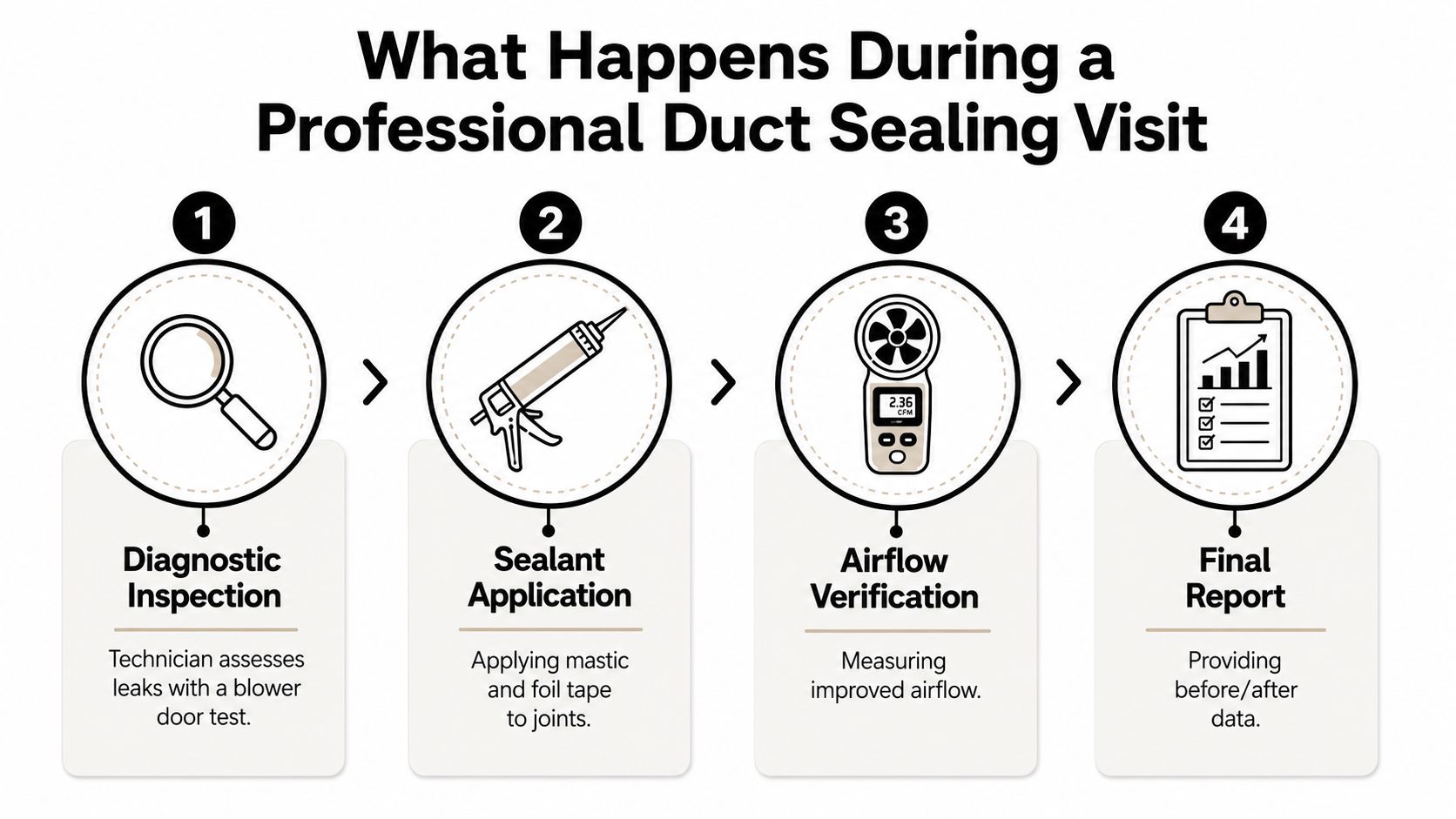
That visit should also include cleanup and verification. If someone says they sealed the ducts but cannot show pre and post numbers, they did not finish the job the way a professional should.
Homeowners who care about quality AC repairs, AC installation, and AC maintenance should insist on this standard. A proper repair mindset includes airflow and duct evaluation because comfort problems usually stack up across the whole system, not just one part. If you want to judge the value of the work in plain terms, use the HVAC energy savings calculator and compare the likely payback before you sign anything.
Energy Savings and Payback Period for Arizona Homes
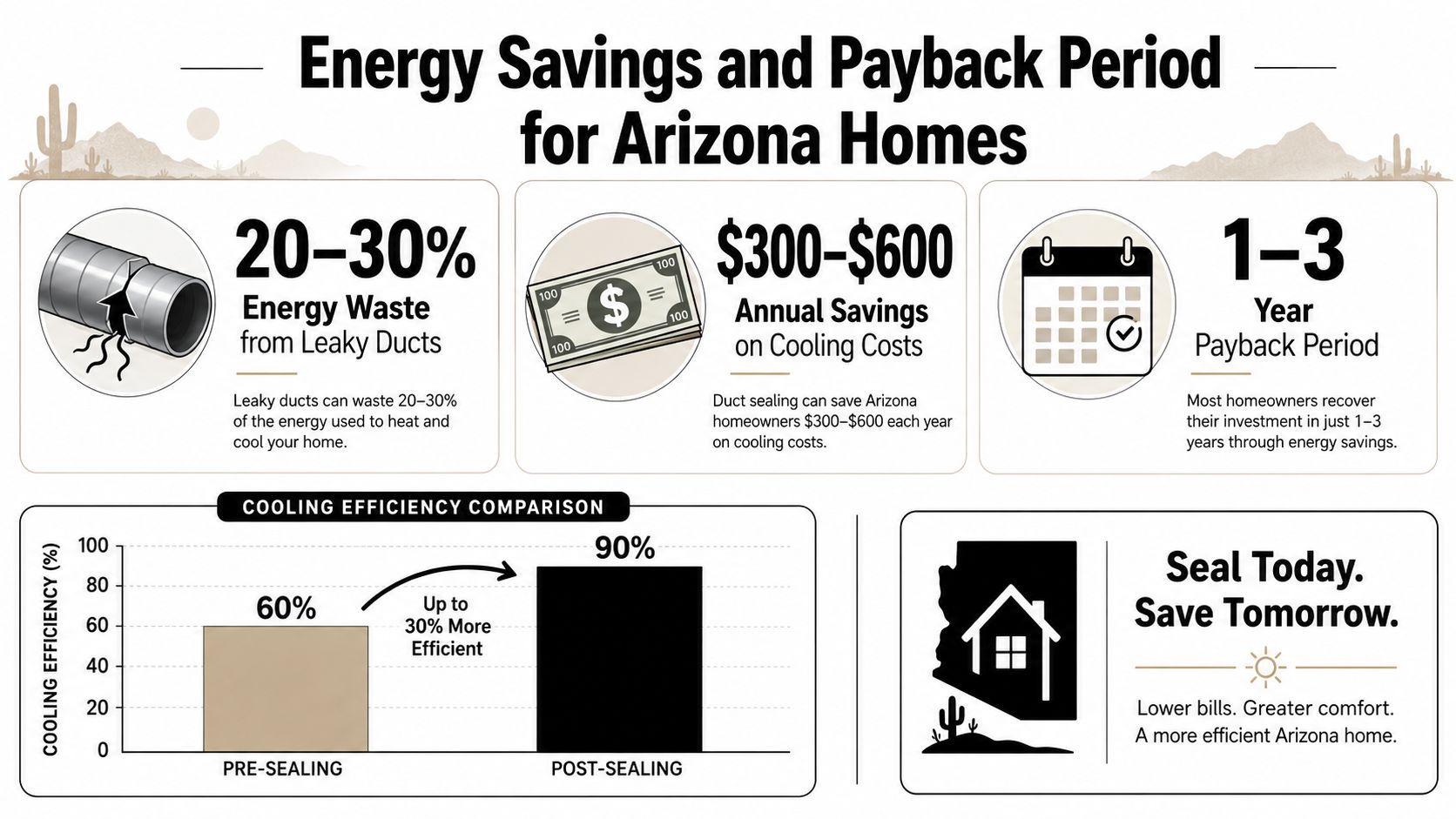
Leaky ducts waste conditioned air before it ever reaches the room you're trying to cool. In some homes, 20 to 30 percent of heated or cooled air escapes through gaps, and that's a huge drain when summer cooling is already expensive in Arizona. Sealing that loss doesn't just trim the bill, it shortens AC run time and reduces wear on the blower and compressor.
Why desert climates usually see value sooner
Globe, Miami, and Superior are not forgiving climates. The AC works hard, the house bakes between cooling cycles, and every bit of leakage gets amplified by the demand on the system. That's why duct sealing often pays back faster here than in a mild climate where the equipment gets fewer hard run hours.
The DOE case study and guideline data support that logic. The 2014 Raleigh example showed aerosol plus manual sealing at about $700 per dwelling unit, and the DOE guidance also ties leakage reduction from 30% to 6% to a cost of about $1.30 to $6.00 per square foot of duct area, or roughly $579 to $2,670 in the example home (DOE case study). The financial point isn't that every home saves the same amount. The point is that tighter ducts reduce the amount of cooled air you pay to make and then lose.
There's also a useful online calculator at Cobre Valley Air's HVAC energy savings calculator if you want to think through the math for your own house.
My rule is straightforward. If the house has uneven cooling, the AC runs too long, and the ducts are in a hot attic or a cramped chase, duct sealing is usually a better investment than another quick repair. It's one of the few HVAC fixes that helps the utility bill and the equipment at the same time.
DIY Duct Sealing vs Hiring a Professional
You can seal some ductwork yourself, but only the easy parts. If the duct joints are exposed in a garage or basement, a handy homeowner can use mastic and foil tape on visible connections. That's a legitimate fix for a small, reachable problem.
The limits show up fast in Arizona homes. Much of the ductwork runs through attics or enclosed spaces where you can't see every joint, and hidden leaks can't be found without pressure testing gear. If you skip testing, you're guessing. If you use the wrong material, especially standard duct tape, the repair won't hold up the way it should.
Where DIY falls short
- Inaccessible ducts: If you can't reach the leak, you can't seal it correctly.
- No verification: Without pre and post testing, you don't know if the leak dropped.
- Airflow mistakes: Bad sealing can restrict flow and create new comfort problems.
- Missed leak points: Small gaps add up fast when they're spread across the system.
Professional sealing makes more sense for most homes because the tools matter as much as the sealant. Contractors can pressure-test the system, find hidden leakage, and verify the result after the work is done. That's the difference between patching a visible problem and fixing the whole system.
If you want a more detailed look at the mechanics of sealing, the guide at Cobre Valley Air's ductwork sealing page is a useful reference. In real service calls, financing can also make the professional route easier to handle, including options through Wisetack and OPTIMUS when a homeowner wants to spread the cost out instead of postponing the repair.
Cobre Valley Air LLC, Arizona license ROC 339078, handles duct evaluations as part of its HVAC work and partners with Goodman, Amana, and Daikin. That matters because the best sealing job is the one tied to the rest of the system, not treated like an isolated patch.
Common Questions About Duct Sealing Costs
Older homes are often the first ones I'd check. Aging duct runs, loose joints, and attic exposure make leaks more likely, so sealing is usually worth serious consideration if the house struggles to cool evenly. I'd also look at duct sealing before replacing an AC unit, because new equipment won't fix leaky distribution.
Homeowners also ask how often ducts need to be re-sealed. There isn't a universal schedule, but if the system was poorly sealed, damaged, or altered during other HVAC work, it may need another evaluation. The better approach is to test the system instead of assuming it still holds.
A few other direct answers:
- Does sealing require cutting into walls or ceilings? Usually no, not for accessible systems. Manual work happens at reachable joints, and aerosol sealing works through the ducts themselves.
- How long does it take? It depends on access and scope, so ask for an on-site estimate instead of a phone guess.
- What should a quote include? Diagnostic testing, pre and post measurements, the sealing method, and warranty terms.
- What's a red flag? A quote that comes without an in-person look, or a price that sounds too low for the scope of work.
If a contractor won't measure it, they're not really quoting it.
For homeowners in Globe, Miami, Superior, and nearby Arizona communities, I'd call for a diagnostic evaluation before the next cooling season turns brutal. Ask for service that's built around repair, not pressure, and expect straightforward answers, 24/7 emergency response, and the kind of service record that includes 40+ five-star Google reviews when you compare local options.
If your house has hot rooms, dust issues, or an AC that never seems to catch up, get the ductwork tested before you replace equipment you might still be able to save. Cobre Valley Air LLC handles duct evaluation, HVAC repair, installation, and sealing work for Arizona homes, and you can start with a no-pressure conversation at Cobre Valley Air LLC.