


It's 115°F in Globe, the thermostat is set normally, and your air conditioner has tripped the breaker three times this week. The house is getting hotter by the minute, the outdoor unit is silent, and the earliest available technician may not arrive until later in the day. That's when the question becomes urgent: when should you replace the air conditioner instead of repairing it again?
Generic advice usually points to a 15-to-20-year lifespan, but Arizona systems live under much harsher conditions than equipment in mild climates. Heat, dust, long operating cycles, poor airflow, and installation mistakes can push a desert system toward failure sooner. The right decision depends on age, performance, repair economics, refrigerant, and whether the equipment still makes financial sense for the next cooling season.
Why Arizona Homeowners Face Different AC Replacement Timelines
Arizona homeowners shouldn't treat the calendar as the only measure of equipment life. A central air conditioner may still run after many years, but that doesn't mean it can cool efficiently, tolerate another severe summer, or justify another major repair.
Desert heat changes the workload
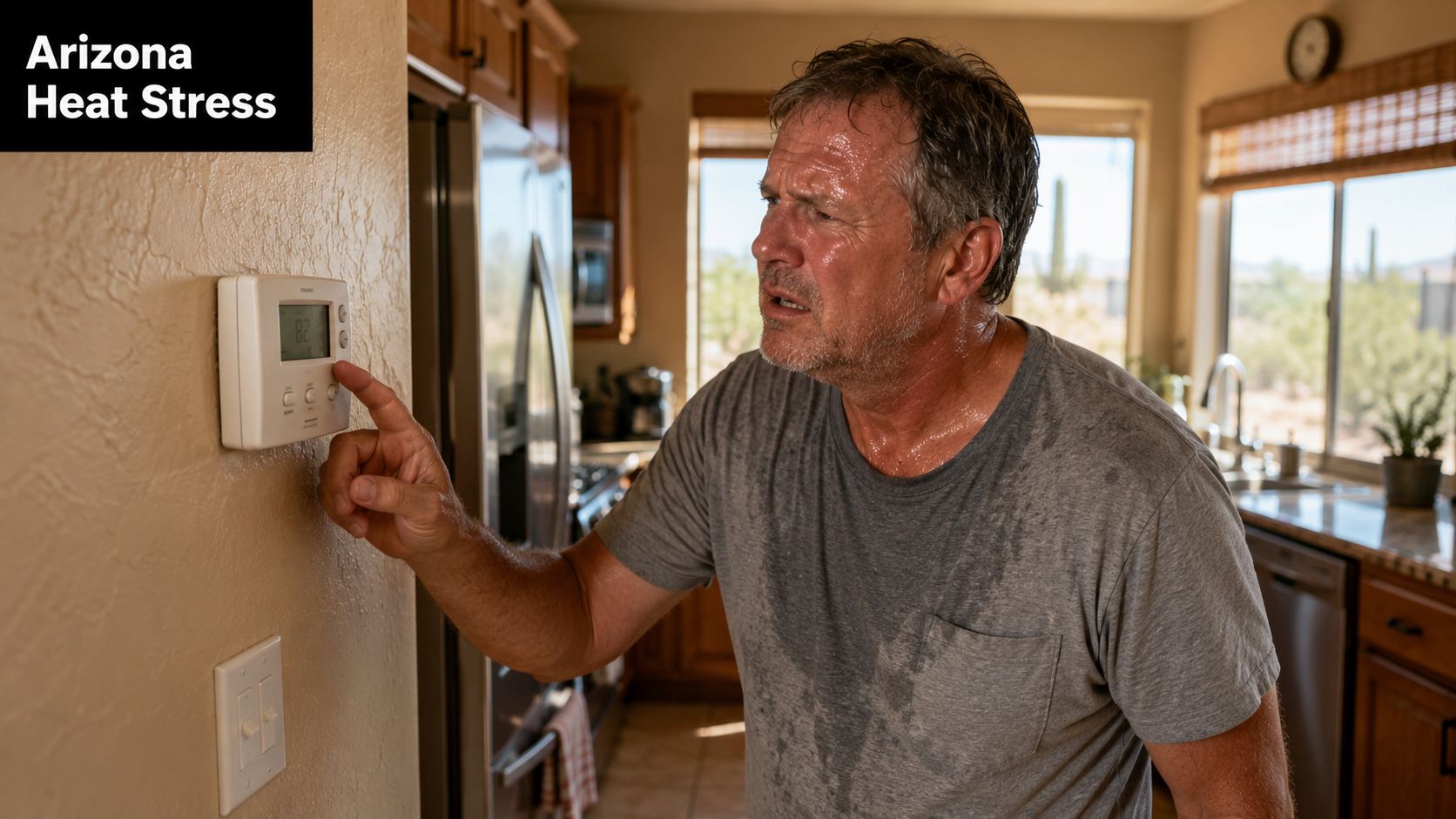
The compressor moves refrigerant through the system while the outdoor condenser tries to release heat into already scorching outdoor air. As outdoor temperatures rise, the equipment has to work harder to reject heat and maintain indoor comfort. Long runtimes increase heat exposure for electrical components, fan motors, compressors, and wiring.
Monsoon dust adds another problem. Fine dust and debris collect on outdoor coils and restrict heat transfer, while neglected filters reduce indoor airflow. The system then runs longer to deliver the same cooling, which increases operating stress and utility use.
That's why a national lifespan range is only a starting point. Carrier's air-conditioning lifespan guidance states that most systems last 15 to 20 years with proper maintenance, while Angi's cited range for central AC units is 12 to 17 years, with neglected systems potentially failing around the 10-year mark. A unit approaching or exceeding fifteen years deserves replacement planning, but a heavily used Arizona unit can become uneconomical earlier.
Desert rule: Judge the system by accumulated runtime, operating conditions, repair history, and cooling performance, not by the installation date alone.
Performance matters more than the birth certificate
A well-maintained system that was correctly sized and installed may remain dependable longer than a younger unit with restricted ducts, refrigerant problems, or years of skipped maintenance. Conversely, a ten-year-old system that struggles through every summer may be a worse investment than a somewhat older unit that still delivers stable airflow and consistent cooling.
If your energy bill has climbed without a change in household habits, review the causes rather than assuming the utility is solely responsible. A useful starting point is this guide to why your energy bill may be so high, followed by a professional inspection of the filter, coils, refrigerant charge, electrical components, ductwork, and thermostat operation.
The practical conclusion is straightforward. In Arizona, start planning before a system reaches the national replacement range, especially if it already has recurring failures or comfort problems. Waiting for a complete breakdown turns a deliberate equipment decision into an emergency purchase during the most demanding part of the year.
Typical Air Conditioner Lifespans and What Shortens Them
National lifespan guidance gives Arizona homeowners a starting point, not a guarantee. Carrier's published lifespan guidance places a properly maintained central AC system in the 15-to-20-year range. Another industry range puts central AC replacement intervals around 13 to 14 years, which often matches how owners plan for major equipment.
Arizona systems often reach the lower end of those expectations. Extreme outdoor heat, dust, and long cooling seasons keep the equipment working for more hours and leave less recovery time between cycles. Equipment quality, sizing, duct design, maintenance, and installation workmanship still determine the actual result.
AC Lifespan Comparison by Climate Zone
| Climate Zone | Avg. Lifespan | Annual Runtime Hours | Primary Stress Factors |
|---|---|---|---|
| Mild climate | Longer within the national range | Lower relative runtime | Moderate cooling demand and less extreme outdoor heat |
| National benchmark | 15 to 20 years with proper maintenance | Varies by location and household | Normal seasonal cycling, maintenance quality, and installation |
| Arizona desert climate | Often closer to the lower end of the national range | High and extended cooling demand | Extreme heat, dust, long runtimes, restricted coils, and airflow problems |
The table explains why installation age alone gives an incomplete answer. Effective lifespan depends on accumulated runtime, operating conditions, and how well the system has transferred heat over the years. A desert unit can wear out sooner than a similar system in a milder climate, even when both have the same installation date.
Components that commonly show stress
Capacitors face repeated exposure to high outdoor temperatures. As one weakens, the motor or compressor may struggle to start, hum, trip a breaker, or shut down unexpectedly.
Compressor windings endure greater stress when dirty coils, an incorrect refrigerant charge, or poor airflow keeps the system running for long periods. Compressor failure requires a serious repair decision because the compressor is the system's central mechanical component.
Coils and refrigerant circuits develop problems through corrosion, debris, leaks, and reduced heat transfer. The unit then runs longer to deliver the same cooling. Older equipment with a legacy refrigerant can become harder and more expensive to service as supply and parts availability change.
Installation defects shorten the service life of every major component. An oversized unit may cycle too often, while an undersized one may run nearly continuously. Leaky ducts, incorrect refrigerant charging, weak electrical connections, and skipped maintenance add further stress.
My recommendation: If your AC has entered the later part of its expected life and already needs repeated repairs, plan replacement before failure. Judge it by reliable, economical operation through the next Arizona summers, not by its age alone.
Warning Signs Your AC Is Nearing End of Life
Not every failure means replacement. A dirty filter, worn contactor, or failed capacitor can often be repaired. The mistake is treating repeated symptoms as isolated events when they're signs of declining equipment.
Start with performance changes, then examine repair patterns and refrigerant issues. The more serious the component and the older the system, the stronger the replacement case becomes.
Early-stage signals
Rising utility bills deserve investigation when your household usage and comfort settings haven't changed. A technician should inspect airflow, coil cleanliness, refrigerant charge, duct leakage, and system operating temperatures. If the unit still has solid capacity and the problem is a dirty filter or coil, maintenance may restore performance.
Uneven cooling can come from duct restrictions, poor balancing, insulation problems, thermostat placement, or equipment capacity loss. Don't replace the condenser based on one hot room alone. Have the duct system and airflow measured first.
Longer cycles are another early warning. If the unit runs much longer to reach the same thermostat setting, check the filter, outdoor coil, indoor coil, refrigerant circuit, and blower performance before deciding.
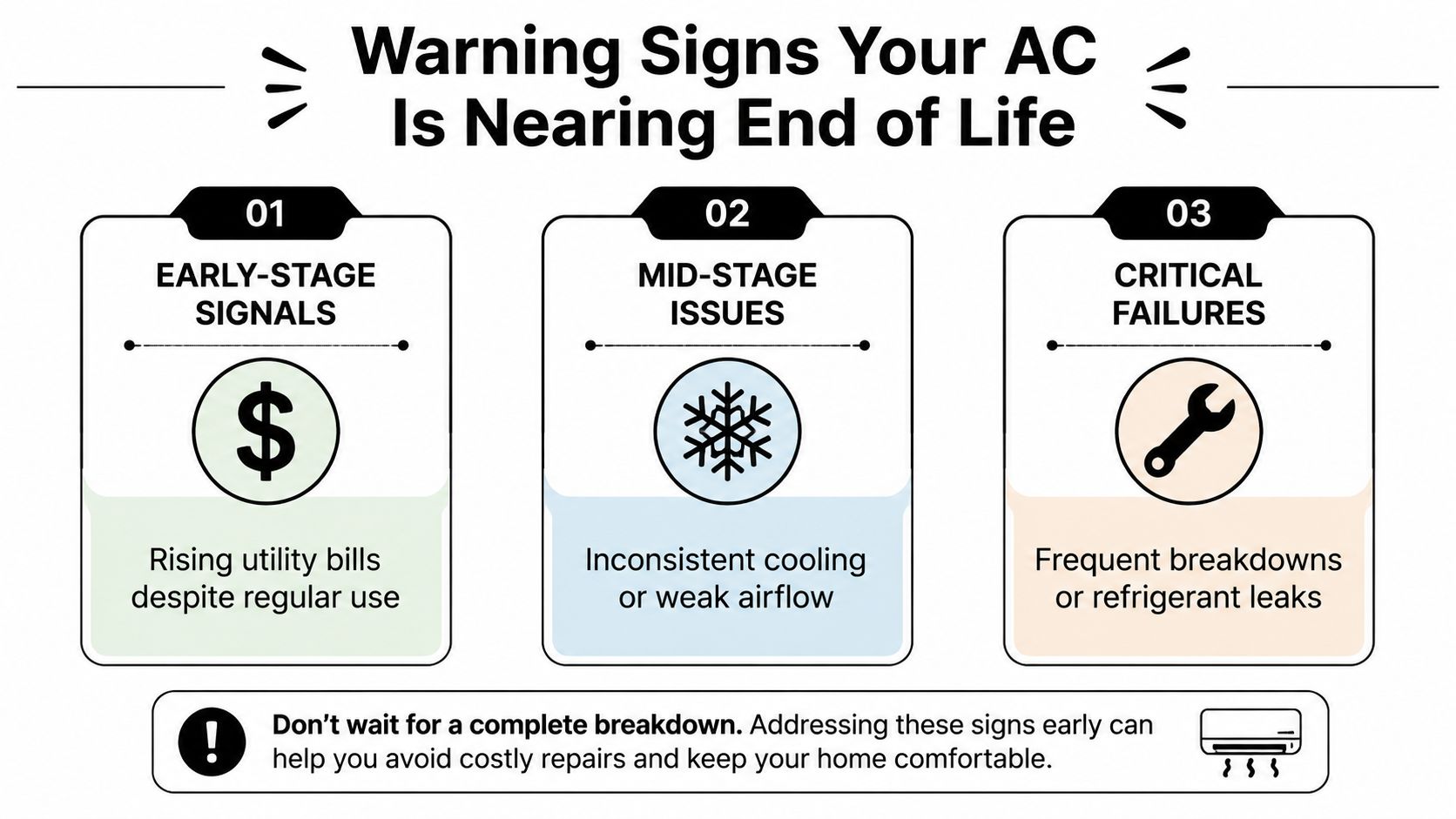
Mid-stage problems
Frequent refrigerant top-offs point to a leak, not normal operation. On an R-22 system, refrigerant availability makes repeated leak repairs a poor long-term strategy. A technician should locate the leak, identify the refrigerant, and explain whether the repair restores dependable service or only postpones another failure.
Recurring capacitor or contactor failures also matter. Replacing one worn electrical part can be reasonable, but repeated electrical failures may indicate heat stress, voltage problems, or broader equipment deterioration.
Grinding, rattling, or harsh compressor noises shouldn't be ignored. The technician should check motor bearings, fan blades, mounting hardware, electrical draw, and compressor operation. Some noises are repairable. A damaged compressor on an aging system usually deserves a replacement comparison.
Critical replacement triggers
A compressor failure on an older system, a significant refrigerant leak, or a repair estimate approaching half the cost of new equipment changes the decision. The 50% rule is a practical benchmark cited in this repair-or-replace decision guide. If the repair reaches or exceeds 50% of replacement cost, replacement usually makes better economic sense, particularly beyond mid-life.
A cracked furnace heat exchanger is a safety matter, not a routine AC repair. It requires immediate professional evaluation and may make furnace replacement necessary, especially when the heating and cooling equipment share an aging system.
For a visual checklist of common failure patterns, review the following video after you've noted your system's symptoms:
Repair vs Replace Decision Framework
A repair makes sense when the system is relatively young, the failure is isolated, and the fix restores dependable cooling. Replacement makes more sense when the unit is aging, breakdowns are recurring, or a major repair leaves you with an inefficient system likely to fail again. Arizona's long, severe cooling season adds weight to the replacement side because equipment accumulates heavy runtime faster than systems in milder climates.
Start with the 50% rule. Compare the written repair estimate with the installed replacement estimate, then consider refrigerant type, repair history, comfort, efficiency, and the chance of another failure during a heat wave. A lower invoice today is not a good deal if it buys only a short period of operation.
A practical comparison
| Scenario | Repair Cost | Replace Cost | Recommendation |
|---|---|---|---|
| Minor electrical failure on a dependable system | Lower than replacement | Higher upfront investment | Repair if diagnosis confirms an isolated issue |
| Major component failure on an aging unit | Can approach 50% of replacement cost | Full installed replacement cost | Compare carefully, replacement usually wins at the threshold |
| Repeated refrigerant leak on a legacy system | Increasing service burden | New compatible equipment | Replace rather than repeatedly recharge |
| Recurring breakdowns and declining comfort | Cumulative repair spending | Planned replacement | Replace when reliability has become the main problem |
The table supports a decision, not a diagnosis. A low repair quote can still waste money when the compressor is weak, coils are deteriorating, or airflow is restricted. A larger repair can be reasonable on a younger, properly installed unit with a clean service history.
Apply the math to your own system
Ask these questions before authorizing work:
- What failed? A capacitor and a compressor require very different decisions.
- How old is the system? Equipment approaching or exceeding the broad 15-to-20-year lifespan benchmark needs replacement planning. In Arizona, heavy runtime can make condition more important than the calendar age.
- What has it cost recently? Keep repair dates, invoices, and diagnoses together. Repeated failures matter more than one isolated part.
- What will the repair buy you? If it only restores operation temporarily, replacement is the more responsible use of your money.
Before comparing estimates, review this guide to average AC repair costs. Get the diagnosis in writing, request both repair and replacement options, and ask how long the technician expects the repaired system to remain dependable.
My blunt advice: Don't replace a healthy system because it reached a certain birthday. Don't pour major money into an aging system because the repair quote is smaller than replacement. The savings disappear when the system fails again during Arizona's hottest weather.
Energy Efficiency Gains from Modern AC Systems
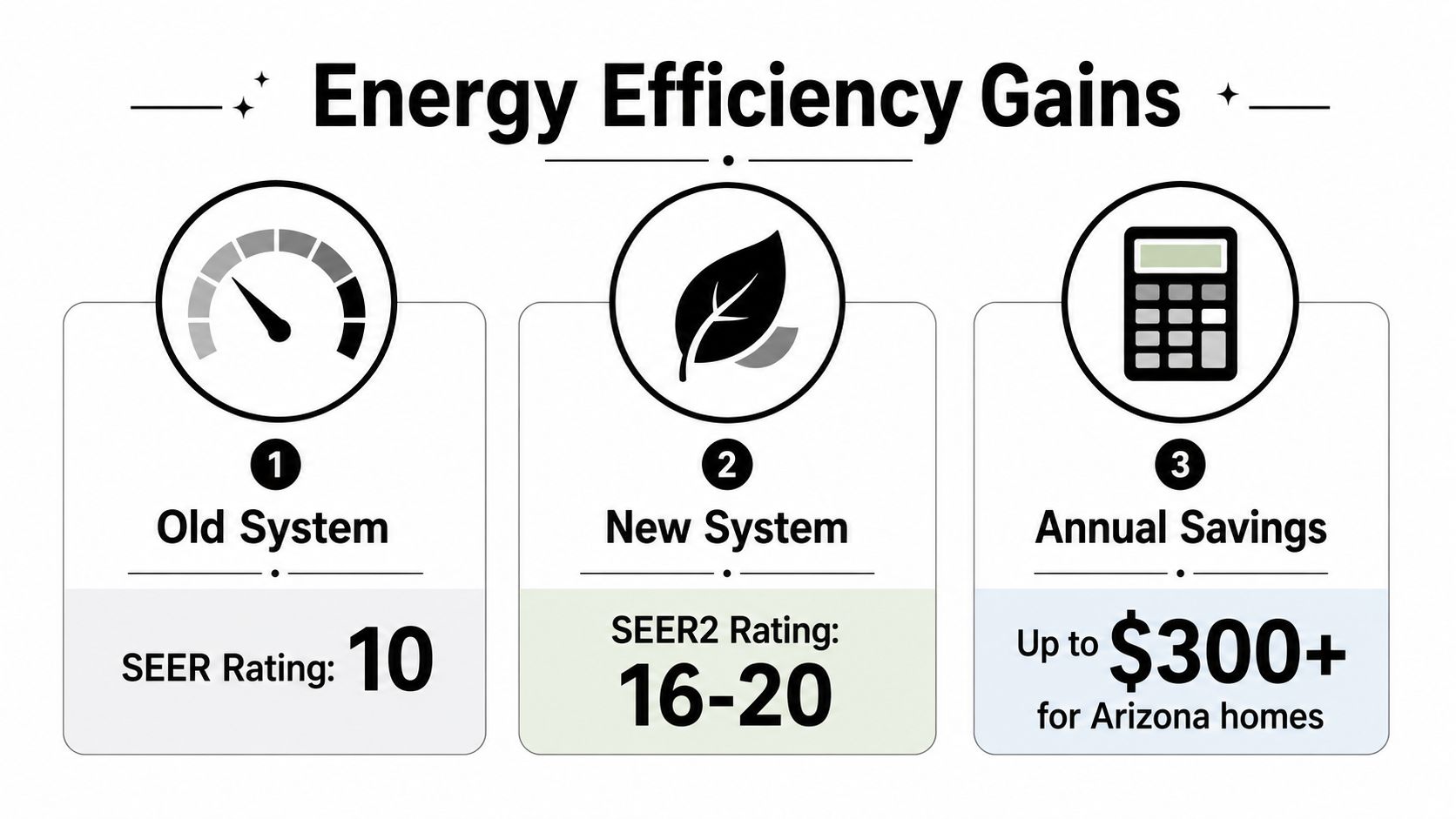
Older air conditioners can still cool a house while consuming substantially more electricity than newer equipment. The U.S. Department of Energy records that federal central AC standards moved from 10 SEER in 1992 to 13 SEER for new central air conditioners manufactured for sale in the United States as of January 23, 2006. The Economic Policy Institute's summary describes that change as about a 30 percent improvement in energy efficiency. See the Department of Energy efficiency-standard document for the underlying standard history.
That gap matters in Arizona because cooling demand is high. A system that spends much of the season running near capacity magnifies the operating difference between an older design and a modern replacement.
Efficiency is more than the rating
SEER and SEER2 measure seasonal cooling efficiency, but the equipment's controls also affect how it operates. Newer systems may use:
- Variable-speed compressors, which can adjust output instead of operating only at full capacity.
- Two-stage operation, which can reduce unnecessary full-power cycling during milder conditions.
- Smart thermostat compatibility, which helps coordinate schedules, temperature settings, and equipment operation.
These features don't rescue a poorly sized or poorly installed system. They work best when the equipment, airflow, ducts, thermostat, and refrigerant circuit are designed as one system.
Standards make replacement planning more important
Federal minimum efficiency floors tightened in 2023. The cited regional requirements include 15 SEER2 in southeastern and southwestern regions and 14 SEER2 in northern states, according to this technical overview of HVAC lifespan and efficiency decline. An older unit below today's baseline may be a poor candidate for major investment, especially if its compressor, coil, or refrigerant circuit is already deteriorating.
Maintenance can also deliver measurable savings before replacement. Replacing a dirty, clogged filter can reduce energy consumption by as much as 15%, annual blower-component cleaning can save up to 15%, and duct sealing can improve energy efficiency by 20% to 30%, according to this EPA-linked HVAC maintenance explanation.
Check current utility programs, manufacturer incentives, and federal eligibility rules before signing a replacement contract. Incentives vary by equipment and location, so confirm the requirements rather than assuming every high-efficiency model qualifies.
Proper Sizing and Duct Design for Replacement Success
Replacing an old AC with the same tonnage may seem efficient, but it can repeat the original sizing error. Arizona homes absorb heat through roofs, windows, walls, air leaks, and direct sun. Square footage cannot establish the right capacity, especially in a desert climate where systems run hard for long hours.
Start with Manual J
ACCA Manual J is the ANSI-recognized standard for calculating heating and cooling loads in single-family homes, small multi-unit buildings, condominiums, townhouses, and manufactured homes. The calculation should measure room-by-room requirements instead of relying on a visual estimate.
Correct sizing prevents two common problems:
- Oversizing can cause short cycling, uneven temperatures, and poor moisture control.
- Undersizing can leave the system running constantly while the home still misses the thermostat setting.
Ask the contractor to show you the load calculation and connect the proposed capacity to its results. If the explanation is “that's what was there before,” get another opinion.
Ducts determine delivered performance
A high-efficiency condenser cannot overcome restricted, undersized, disconnected, or leaky ducts. ACCA Manual D provides ANSI-recognized duct-sizing principles for every duct material. Manual D training guidance uses room-by-room airflow, available static pressure, and total effective length to size each duct section. You can also review our duct design process to see why duct assessment belongs in replacement planning.
The cited design targets include total external static pressure at or below 0.8 inches water column, friction rate between 0.06 and 0.18, available static pressure at or above 0.32, and total effective length at or below 550 feet. The installer should measure these conditions and apply them to the design, rather than copy the old duct layout.
Friction rate equals available static pressure divided by total effective length, multiplied by 100, then matched to duct-sizing charts. This Manual D duct-design explanation also explains that Manual S helps select equipment after Manual J loads are established, while Manual D sizes the ductwork for the required airflow.
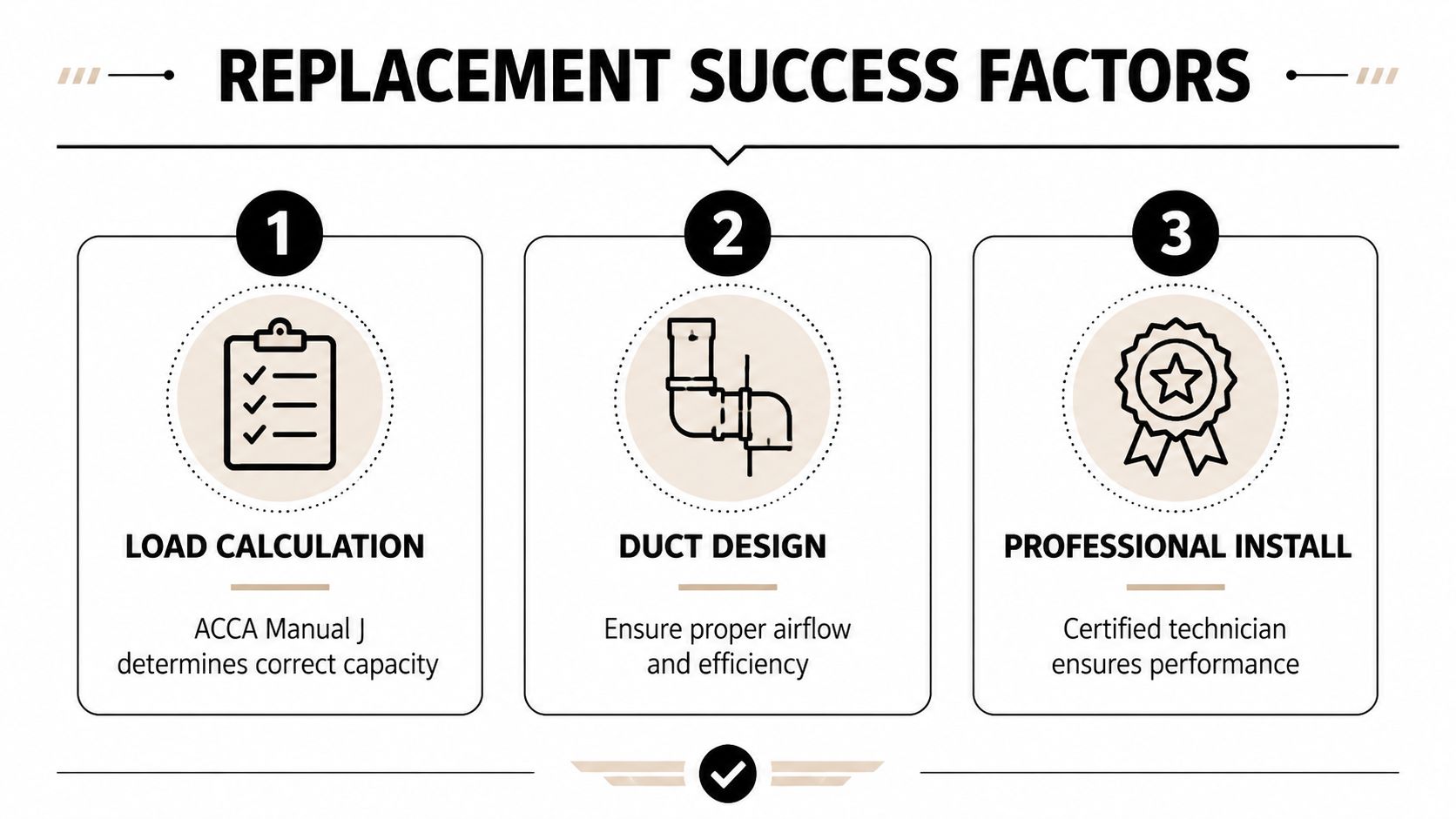
Before approving the work, ask about line-set compatibility, duct inspection, static-pressure testing, airflow verification, permits, startup procedures, and warranty terms. In the Globe-Miami area, Cobre Valley Air LLC provides replacement evaluations that include load calculations, equipment sizing, and airflow and duct assessments.
Your Next Steps for AC Replacement Planning
Don't wait for a complete failure if your system is old, noisy, inefficient, or already collecting repair invoices. Spring is the right time to schedule an evaluation because you can compare equipment and installation options before peak summer demand leaves you choosing from whatever is available.
Prepare for the appointment with four pieces of information:
- Recent utility bills: Bring several months that show your typical cooling pattern.
- Comfort complaints: Identify hot rooms, weak registers, excessive cycling, or rooms that never reach the thermostat setting.
- System history: Note the installation age, refrigerant type if available, and every recent repair.
- Questions about the replacement: Ask about SEER2, heat-pump options, warranty coverage, duct testing, load calculations, and expected maintenance.
A thorough in-home evaluation should include equipment diagnostics, electrical inspection, coil and refrigerant review, duct inspection, airflow testing, and a Manual J load calculation when replacement is being considered. The recommendation should match the home, not duplicate the old unit.
Ask about manufacturer rebates, utility incentive programs, and available payment plans. Cobre Valley Air works with financing options through Wisetack and OPTIMUS, but confirm current terms and eligibility directly before making a decision.
If your home also needs heating, compare a heat pump with a furnace and AC combination. The right choice depends on the home's load, electrical service, ductwork, comfort priorities, and installation conditions. A planned evaluation gives you time to make that comparison without the pressure of a failed system in extreme heat.
Cobre Valley Air LLC provides AC diagnostics, quality repairs, maintenance, duct evaluation, and complete air conditioning installation for homeowners in Globe, Miami, Superior, and nearby communities. Visit Cobre Valley Air LLC to schedule a no-pressure replacement evaluation before your aging system fails during Arizona's hottest weather.