


The shower turns cold halfway through rinsing shampoo, and a small puddle appears beneath the water heater in the garage. In Globe, that can happen when a familiar tank reaches the end of its service life, leaving a homeowner to choose between another storage tank, a first tankless system, or a replacement for an older tankless unit. The decision becomes more complicated when hard water, colder incoming water, gas piping, venting, permits, and the home's broader HVAC setup enter the picture.
A good tankless water heater replacement isn't just a matter of matching the old unit's size. You'll need to understand what failed, how much hot water your household uses at the same time, what temperature rise the equipment must handle, and whether the existing gas, electrical, venting, and condensate systems meet current requirements. The following guide walks through those decisions in practical terms, including realistic trade-offs for homes in Globe, Miami, Superior, and nearby Arizona communities.
When a Failing Heater Forces a Fast Decision
A homeowner in the Globe area might first notice the problem before breakfast. The shower runs lukewarm, someone finds water on the garage floor, and the water heater makes a popping sound when it tries to recover. A call to a local HVAC company quickly turns into a decision about whether to repair the old equipment or replace it before the household loses hot water completely.
That decision shouldn't be made from a sales slogan. A storage tank may still be the sensible choice when the existing connections are serviceable, hot-water demand is modest, and the priority is a lower upfront project. A tankless system may fit better when floor space matters, the household uses hot water throughout the day, or the owner plans to stay long enough to benefit from its operating characteristics.
Practical rule: Treat a leaking tank, failed gas connection, or damaged vent as a safety and replacement question, not just a convenience issue.
The replacement process usually involves more than removing one box and hanging another. The technician should evaluate peak simultaneous demand, incoming water temperature, mineral exposure, gas capacity, approved vent materials, electrical supply, condensate drainage, and permit requirements. In an Arizona home, the same unit can behave differently from one installation to another because groundwater temperature and water quality affect performance.
By the end of the evaluation, you should be able to answer several practical questions:
- Is repair reasonable: Can the failed component be replaced without leaving you with an aging system and recurring problems?
- Which replacement path fits: Would another tank, a first tankless unit, or a new tankless model make more sense?
- Can the home support it: Does the gas line, venting, power, and drain arrangement meet the equipment requirements?
- What will the quote include: Are labor, permits, venting changes, gas-line work, electrical changes, and water treatment clearly separated?
- How will it be maintained: What flushing, filter cleaning, and inspection routine will protect the new equipment?
A fast response matters after a failure, but speed shouldn't eliminate sizing or code checks. A rushed like-for-like installation can create ignition faults, weak performance, or expensive corrections later.
Seven Warning Signs Your Water Heater Needs Replacement
Not every symptom calls for a new heater. A failed thermocouple, worn valve, blocked filter, or control issue may be repairable. The following signs point more strongly toward replacement, especially when several appear together.
Start with the unit's condition
Age: Older storage tanks often become less attractive to repair once corrosion and repeated component failures appear. If a technician finds a sound vessel and one isolated failed part, repair may be sensible. If the tank itself is deteriorating, put replacement at the top of the list.
Rust-colored water: Discolored hot water can indicate corrosion inside the tank or in the hot-water piping. Ask the technician to test both hot and cold taps. Rust only at hot fixtures raises more concern about the heater than a problem affecting the whole plumbing system.
Fluctuating temperatures: A shower that shifts from hot to cold may reflect a burner, heating element, flow sensor, mixing valve, or scale problem. A service call can identify a repairable fault, but recurring temperature swings after previous repairs suggest the equipment is no longer dependable.
Listen, look, and compare
Rumbling or popping: Mineral deposits can collect inside a storage tank and create banging or popping as water heats around the buildup. Flushing may help in an earlier stage. Persistent noise combined with weak recovery or cloudy water often makes replacement the more practical choice.
Leaking tank seams: Water at a fitting may be repairable, but water escaping from the tank body or seam usually means the vessel has failed. Shut off water and fuel as appropriate, then arrange professional service promptly.
Rising energy bills: A gradual increase can come from many sources, including changing usage, a gas problem, or another appliance. If consumption has changed little and the heater runs longer than before, have its operation checked rather than assuming a new unit will automatically solve the bill.
Corrosion on connections: Oxidized nipples, valves, gas fittings, or electrical connections deserve inspection. Corrosion can signal moisture, an incompatible material, a leak, or poor drainage. Don't cover it up before a technician identifies the cause.
| Symptom | Likely Cause | Likely Action |
|---|---|---|
| Rust-colored hot water | Internal corrosion or corroded hot-water piping | Test the water source and plan replacement if the tank is deteriorating |
| Temperature swings | Burner, element, sensor, valve, or scale issue | Diagnose first, replace when the fault keeps returning |
| Rumbling or popping | Mineral buildup inside a storage tank | Flush if appropriate, replace when noise accompanies poor performance |
| Water from the tank seam | Failed tank vessel | Shut down safely and replace |
| Corroded connections | Moisture, leakage, or material deterioration | Inspect immediately and repair or replace affected equipment |
Replacement Paths From Tank to Tankless
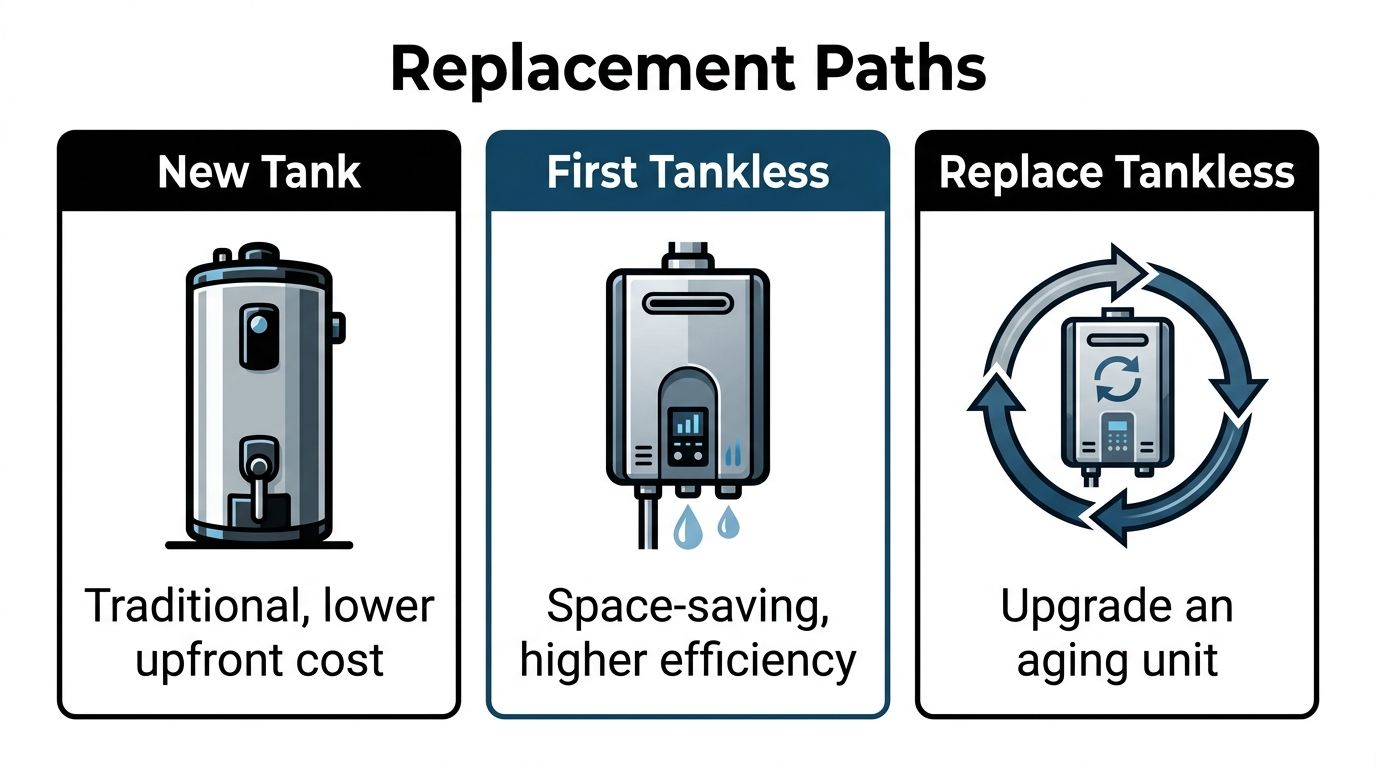
Once replacement is justified, compare the equipment path with the home's actual priorities. A direct tank replacement usually involves fewer changes, while a first tankless installation can require gas, venting, electrical, and condensate work. Replacing an existing tankless unit may be more straightforward, but the old installation still needs to be checked rather than copied automatically.
Compare the three practical choices
New tank: A storage tank can be the right answer when the existing location, gas supply, venting, and drain arrangement are usable. It generally offers a familiar operating pattern and a simpler project, but it keeps standby heating and occupies floor space. Hard water can also accelerate sediment accumulation, so maintenance remains important.
First tankless: Moving from a tank to tankless frees floor space and heats water on demand. It can suit households that use hot water at overlapping times, but the equipment must be sized for peak flow and the local temperature rise. Installation may require new venting, gas-line adjustments, dedicated power, and condensate handling.
Replacement tankless: A new tankless unit can preserve wall space and the household's existing expectations about continuous hot water. However, the old vent, gas line, isolation valves, filters, and condensate route still need inspection. A previous installation doesn't automatically meet the requirements of a new listed appliance.
The global market context supports the idea that tankless equipment is no longer a niche product. One tankless water heater market study estimates the sector at about US$4.9 billion in 2024 and projects US$9.5 billion by 2034, while another estimate places it at US$4.87 billion in 2026 and projects US$8.84 billion by 2033. Those projections point to a growing installed base, which supports ongoing demand for maintenance, retrofits, and replacement work, but market growth doesn't prove that tankless is right for every Arizona household.
The better choice depends on usage, space, fuel infrastructure, water quality, and how long you expect to own the property. A modest-use home may favor a simpler tank replacement, while a busy home with limited mechanical space may value tankless performance even when the initial project is more involved.
Sizing a Tankless Unit for Your Home
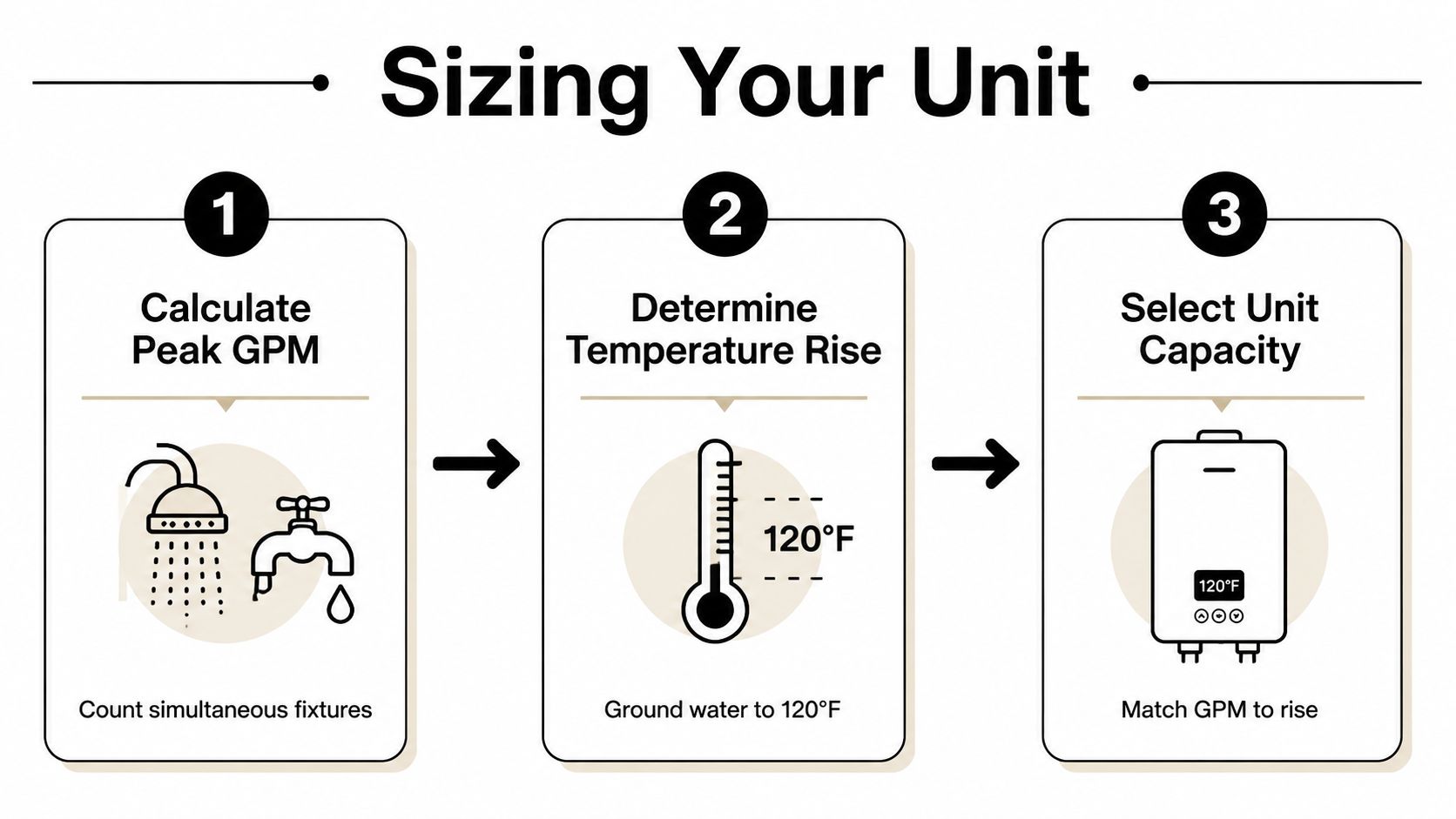
Tankless capacity isn't a single number printed on the front of the unit. The technician must match peak simultaneous flow with the temperature rise required at the installation site. A shower, faucet, washing machine, and other fixture can demand hot water at the same time, and the heater must raise incoming water to the selected output temperature while delivering that combined flow.
Calculate demand before choosing equipment
Begin by listing the fixtures that commonly run together. Don't count every fixture in the house if your family never uses them simultaneously. Instead, describe the busiest realistic moment, such as two showers and a kitchen faucet, then use the fixture flow information and the manufacturer's sizing method to estimate the required gallons per minute.
Next, calculate temperature rise:
Required temperature rise = desired hot-water temperature minus incoming water temperature.
If the outlet target is 120°F and incoming water is 55°F, the required rise is 65°F, as shown in Navien's tankless sizing guidance. That higher rise reduces the flow the same heater can deliver compared with an installation receiving warmer water.
Arizona homeowners can get caught by this calculation during colder well-water conditions or in higher-elevation communities. Two identical units may deliver different practical results in Globe and Phoenix if their incoming water temperatures differ. The installer should use the manufacturer's flow chart at the calculated temperature rise, not the unit's most flattering maximum flow claim.
Before the appointment, write down:
- Simultaneous fixtures: Which showers, faucets, appliances, or tubs operate together?
- Incoming temperature: Has the installer measured or reasonably verified the cold-water temperature for the site?
- Desired output: Is the household using a 120°F setting, or does a specific application require something different?
- Fuel and model: Is the proposed unit gas-fired or electric, and does its capacity chart support the calculated rise?
- Future demand: Will a bathroom addition, rental conversion, or household change alter peak usage?
For a homeowner-friendly explanation of the selection process, review this guide on how to choose a tankless water heater.
The following video provides another visual explanation of tankless sizing concepts:
Gas, Venting, Power, and Permit Requirements
A tankless replacement often isn't a true like-for-like job. Gas-fired equipment can need a dedicated 120V electrical supply for ignition and controls, a properly sized gas line based on BTU load and run length, approved venting, and a reliable condensate route if the model is condensing.
Verify the fuel supply
Many gas-fired tankless systems use a 3/4-inch gas supply line, or another pipe size determined by the appliance load and the length of the run. The existing line may have served the old tank adequately but still be undersized for a higher-input tankless unit. A technician should calculate the load and inspect regulators, shutoff valves, connectors, and other connected appliances.
Arizona conditions add a practical concern. During monsoon-season work, a damp or poorly protected gas-line connection, blocked termination, or drainage problem can become more troublesome. The technician should confirm that outdoor terminations, connections, and condensate pathways are protected and installed according to the model instructions and local requirements.
Treat venting as appliance-specific
Listed condensing models may use Category III stainless steel or approved PVC, while other models require different materials and configurations. Positive-pressure exhaust appliances cannot reuse old Type B venting. The referenced tankless installation documentation explains why vent materials and gas-tight, corrosion-resistant construction matter.
Condensate must drain safely without damaging the wall, foundation, or equipment. The installer should also confirm service clearances, combustion air, freeze protection where relevant, and the location of intake and exhaust terminations.
Permits and inspections can apply in Globe, Miami, Superior, and surrounding communities. Ask who will pull the permit, which authority will inspect the work, and whether the final documentation will be provided. The water heater replacement permit guide can help you prepare questions before approving the project.
Realistic 2026 Replacement Costs and Payback Math
A useful 2026 tankless replacement quote separates the equipment from the work needed to make the home ready. The price can change substantially when a tankless installation requires gas-line resizing, new venting, electrical work, condensate drainage, wall repairs, or permit handling. A quote that lists only the heater may leave out the most important project conditions.
Because verified local pricing data isn't provided here, a responsible contractor should give you a site-specific line-item estimate rather than rely on a universal Globe, Miami, or Superior price promise.
| Cost Component | Typical Range | Notes |
|---|---|---|
| Equipment | Varies by selected model | Compare capacity at the required temperature rise, not the largest advertised flow |
| Labor | Varies by access and installation complexity | A direct replacement differs from a tank-to-tankless conversion |
| Venting upgrades | Varies by model and route | Existing Type B venting may not be acceptable |
| Gas-line work | Varies by load and run length | The technician should document the sizing calculation |
| Permit and inspection | Varies by local authority | Confirm whether the contractor includes permit handling |
| Electrical changes | Varies by existing service | Gas-fired units commonly need dedicated 120V power |
| Condensate work | Varies by equipment and drain location | Condensing models need a safe drainage arrangement |
For a project-specific discussion of tankless water heater installation cost, use the scope of work as the starting point, not a headline figure.
Understand the payback limits
Tankless units reduce standby losses because they don't continually maintain a stored volume of hot water. However, Consumer Reports' water-heater guidance cautions that replacement can be expensive and that payback may take longer than the warranty.
The U.S. Department of Energy adds an important qualification. Savings vary with daily draw volume, with the greatest gains around 50 gallons per day and much smaller gains at low draws, as summarized in the verified consumer guidance. That means a large, busy household may see a stronger operating case than a vacation property or a small household with intermittent use.
Financing can spread the project over time, but financing charges affect the total paid. Ask for the cash price, financed price, term, interest details, and any early-payment conditions in writing. In some homes, tankless replacement is primarily a space and comfort decision, not a guaranteed short-term bill-saving project.
Choosing the Right Contractor for the Job
The unit brand matters, but installation quality determines whether the system is sized, vented, drained, and commissioned correctly. Ask each contractor to explain the recommendation in terms you can follow.
Use a written screening checklist
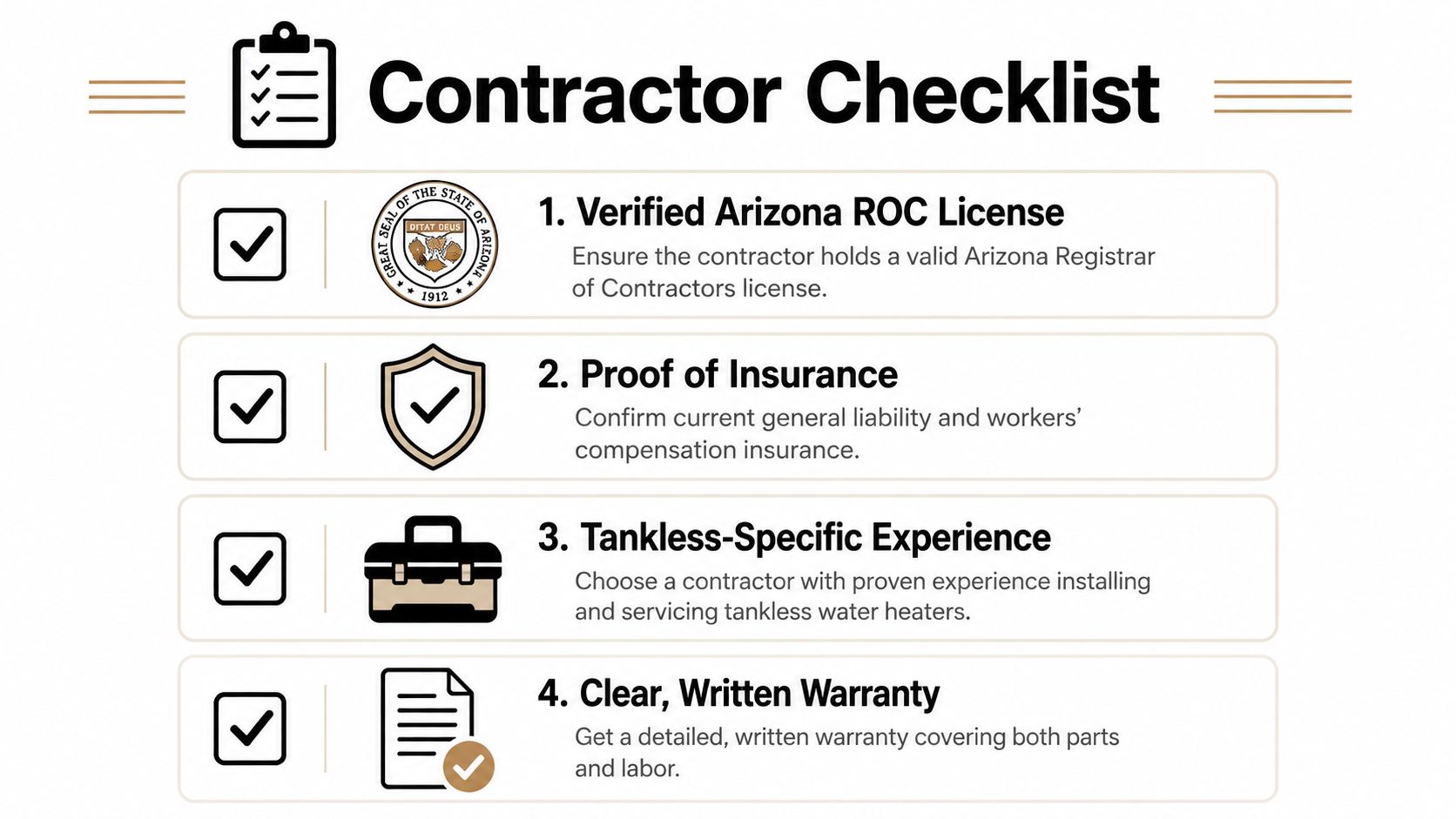
- Verify the Arizona ROC license: Confirm the contractor's license information and that the work falls within the appropriate classification.
- Request proof of insurance: Ask for current general liability and worker coverage documentation.
- Demand a sizing rationale: The proposal should show peak simultaneous demand and the temperature rise used to select the model.
- Ask about water quality: Hard water can increase scale exposure, so discuss filtration, isolation valves, and a descaling plan.
- Require line-item pricing: Equipment, labor, venting, gas work, electrical changes, condensate work, permits, and disposal should be distinguishable.
- Confirm warranty handling: Separate manufacturer equipment coverage from labor coverage, and ask who handles a warranty diagnosis.
- Evaluate airflow and ductwork: A company that services the water heater can also identify whether the home's HVAC airflow, duct design, and return-air arrangement deserve attention during the visit.
The duct and airflow review deserves special attention in Arizona homes. Water-heater work doesn't replace an air-conditioning load calculation, furnace inspection, or heat-pump evaluation, but a full comfort assessment can reveal restricted returns, damaged ducts, or poor airflow that homeowners may mistake for equipment failure. Quality air-conditioning repair, AC installation, AC maintenance, heat-pump and furnace service, and duct design all depend on matching equipment to the home rather than guessing from the old system.
Watch for red flags. High-pressure same-day signing, vague references, missing permit information, an unexplained reuse of old venting, or a proposal that says only “install tankless heater” should make you pause. Cobre Valley Air LLC offers tank and tankless water-heater service alongside HVAC diagnostics, installation, duct evaluation, and airflow planning, giving homeowners one local option to consider when the project involves both hot water and broader comfort concerns.
Maintenance, Longevity, and Common Questions
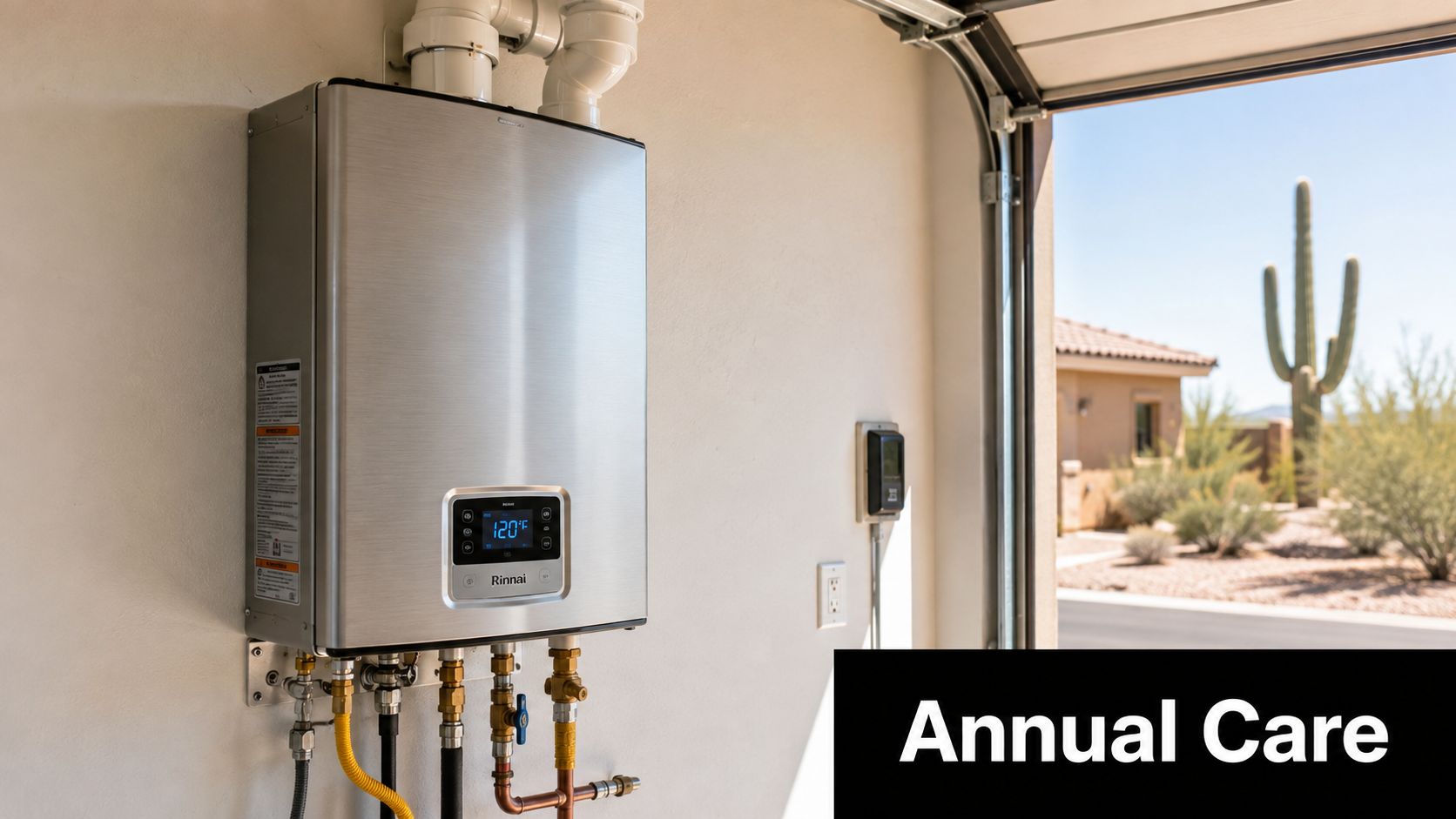
Arizona's mineral-heavy water can make maintenance a central part of tankless ownership. A technician may recommend periodic descaling, inlet-filter cleaning, condensate-trap checks, and vent inspection based on the water quality and installation. Follow the manufacturer's maintenance instructions rather than waiting for an error code or a sudden temperature problem.
Build a simple service routine
At the regular maintenance visit, ask the technician to inspect the heat exchanger, flush scale from the water path when appropriate, clean the inlet filter, check valves and isolation points, examine the condensate trap, and inspect intake and exhaust terminations. The technician should also look for corrosion, leaks, abnormal ignition behavior, and signs that the gas supply or venting isn't performing correctly.
Keep the service records, model information, installation documents, permit records, and warranty terms together. Those records help a future technician diagnose the system and show which maintenance has already been performed.
Common questions after installation
Why does the water briefly turn cool between uses? A short cold-water sandwich can occur when water sitting in the pipe reaches the fixture before the heater fires. Long plumbing runs, low flow, crossover problems, or recirculation settings can also affect the experience. A technician can determine whether the behavior is normal for the layout or needs correction.
What causes an error code? Low gas pressure, restricted flow, scale, blocked venting, ignition problems, sensor faults, and condensate issues can all trigger codes. Record the code, avoid repeatedly resetting the unit, and call for diagnosis if it returns.
Why is ignition delayed? The unit may be waiting for adequate flow, or it may have a fuel, venting, control, or maintenance issue. Don't bypass safety controls or alter gas components yourself.
When should you call a technician? Call promptly for gas odor, water from the cabinet, repeated shutdowns, unsafe venting concerns, severe temperature swings, or an error code that returns after the basic manufacturer-approved checks. A tankless unit can provide dependable service, but it still needs correct sizing, clean water passageways, and safe combustion conditions.
Cobre Valley Air LLC provides tankless and tank water-heater replacement, code-compliant installation, sizing guidance, and HVAC evaluations that include airflow and duct considerations for Globe, Miami, Superior, and nearby communities. Visit Cobre Valley Air LLC to request an evaluation and discuss the right replacement path for your home.