


Your AC quits on a brutal Arizona afternoon, the house starts heating up fast, and every company you call says some version of the same thing: “We can get someone out today.” That sounds good until you realize fast service and qualified service are not the same thing.
Homeowners can face serious repercussions. The wrong person might swap a part, add refrigerant, or sell you a system that never should've been installed in the first place. Then you deal with hot rooms, high power bills, noisy airflow, repeat breakdowns, and arguments about who's responsible. If you care about quality air conditioning repairs, AC installation, AC maintenance, heat pumps, furnaces, and duct design, hiring a licensed HVAC technician is the line you don't cross.
Why Your Choice in HVAC Technician Matters
In Globe, Miami, Superior, and nearby Arizona communities, HVAC problems usually don't happen when it's convenient. They show up when the outdoor heat is pounding, your system has been running hard for weeks, and you need an answer that's correct the first time.
A lot of homeowners make the same mistake under pressure. They hire the first person who answers the phone, especially if that person promises a cheap repair. Then the “repair” turns into another service call a week later. Then another. By the time they finally call a real professional, they've already spent money on bad diagnosis, bad refrigerant handling, or poor electrical work.
Cheap work gets expensive fast
A good HVAC technician does more than get the unit running for the moment. They check the actual cause of failure, inspect airflow, look at duct restrictions, verify whether the equipment is sized correctly, and make sure the repair won't create a second problem.
That matters because HVAC isn't just a box outside and a thermostat on the wall. It's a full system. The condenser, air handler or furnace, heat pump components, refrigerant circuit, drain system, controls, duct design, return air, and filtration all affect comfort and reliability. If the person working on it doesn't understand the whole system, you're gambling with your home.
Practical rule: If a tech wants to quote major work without checking airflow, duct condition, and equipment match, slow the conversation down.
The demand for qualified people is only going up. Employment of licensed HVAC technicians is projected to grow by 9% from 2023 to 2033, with about 40,100 job openings expected each year, according to InterCoast's summary of U.S. Bureau of Labor Statistics HVAC career data. That growth is tied to energy-efficient systems and aging equipment that still needs skilled maintenance and repair.
Good work protects comfort and property
The right hire protects more than comfort. It protects your wiring, your refrigerant system, your indoor air quality, and your long-term equipment life.
For homeowners, that means fewer surprise failures and fewer “band-aid” fixes. For commercial and restaurant owners, it means less downtime on rooftop units, walk-in coolers, and critical cooling equipment. In both cases, the decision is simple. Hire for verified qualifications first. Everything else comes after that.
What Licensed Really Means for Your Home
A lot of people hear “licensed” and “certified” and treat them like the same thing. They aren't. That confusion is one of the biggest reasons homeowners end up with illegal work, poor workmanship, or no real recourse when something goes wrong.
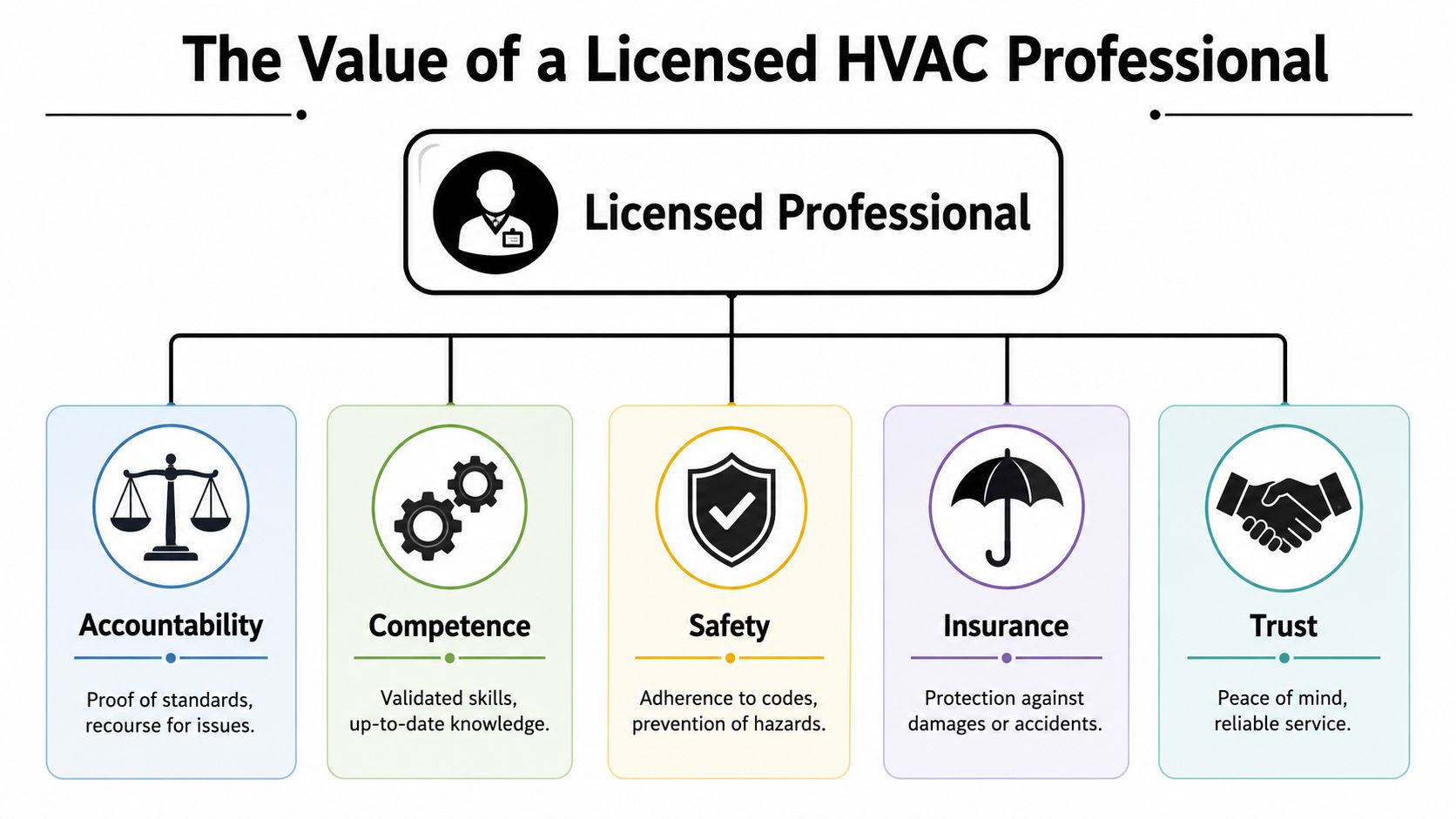
Licensed means the contractor has met state requirements to perform regulated work. In Arizona, that means oversight through the Registrar of Contractors, often called the ROC. That's the accountability piece. If someone isn't properly licensed for the work they're offering, you should move on.
Licensing and certification are not the same thing
Certification proves a narrower point. It shows that a technician has met a specific technical standard. The biggest one homeowners should know is EPA Section 608 Universal certification, which is required for anyone who legally handles refrigerants.
If a technician works on refrigerant lines, replaces components involving refrigerant, or services systems where refrigerant handling is part of the job, this certification is not optional. Without EPA Section 608 Universal certification, technicians cannot legally replace or repair components involving refrigerant lines, and untrained individuals are 3.2 times more likely to cause refrigerant leaks, according to Aerotek's summary of HVAC certification requirements.
That matters to you for two reasons:
- Leak prevention: Refrigerant leaks hurt efficiency and can damage system performance.
- Legal compliance: Anyone touching refrigerant without the required certification is a problem you don't want in your home.
- Repair quality: A person can't properly diagnose many AC and heat pump problems if they aren't qualified to work within the refrigerant circuit.
What a homeowner should verify
Don't stop at “Are you certified?” Ask better questions.
| What to ask | Why it matters |
|---|---|
| Are you licensed for this work in Arizona? | Confirms legal authority and state accountability |
| Do your technicians carry EPA Section 608 certification? | Confirms legal refrigerant handling |
| Are you insured and bonded? | Helps protect you if damage or disputes arise |
| Will you pull permits when the job requires them? | Separates real contractors from shortcut artists |
“Certified” sounds impressive. It doesn't replace a contractor license.
A handyman may be able to replace a thermostat or change a filter. That does not mean they should be installing a split system, repairing a heat pump refrigerant issue, redesigning ductwork, or replacing a furnace. Those jobs affect safety, code compliance, airflow, equipment life, and the value of what you paid for.
Arizona HVAC Licensing A Closer Look
Arizona gives homeowners a concrete way to separate professionals from pretenders. That's why I like the ROC system. It creates a paper trail and a standard. If someone says they're qualified, you don't have to take their word for it.
What Arizona requires
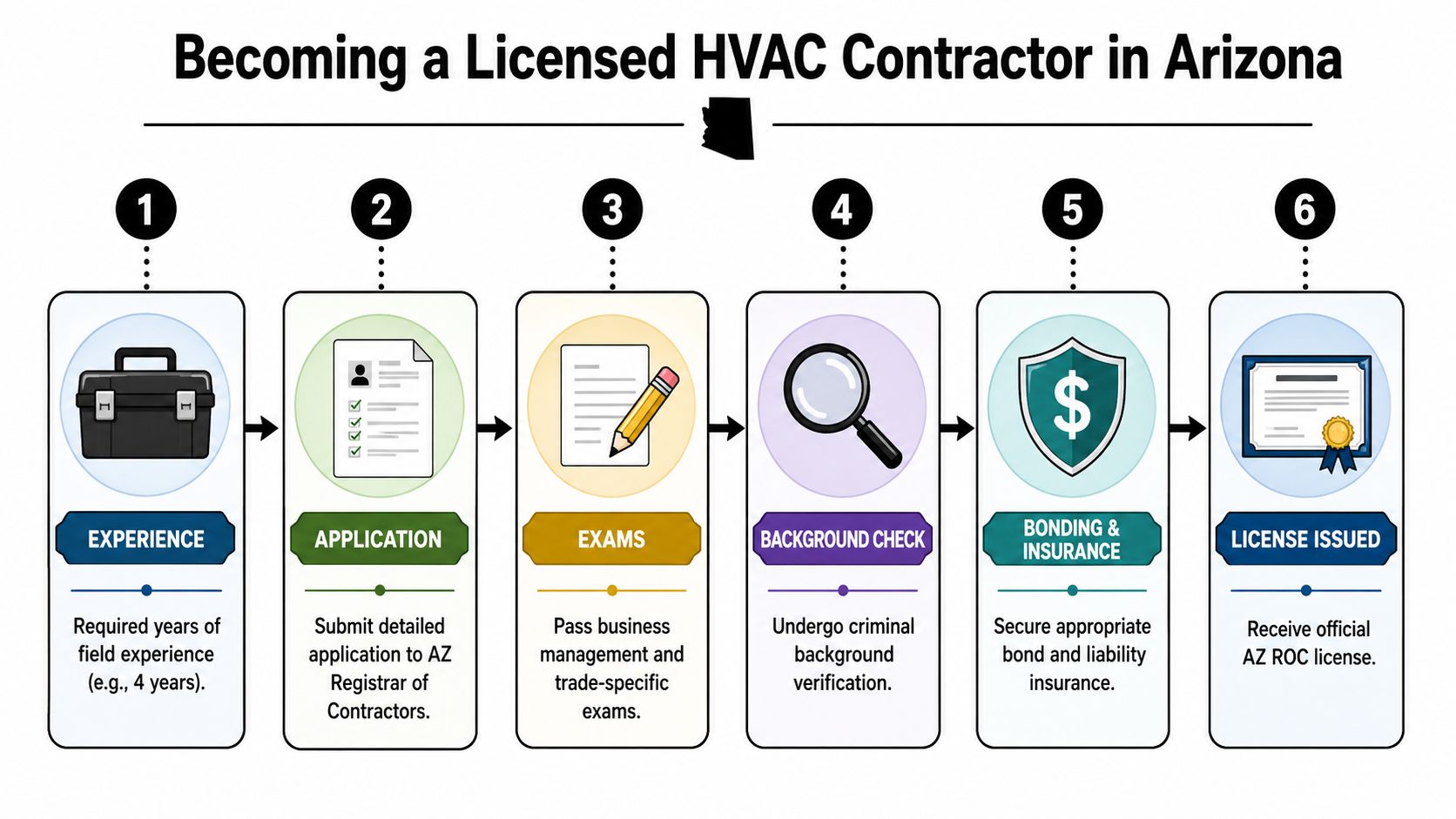
Arizona doesn't hand out HVAC licenses because someone bought gauges and printed business cards. A licensed HVAC contractor in Arizona must show at least 4 years of practical HVAC experience and pass two PSI exams, including the Trade Exam such as R-39 for residential and the Arizona Business Management Exam, with a minimum score of 70%, according to Workiz's overview of Arizona HVAC licensing through the ROC.
That requirement matters because it filters out people who only know how to do parts-swapping. Real field experience exposes contractors to failed compressors, bad airflow, oversized systems, poor duct design, furnace safety issues, drain problems, rooftop package unit troubleshooting, and installation details that separate solid work from sloppy work.
Why the ROC process protects you
The trade exam tests technical knowledge. The business exam tests whether the contractor understands how to operate legally and responsibly. That combination is exactly what homeowners need.
You're not just hiring someone to turn a wrench. You're hiring someone who may need to size equipment, evaluate return air, inspect static pressure, coordinate permit requirements, follow code, and stand behind the finished work.
Arizona also requires bond coverage tied to business volume for HVAC contractors doing this work. For AC installation and furnace or heat pump work, those bond amounts range from $4,250 at lower revenue levels to $50,000 at higher revenue levels, as outlined in RocketCert's Arizona air conditioning and refrigeration license guide. That bond structure exists for a reason. It creates another layer of consumer protection.
How to verify a contractor before you sign
If a contractor gives you a license number, check it. If they won't give it to you, you already have your answer.
Use the Arizona ROC lookup before approving major repair or replacement work. You should also ask whether the scope requires permitting. If you've ever wondered why permits matter for mechanical work, this explanation of water heater replacement permit requirements shows the bigger point clearly: regulated home systems need compliant work, documented properly.
A legitimate HVAC contractor should be comfortable with all of this:
- Providing the ROC number
- Explaining the license classification
- Confirming whether permits apply
- Documenting the job in writing
If a contractor gets irritated when you ask for license verification, that's not confidence. That's a warning sign.
One more practical example. A company that openly publishes a license number such as ROC 339078 is giving you something you can verify. That's how this should work. Credentials should be checkable, not mysterious.
Services Demanding a Licensed Professional
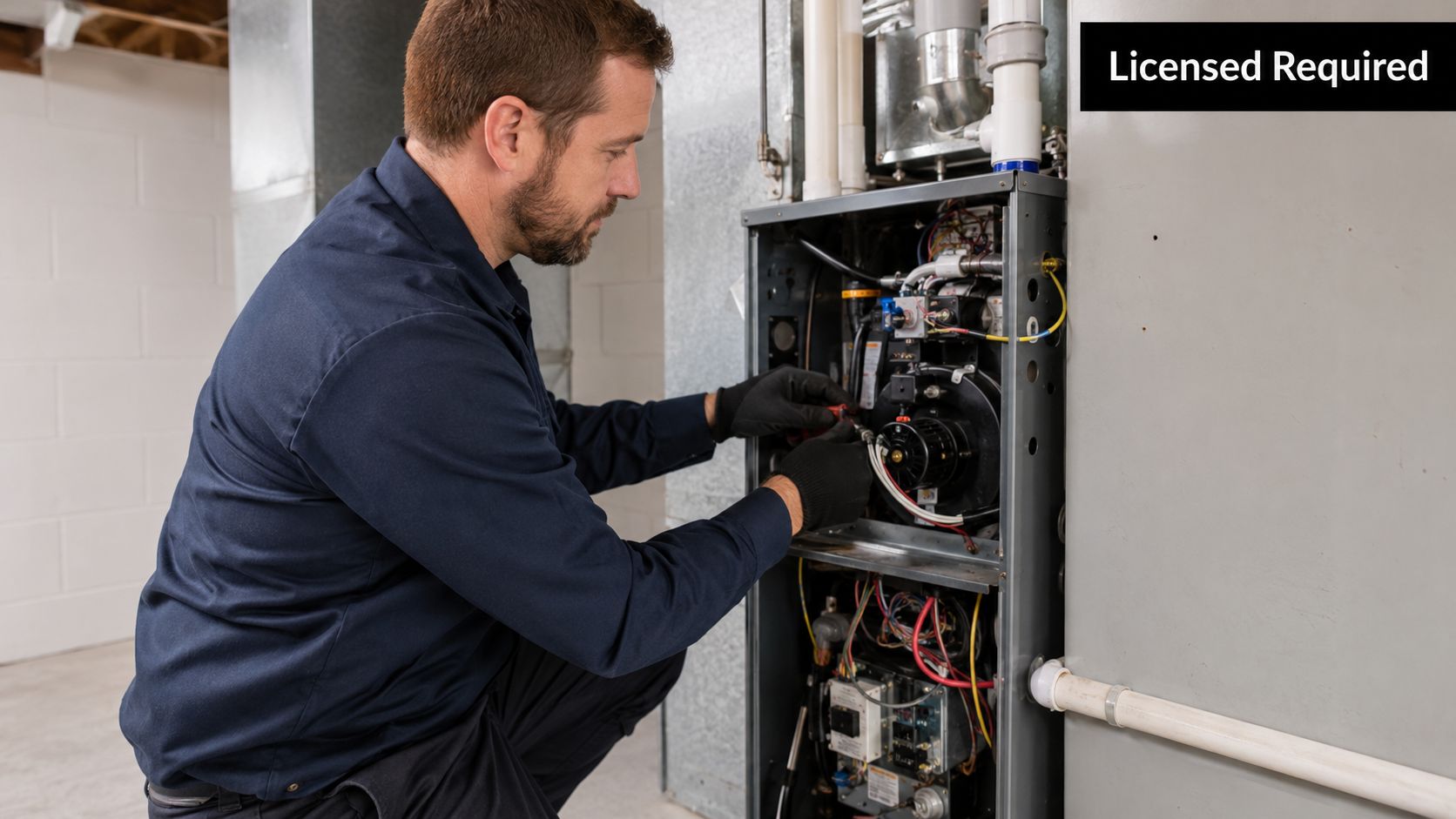
Some home projects have room for trial and error. HVAC isn't one of them. If the work affects refrigerant, electrical components, combustion, duct design, or equipment sizing, bring in a licensed professional.
AC installation needs more than a good price
Bad AC installation creates problems that never go away. The home cools unevenly. The system short cycles. Humidity feels off. Bedrooms stay warm. Utility bills stay higher than they should.
A licensed HVAC technician should handle the job as a system, not a box swap. That includes load calculations, equipment sizing, airflow planning, refrigerant charging, electrical setup, condensate management, and duct evaluation. If any of that gets skipped, the equipment may run, but it won't run right.
This is especially important in Arizona homes with additions, older duct systems, hot attic conditions, or rooms that were never balanced correctly in the first place.
Duct design, heat pumps, and furnaces are not handyman work
Duct design is where a lot of installations often fail unnoticed. Homeowners see a shiny new condenser and assume the job was done well. Meanwhile, the return is undersized, supply runs are poorly routed, or the system can't move air the way the equipment was designed to.
That's why I'd never trust unlicensed work on:
- Heat pump installation: Reversing valve operation, refrigerant charge, controls, and defrost setup all matter.
- Furnace service: You're dealing with combustion, venting, gas components, safety switches, and airflow.
- Whole-home duct repair or redesign: Poor duct layout affects pressure, comfort, filtration, and equipment strain.
- Major AC repair: Compressor issues, evaporator coil problems, metering device faults, and refrigerant leaks need qualified hands.
In jurisdictions with tougher experience standards like Arizona, licensed technicians show 28% higher competency in complex system diagnostics and reduce customer callbacks by 40% compared with uncertified peers in states with minimal training requirements, according to Texas licensing material cited for technician competency outcomes. That lines up with what homeowners see in real life. Better diagnostics mean fewer repeat visits and fewer expensive guesses.
Refrigerant work is where mistakes get costly
If someone says, “You just need a little Freon,” be careful. That sentence often hides a weak diagnosis.
Refrigerant systems are sealed systems. Low charge usually means there's a leak, an installation problem, or a prior service problem. Before approving that kind of repair, it helps to understand whether Freon is still used and what refrigerant issues actually mean.
A licensed HVAC technician should be able to explain what failed, why it failed, and what else they checked before recommending the repair.
That's the standard. Not pressure. Not vague language. Not a sales script.
Questions to Ask Before You Hire an HVAC Tech
You don't need to be an HVAC expert to hire well. You need a short list of questions, and you need to insist on clear answers.
Start with this. “What is your Arizona ROC license number?” Ask it early, not after the quote. A professional company won't dance around it.
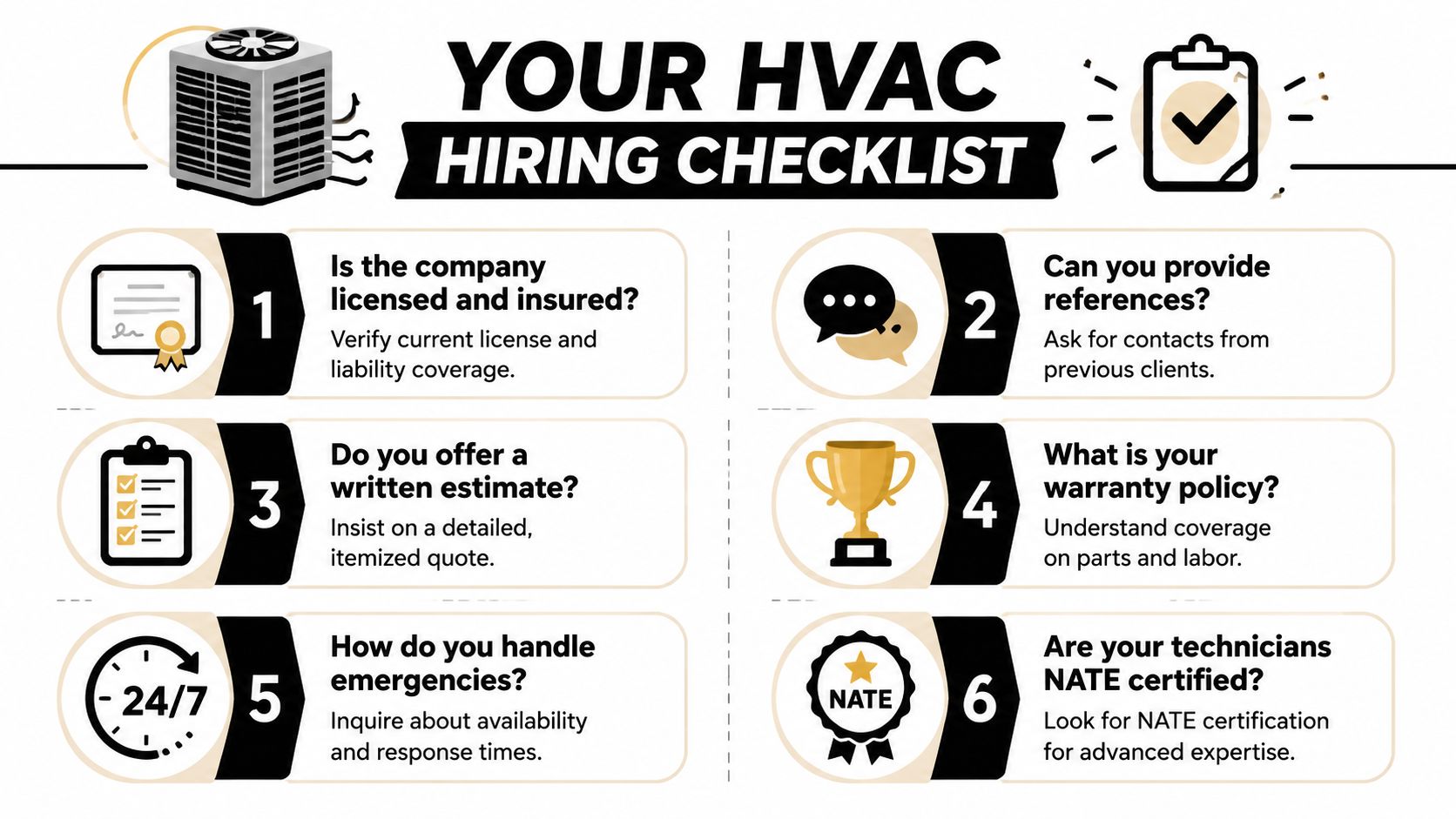
The questions that separate pros from pretenders
Use this checklist when you call:
What's your Arizona ROC license number?
Verify it before booking major work.Do your technicians have EPA Section 608 certification for refrigerant work?
If they service ACs or heat pumps, this matters.Are you insured and bonded?
If they hesitate, keep looking.Will the estimate include airflow and duct evaluation?
This is critical for installations and comfort complaints.What experience do you have with my system type?
Ask specifically about ductless mini-splits, furnaces, heat pumps, rooftop units, or walk-in coolers if that's what you have.Will you provide a written estimate and explain the scope?
You want model numbers, labor scope, and clear exclusions.
A local option for comparing service expectations is to review how an established AC company near me in the Cobre Valley area describes diagnostics, repair, and installation standards.
Red flags you should treat seriously
Some warning signs are obvious. Others are subtle.
| Red flag | What it usually means |
|---|---|
| No ROC number provided | Possible unlicensed operation |
| Cash-only demand | Limited accountability |
| Pressure to decide immediately | Sales tactic, not diagnosis |
| No written estimate | Easy way to change the story later |
| No physical business presence | Harder to track down if problems show up |
| Quote without inspecting ducts or airflow | Shortcut approach |
The cost question matters too. The median annual wage for licensed HVAC technicians was $59,810 in May 2024, according to the U.S. Bureau of Labor Statistics occupational outlook for HVAC mechanics and installers. Skilled labor costs money. That doesn't mean every expensive bid is fair. It does mean the cheapest bid often leaves out the very expertise and accountability that protect homeowners from bad work.
Here's a quick video that helps frame the hiring process:
What a good answer sounds like
A good contractor gives direct answers. They explain the problem in plain language. They don't dodge questions about permits, license status, insurance, or scope.
Ask for specifics, not reassurance. “We'll take care of you” is not a substitute for a written estimate and verified credentials.
When you hear vague promises, slow down. When you hear details, documentation, and a clear process, you're probably talking to the right kind of company.
The Long-Term Benefits of Choosing a Licensed Pro
The cheapest HVAC call often becomes the most expensive HVAC decision. That's not theory. It's how homeowners end up paying twice for the same repair, replacing equipment early, or living with rooms that never cool correctly because the original installation was wrong.
A licensed HVAC technician gives you a better shot at getting the fundamentals right. That means proper AC installation, better AC maintenance, safer furnace and heat pump work, and duct design that supports comfort instead of fighting it. Those aren't cosmetic details. They're the difference between a system that performs and a system that constantly drains money.
What you're really buying
You're not just paying for labor on one day. You're paying for accountability, legal compliance, and workmanship that holds up.
That long-term value shows up in a few practical ways:
- Safer operation: Licensed work is far more likely to follow code and proper procedures.
- Better comfort: Correct sizing and airflow planning usually produce more even temperatures.
- Fewer repeat problems: Good diagnostics reduce the cycle of guesswork and callback visits.
- Stronger protection: Insurance, bonding, and license oversight matter when a dispute or damage issue appears.
- More confidence: You know who did the job and whether they were qualified to do it.
The smart standard for Arizona property owners
If the job involves refrigerant, installation, heat pumps, furnaces, ductwork, or major AC repair, hire accordingly. Ask for the ROC number. Check it. Ask about certification, insurance, and whether the bid includes airflow and duct review. If a company resists those questions, that's enough reason to walk away.
Good HVAC work is rarely the fastest pitch and almost never the cheapest one. It's the one done by the right person, under the right license, with the right process.
If you want help from a local team that focuses on service before sales, Cobre Valley Air LLC serves Globe, Miami, Superior, and surrounding Arizona communities with licensed HVAC repair, AC installation, AC maintenance, duct design, heat pump and furnace service, indoor air quality solutions, and code-compliant replacements. Their team holds Arizona ROC 339078, provides all-inclusive system evaluations with airflow and duct review, and offers straightforward guidance for homeowners and business owners who want the job done right.