


When the AC quits in Globe, Miami, or Superior, it usually happens on the wrong day. The house is already warm, the air coming out of the vents feels weak or not cold enough, and every hour starts to feel longer than it should. The core needs in that moment are simple. Get it fixed fast, get the temperature down, and don't get taken for a ride.
That's exactly why quality AC repair matters. A fast repair isn't always a good repair. Replacing one failed part without checking airflow, ductwork, electrical load, refrigerant performance, and overall system condition can get a unit running again for a day, a week, or a month, then the same complaint comes back.
In the Globe-Miami-Superior area, cooling systems work hard for long stretches. Dust, clogged filters, aging duct systems, attic heat, and neglected maintenance all add stress. The job isn't just to make the outdoor unit turn on. The job is to restore comfort, protect the equipment, and make sure you're not paying twice for the same problem.
Before You Call for AC Repair A Quick Homeowner Checklist
Before you schedule a service call, check the simple stuff. Not because your problem is always simple, but because a few basic issues can look exactly like equipment failure.
A good homeowner checklist saves time, avoids unnecessary cost, and gives the technician a better starting point if you do need service.
Start with the controls
Look at the thermostat first.
- Set it to cool: Make sure it's in cooling mode, not heat, fan-only, or off.
- Lower the setpoint: Put the thermostat below the current room temperature and wait a few minutes.
- Check the fan setting: If the fan is set to “on,” it may blow room-temperature air between cooling cycles. “Auto” is usually the better test setting.
- Replace batteries if needed: Some thermostats act erratically or go blank when batteries get weak.
If the screen is blank, the problem may be power-related rather than a failed AC component.
Check power before assuming the unit is dead
An AC system has more than one place where power can be interrupted.
- Inspect the breaker panel: A tripped breaker can shut down the indoor unit, the outdoor unit, or both.
- Look for a shutoff switch: There may be a service switch near the air handler or furnace.
- Check the disconnect by the outdoor unit: Don't open or handle electrical components if you're not trained, but notice whether anything looks obviously out of place.
If a breaker trips again after you reset it once, stop there. Repeated trips usually point to an electrical fault that needs testing, not repeated resetting.
Practical rule: If the system won't start, don't assume the compressor is bad until you've ruled out thermostat and power issues.
Look at airflow inside the house
Weak airflow fools a lot of people. They think the AC stopped cooling, when the actual problem is that the system can't move enough air.
Check these items:
- Air filter: A clogged filter is one of the most common causes of poor performance. Consumer guidance commonly recommends changing filters every 1 to 3 months and getting annual professional checkups that inspect refrigerant, electrical components, coils, and airflow restrictions, as noted by professional AC maintenance guidance.
- Supply vents: Make sure they're open and not blocked by furniture or rugs.
- Return grilles: Don't let boxes, laundry, or other items choke off return airflow.
Take a quick walk outside
Look at the outdoor condenser.
- Clear obvious debris: Leaves, grass, and dirt around the coil reduce heat rejection.
- Listen for unusual sound: Buzzing, hard starting, or repeated clicking can help narrow down the issue.
- Watch for ice or heavy water: Ice on refrigerant lines or the coil points to a deeper problem, often airflow or refrigerant related.
These checks won't turn a homeowner into a technician. They just help rule out the easiest failures before you pay for diagnosis.
What Quality AC Diagnostics Really Look Like
A lot of bad repairs start with a bad assumption. The unit won't cool, so someone swaps a capacitor. The coil iced up, so someone adds refrigerant. The breaker tripped, so someone resets it and leaves. That isn't diagnosis. That's guessing with a parts cannon.
The U.S. Department of Energy warns that incorrect diagnosis is a recognized problem in HVAC work, which is why a quality repair process should begin with instrumented checks such as refrigerant-side testing, airflow verification, and electrical inspection before any parts are replaced, as described in this DOE fault detection and repair guidance.
A real diagnosis starts with measurements
A technician doing quality work should build a baseline before taking anything apart. That usually means checking operating conditions and looking at the whole system, not just the one part that appears to have failed.
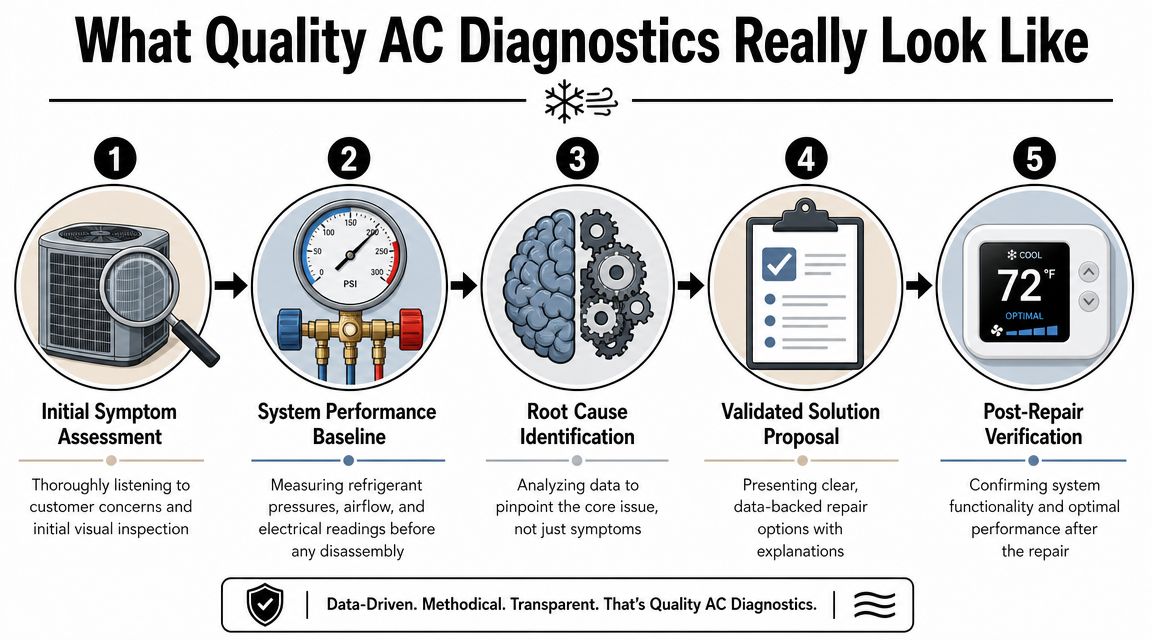
Good diagnostic work often includes:
- Electrical checks: Voltage, amperage, capacitor condition, contactor condition, and wiring integrity.
- Refrigerant-side testing: Pressures, line temperatures, and signs that charge or metering may be off.
- Airflow checks: Filter condition, blower performance, coil condition, and static pressure if airflow problems are suspected.
- Condensate inspection: Drain issues can shut systems down or cause water damage.
- Control verification: Thermostat operation, safety switches, relays, and sequencing.
If you want a simple homeowner-level understanding of the outdoor section, this guide to the parts of an outdoor AC unit can help you follow what the technician is explaining without guessing at terminology.
Airflow is where a lot of “repairs” fail
This is the part many homeowners never get told. A system can have a new capacitor, new contactor, or even a new compressor and still cool poorly if the airflow is wrong.
Poor airflow can cause a repaired system to short-cycle, freeze up, or underperform. The Department of Energy has reported that duct leaks can waste a substantial share of heating and cooling energy, and NREL has shown many homes have measurable duct leakage and pressure imbalances, which is why airflow diagnostics often matter more than another quick parts replacement, as discussed in this airflow and ductwork overview.
If one room is always hot, another is always cold, and the AC runs forever, the equipment may not be the only problem.
In older homes around Globe and Miami, it's common to find one or more of these issues at the same time:
| Problem | What it causes |
|---|---|
| Dirty indoor coil | Low airflow and loss of cooling capacity |
| Undersized return | Noisy operation, strain on blower, poor room comfort |
| Leaky ducts | Lost air before it reaches the room |
| Crushed flex duct | Weak airflow at certain vents |
| Oversized equipment | Short cycling and uneven temperatures |
Post-repair proof matters
A quality repair should end with verification. The technician shouldn't just replace a part, hear the unit start, and call it done.
They should confirm that the system is operating normally after the repair. That means checking temperatures, airflow, drain function, and electrical performance again. If the original complaint was weak cooling in the back bedrooms or humidity that never dropped, the final test should address that complaint directly.
That's the difference between getting the AC to run and getting the house comfortable again.
Your Technician's Toolkit Questions to Ask and Red Flags to Watch
You don't need to know HVAC theory to protect yourself. You just need to ask a few direct questions and pay attention to how the technician works.
Competent technicians usually don't mind explaining what they found. Inexperienced or sales-first operators often stay vague because they don't have solid test results behind the recommendation.
Questions worth asking on the spot
These questions are simple, fair, and useful:
- What did you test first? A solid answer should mention electrical checks, refrigerant-side readings, airflow, or controls.
- What's the root cause, not just the failed part? If a capacitor failed, ask why. High heat, low airflow, overamping, or age can all contribute.
- Can you show me the reading or the failed component? You're not asking for a lecture. You're asking for proof.
- Did you check airflow and the filter? This matters more than many homeowners realize.
- What should be watched next if I choose repair instead of replacement? Honest techs can usually tell you the next weak point.
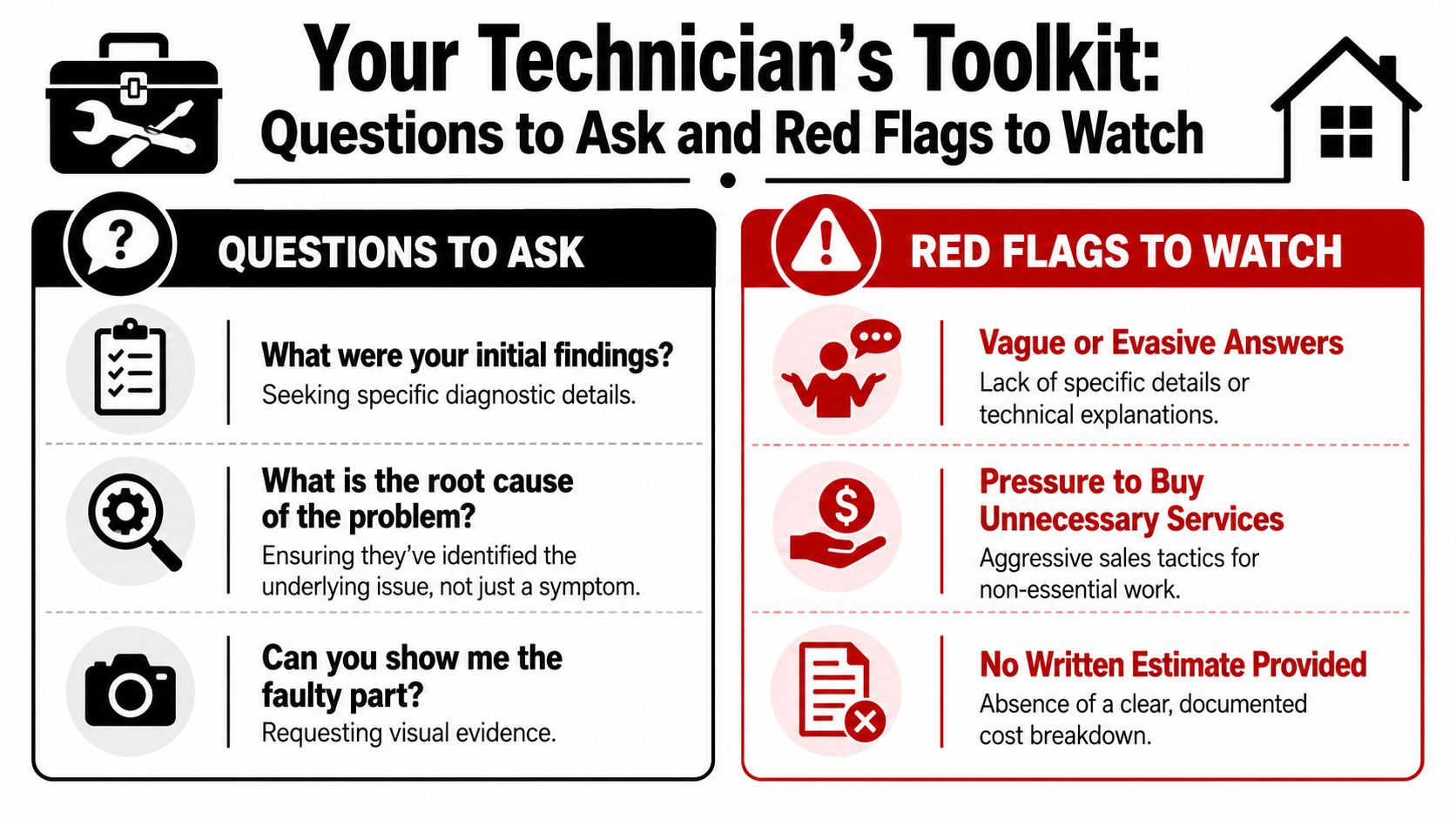
You can also ask for the written estimate before approving work. That protects both sides.
Green flags that usually point to quality work
Look for behavior, not just promises.
- They inspect before quoting: A real diagnosis comes before a firm repair recommendation.
- They use instruments: Digital gauges, electrical meters, thermometers, and airflow tools show they're measuring, not guessing.
- They explain the why: Not in a rushed or condescending way. In plain language.
- They note system condition beyond the immediate failure: Dirty coil, collapsing duct, weak airflow, worn contactor, bad drain setup. Those details matter.
- They leave the area clean: Attention to detail during cleanup often mirrors attention to detail during diagnosis.
What you want to hear: “The part failed, but I also found the airflow is low across the coil, so if we don't address that, the problem can come back.”
Red flags that should slow you down
Some warning signs are easy to miss when the house is hot and you want a quick answer.
A few to watch closely:
| Red flag | Why it matters |
|---|---|
| Immediate replacement push with little testing | May be sales-driven, not diagnosis-driven |
| Vague phrases like “it's probably low” | “Probably” isn't enough when refrigerant and electrical issues are involved |
| No written estimate | Leaves room for disputes and surprise charges |
| No explanation of failure mode | Suggests guesswork |
| Recommending parts without post-repair verification | Increases risk of repeat calls |
The Department of Energy's guidance on HVAC fault detection makes this point clearly. Incorrect diagnosis is a known industry problem, so the repair process should start with instrumented checks and verified fault isolation, not part replacement by assumption.
Don't confuse speed with competence
Emergency service matters in Arizona. But a fast arrival doesn't mean the diagnosis is right.
A good technician can work efficiently and still be methodical. That balance matters more than hearing “I know exactly what it is” in the first minute. In many cases, the best answer early in the call is, “Let me test it first.”
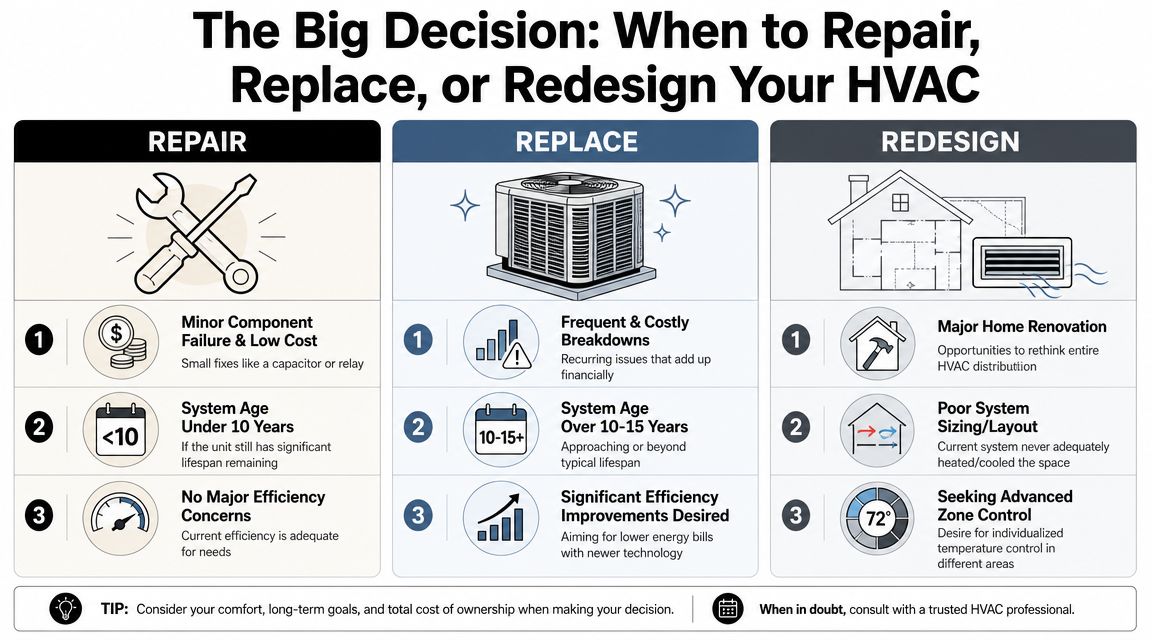
The Big Decision When to Repair Replace or Redesign Your HVAC
Some repair calls are straightforward. A failed capacitor on an otherwise sound system. A contactor that's pitted and no longer pulling in reliably. A condensate drain issue that shut the unit down. Repair makes sense.
Other times, repair is only one piece of the decision. If the unit is older, uses an older refrigerant path, has recurring airflow problems, or never cooled the house evenly in the first place, then fixing the latest failed part may not be the best value.
When repair usually makes sense
Repair tends to be reasonable when the system's underlying design is still sound and the failure is isolated.
Common examples include:
- Single component failure: Capacitor, contactor, fan motor, or thermostat issue.
- Stable comfort before the breakdown: The home cooled well, airflow was decent, and rooms were fairly even.
- No pattern of repeat service: One failure is not the same as ongoing decline.
If the technician can explain the failure, fix it, and verify proper operation afterward, repair is usually the right call.
When replacement deserves a serious look
A lot of homeowners get trapped by the phrase “repair before replacement” without asking whether the system is still a good investment.
A more useful framework looks at:
| Factor | Why it matters |
|---|---|
| System age | Older equipment has less remaining service life |
| Repair frequency | Repeated calls add up fast |
| Refrigerant type | Older refrigerant situations can complicate service decisions |
| Comfort history | If the house never cooled properly, replacing one part won't solve that |
| Efficiency loss | A worn or struggling system can keep running while still performing poorly |
A major issue getting more attention now is refrigerant transition. Industry guidance notes that homeowners should consider refrigerant type, including the R-410A phase-down, when weighing repair versus replacement because service costs, future parts decisions, and long-term economics can all be affected, as discussed in this overview of the repair-versus-replace tradeoff and refrigerant transition.
If you're trying to understand older refrigerant terminology and what people mean when they say Freon, this page on whether Freon is still used is a useful reference.
A short video can also help frame the decision from a homeowner perspective.
Redesign is the option people forget
Sometimes neither basic repair nor equipment-only replacement solves the underlying problem.
That's where redesign comes in. In practical HVAC terms, redesign means looking at the system as a whole:
- equipment sizing
- return and supply layout
- duct restrictions or leakage
- room-by-room comfort issues
- thermostat placement
- zoning or distribution problems
This matters a lot in homes that have always had one hot side, one cold side, loud return noise, weak back-bedroom airflow, or a unit that seems to run all day without making the house comfortable.
A new system installed on bad ductwork often delivers old problems at a new equipment price.
Don't leave out heat pumps, furnaces, and dual-purpose decisions
Even when the summer call starts as AC repair, the smart decision may involve the full HVAC system.
For example:
- Heat pumps: Good option when you want heating and cooling from one system.
- Furnaces with split AC systems: Sometimes the cooling issue is tied to blower performance or airflow through the indoor section.
- Ductless mini splits: Useful for additions, garages, rooms with chronic duct problems, or older homes with layout limitations.
For local homeowners comparing options, companies such as Cobre Valley Air LLC handle repairs, installations, duct evaluation, and load-based system sizing in the same scope, which is the right approach when comfort problems go beyond one failed part.
The main point is simple. Don't ask only, “Can this be repaired?” Ask, “If I repair it, will I still have the comfort, reliability, and operating issues that brought me here?”
Finding Your Local Pro Vetting Contractors in Globe Miami and Superior
The quality of the company matters almost as much as the quality of the part being installed. In a smaller market like Globe, Miami, and Superior, reputation travels fast, but so do rushed jobs and shortcuts.
Homeowners usually feel pressure to choose the first available truck when the AC is down. That's understandable. But if you can slow down long enough to verify a few basics, you'll make a better decision.
Start with license, insurance, and actual accountability
In Arizona, verify that the contractor holds the right license and that the license is current. If a company gives you a ROC number, that's useful because it gives you a clean way to confirm who you're hiring. For example, Cobre Valley Air lists Arizona license ROC 339078, which is the kind of detail a homeowner should expect any legitimate contractor to provide.
Also ask whether the company is insured and whether the technician working on your equipment is employed by the company or subcontracted in.
Then look at review patterns, not just star count. Read the recent reviews and watch for specifics:
- Did customers mention diagnosis quality?
- Did they say the company explained options clearly?
- Were there comments about repeat issues after service?
- Did commercial clients mention reliability on rooftop units or walk-in coolers?
Why the cheapest bid often carries the most risk
HVAC work is skilled trade work. According to the U.S. Bureau of Labor Statistics, heating, air conditioning, and refrigeration mechanics and installers earned a median annual wage of $59,810 in May 2024, and employment is projected to grow 8% from 2024 to 2034 with about 40,100 openings per year on average, as shown in the BLS HVAC career profile.
That labor market matters because good service depends on trained people. The same BLS profile notes that many technicians need postsecondary training plus on-the-job instruction, and some positions require licensure or certification. In plain terms, the companies that invest in skilled technicians, stock proper tools, and make time for diagnosis usually won't be the lowest bid.
If one quote is much lower, ask what testing, parts quality, warranty detail, and duct evaluation were left out.
Questions that separate a real contractor from a guy in a truck
Ask these before approving larger work:
| Ask this | What a solid answer sounds like |
|---|---|
| Who is responsible if the repair doesn't solve the complaint? | Clear follow-up process |
| Will you inspect airflow and duct condition? | Yes, if comfort or repeat failure suggests it |
| Do you provide a written estimate? | Always |
| How do you size replacement equipment? | Load calculation, not rule of thumb |
| Do you service both residential and light commercial equipment? | Relevant if you own rentals, restaurants, or mixed-use property |
If you want to compare local service details, this page about an AC company in Globe, AZ shows the kind of information homeowners should expect to find before booking.
In this area, local knowledge matters too. Contractors who regularly work in Globe, Miami, and Superior tend to understand the older housing stock, duct challenges, rooftop exposure, and the way dust affects condensers and filters. That doesn't replace technical skill, but it does make the diagnosis sharper.
After the Service Validating the Work and Planning for the Future
When the technician leaves, the job shouldn't feel like a mystery. You should have a working system, a clear explanation of what was done, and a simple plan for what comes next.
What to check that same day
Walk through the house and pay attention.
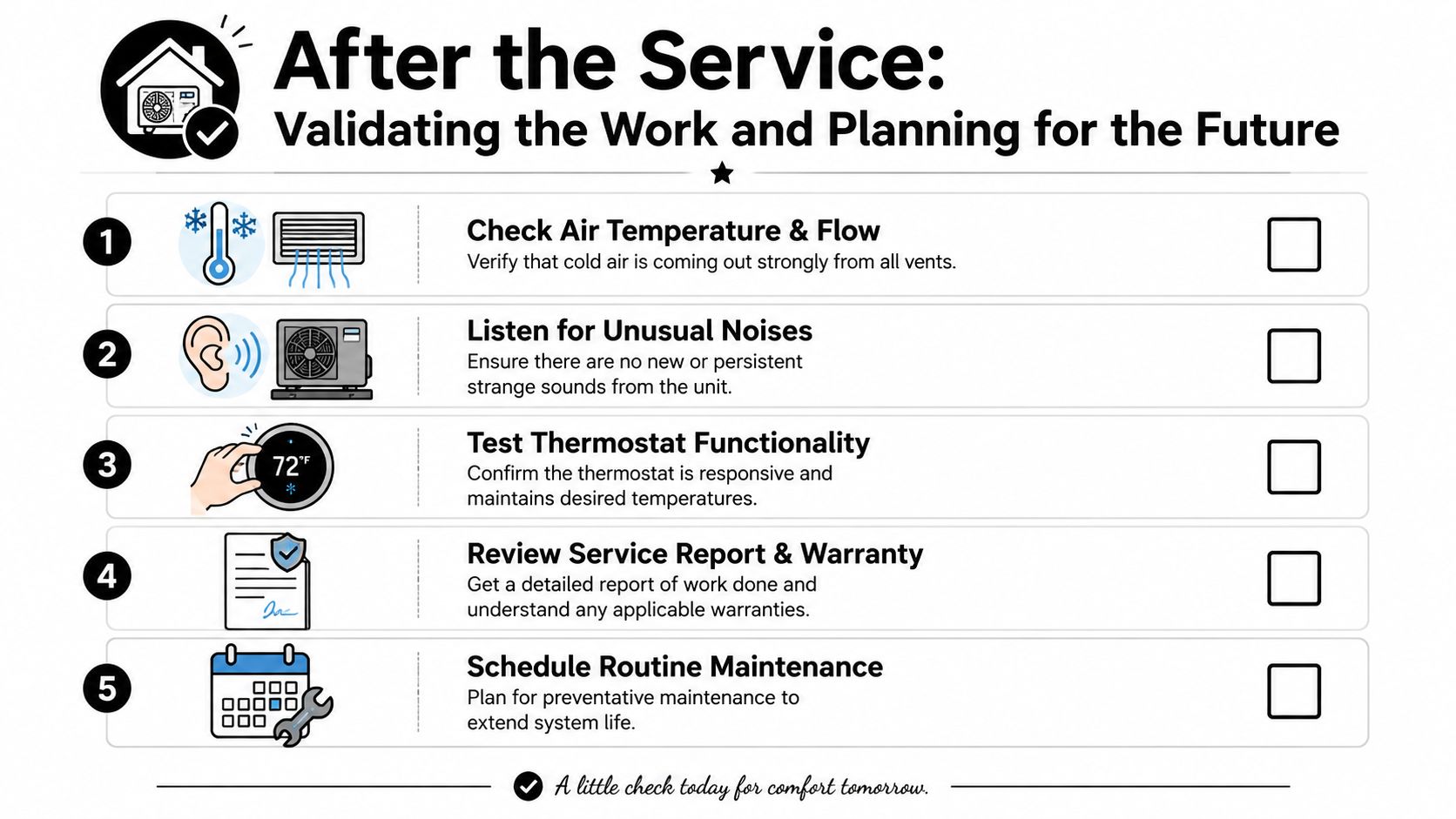
Use this quick checklist:
- Feel the airflow: Air from the vents should be strong and consistently cool where the system is supposed to be serving.
- Listen for new noises: Rattling, buzzing, or hard-start sounds shouldn't appear after a repair.
- Watch the cycle pattern: The system should start, run, and shut off normally rather than short-cycling repeatedly.
- Check the thermostat response: Make sure it holds the set temperature and responds correctly.
- Review the paperwork: Keep the invoice, part information, and any warranty details.
If something still feels off, call back early. It's easier to resolve a concern when the job details are fresh.
Maintenance is what protects the repair
A quality repair isn't the finish line. It's the point where reactive service should turn into prevention.
The Department of Energy says maintenance of filters, coils, fins, and refrigerant lines is essential for efficient AC performance, and it warns that neglect can increase energy use and even contribute to water damage if drain channels clog. Consumer Reports also found that about 19% of central AC systems purchased encountered at least one problem during one survey period, and it recommends annual service that includes coil cleaning, drain system flushing, and refrigerant checks, along with getting at least three quotes when choosing contractors, as outlined in this air-conditioner maintenance guidance from the U.S. Department of Energy.
That's why good service should lead to a simple routine. Change filters on schedule. Keep the outdoor unit clear. Don't ignore weak airflow or water around the indoor unit. Schedule professional maintenance before peak season, not after the first breakdown.
The cheapest AC repair is often the one you never need because the system was maintained before it failed.
Frequently Asked Questions About AC Service
Why does my AC run but the house still feels warm?
The system may be operating, but not delivering enough cooling to the rooms. Low airflow, dirty coils, duct leakage, thermostat issues, or incorrect system sizing can all cause that complaint. A running unit isn't the same thing as a correctly performing system.
Should I repair my heat pump the same way I'd repair a standard AC?
The diagnostic mindset is the same. Test first, confirm the fault, and check airflow and controls. The difference is that a heat pump handles both heating and cooling, so reversing valve operation, defrost controls, and seasonal performance matter too.
Can a furnace affect summer cooling?
Yes. In a split system, the blower section and indoor coil are tied together. If the furnace blower is weak, dirty, or not moving the right amount of air, cooling performance suffers.
Is annual maintenance really necessary if the unit seems fine?
Yes. AC systems often drift before they fail. Dirty filters, blocked drains, restricted coils, and electrical wear can all build slowly. Catching those problems early is usually cheaper and less disruptive than waiting for a no-cooling call in the middle of summer.
Why do some rooms in my house never cool well even after repairs?
That usually points to airflow, duct layout, leakage, return-air problems, or equipment sizing. If the complaint has been there for years, another part replacement probably won't solve it by itself.
Do I need more than one quote for larger work?
For major repairs or replacement, yes. Getting more than one quote helps you compare diagnosis quality, scope of work, warranty details, and whether anyone is addressing duct and airflow issues instead of only talking about the box outside.
If you need honest HVAC guidance in the Copper Corridor, Cobre Valley Air LLC serves Globe, Miami, Superior, and nearby communities with AC repair, installation, maintenance, duct evaluation, heat pump and furnace service, and code-compliant system replacements. If your system isn't cooling right, ask for a diagnosis that looks at the whole system, not just the first failed part.