


By midafternoon in an Arizona summer, you can feel the house change fast. The rooms that were comfortable in the morning start holding heat, the hallway feels warmer than the living room, and somebody usually notices first that the system seems to be running longer than it should. That's when most homeowners start asking the same question. What, exactly, is my AC doing, and why does one small problem seem to affect the whole house?
A central air conditioner isn't just a metal box outside and a thermostat on the wall. It's a complete cooling system with mechanical parts, airflow paths, controls, and ductwork that all have to do their jobs at the same time. When one part falls behind, comfort drops off quickly, especially in Globe, Miami, Superior, and nearby communities where cooling isn't a luxury. It's part of how you live through the season.
Your AC A Lifeline in the Arizona Heat
The air conditioner often goes unnoticed until the house won't cool down at the end of a long hot day. A bedroom feels stuffy. The supply vents are blowing, but the air doesn't feel cold enough. The outdoor unit is running, yet the house never quite catches up. In Arizona, that isn't a minor inconvenience. It changes sleep, comfort, and how hard the rest of the equipment has to work.
Air conditioning has been moving toward that role for a long time. The modern system traces back to Willis H. Carrier's 1902 invention, and by the late 1960s most new U.S. homes had central air. Today, air conditioning is in nearly 100 million American homes, equal to 87% of households, according to the U.S. Department of Energy's history of air conditioning. That tells you something important. Central AC didn't stay a specialty machine. It became basic home infrastructure.
A reliable cooling system isn't just about temperature on the thermostat. It's about whether every part of the system can keep moving heat out of the house when the weather won't let up.
Homeowners usually get handed a parts list when they really need a working picture. They need to know what the outdoor unit does, what the indoor coil does, why airflow matters, and why a bad room-to-room balance may have more to do with duct design than with the condenser outside.
That's the practical side of understanding central air conditioning system components. When you know how the system is supposed to work, service decisions get clearer. You can spot early warning signs sooner. You can also tell the difference between a simple maintenance problem and a design issue that keeps causing the same breakdown every summer.
The Heart of the System Core AC Components Unpacked
A central air conditioner makes more sense when you stop thinking of it as one machine and start thinking of it as a working body. Each part has a specific job. If one part can't do that job, the whole system feels it.
According to RSI's overview of air-conditioning system components, a standard central air-conditioning system is built around the compressor, condenser coil, and evaporator coil, supported by the thermostat, air handler, ductwork, and an expansion valve. That arrangement became the template for modern systems, and it's still the foundation of what technicians service every day.
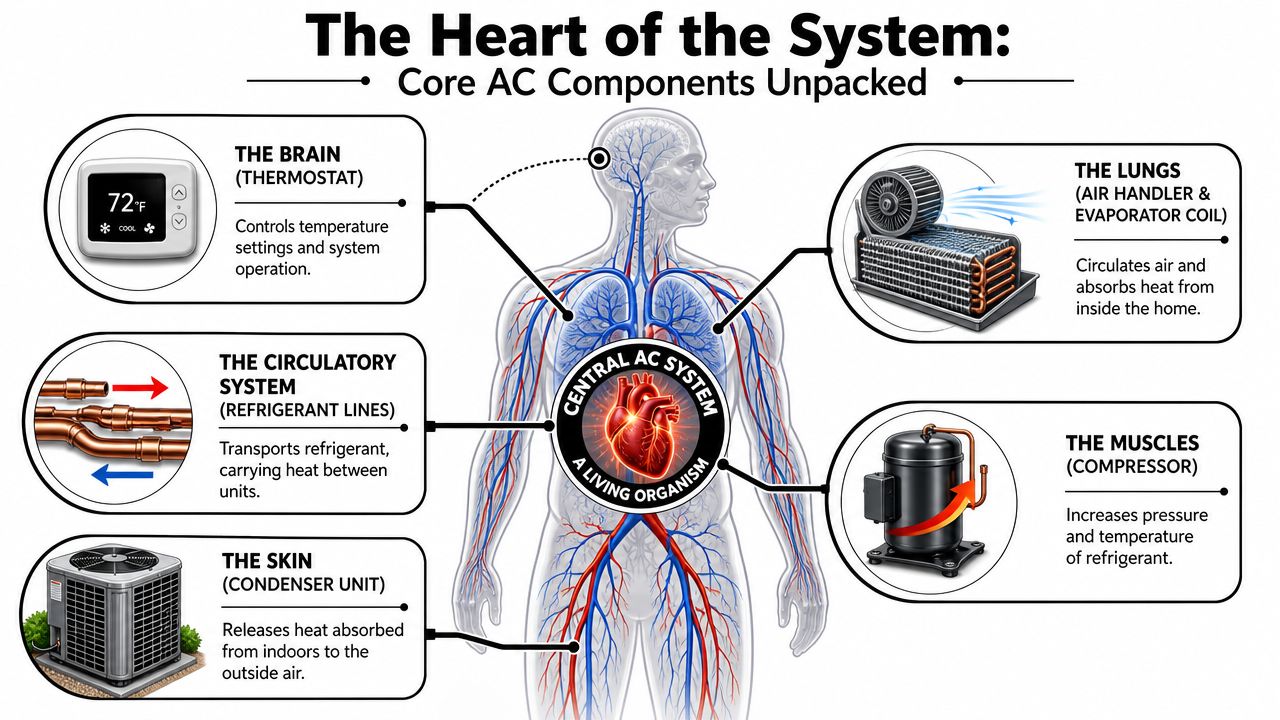
The thermostat acts like the brain
The thermostat tells the system when to start and when to stop. It reads indoor temperature and calls for cooling when the house rises above the set point. That sounds simple, but a thermostat doesn't create cooling. It only starts the sequence.
That distinction matters because homeowners often blame the thermostat first. Sometimes the control is the issue. Often it isn't. A system can have a thermostat that's calling correctly while the actual problem sits in airflow, refrigerant movement, or outdoor heat rejection.
The compressor does the heavy lifting
If the thermostat is the brain, the compressor is the muscle. It pressurizes the refrigerant and keeps the refrigeration cycle moving. Without it, heat doesn't get carried out of the house.
When people ask about the parts of an outdoor AC unit, this is usually the first component I point to. The compressor is one of the biggest reasons correct installation matters so much. Poor airflow, bad charge, dirty coils, and electrical issues can all force the compressor to operate under strain. When that happens, the most expensive part of the system starts paying for problems that started somewhere else.
The condenser coil sheds the heat
The condenser coil sits in the outdoor unit with the compressor and fan. Its job is to release the heat the system picked up from inside the home, acting as the system's skin, where unwanted heat leaves the body.
If that coil is packed with dirt or blocked by debris, the system can't reject heat efficiently. The unit may still run, but cooling capacity falls off. In Arizona, where the outdoor environment is already working against the equipment, the condenser needs clear airflow and enough space around it to breathe.
The evaporator coil is where indoor heat gets absorbed
The evaporator coil sits indoors, usually with or near the air handler. This is the part that absorbs heat from the air inside the house. Warm return air moves across the coil, heat transfers into the refrigerant, and the blower sends cooler air back into the rooms.
Homeowners don't see this coil every day, so it's easy to overlook. But if airflow is restricted by a dirty filter, crushed duct, weak blower performance, or poor return design, the evaporator can't do its job well. That's one reason “my AC runs but doesn't cool” isn't a complete diagnosis. The mechanical parts may be operating, but the heat exchange can still be compromised.
The air handler moves the air you paid to cool
The air handler contains the blower that pushes conditioned air through the duct system. In a practical sense, this is one of the most underappreciated parts of the system. Homeowners focus on the outdoor unit because it's visible and noisy. But comfort inside the house depends just as much on moving the right amount of air across the indoor coil and through the duct network.
Practical rule: If the blower can't move air correctly, even healthy refrigeration components won't deliver the comfort you expect.
A system with poor airflow often acts like it has a refrigeration problem. Rooms cool unevenly. The coil may get too cold. Runtime increases. Utility use can climb. The root cause can be something as basic as a neglected filter or something more structural, like undersized return air.
The expansion valve meters the refrigerant
The expansion valve is the traffic control point in the refrigeration circuit. It meters refrigerant into the evaporator coil at the proper rate. That pressure drop is what helps the refrigerant enter the indoor coil in the right condition to absorb heat.
This is not a flashy part, but it's a critical one. If it doesn't meter correctly, the evaporator won't perform the way it should. Homeowners usually don't hear much about the expansion device until it causes trouble, but technicians pay close attention to it because it directly affects how the whole cooling cycle behaves.
The refrigerant lines and ductwork complete the path
Copper refrigerant lines connect the indoor and outdoor sections. They carry heat through the refrigerant loop. The ductwork does the separate but equally important job of carrying cooled air to the living spaces and returning warmer air to be conditioned again.
That's where many AC conversations go wrong. People talk about the box outside as if it is the system. It isn't. The system includes the delivery network too. If the ducts are leaking, badly sized, or poorly laid out, the equipment can't show its real performance.
The Cooling Symphony How Components Work Together
A central AC system works like a heat-moving conveyor belt. It doesn't create cold as one might expect. It moves heat from inside the house to the outdoors through a repeating refrigerant cycle.
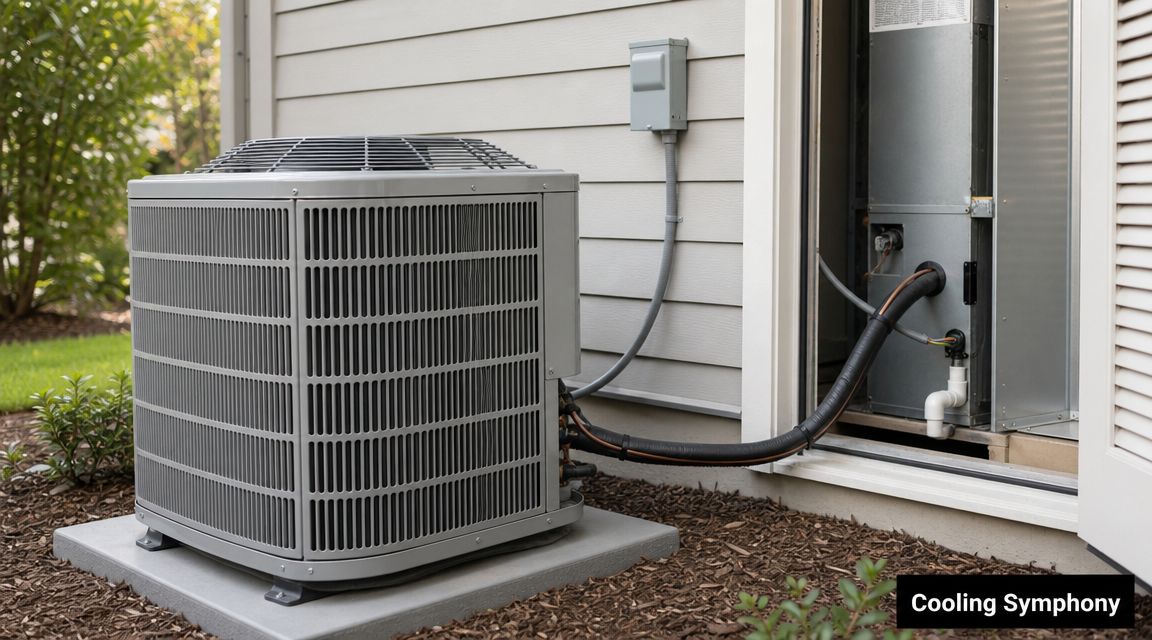
Lennox explains central air conditioning as a split-system. The outdoor unit contains the compressor and condenser coil. The indoor unit contains the evaporator coil and blower. Refrigerant circulates between them. The indoor coil absorbs heat, and the outdoor coil rejects it. That's the core loop that removes thermal energy from the building.
The cycle starts indoors
Warm air from the house returns to the air handler and passes over the evaporator coil. The refrigerant inside that coil absorbs heat from the air. The blower then pushes cooled air into the supply ducts and back into the rooms.
If you want a simple picture, think of the evaporator coil as the pickup point. It collects indoor heat and loads it into the refrigerant stream.
The refrigerant carries that heat outside
Once the refrigerant has picked up heat indoors, the compressor increases its pressure and temperature so the system can move that heat to the outdoor side. The refrigerant then travels to the condenser coil, where the outdoor fan helps release that heat to the outside air.
This is why a system can fail in ways that seem confusing to a homeowner. The thermostat may be calling. The blower may be running. The outdoor fan may be spinning. But if any part of the cycle is weak, restricted, or out of balance, the entire conveyor belt slows down.
Here's a visual explanation that helps show the cycle in motion:
The expansion device resets the loop
After the condenser coil sheds heat, the refrigerant passes through the expansion device. That metering step reduces pressure before the refrigerant re-enters the evaporator coil. Then the cycle repeats.
A homeowner doesn't need to memorize the chemistry to understand the big takeaway. Every part in the loop depends on the others. If the evaporator can't absorb heat well, the condenser has less to reject. If the condenser can't reject heat well, the refrigerant comes back to the indoor side in the wrong condition. Cooling performance is tied together from start to finish.
When one part of the refrigeration loop struggles, the symptom often shows up somewhere else.
That's why accurate diagnosis matters. A house that won't cool evenly may have a refrigerant problem, an airflow problem, a duct problem, or more than one at the same time. Treating the symptom alone usually doesn't fix the system.
Beyond the Box The Critical Supporting Cast
A lot of AC advice stops at the condenser and evaporator coil. That misses the parts that often decide whether the house feels comfortable or frustrating. The system is bigger than the equipment cabinet.
The U.S. Department of Energy says proper installation, duct sizing, sealing, and airflow are critical to performance, and that leaky ducts can waste up to 30% of cooling energy, especially in unconditioned spaces, as noted in its central air conditioning guidance from Energy Saver. That's one of the clearest reasons a “bad AC” diagnosis can be misleading. Sometimes the equipment is sound, but the air distribution system is wasting the cooling before it ever reaches the room.
Ductwork decides whether the cooling reaches the rooms
Ducts are the delivery path. If they leak, pinch down, or were poorly designed from the start, the house can have hot spots, weak airflow, and long runtimes even when the refrigeration side is functioning.
In Arizona homes, this shows up in familiar ways:
- Back bedrooms stay warmer: The system may be cooling, but airflow isn't reaching the far end of the duct run effectively.
- One room blasts air while another barely moves any: Balancing and duct sizing may be off.
- The unit runs constantly in the afternoon: Heat gain and duct losses can pile onto each other, making the equipment work harder than it should.
A proper repair call should never ignore the duct system. Replacing a capacitor or adding refrigerant won't solve a return air problem or a supply layout that never delivered evenly in the first place.
The thermostat controls, but it doesn't compensate for bad design
A thermostat is important, but it can only respond to what it senses in one location. If the hallway is comfortable and the master bedroom is not, the thermostat may believe the job is done while part of the house still feels warm.
That's why placement matters, and so does system design. Smart controls can help scheduling and convenience. They can't overcome duct leakage, poor airflow, or an oversized or undersized installation by themselves.
The thermostat is the traffic signal. It is not the engine, the duct system, or the fix for uneven airflow.
Filters protect airflow and equipment
Air filters do two jobs at once. They help keep dust and debris from coating the indoor coil, and they support indoor air quality. When they load up, airflow drops.
That reduced airflow can make the system act weak, noisy, or inconsistent. It can also stress the indoor side of the equipment. A basic maintenance item can create symptoms that look much more serious than they are.
The condensate drain handles the moisture side
Cooling doesn't only remove heat. It also produces condensation as warm indoor air passes over the cold evaporator coil. The condensate drain carries that water away.
When that drain clogs, homeowners may notice water around the indoor unit, a shutoff event, or musty conditions near the air handler. It's a small supporting part with a very practical job. If it's neglected, you can get comfort problems and water issues at the same time.
Installation quality ties the supporting parts together
Craftsmanship, rather than marketing, proves paramount. A system with quality equipment can still underperform if the return is undersized, if the duct transitions are sloppy, if the airflow isn't verified, or if the equipment was selected without a real load calculation.
For homeowners comparing repair and replacement options, that's worth remembering. The model number on the box matters. The design and installation behind it matter just as much.
When Things Go Wrong Common Problems and Symptoms
Homeowners usually notice symptoms long before they know which component is involved. The AC runs but the house doesn't cool. It turns on and off too often. A vent feels weak. The outdoor unit is louder than normal. Good diagnosis starts by connecting those symptoms to the part of the system that could be causing them.
One of the biggest trouble spots is the coordination between the expansion valve and the compressor. As explained by Advanced Heating and Cooling's component overview, the expansion valve meters refrigerant into the evaporator while the compressor maintains the pressure difference that drives the cycle. When that coordination fails, the symptoms can look like several different problems at once. That's one reason misdiagnosis happens.
Symptoms homeowners can check first
Some issues are worth checking before you schedule service.
- Dirty filter: If airflow has dropped, start there.
- Thermostat setting: Make sure it's on cool and the set point is below indoor temperature.
- Blocked return or supply vents: Furniture, rugs, and closed vents can create avoidable airflow trouble.
- Outdoor unit crowding: Leaves, weeds, and debris can choke condenser airflow.
Those are homeowner-level checks. If the system still isn't cooling right after that, the next step should be professional testing, not guesswork.
Common AC Problems and Their Sources
| Symptom | Potential Component Fault | What It Means | Action |
|---|---|---|---|
| AC runs but home stays warm | Dirty filter, restricted evaporator airflow, refrigerant-side issue, duct leakage | The system may be operating, but heat removal or air delivery is weak | Start with filter and vent check. If the problem continues, schedule professional diagnosis |
| Weak airflow at vents | Blower issue, clogged filter, duct restriction, return air problem | The house isn't getting enough conditioned air | Check filter first. Duct and blower problems need a technician |
| Outdoor unit runs, indoor comfort is poor | Condenser airflow problem, refrigerant imbalance, indoor airflow problem | The outdoor section is on, but the cooling cycle may be out of balance | Professional service is the right move |
| Short cycling | Thermostat issue, airflow problem, electrical/control fault, sizing issue | The system is starting and stopping too often | Needs diagnosis. Repeated cycling is hard on components |
| Ice on indoor line or coil | Low airflow, refrigerant issue, metering problem | The evaporator may be operating under the wrong conditions | Turn the system off and call a technician |
| Water around indoor unit | Condensate drain blockage or drainage issue | Moisture isn't leaving the system properly | Homeowner can inspect for obvious blockage. Persistent issues need service |
| Unusual noise from equipment | Loose parts, motor problem, compressor strain, airflow issue | Mechanical or electrical components may be under stress | Do not ignore it. Have it inspected before damage spreads |
What not to do
Don't keep resetting the thermostat lower and lower hoping the system will catch up. If the equipment is underperforming, that won't fix the cause. It only increases runtime.
Don't assume every cooling issue means the system needs refrigerant. Refrigerant problems happen, but they're far from the only reason a house feels warm. If you're sorting out refrigerant questions, this overview on whether Freon is still used helps explain why older and newer systems aren't all serviced the same way.
A good service call doesn't start with replacing a part. It starts with proving what failed, what caused it, and whether another problem pushed that part into failure.
When to call a technician right away
Call for service promptly if you notice any of these:
- Ice formation: That points to a system operating outside normal conditions.
- Burning smell or hard-start behavior: Electrical and compressor issues shouldn't wait.
- Water leakage near the air handler: Minor drain problems can become bigger interior damage problems.
- Rapid loss of cooling in extreme heat: The system may still be running, but something important isn't functioning correctly.
Lifespan Maintenance and When to Replace Your System
Most air conditioners don't fail all at once. They lose ground a little at a time. Airflow drops. Coils get dirty. Electrical parts wear. Refrigeration issues start showing up as longer runtimes or weaker performance. That's why maintenance beats reactive repair. It gives you a chance to correct small problems before they turn into peak-season breakdowns.
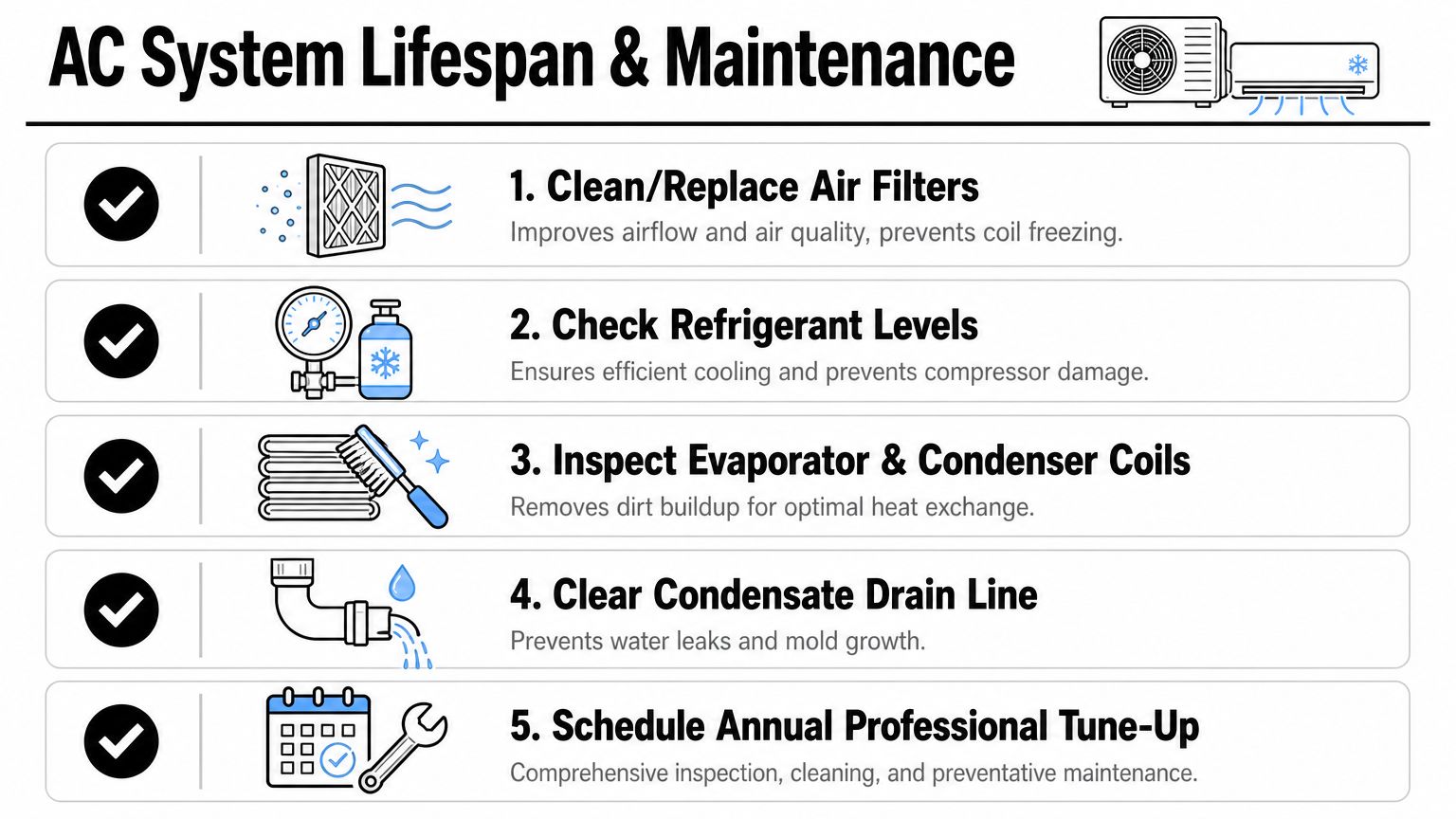
For homeowners, the basic routine matters more than people think. Clean filters, clear airflow around the outdoor unit, and regular inspection of visible components all help the system do what it was designed to do.
What homeowners should handle
A few maintenance tasks are practical for almost any homeowner:
- Replace or clean the air filter: A clogged filter can choke airflow and create comfort problems.
- Keep the outdoor unit clear: Remove debris and give the condenser space to move air.
- Watch for drainage issues: Water near the indoor unit is a warning sign worth acting on early.
- Pay attention to changes: Longer runtimes, new noises, or room-to-room imbalance are worth noting before they become failures.
If you want a quick reference, this guide on how often to replace an HVAC filter is a useful starting point for the most commonly overlooked maintenance item in the house.
What should be part of professional service
A proper tune-up goes beyond a filter swap. A technician should inspect the mechanical and airflow side together.
- Coil inspection and cleaning: Dirty indoor or outdoor coils reduce heat transfer.
- Refrigerant-side evaluation: The system should be checked for proper operation, not guessed at.
- Electrical inspection: Connections, controls, and motors need to be verified under load.
- Drain and airflow review: Moisture removal and air movement are part of cooling performance.
Repair or replace depends on the whole picture
Replacement shouldn't be the automatic answer every time a part fails. But repair shouldn't be automatic either. The right decision depends on condition, repeat issues, installation quality, refrigerant considerations, and whether the duct and airflow side are helping or hurting the equipment.
A few signs push the conversation toward replacement:
- Repairs keep stacking up: Repeated failures usually mean the system is aging as a whole.
- Comfort has never been right: If the home has chronic airflow or sizing issues, replacing only one component may not solve the problem.
- Major component trouble appears alongside design problems: A new condenser on a weak duct system won't deliver the result most homeowners expect.
For homes with heat pumps or furnace pairings, the same logic applies. The cooling section doesn't exist in isolation. Matched equipment, verified airflow, and proper design make a bigger difference over time than patching a system year after year without addressing root causes.
Why Local Expertise Matters for Your HVAC System
A central air conditioner succeeds or fails as a system. That's the lesson behind all the central air conditioning system components people read about online. The compressor matters. The coils matter. The expansion device matters. But the final result in your house depends just as much on airflow, duct design, load matching, installation quality, and accurate diagnostics.
That's especially true in Arizona, where long cooling seasons expose every shortcut. A unit that's slightly oversized, a return that's slightly undersized, or a duct run with too much restriction may limp along in mild weather. In real summer conditions, those flaws show up fast. Homeowners feel them as hot rooms, long runtimes, noisy operation, and repair calls that never seem to solve the whole issue.
Craftsmanship changes the outcome
Good HVAC work is rarely flashy. It shows up in the details. Refrigerant lines are installed correctly. Airflow is measured, not assumed. Duct transitions are built to move air cleanly. Equipment is selected to fit the house, not just the old nameplate.
That same approach matters for more than cooling. Heat pumps, furnaces, ductless systems, and new-construction installs all depend on sizing and airflow discipline. Builders need proper load calculations and duct planning. Restaurant owners need rooftop units and walk-in cooler service that won't drag into avoidable downtime. Property managers need diagnostics that identify the root cause instead of replacing parts until something works.
Local conditions require local judgment
A technician who works in this area understands the difference between a textbook answer and a field answer. Dust load, attic conditions, heat exposure, and duct layout all shape how equipment performs in actual homes here.
That's where a company like Cobre Valley Air LLC fits into the picture. The practical value isn't a slogan. It's the kind of work described in its service model: HVAC repair and installation, duct design and inspection, airflow evaluation, new construction sizing, and support for both residential and commercial systems.

What homeowners should look for in any HVAC contractor
If you're comparing providers, ask questions that go beyond brand names:
- Will they evaluate ductwork and airflow: If not, they're only looking at part of the system.
- Do they explain the cause of failure: A real diagnosis should connect symptoms, testing, and root cause.
- Can they handle the full HVAC picture: That includes heat pumps, furnaces, controls, and design, not just the outdoor unit.
- Do they install to code and verify performance: Good equipment deserves good commissioning.
The difference between a temporary fix and a reliable system usually comes down to whether the contractor treats the house like a complete airflow system or just a collection of replaceable parts.
When homeowners understand how their system works, they make better repair, maintenance, and replacement decisions. That knowledge won't turn you into a technician, but it will help you ask smarter questions and avoid the common mistake of blaming the wrong component.
If your home or business in Globe, Miami, Superior, or the surrounding area needs AC repair, system replacement, duct evaluation, heat pump service, furnace work, or a second opinion on airflow and installation quality, contact Cobre Valley Air LLC for practical, code-conscious HVAC help.