


If you're asking what size water heater you need, there's a good chance you're already dealing with one of two problems. You either run out of hot water halfway through the morning rush, or you're replacing an old unit and don't want to guess wrong on the next one.
Around Globe, Miami, and Superior, that decision gets more complicated than most online calculators make it sound. House layout, fixture use, utility setup, hard water, and your family's routine all matter. A water heater that looks right on paper can still disappoint in real use if the sizing method is wrong.
The biggest mistake homeowners make is choosing by habit. They look at the old tank, see the label size, and buy the same thing. Sometimes that works. A lot of times it doesn't. The right answer depends on whether you're installing a traditional tank or a tankless unit, and those two systems are sized in completely different ways.
How to Size a Traditional Tank Water Heater Using FHR
A common Globe-area call goes like this. The house has a 50-gallon tank, nobody changed the family routine much, and they still run short on hot water during the morning rush. The problem is usually not the label on the tank. It is whether that heater can deliver enough hot water in the busiest hour.
For a standard storage water heater, the sizing number that matters is the First-Hour Rating, or FHR. That is the amount of hot water the unit can supply in a busy hour, with stored water plus burner or element recovery included. The U.S. Department of Energy says tank heaters should be sized by matching the FHR to the household's peak-hour demand in its water heater sizing guide.
Why FHR matters more than tank size
Tank size tells you how much water the heater stores. FHR tells you how the heater performs once showers, laundry, and dishes start stacking up in the same hour.
That difference matters in real houses.
Two heaters can both say 50 gallons on the jacket and still perform very differently. One may carry two back-to-back showers and a washer load without trouble. The other may leave the last person with lukewarm water because its recovery rate is slower and its FHR is lower.
In Globe, Miami, and Superior, this shows up often in older homes where a like-for-like replacement gets installed without checking the rating plate. Same tank size does not always mean same output.
Practical rule: Match the heater's FHR to your busiest hour. Do not buy by tank label alone.
Build your peak-hour demand the same way a tech does
Start with one question. What is the busiest hot-water hour in your house?
For many homes, it is early morning. Two showers run back to back, somebody starts laundry, and the kitchen sink gets used for breakfast cleanup. In other homes, the heavy hour is after work. What matters is the one-hour stretch with the most overlap.
Use a simple worksheet:
Pick the busiest hour
Write down the one-hour period that puts the most demand on the heater.List each hot-water use in that hour
Include showers, dishwasher use, clothes washing, tub fills, and big sink draws.Add those gallons together
That total is the demand your tank needs to cover.
The DOE example uses common household events that add up fast. A shower is often figured at about 20 gallons, a dishwasher cycle at 7 gallons, and a washing machine load at up to 25 gallons, as noted in the DOE guidance.
Typical hot water usage by fixture
| Fixture/Appliance | Average Gallons Used |
|---|---|
| Shower | 20 gallons |
| Dishwasher cycle | 7 gallons |
| Washing machine load | up to 25 gallons |
A practical morning example
Say your busiest hour looks like this:
- One shower
- A second shower right after
- One dishwasher cycle
- One washing machine load
Add those together and compare that total to the heater's FHR. If the heater's FHR is below that number, you can still have a tank that sounds large enough and run out of hot water before the hour is over.
That is why I tell homeowners to read the spec sheet, not just the front sticker. The answer is on the manufacturer performance chart. If you are also weighing a storage tank against an on-demand setup, this guide on how to choose a tankless water heater helps explain where the sizing process changes.
What works and what causes problems
What works:
- Match FHR to the busiest hour in your home
- Count actual habits, including back-to-back showers and same-hour laundry
- Check the yellow EnergyGuide label or manufacturer specs before you buy
What causes problems:
- Replacing the old heater with the same gallon size without checking FHR
- Sizing by number of people only
- Ignoring overlap because each fixture seems small by itself
In the field, that replacement mistake is common. A home had a 50-gallon tank, so another 50-gallon tank goes in. If the new unit has a lower FHR, or if the household now uses more hot water in the same hour, the new heater can disappoint from day one.
Local conditions add another layer. In Globe, Miami, and Superior, incoming groundwater temperature and hard water can affect how a system performs over time, especially if sediment buildup cuts recovery efficiency. That does not change the FHR method, but it is one reason a paper match is not always a good field match.
Calculating Flow Rate and Temperature Rise for a Tankless Water Heater
Tankless sizing is a different job. There's no stored reserve to lean on, so the unit has to handle the load live, in real time.
That means two numbers control everything. The first is how much hot water you want at once. The second is how much the heater has to warm the incoming water before it reaches the tap.
Start with simultaneous flow
With tankless, don't count every fixture in the home. Count only the fixtures that may run at the same time.
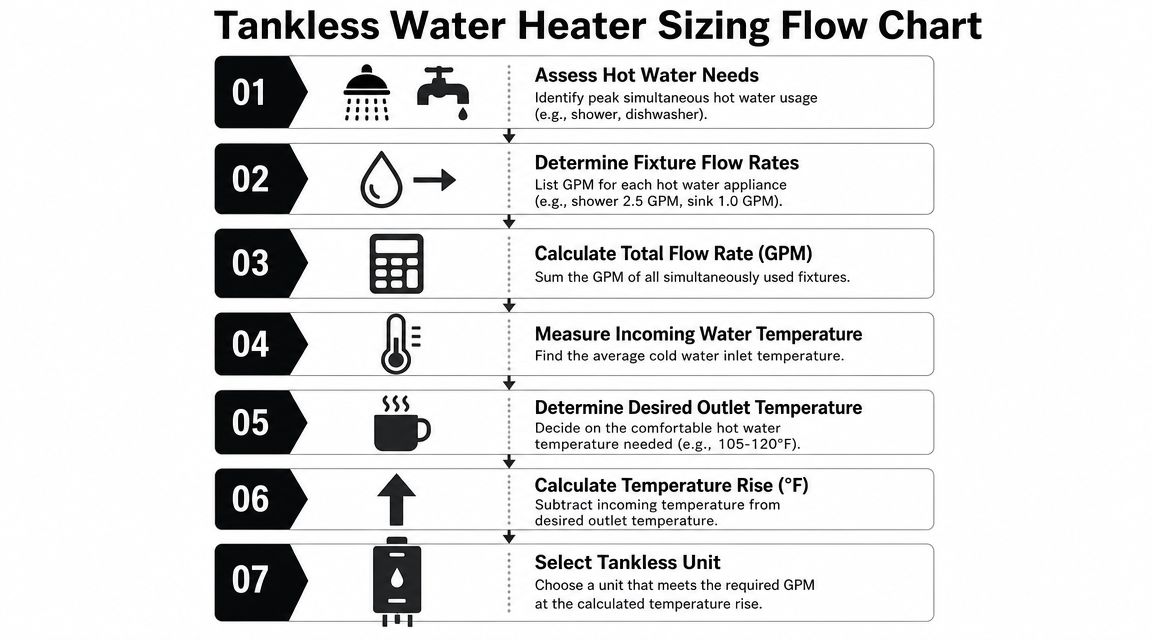
The accepted workflow is straightforward. Measure the cold-water inlet temperature during the coldest season, choose the desired outlet temperature, calculate the required temperature rise, then add the simultaneous hot-water fixture flow rates to get peak GPM. The selected model has to meet or exceed both the needed GPM and temperature rise on the manufacturer's chart, as explained in this residential tankless sizing guide from Plumbing and Mechanical.
A practical way to do that at home:
- List the hot fixtures that overlap such as two showers, or a shower plus kitchen sink
- Write down each fixture's flow rate from the fixture spec sheet
- Add only the fixtures that can realistically run together
- Compare that total to the tankless model's performance chart
If you want help narrowing down equipment types before you get into specs, this guide on how to choose a tankless water heater is a useful starting point.
Then calculate temperature rise
This is the part many homeowners miss. Tankless units aren't sized by flow alone. They also have to heat the incoming water enough, fast enough.
The formula is simple in practice:
- Measure incoming water temperature during the coldest part of the year
- Choose your target hot water temperature
- Subtract inlet temperature from target temperature
- Use that result as the required temperature rise
For Globe-area homes, incoming water temperature usually won't behave like a colder northern market. That matters because a tankless heater in Arizona often faces a different heating job than one installed in a much colder climate. But local conditions still vary by season, plumbing run, elevation, and where the line enters the house, so I don't recommend guessing.
When tankless systems disappoint, it's usually not because the brand is bad. It's because nobody matched the unit to both the real GPM load and the real temperature rise.
A local way to think about it
In Globe, Miami, and Superior, homeowners sometimes read a national buying guide and assume one recommendation fits every climate. It doesn't. A unit that's oversized for one Arizona home might be appropriate somewhere colder. The reverse is also true.
What matters is your house. If the cold-water inlet is warmer here than in colder regions, the heater has less work to do. If your household also staggers hot water use instead of stacking it all at once, that changes the required size again.
Common tankless sizing mistakes
A few patterns show up over and over:
Buying by marketing label only
The box may sound impressive, but the actual answer is on the manufacturer performance chart.Ignoring winter inlet temperature
If you measure in a warm season only, you can undersize the unit for the months when demand is hardest to satisfy.Adding every fixture in the house
That can lead to unnecessary oversizing. You want realistic simultaneous use, not theoretical maximum use.Treating tankless like a tank
There's no FHR shortcut here. Tankless sizing is flow plus temperature rise. Both matter every time.
If you're asking what size water heater you need and you're leaning tankless, this is the point where a model-by-model comparison matters. One unit may carry your target flow at your required temperature rise. Another may not, even if the marketing language makes them sound similar.
Tank vs Tankless Which Water Heater Is Right for You
Choosing between tank and tankless isn't really about which one is better in general. It's about which one fits your house, your utility setup, your budget, and how you use hot water.
Some homes do better with the simplicity of a tank. Others benefit from the way a properly sized tankless unit handles repeated showers and saves space on the wall.
Where a tank water heater makes sense
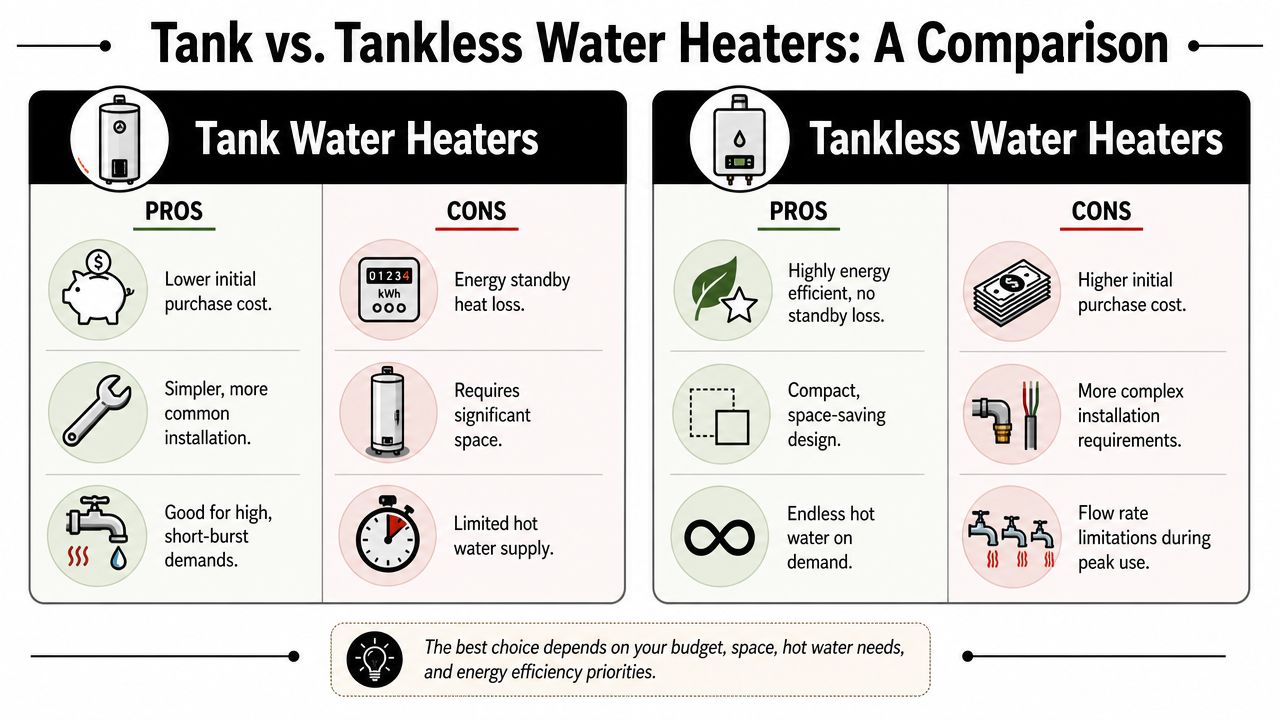
A storage tank is often the straightforward choice when you want a familiar installation and predictable replacement path. If the home already has the right connections and the current setup has worked reasonably well, replacing with another tank can keep the project simpler.
Tank systems also handle short, heavy bursts of use in a way some homeowners prefer. If the household tends to draw a lot of hot water in one concentrated stretch and the tank is sized correctly, that reserve can be useful.
A tank may be the better fit when these points matter most:
- Simpler replacement path if you're swapping an older standard heater
- Lower upfront complexity compared with a tankless retrofit
- Familiar serviceability because most plumbers and techs work on them regularly
Where tankless is the better fit
Tankless works well when the installation conditions support it and the unit is sized correctly to your simultaneous demand. Homeowners often like the space savings and the on-demand feel.
That said, tankless isn't magic. It doesn't create unlimited capacity under all conditions. It supplies continuous hot water only within the limits of the unit's flow and heating ability.
Here's a good way to think about the trade-off:
- Tankless favors long-run convenience if your hot water use is spread out and the unit is matched to your real load
- Tank favors stored capacity if your usage comes in intense bursts and you want a simpler equipment swap
If you're comparing installation options locally, water heater installation services near you can help clarify what's realistic for your existing home.
A short walkthrough can help if you want to see the two approaches side by side:
Real ownership trade-offs
A lot of buying decisions get made on one feature alone. That usually leads to regret. The better approach is to weigh the everyday ownership issues.
| Decision area | Tank | Tankless |
|---|---|---|
| Upfront installation | Usually more straightforward | Often more involved |
| Physical space | Takes floor space | Frees up wall and floor area |
| Hot water experience | Limited by stored supply | Continuous within unit capacity |
| Sizing risk | Wrong FHR causes shortages | Wrong GPM or temperature-rise match causes performance issues |
| Retrofit complexity | Often easier | May require more planning |
If you want the least disruptive replacement, a tank often wins. If you want compact equipment and you're willing to size it carefully, tankless can be a strong option.
The wrong way to choose is by copying a neighbor, buying the biggest model you can find, or assuming tankless automatically solves every complaint. The right way is to match the equipment style to the house and then size that style correctly.
Other Key Factors That Influence Your Sizing Decision
Two homes with the same number of people can need very different water heaters. Usage habits, fixture choices, and equipment type change the answer fast.
That's why the basic sizing method is only the starting point. Before you lock in a model, look at the details that push demand up or pull it down.
Your household routine matters more than head count
Some families all shower in the same narrow window. Others spread hot water use across the day. Those are not the same sizing job.
If everyone gets ready at once, you need a system that handles stacked demand. If showers, dishes, and laundry are staggered, a smaller system may still perform well.
Household reality check: The busiest hour tells the truth. Family size by itself doesn't.
A few patterns that change sizing decisions:
- Back-to-back showers increase demand quickly
- Long showers create a bigger draw than short, efficient use
- Laundry during peak times can push a borderline system into shortage
- Dishwashing habits matter more when they overlap with bathing
Fixtures can quietly raise the load
Large soaking tubs, body-spray showers, and oversized primary baths can change the job completely. Standard online advice often misses this because it assumes ordinary fixtures and ordinary routines.
One bathroom remodel can turn a once-adequate water heater into a daily frustration. The same thing happens when a guest bath starts getting regular use or an addition changes the plumbing layout.
Watch for these demand boosters:
- Large tubs that require a substantial hot water volume before they're even usable
- Multi-head showers that ask for more hot water at once
- Added bathrooms that increase the odds of simultaneous use
- Long pipe runs that make delivery feel slower and waste more hot water before it reaches the fixture
Fuel type and equipment style affect performance
A gas tank, electric tank, heat pump water heater, and tankless unit don't all respond the same way once hot water demand starts. Recovery behavior differs. Installation requirements differ. The way the system feels in daily use differs too.
Homeowners often get tripped up during replacement. They assume one water heater style can be swapped for another with the same nominal capacity and deliver the same performance. That's not always true.
Don't size in a vacuum. The heater type, fuel available at the house, fixture load, and usage habits all work together.
A practical example is switching from one system type to another without reevaluating the load. The old setup may have masked demand problems because of how it recovered or because your family used water differently when it was installed.
Appliance efficiency can help, but don't rely on it blindly
Some newer dishwashers and washing machines use hot water more efficiently than older models. That can reduce demand. But it shouldn't be your only assumption unless you know exactly how those appliances operate in your house.
A lot of homeowners over-credit efficiency upgrades while ignoring bigger demand drivers like shower timing and bathroom additions. In practice, shower usage usually decides more sizing calls than laundry equipment does.
If you're trying to answer what size water heater you need, this is the checkpoint that keeps you from buying a unit that's technically close but practically wrong.
Sizing Considerations for Globe Miami and Superior AZ Homes
A water heater that works fine in Phoenix or on a national sizing chart can still disappoint in Globe, Miami, or Superior. I see that on replacement calls all the time. The equipment tag may look right, but the house, the water, and the install conditions say otherwise.
Homes in this part of Arizona have a few local conditions that matter more than homeowners expect. Incoming groundwater temperature affects how hard a tankless unit has to work. Hard water affects how long any heater keeps performing like it did on day one. Older home layouts can also limit what size and type fit and vent correctly.
Local water conditions change the real sizing job
Tankless sizing depends on two things at once. You need enough flow, and you need enough temperature rise. In Globe-area homes, incoming water is often warmer than what many broad national examples assume, which can reduce the temperature lift the heater has to produce.
That helps, but it does not give you a free pass to size small.
A house with two bathrooms, back-to-back morning showers, and a washing machine running at the same time can still outrun an undersized tankless unit even if the groundwater starts warmer than it would in a colder state. For tank models, the same local conditions show up differently. First-hour performance, burner or element recovery, and the way your household clusters hot water use usually matter more than the sticker size alone.
Hard water changes the margin for error
Mineral scale is a real sizing issue here, not just a maintenance footnote. In Globe, Miami, and Superior, hard water can coat heating surfaces and tighten up passages inside the unit. As that buildup increases, efficiency drops and hot water delivery can feel weaker or slower.
That matters most on systems that were sized too close to the line in the first place.
A heater that barely keeps up when it is clean often starts showing complaints sooner in a hard-water home. Tankless units tend to make that problem obvious fast because scale affects heat exchange and flow more directly. Tank heaters feel it too, usually through slower recovery and less reliable output during busy parts of the day.
Older homes add installation limits
A lot of houses in this area were not built around newer water heater options. Garage closets can be tight. Utility spaces may have poor service access. Gas piping may be undersized for a larger tankless conversion. Electrical service may also limit what is realistic for an electric tankless or heat pump setup.
Those details affect sizing because they affect what equipment can be installed correctly and serviced later.
Check these early:
- Gas line capacity for higher-BTU gas equipment
- Electrical panel and circuit availability for electric or heat pump models
- Wall and floor space around the unit
- Venting path and termination options if you are changing heater type
- Drain access for pans, relief discharge, or condensate where required
- Room to flush and maintain the unit in a hard-water area
National calculators rarely ask about any of that. They also do not know whether your home in Superior sits on a tight utility layout or whether your older Globe house has venting and access issues that change the practical equipment choice.
Local sizing should reflect the house, not just the household count
Two families with the same number of people can need different water heaters in this area. One may have low-flow fixtures, a short pipe run, and staggered shower use. The other may have an older home, harder water, a large soaking tub, and three hot-water events stacked into the same half hour.
That is why local job conditions matter.
Cobre Valley Air LLC water heater services handles sizing as part of installation planning for Globe-area homes. The primary goal is simple. Match the equipment to the way the house uses hot water, the water quality it deals with, and the installation limits already in place.
Why a Professional Load Calculation Is the Safest Bet
A homeowner can get close with the right method. That's useful. It helps you avoid obvious mistakes and ask better questions.
But there's a line between a rough estimate and a true installation decision. Once you're spending real money on equipment, venting, electrical changes, gas piping, plumbing changes, or a conversion from one heater type to another, guessing gets expensive.
When DIY sizing stops being enough
Some jobs are simple replacements. Many aren't.
You should stop relying on rough estimates alone if any of these apply:
- You're changing water heater type from tank to tankless, or the other way around
- You've added bathrooms or remodeled since the last heater was installed
- Your home has large tubs or specialty showers
- Your current heater never performed well, even when it was newer
- You're dealing with venting, gas, electrical, or code questions
- You want the installation sized for long-term use, not just today's habits
A professional load calculation is where the shortcuts end. The installer checks actual fixture demand, likely simultaneous use, equipment compatibility, utility conditions, location constraints, and service access. That's what separates a “should be okay” replacement from one that performs the way it should.
What professionals catch that homeowners often miss
The biggest misses usually aren't dramatic. They're small details that stack up.
A plumber or HVAC technician may find that the old unit was undersized all along. Or that a tankless conversion needs more than just a wall-mounted heater. Or that the home's hardest-use hour happens at a different time than the homeowner first assumed.
Here's what a professional review commonly clarifies:
- Real fixture overlap instead of guessed overlap
- Installation constraints that affect model choice
- Code issues around venting, combustion air, drainage, or clearances
- Water quality concerns that affect maintenance and performance
- Serviceability so the next repair or flush isn't a headache
The safest water heater is not the biggest one. It's the one that matches the load, fits the installation, and can be maintained properly.
Why right-sizing protects comfort and equipment life
Improper sizing causes predictable problems. Too small, and you get hot water complaints. Too large, and you can spend more than necessary on equipment and installation without solving anything meaningful. Wrong equipment type, and you may end up with a system that doesn't fit the house well in the first place.
This is the same principle that applies in HVAC. Whether you're dealing with air conditioning repairs, AC installation, AC maintenance, heat pumps, furnaces, or duct design, the equipment has to match the load and the house. Water heaters are no different.
That's why a site visit matters. A technician can compare your actual usage, your plumbing layout, your utility setup, and your local water conditions before recommending a unit. If you want that kind of review, water heater services should include sizing guidance, replacement planning, and code-compliant installation, not just a product quote.
The safest answer to what size water heater you need
If your setup is straightforward, a careful estimate can get you in the ballpark. If the house has any complexity at all, the safest move is to have the load checked before ordering equipment.
That's how you avoid the two outcomes nobody wants. The first is paying for a new water heater and still running out of hot water. The second is paying for a larger or more complex system than your home needed.
Right-sizing is the whole job. The tank or tankless label comes after that.
If you want a clear answer for your home in Globe, Miami, Superior, or nearby areas, contact Cobre Valley Air LLC. They handle tank and tankless water heater evaluations, replacement planning, and code-compliant installation with a service-first approach, so you can choose equipment based on actual demand instead of guesswork.