



The house can feel sealed up and still feel dirty. In a Globe or Miami home, the AC may run all afternoon, the bedrooms still feel stuffy, and the return grille keeps collecting dust fast enough to make you question whether the filter is doing anything at all. That's the point where indoor air quality HVAC stops being an abstract idea and becomes a real service issue, because the same ducted system that cools the house is also moving, filtering, and conditioning the air everyone breathes.
A lot of homeowners think of the equipment as a heater or an air conditioner first. In practice, it's the home's main air-handling system, and that means its layout, runtime, filtration, ventilation, and humidity control all shape the air inside. The National Academies identify ventilation rate, ventilation effectiveness, filter efficiency, temperature and humidity control, and maintenance as the core drivers of good indoor air quality, which is why a decent-looking system can still produce lousy air if one of those pieces is off National Academies indoor air quality chapter.
When people say the air feels stale, they're usually describing a system that isn't diluting pollutants well enough. When they complain about dust on furniture, odors from the kitchen, or bedroom discomfort, they're usually seeing the result of airflow decisions, duct leaks, filter choices, or moisture control issues that were left unresolved. Good HVAC service doesn't just restore cooling, it restores the system's ability to clear the air.
Why Your HVAC System Shapes the Air You Breathe
An Arizona living room can look fine and still feel off. The AC is running, the thermostat is holding temperature, and yet the air smells a little musty after monsoon weather, the return grille is fuzzy with dust, and the back bedroom never quite feels refreshed. That's not a mystery, it's a sign that the HVAC system is either helping the house breathe or just recirculating whatever's already floating around inside.
The system is the air pathway, not just the comfort machine
Every day, contaminants enter through people, pets, cooking, shoes, cleaning products, open doors, and the building itself. The EPA notes that Americans spend about 90% of their time indoors, and pollutant concentrations are often 2 to 5 times higher indoors than outdoors, which is why filtration, ventilation, and moisture control matter so much in occupied buildings EPA indoor air quality guidance. In that context, the HVAC system is the only major mechanical pathway that can dilute, capture, or spread those pollutants room to room.
That's also why duct layout and runtime matter more than many realize. A short-cycling system may hit the thermostat and still fail to move enough air through the filter or across the coil. A poorly sealed return can pull dusty attic air into the airstream, while a poorly balanced supply can leave one bedroom stale and another over-conditioned.
Practical rule: if the air feels worse when the system runs, don't assume the equipment is the problem alone. Look at how air moves through the house, because airflow is often where the real issue lives.
The National Academies framing is useful here because it keeps the focus on the whole system, not just the box in the yard. Ventilation rate, ventilation effectiveness, filter efficiency, temperature and humidity control, and maintenance all work together, and when one is weak, the rest can't fully compensate National Academies indoor air quality chapter. That's why a good repair call often looks more like an air-quality check than a simple parts swap.
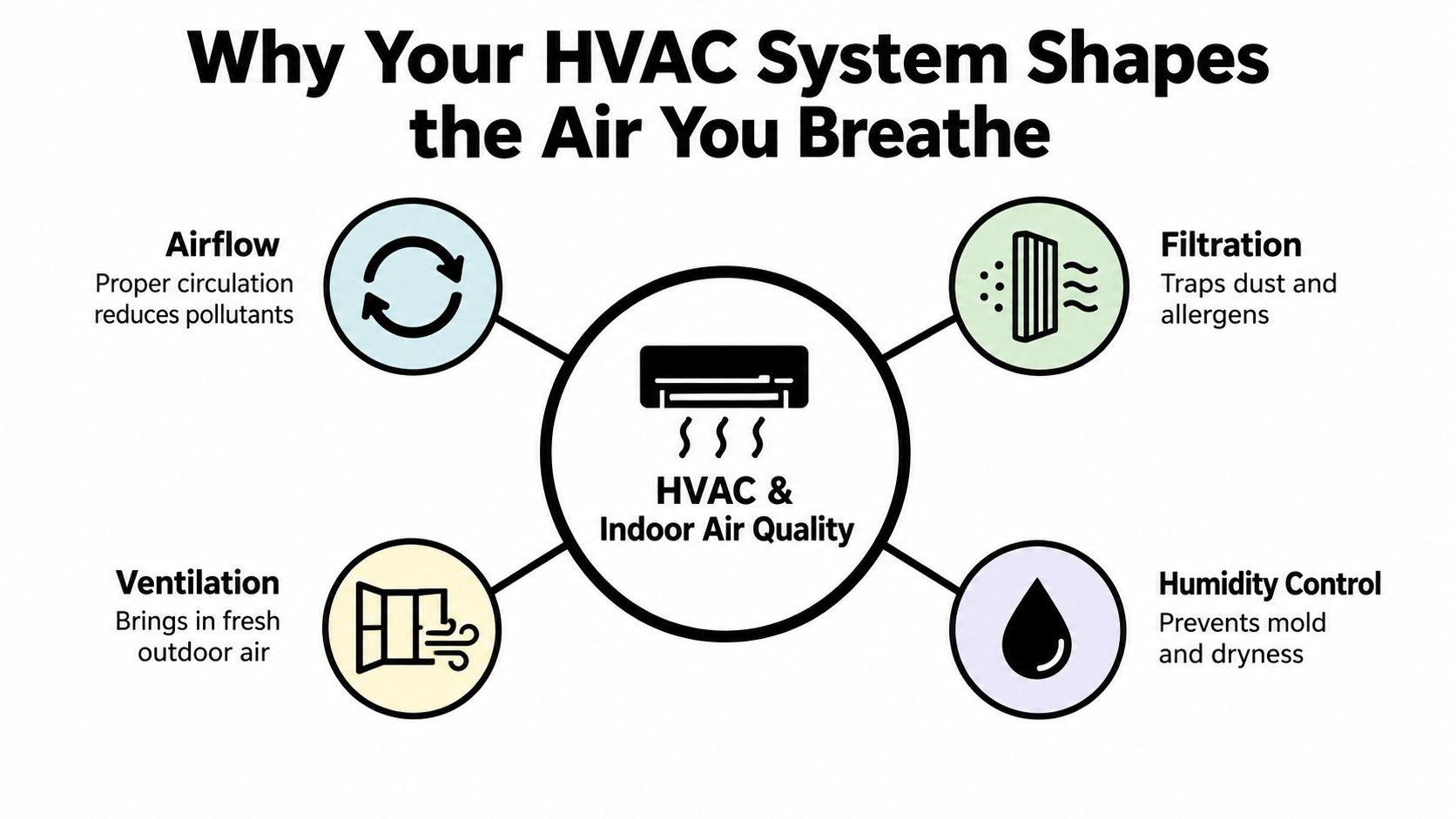
The useful takeaway for homeowners is simple. If the system is sized right, sealed right, and maintained right, it can reduce exposure to dust, odors, and moisture problems. If it's not, it can turn every room in the house into a place where the same contaminants keep cycling back.
The Pollutants Living in Your Ductwork
Indoor air quality starts with naming what's in the air. In a house, the most common problem categories are particulates, biological contaminants, gaseous pollutants, and indicators like carbon dioxide and humidity that tell you how the building is being used and ventilated.
What each pollutant category looks like at home
Particulates are the visible and invisible solids you deal with every day. That includes dust from flooring and attic leaks, pollen brought in on clothes, pet dander, and fine particles that can irritate breathing when the house is closed up for long stretches. These are the contaminants most homeowners notice first because they show up on registers, furniture, and filter media.
Biological contaminants are a different problem. Mold spores, bacteria, and dust-mite allergens tend to show up when humidity drifts high enough for moisture to linger on coils, drain pans, duct insulation, or dusty surfaces. This is why a cooling system that removes moisture well can help, while a wet condensate pan or dirty coil can make the air smell and feel worse.
Gaseous pollutants are the odors and chemical vapors that don't behave like dust. VOCs can come from cleaning products, paint, new furniture, cooking, and attached garages. These often linger even when the filter looks clean, because standard filtration doesn't remove all gases the way it captures particles.
Carbon dioxide and excess humidity are less about a single contaminant and more about what the home is telling you. CO2 rises when too many people are sharing too little fresh air, and high humidity tells you the system may be underperforming in dehumidification or ventilation. That's why these two readings are useful as operating clues, not just comfort numbers.
If the filter catches dust but the living room still smells like cooking, the fix is probably not “a better filter only.” That smell is a source-control and ventilation problem.
The practical split matters. Filtration handles many particulates. Ventilation helps dilute CO2 and some odors. Humidity control helps prevent biological growth and makes the house feel more comfortable. But source control still matters, because no HVAC system can fully cancel out poor habits, leaks from a garage, or ongoing moisture intrusion.
A duct inspection or cleaning service can be part of the solution when debris, leaks, or contamination are already in the system, and homeowners in the Valley who are trying to sort out recurring dust complaints often start with a local inspection like duct cleaning services near me. The key is knowing whether the issue is in the ducts, in the room sources, or in both.
How Filtration, Ventilation, and Humidity Actually Work
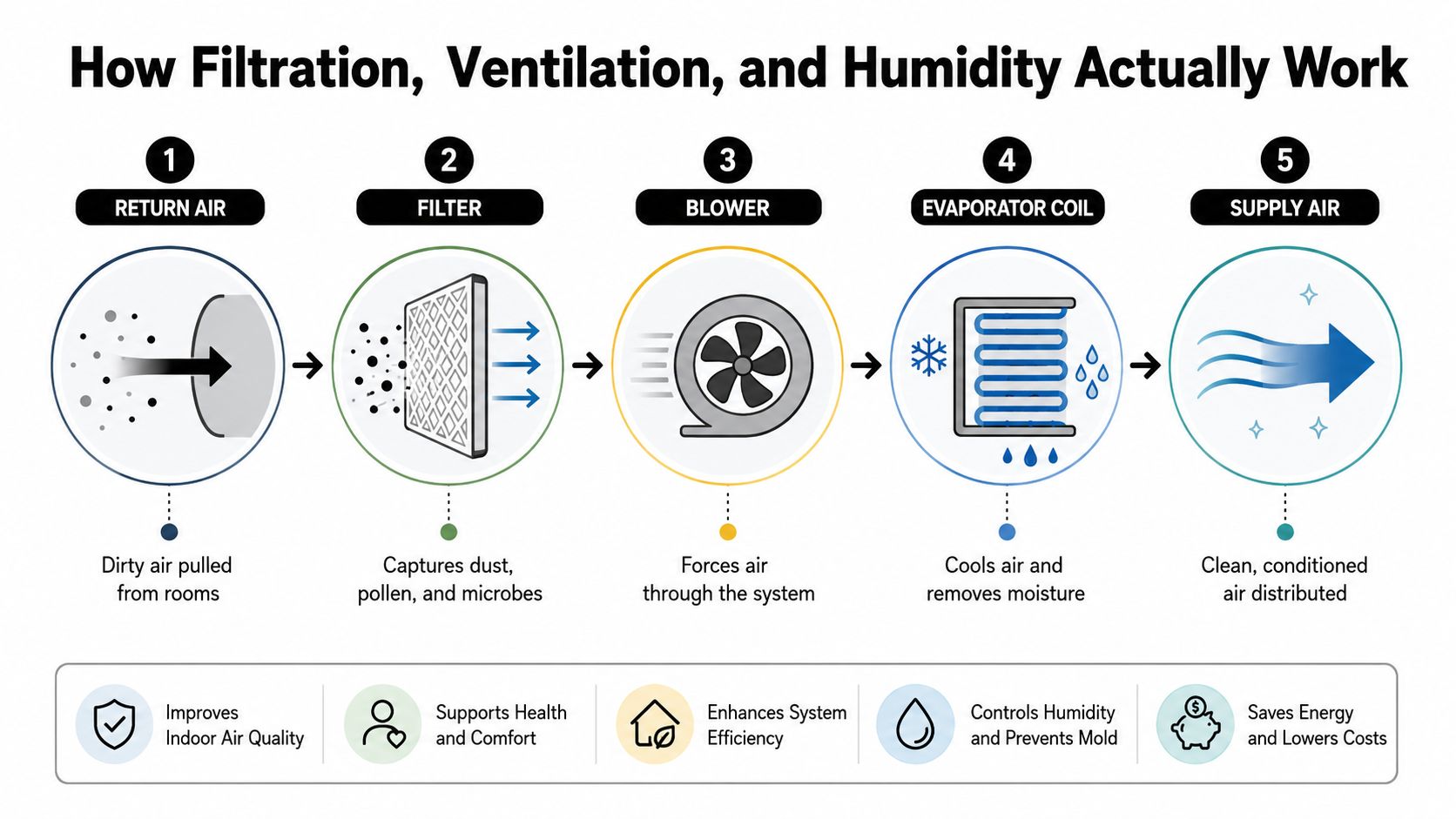
The mechanics matter because indoor air quality doesn't improve by wishful thinking. Air gets pulled from the rooms, passes through the return side, hits the filter, moves across the blower and coil, then goes back out through the supply ducts. If there's a fresh-air intake, that outdoor air joins the stream somewhere along the way, and each part of that path has a job to do.
Filtration has to match the blower, not just the wish list
The EPA recommends filters with either a dust-spot rating between 35% and 80% or a MERV rating between 8 and 13 for HVAC systems used for indoor air quality EPA HVAC indoor air quality design tools. In plain terms, a MERV 8 filter is a common baseline for many homes, while higher-efficiency filters capture finer particles but also create more resistance.
That's where homeowners get into trouble. A filter upgrade sounds harmless, but if the blower and duct system weren't designed for the added resistance, airflow drops. Lower airflow can reduce comfort, weaken dehumidification, and make the system work harder than it should. That's why filter choice has to be treated as a system decision, not a shopping decision.
Ventilation depends on occupancy and use
The EPA says that if outside air is supplied mechanically, at least 15 cfm per occupant should be delivered, and their classroom example shows that 30 people need 450 cfm of outdoor air EPA HVAC indoor air quality design tools. That example makes the point clearly, the right amount of fresh air depends on how many people are in the space and what the space is used for.
For homes, industry references tied to ASHRAE-oriented guidance put outdoor-air rates around 0.35 to 1 cfm per person for residences, 2 to 3 cfm per person for offices and retail, and 6 to 8 cfm per person for restaurants ESSENTRA HVAC IAQ guidance. Those are operational benchmarks, not magic settings, and they show why a house, a shop, and a restaurant can't use the same ventilation assumption.
Humidity control makes or breaks comfort in Arizona
Cooling mode should remove moisture as the coil condenses water, but that only works when the system runs long enough and the coil, drain pan, and airflow are in decent shape. In Arizona, summer humidity spikes during monsoon season can make a house feel sticky even when the thermostat looks fine, and some homes need supplemental humidity in winter if indoor air gets too dry.
UV lamps and sensors are optional layers, not substitutes for good design. UV can help keep wet surfaces cleaner in the air handler, while sensors can show CO2, humidity, and temperature trends that reveal a ventilation or dehumidification problem before occupants start complaining. The best systems use those layers to support, not replace, solid airflow and maintenance.
A good way to judge upgrades is to ask a blunt question, does this change improve airflow, pollutant capture, or moisture control without pushing the system outside its design limits? If the answer is no, it's probably not the right first move.
How to reduce indoor air pollution covers some source-control habits that work alongside filtration and ventilation, and that combination usually beats trying to solve everything with equipment alone.
What a Real IAQ Diagnostic Looks Like
A real diagnostic starts with measurements, not guesses. A homeowner calls because the house smells stale, one bedroom won't cool, or the family keeps noticing dust after every cleaning, and the tech who does the job right treats that as an airflow and air-quality problem first.
The visit should measure the system, not just inspect the parts
A proper service call usually begins at the thermostat and return grille, then moves to the supply registers and the mechanical equipment. The tech checks return and supply temperatures, looks at static pressure across the filter and coil, and measures humidity at the supply register to see whether the system is removing moisture the way it should.
Then the technician looks at what the house is breathing. CO2 trend readings over an occupied hour can show whether the home is getting enough outside air or whether the system is just recirculating stale air through the same rooms. High CO2 does not tell the whole story, but it does tell you the ventilation side needs attention.
A quick refrigerant top-off or part swap might fix a symptom. It won't tell you why the air still feels wrong.
Duct inspection matters just as much, especially in older Globe and Miami homes where attic flex can kink, mastic can fail, and disconnected runs can dump conditioned air where nobody lives. Those hidden problems can leave one room starved for air while the blower keeps running against a system that is no longer moving air the way it was intended.
For small commercial spaces, the same logic applies to rooftop units and airflow around walk-in coolers, because poor ventilation and bad air movement do not stay a comfort issue for long. They turn into odor, condensation, and food-safety headaches fast enough that owners cannot ignore them.
A thorough provider will document what they found before recommending a fix, and that is the difference between a service visit and a parts chase. If you are comparing options, a proper indoor air quality testing visit is the kind of first step that keeps the recommendation grounded in evidence rather than assumptions.
ASHRAE Standard 62.2 gives a residential ventilation target to measure against, and that matters because a house can have a working air conditioner and still be under-ventilated. Manual checks should also account for filter loading, duct leakage, airflow balance, humidity trends, and whether the equipment is properly configured to handle the way the home is used.
A good diagnostic should also weigh trade-offs instead of chasing one fix. Higher filtration can help capture fine dust, but it can also raise resistance if the duct system is weak. More outside air can clear stale indoor air, but it can also bring in monsoon moisture and dust if the system is not designed for it. UV lamps can help with wet coil surfaces, but they do not correct bad airflow or a poorly sealed return. That is why the report should point to the system conditions, not just the device that looks easiest to sell.
Maintenance Habits That Prevent IAQ Problems
Homeowners usually want one big correction, but indoor air quality usually improves through routine care. Filters, coils, drains, duct seals, and humidity checks protect air quality better than occasional heavy cleanings, because the same faults that create the problem return when nobody is tracking them.
A practical maintenance rhythm
- Filter replacement: Check filters monthly during monsoon season and after construction or renovation dust. Replace them more often when pets, allergies, or heavy runtime are part of the picture.
- Coil cleaning: Keep the evaporator coil clean so moisture does not sit on debris and support biological growth.
- Condensate pan and drain line care: Inspect these regularly and clear blockages before water backs up, odors start, or mildew spreads.
- UV lamp upkeep: Replace lamps on schedule if the system uses them, because a lamp that still glows can still have lost much of its useful output.
- Duct sealing checks: Verify leaks periodically instead of assuming a previous seal job still holds, especially in attics and crawlspaces.
The EPA's school HVAC guidance ties air quality to sensible filter choices, and manufacturer maintenance guidance shows the same point in practical terms, a system has to stay clean, dry, and moving air the way it was designed to move it EPA HVAC indoor air quality design tools. Public-health guidance from the National Academies and Arizona health agencies keeps returning to ventilation, humidity control, and routine maintenance because those are the levers that prevent problems from forming in the first place National Academies indoor air quality chapter. That is why regular service beats waiting until the system smells wrong or starts leaving dust behind.
A homeowner should also ask what happens at installation time. If a new system is being put in, load calculation, airflow planning, and duct evaluation should be part of the job from day one, because fixing bad air later is always harder than building it in correctly.
The rule of thumb is simple. Do not let a clean-looking unit fool you. Inspect the parts that touch moisture and air movement, because that is where IAQ usually slips first.
Upgrades Versus Replacements and the Right-Sizing Trap
A lot of IAQ upgrades fall short because the base system was never right-sized or properly sealed. A homeowner adds a higher-MERV filter, a fresh-air kit, or a specialty accessory, then notices the house feels stuffier or the electric bill rises while comfort gets worse. The upgrade is not automatically the problem. The system underneath it may not have the airflow reserve to handle the added resistance or the extra load.
A ducted system does more than heat and cool. It is the house's air-clearing machine, and every change to filtration, ventilation, humidity control, UV treatment, or sensors has to fit the blower, the ducts, and the static pressure the equipment can handle. In older Globe, Miami, and Superior homes, that matters even more because leaky ducts, undersized returns, and patchwork repairs can turn a good idea into a weak result.
Bigger filtration isn't automatically better
If you put a MERV 13 filter on a system that was comfortable with a MERV 8 level of resistance, static pressure rises and airflow can drop. That can hurt dehumidification and make the blower work harder, which is the opposite of what most homeowners want. The filter may catch more fine particles, but if the room air is not moving well, the house can still feel worse.
I see this trade-off all the time. A tighter filter can help with dust, pollen, and smoke, but only if the fan and duct system can still move the air the equipment was designed to move. If the return is undersized or the coil is already dirty, the higher-efficiency filter can expose a problem that was there all along.
That is why the right order matters. Confirm the equipment is sized correctly. Verify the ductwork is sealed and balanced. After that, decide whether a filtration upgrade, ventilation change, humidity control addition, or UV component makes sense for the home.
Outdoor air has to fit the use case
Outdoor-air targets change with the building and how people use it. Homes, offices, retail spaces, and restaurants all need different ventilation rates because occupancy and activity levels are not the same. ACCA right-sizing and airflow guidance discusses why capacity, duct design, and airflow checks belong together, not as separate afterthoughts. A fix that works in a lightly occupied house can miss the mark in a busy kitchen or a storefront with frequent door openings.
Energy use and IAQ are not enemies when the system is set up correctly. Right-sizing, duct design, and commissioning let the system move the right amount of air without wasting capacity, and that usually improves comfort at the same time. In older homes, the better answer is often repair and sealing, not a larger cabinet or a bigger compressor. A replacement can be the right move when the equipment is worn out or the duct system cannot support the load, but an upgrade should still be judged against static pressure, return air, and the humidity swings that come with Arizona summers and monsoon season.
Cobre Valley Air LLC is one option that approaches replacements with airflow and duct evaluation included, along with indoor air quality solutions and duct design work for homes and small commercial spaces. That kind of quote is worth comparing to any proposal that only prices the equipment swap.
Hiring an HVAC Pro in Globe, Miami, and Superior
A homeowner can spend money on filters, a UV light, or a new thermostat and still breathe the same dusty air if the contractor never checks the duct system. The right pro looks at the whole air path, from return grille to supply register, because HVAC equipment is also the home's air-cleansing system.
A technician who measures, explains, and documents the system usually finds the cause faster than someone who only quotes parts. That matters in Globe, Miami, and Superior, where older ductwork, monsoon dust, and summer humidity swings can all show up as the same complaint, stale air, dust on surfaces, or rooms that never feel quite right.
Questions worth asking before you sign anything
- Do you perform load calculations and duct evaluations on every job? If not, you are trusting guesswork where airflow and sizing matter most.
- What do you measure during a diagnostic visit? The answer should include temperatures, pressure, humidity, and a look at ventilation, not just a quick visual check.
- Are you licensed and certified for the work you are recommending? That matters for code compliance, safety, and whether the fix will hold up.
- Will the quote include airflow and duct design, or just the equipment? Equipment alone does not solve an airflow problem.
- What maintenance will the system need after the repair or replacement? Good contractors explain the upkeep before they leave.
For Arizona homeowners, contractor screening should also include license and business checks. You can verify state registration through the Arizona Registrar of Contractors, and you can review complaint history, accreditation, and business practices through BBB standards for accredited businesses. That does not guarantee a good job, but it does help separate a licensed operator from someone selling parts without a real diagnostic process.

The main issue is whether the contractor treats ventilation, filtration, temperature, humidity, and maintenance as connected parts of the same system. A good visit should make it clear how each choice affects the others, because a tighter filter can help with dust but create airflow pressure if the ducts are weak, and added ventilation can help freshen air while making humidity control harder during the wrong season.
In this region, Cobre Valley Air LLC offers diagnostics, code-compliant installations, all-inclusive replacements with airflow and duct evaluations, RGF-certified indoor air quality solutions, ductless mini split installs, duct design and repair, water heater service, and 24/7 emergency response. The company also carries Arizona ROC license 339078, works with Goodman, Amana, and Daikin equipment, and offers financing through Wisetack and OPTIMUS, so homeowners can compare a repair-first or replacement-first path with a contractor who looks at the air side of the job.