



Cooling is no longer a comfort upgrade, it's a climate issue. The IEA says cooling-related carbon dioxide emissions have tripled since 1990 to 1,130 million tonnes, roughly equal to Japan's total emissions, and space cooling used about 2,100 TWh of electricity in 2022, about 7% of global electricity use IEA cooling report. In hot places like Arizona, that matters twice, because bad equipment wastes power all summer and poor installation can erase the gains you paid for.
Eco friendly air conditioning isn't just a label on a box. The gains come from right sizing, airflow design, duct sealing, better refrigerants, and maintenance that keeps the system working the way it was designed to work. I've seen plenty of high-efficiency systems underperform because the house was leaky, the ducts were sloppy, or the installer guessed instead of calculating the load.
Why Eco Friendly Air Conditioning Matters Now
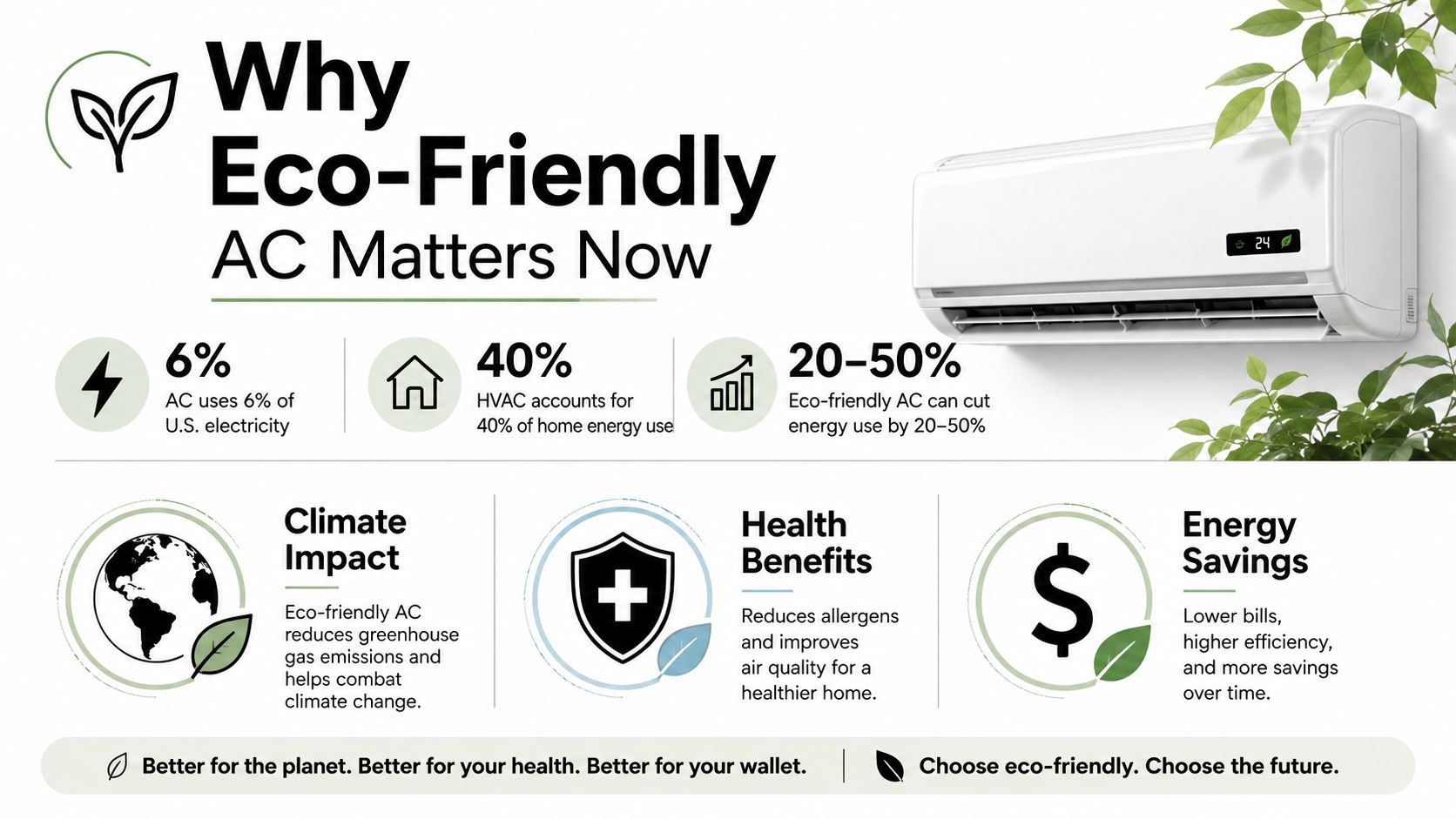
Air conditioning has become one of the clearest examples of how comfort, health, and emissions collide. The IEA-based summary says space cooling produced about 1 billion tonnes of CO2 from electricity alone in 2022, and when refrigerants are included, the total climate footprint rises to about 3.2% of global greenhouse gas emissions IEA cooling report. The U.S. Department of Energy also reported that stationary air-conditioning systems were responsible for nearly 700 million metric tons of CO2-equivalent emissions annually, with about 74% tied to electricity generation and the rest to refrigerant leakage IEA cooling report. That's why eco friendly air conditioning is really a system problem, not a shopping problem.
Cooling is a health issue too
The cleanest AC conversation ignores the fact that cooling saves lives. The IEA says access to effective cooling has already prevented tens of thousands of deaths, and the average annual number of heat-related deaths averted by air conditioning rose 3-fold, reaching an estimated 190,000 lives saved per year during 2019 to 2021 IEA lives saved report. That's not a marketing angle, it's public health.
Practical rule: If a home can't hold cooled air, the system has to work harder just to protect comfort and safety. That's where insulation, shading, sealing, and correct equipment selection start paying off.
The numbers also explain why “efficient” alone isn't enough. Nature reported in 2024 that air conditioning is responsible for an estimated 2 billion tonnes of carbon dioxide annually, or nearly 4% of global greenhouse gas emissions [Nature 2024 summary in verified data]. That level of impact is too large for cosmetic fixes. Better equipment matters, but the biggest climate wins come when the building, the ducts, the refrigerant, and the controls all work together.
Comparing Low-Impact Cooling Technologies
The right low-impact system depends on the house, not the brochure. In Arizona retrofits, I start with three questions, whether the home needs whole-house cooling or room-by-room control, whether the ducts are worth keeping, and whether the envelope can handle the load before anyone starts talking about equipment. A ductless mini-split can be the better fit for one home, while a right-sized central system makes more sense for another. For homeowners comparing retrofit paths, this mini-split overview is a useful starting point.
Here's the clearest way to compare the main options.
| Technology | Efficiency Range | Best For | Installation Complexity | Refrigerant Options |
|---|---|---|---|---|
| Heat pumps | Varies by model and design | Homes that need both cooling and heating | Moderate to high, depending on ductwork and electrical service | Low-GWP options vary by manufacturer and market |
| High-SEER central systems | High seasonal efficiency when properly installed | Whole-home cooling with usable ducts | Moderate to high | Often R-32 or other lower-impact options |
| Ductless mini-splits | Strong part-load efficiency in zoned applications | Add-ons, remodels, room-by-room control, leaky duct retrofits | Lower than full ducted replacements | Often R-32 or other low-GWP refrigerants |
| R-32 systems | One manufacturer datasheet lists SEER 6.1 to 7.4 and SCOP 4.0 to 4.1 for certain split units, with cooling power modulating from 0.9 to 7.9 kW depending on model and operating point, and the same datasheet lists R-32 with GWP 675 and zero ozone depletion potential R-32 datasheet | Buyers who want a lower-impact refrigerant with strong performance | Depends on system type | R-32 |
| R-290 systems | Strong low-impact option in the right application | Buyers prioritizing lower refrigerant climate impact | Higher code and safety sensitivity | R-290, propane |
What I'd choose in the field
If the house has decent ducts and the owner wants whole-home comfort, a high-quality central system or heat pump can work well. If the ducts are a mess, or the home needs targeted cooling, ductless often delivers cleaner real-world performance because the system avoids a lot of duct losses.
In hot climates, the “best” system is the one that matches the house, not the one with the flashiest efficiency label.
The refrigerant choice needs more nuance than most consumer guides give it. The European Commission notes the market is moving toward lower-GWP refrigerants like R-290 and CO2-based alternatives, but it also highlights the trade-offs around safety class, serviceability, and climate performance EU alternatives for air conditioning. Propane has very low global warming impact, but it also brings flammability constraints. CO2 has ultra-low GWP, but the engineering is different. The right answer is the one that is code-compliant, serviceable, and suitable for the specific property.
The Hidden Efficiency Killers in AC Installation
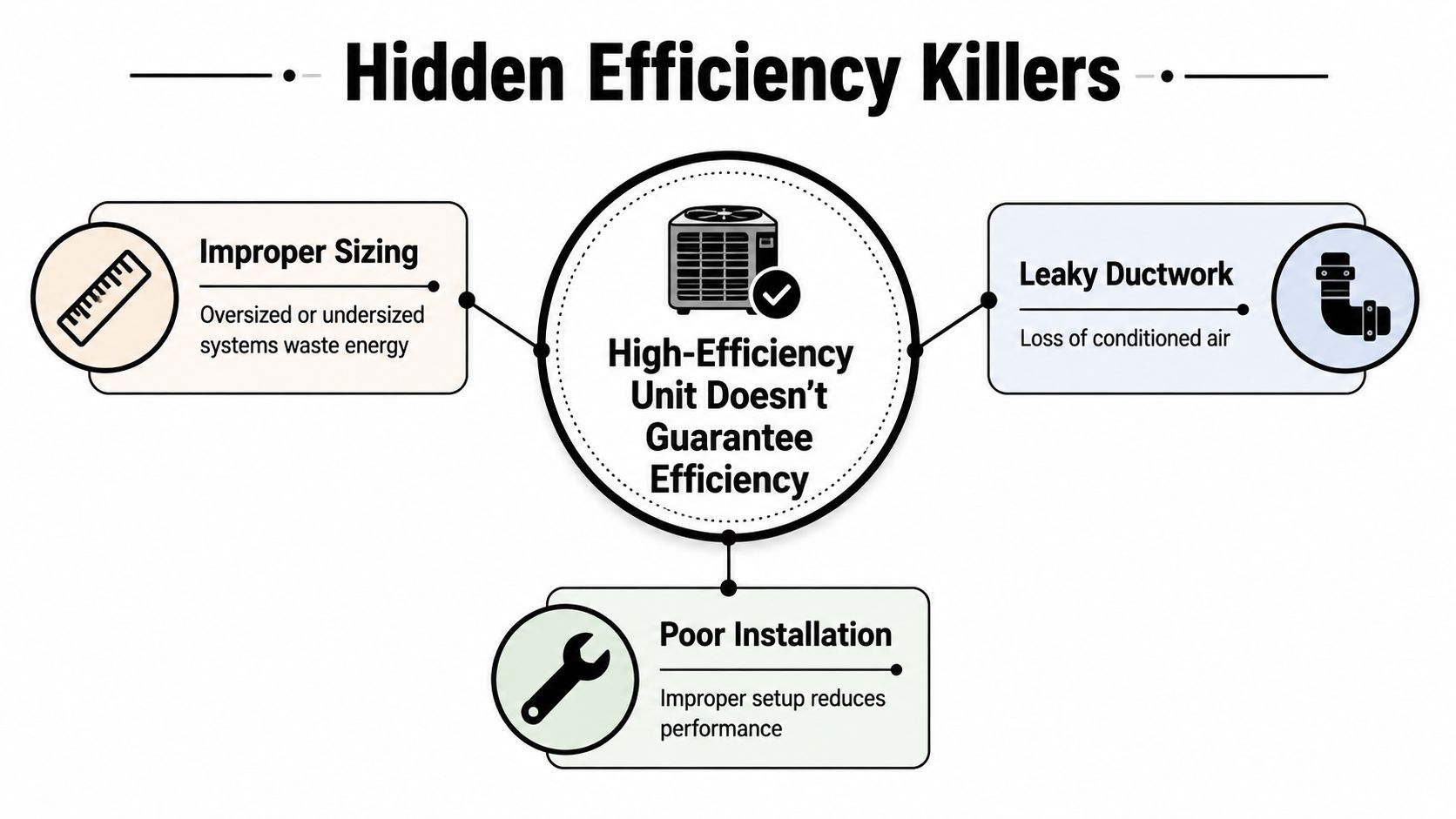
A high-efficiency unit doesn't stay high-efficiency if the install is sloppy. I've seen systems underperform because the load was guessed, the ducts leaked into hot attic space, or the airflow never matched the equipment. The customer still paid for premium hardware, but the house got mediocre results.
Why sizing comes first
Oversizing is one of the easiest ways to sabotage efficiency. Green public procurement guidance explicitly says oversized ACs consume more energy and recommends sizing capacity to actual cooling demand, along with variable-speed compressors, occupancy and temperature limiting controls, and smart peak-load management U4E procurement guidance. In practical terms, short cycling hurts humidity control, increases wear, and makes the system spend more time in inefficient starts and stops.
If you want the simplest contractor question, ask for the load calculation before anyone names a tonnage. The calculator should reflect the home, not the neighbor's house and not the old unit's sticker.
Ducts decide what reaches the rooms
Leaky ducts waste conditioned air, especially when they run through attics or other unconditioned spaces. The U.S. Department of Energy says high-performance building design should minimize the need for A/C by reducing cooling loads DOE AC report, and that principle extends directly to duct design, because every leak, restriction, and bad transition raises the cost of every cooled hour.
The U4E guide also pushes a systems-level view, because efficiency targets mean little if airflow is wrong and the install can't deliver rated performance in the house U4E AC guide. That's where good contractors separate themselves from box-pushers.
Practical rule: The installer matters as much as the brand. If a contractor won't discuss load calculation, duct evaluation, and airflow balancing, they're not finishing the job, they're just hanging equipment.
For a technical example of proper sizing work, the manual J load calculation link is the right place to start before replacement decisions are made. Manual J load calculation overview fits directly into any serious efficiency conversation.
Maintenance Practices That Preserve Efficiency
Eco friendly air conditioning only stays eco friendly if it's maintained like a mechanical system, not treated like a wall decoration. Filters clog, coils get dirty, refrigerant leaks happen, and controls drift out of calibration. Once that starts, the system runs longer to do the same job.
The maintenance tasks that actually matter
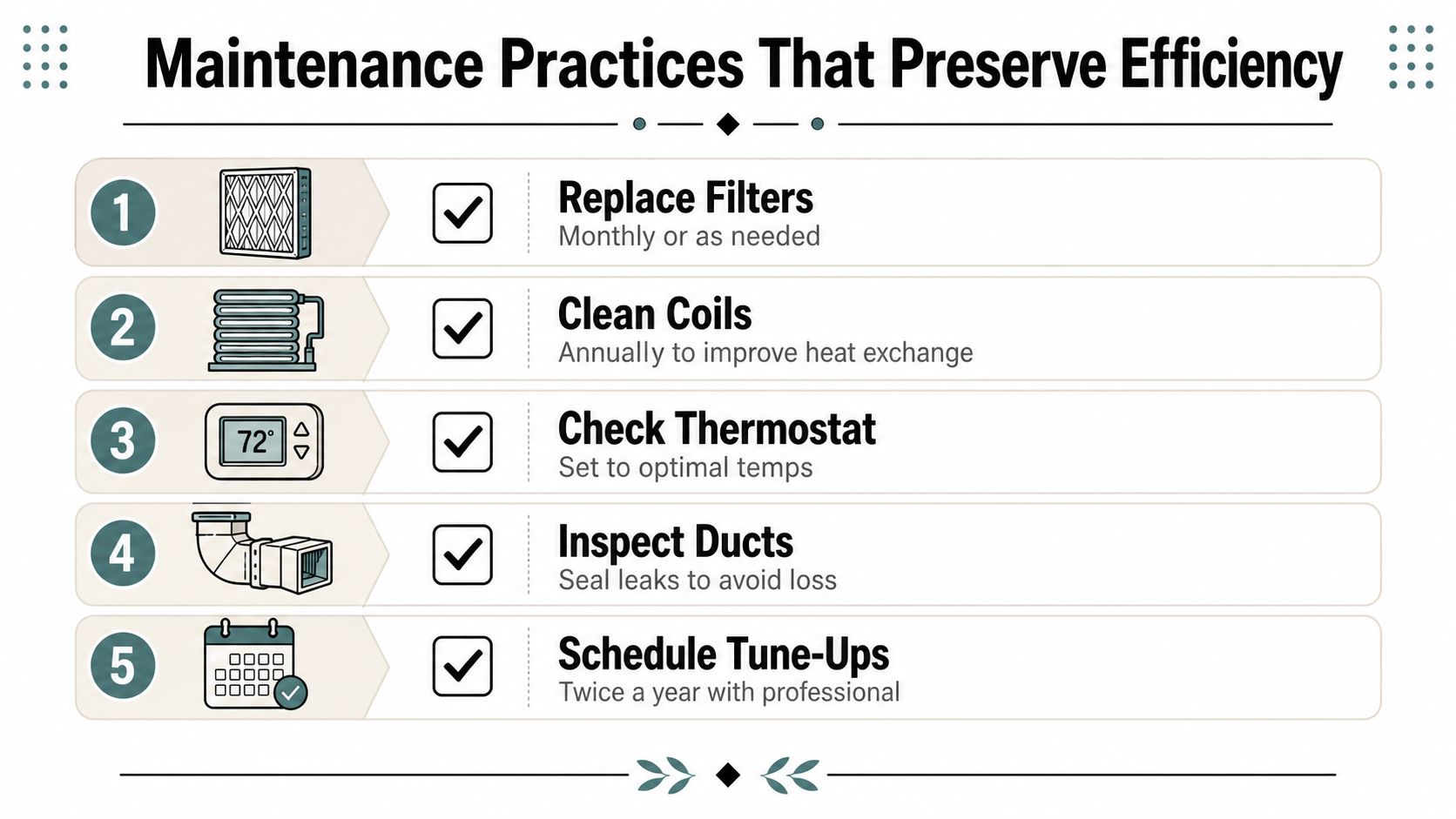
- Replace filters. A dirty filter chokes airflow and makes the blower work harder. The infographic's monthly or as-needed schedule is a good homeowner baseline, but pets, dust, and renovation work can push that faster.
- Clean coils. Coils transfer heat, and when they're coated with grime, the system loses heat-exchange performance. Annual cleaning is the right rhythm for most homes.
- Check the thermostat. Bad setpoints and poor calibration can make a good system act clumsy. A thermostat that's fighting the wrong schedule wastes energy all day.
- Inspect ducts. Sealing leaks protects cooled air from escaping before it reaches the rooms. That matters even more in hot attics.
- Schedule tune-ups. The Cobre Valley Air maintenance checklist resource is a useful example of the kind of seasonal care that keeps systems honest. HVAC maintenance checklist template
Refrigerant checks belong on the professional side of the line. If the charge is off, there's usually a reason, and guessing at it is how small problems become expensive ones.
A neglected system can drift badly from its installed performance over time. The exact loss depends on the home and the fault, but the pattern is always the same, airflow drops, runtime rises, and utility bills follow. Keep the system clean and balanced, and it'll reward you with steadier comfort and fewer emergency calls.
Costs, Rebates, and Arizona-Specific Incentives
The upfront price of eco friendly air conditioning depends on the equipment type, the ductwork, and whether the installation needs electrical or airflow upgrades. A retrofit with good ducts is a very different job from a full replacement in a house that needs redesign work. That's why the cost question is never just the condenser price, it's the whole path to rated performance.
The incentive picture matters, because it changes the math on what's worth doing now versus later. Federal credits and utility rebates can offset part of the project cost, but they don't fix a bad design. The right sequence is still load reduction, then equipment selection, then installation quality, then incentives.
Best financial move: Put money into the parts that lower the load first, then size the system to the house. That usually beats paying extra for a bigger unit.
Arizona homeowners also need to compare utility programs carefully. APS and SRP incentives can help on qualifying upgrades, but the details change, so the safest approach is to verify current requirements before signing a contract. A contractor who understands efficiency ratings, refrigerant choices, and duct corrections can help you focus on the systems that qualify and the ones that won't deliver a strong return.
Real ROI comes from three places, lower electricity use, fewer breakdowns, and better performance over the system's life. That's why a cheaper install can be more expensive in the long run if it's undersized, noisy, or leaky. The eco friendly choice is the one that keeps working in Arizona heat without forcing the equipment to fight the house every afternoon.
How Cobre Valley Air Delivers Eco-Friendly Solutions
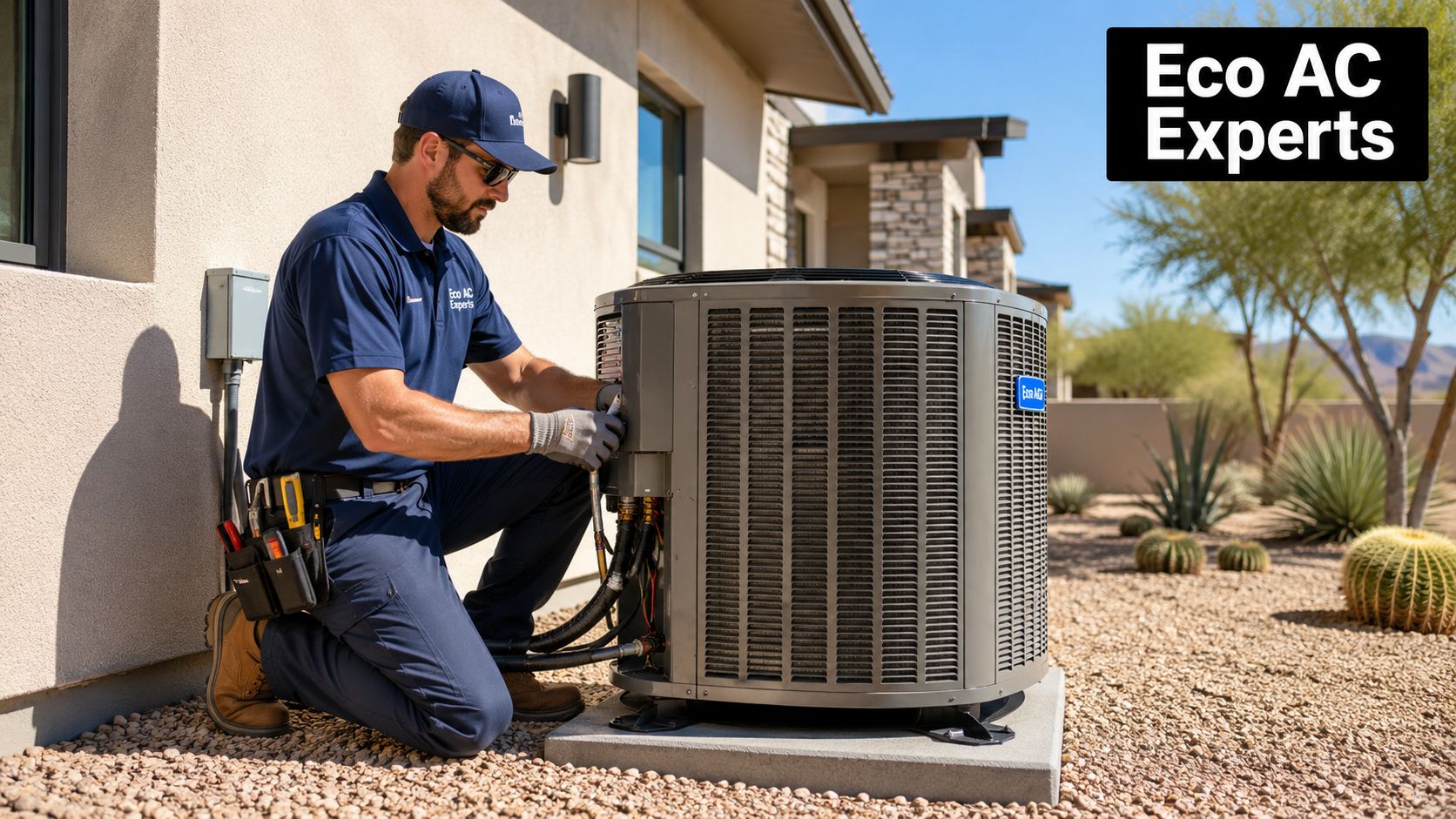
In Globe, Miami, Superior, and nearby Arizona communities, Cobre Valley Air LLC focuses on the parts of the job that decide whether a cooling system performs. That starts with precise diagnostics, code-compliant installations, and all-inclusive replacements that include airflow and duct evaluations, because those are the details that protect efficiency after the truck leaves.
Service quality beats sales pressure
For new construction, the right play is load calculation, proper sizing, and airflow planning from day one. For retrofits, the useful questions are different, duct condition, room-by-room comfort, indoor air quality, and whether a ductless mini split would solve the problem more cleanly than another oversized ducted system. Cobre Valley Air also handles HVAC repair, duct design, repair, and inspection, indoor air quality solutions, and ductless mini split installs, so the equipment choice doesn't get separated from the building it serves.
The company's partnerships with Goodman, Amana, and Daikin give homeowners and contractors access to high-efficiency equipment options, while financing through Wisetack and OPTIMUS can make replacement and upgrade work more manageable. For commercial and restaurant clients, rooftop units and walk-in coolers also stay on the same service list, which matters when downtime has to stay low.
If you want the greener result, the contractor has to design for it, not just sell it. That means checking the envelope, checking the ducts, and matching the system to the home or business instead of chasing a bigger box.
If you're ready to improve comfort without wasting power, contact Cobre Valley Air LLC for HVAC repair, installation, duct design, and maintenance that starts with the building, not the brochure. Visit Cobre Valley Air LLC to talk through a right-sized cooling plan for your home or business in Arizona.