


If your heating and cooling system is getting noisy, struggling to keep up, or pushing you toward a replacement quote, you've probably heard two terms that sound interchangeable but aren't: air handler and furnace. In Arizona, that difference matters more than many homeowners expect.
A lot of people in Globe, Miami, Superior, and nearby communities are really making two decisions at once. They're choosing a piece of equipment, and they're choosing how their home will stay comfortable through a long cooling season with a shorter, lighter heating season. That's why the difference between air handler and furnace isn't just a technical detail. It affects operating cost, winter comfort, duct design, service needs, and what kind of system makes sense for your property.
Here's the short version before we go deeper: a furnace creates heat, while an air handler moves air and depends on another component, usually a heat pump or air conditioner, to do the actual heating or cooling.
| Feature | Furnace | Air Handler |
|---|---|---|
| Main job | Generates heat directly | Moves conditioned air |
| How it heats | Combustion or electric resistance | Through a paired heat pump, with optional electric backup heat |
| Typical pairing | AC condenser for cooling | Heat pump or AC |
| Fuel or power setup | May use natural gas, oil, propane, or electricity | All-electric indoor unit |
| Venting needs | Combustion models need venting | No flue |
| Common fit in Arizona | Good fit in some existing gas homes | Often a strong fit for heat pump systems |
Choosing the Right HVAC System for Your Arizona Home
When a system starts failing in Arizona, it usually shows up at the worst time. The house won't cool evenly. One room feels sticky, another never catches up, and the utility bill doesn't make the problem any easier to tolerate. By the time replacement comes up, most homeowners want a straight answer, not a pile of jargon.
The confusing part is that both a furnace and an air handler can sit indoors, connect to ductwork, and use a blower to move air through the house. From the outside, they can look similar. But they are not the same piece of equipment, and they are not interchangeable in how they produce comfort.
That matters even more in Arizona because cooling carries most of the workload. A homeowner in a cold northern climate may prioritize winter heating output first. Around here, the better question is usually whether the entire system is matched well for long cooling runs, mild winter mornings, and ductwork that can deliver the air where it needs to go.
A proper replacement starts with sizing and airflow, not just the box in the closet. If you want a clearer picture of that side of the decision, this guide on how to size an HVAC system is worth reading before you approve any proposal.
Arizona rule of thumb: The right indoor unit only performs well if the duct system, return air, and equipment match are right.
Homeowners often ask three practical questions:
- Do I need a furnace or an air handler? That depends on whether your home uses gas heat, all-electric heat, or a heat pump.
- Will one save more money to run? Sometimes yes, but the answer depends on system type, not just the indoor cabinet.
- What lasts longer and repairs easier? Both can be reliable when they're installed correctly and maintained, but they fail in different ways.
What Is a Furnace and How Does It Create Heat
A furnace is a heat-generating appliance. It creates warm air directly, either by burning fuel such as natural gas, oil, or propane, or by using electric resistance heat. In real system design, the furnace is the primary heating source in that setup, not just an air-moving cabinet. That distinction is one of the clearest ways to understand the difference between a furnace and an air handler.
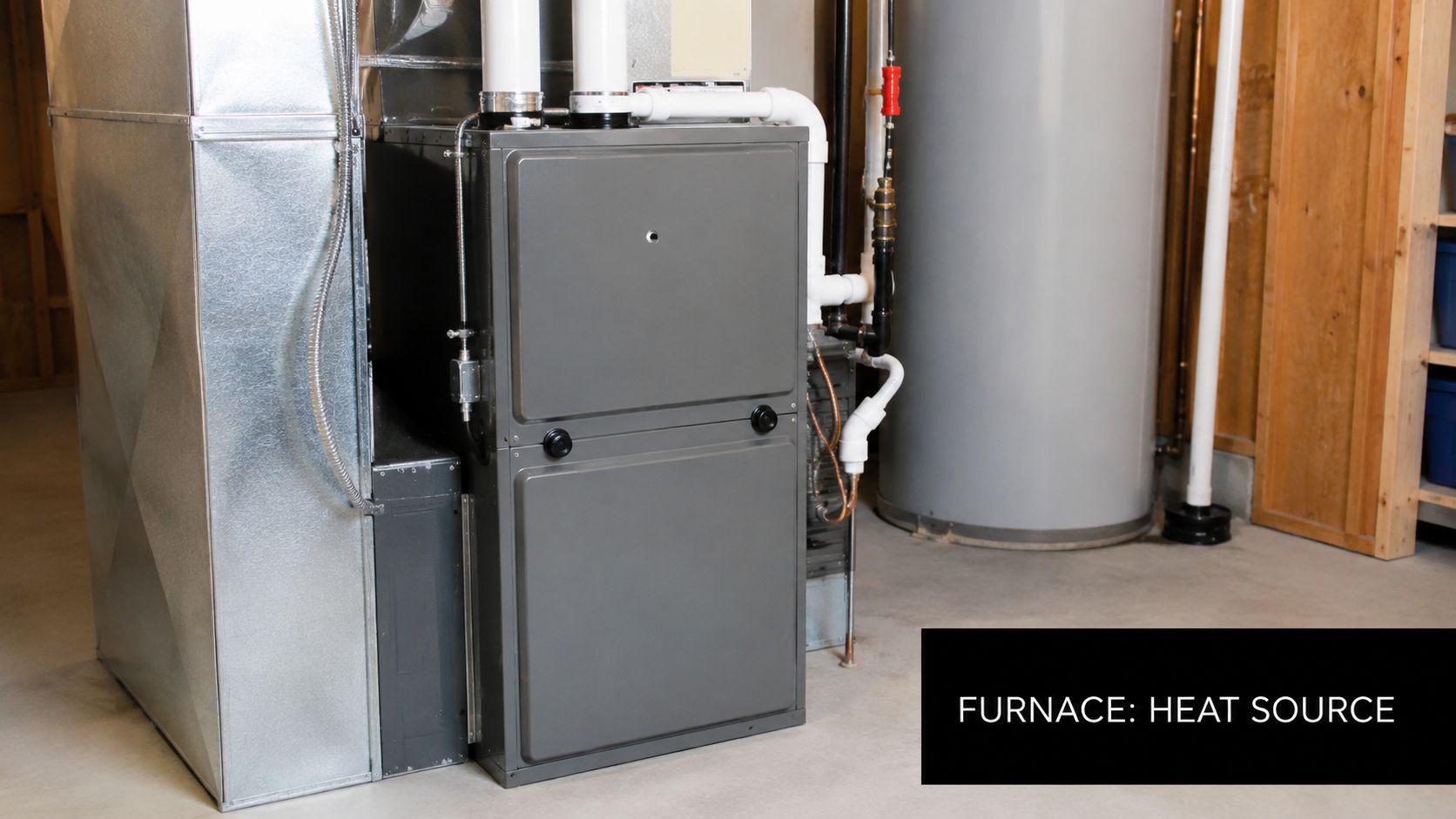
How a gas furnace makes heat
In a gas furnace, the thermostat calls for heat. The ignition sequence starts, burners fire, and the heat exchanger gets hot. The blower then pushes household air across that heated surface and sends warm air through the supply ducts.
That's why a furnace is considered a self-contained heat source. The heat is being made inside the unit itself.
Combustion furnaces also need proper venting. They produce exhaust gases, so the installation has to account for safe venting, code compliance, and combustion setup. In the field, this is one of the biggest practical differences between a furnace installation and an all-electric air handler installation.
What electric furnaces do differently
An electric furnace skips the burner and heat exchanger process tied to fuel combustion. Instead, electricity heats internal elements, and the blower moves air across them.
This can work, but in Arizona, homeowners should look carefully at operating costs and the overall system strategy before defaulting to electric resistance heat as the main plan. Electric heat is simple in concept, but simple doesn't always mean economical for day-to-day use.
A furnace can also handle summer airflow. When paired with an outdoor AC unit, its blower circulates cooled air through the same duct system.
Why furnaces still make sense in some Arizona homes
Furnaces are often associated with colder climates, and that's fair. They are common where strong winter heating is the main demand. But that doesn't mean they have no place in Arizona.
A furnace can make practical sense when:
- The home already has gas infrastructure. Existing gas service can make replacement more straightforward.
- The owner wants familiar heating performance. Many homeowners like the feel of gas heat and want to keep the same system type.
- The cooling side is already built around a furnace plus AC layout. In some homes, replacing like for like avoids unnecessary redesign.
What homeowners often overlook
The furnace itself isn't the whole comfort system. The blower can be fine, the burners can be clean, and the unit can still underperform if the return is undersized or the ducts leak badly. In Arizona homes, I've seen comfort complaints blamed on “bad equipment” when the underlying cause was poor airflow.
That's why any furnace conversation should include these checks:
- Duct condition. Crushed, leaking, or poorly sized ducts hold back performance.
- Return air capacity. If the system can't pull enough air back, heating and cooling both suffer.
- Indoor coil compatibility. The furnace often shares cabinet space and airflow duties with the cooling coil.
- Venting and gas setup. Safety and code compliance aren't optional.
What Is an Air Handler and How Does It Move Air
An air handler is the indoor distribution unit in a split HVAC system. Its main job is to move air, not create heat by itself. It relies on an outdoor system, usually a heat pump or an air conditioner, to provide the heating or cooling that the blower delivers through the ductwork. That core distinction is one of the main points Bryant highlights in its explanation of air handler vs. furnace differences.
What's inside an air handler
Inside the cabinet, you'll usually find a blower motor and an indoor coil. Those two parts do most of the work homeowners feel every day.
In cooling mode, the system sends refrigerant through the indoor coil, and the blower moves warm indoor air across it. The air loses heat, then travels back into the house through the supply ducts as cooled air.
In heating mode, when the air handler is paired with a heat pump, the refrigeration cycle reverses. The indoor coil becomes the warm coil, and the blower distributes that heat through the home.
If you want a better picture of how these pieces fit together, this breakdown of central air conditioning system components helps connect the indoor and outdoor sides.
Why air handlers are common in Arizona
Arizona is a strong climate for heat pumps and the air handlers that go with them. The reason is practical. Much of the year, the home needs cooling, and winter conditions are often mild enough that a heat pump can handle heating efficiently without needing a furnace as the primary heat source.
That doesn't mean every air-handler setup is automatically a smart one. It needs to be matched properly to the outdoor equipment, the duct system, and the actual load of the house.
In mild to moderate climates, an air handler paired with a heat pump often lines up well with how the home actually uses heating and cooling over the course of the year.
The role of electric heat strips
Many air handlers include optional or built-in electric heat strips for backup or supplemental heat. On a cold Arizona morning, those strips can help when the heat pump needs support.
Homeowners should understand what that backup heat is for. It's there to assist, not to hide poor design. If a system spends too much time relying on strip heat, the problem may be staging, sizing, thermostat setup, or duct performance.
What works and what doesn't
An air handler works well when the whole system is designed as a matched package. Good airflow, a clean coil, a properly set blower profile, and solid return design make a major difference.
What doesn't work is dropping in an air handler and assuming comfort will sort itself out. If the duct system is undersized, the static pressure is too high, or the equipment pairing is off, you can end up with weak airflow, noisy operation, poor humidity control, and higher wear on components.
Furnace vs Air Handler A Side by Side Comparison
The fastest way to understand the difference between air handler and furnace is to compare them by decision point, not by appearance. Homeowners don't buy an indoor cabinet. They buy a comfort strategy.
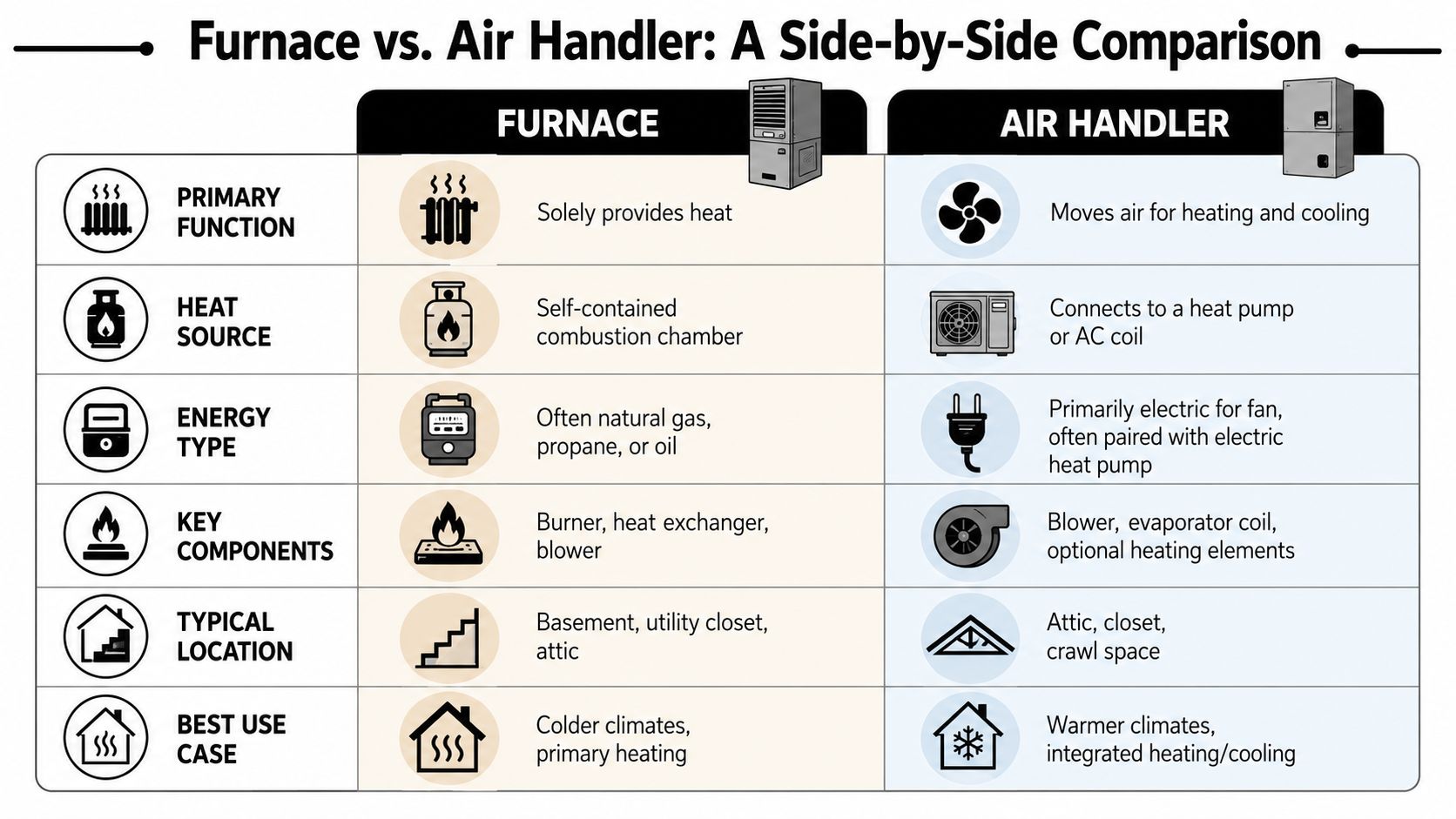
Heat source and how comfort is produced
A furnace creates heat directly. If it's a combustion furnace, it burns fuel. If it's electric, it uses resistance elements. Either way, the heat starts inside the furnace cabinet.
An air handler does something different. It moves conditioned air and depends on a connected system to create the heating or cooling effect. In most Arizona replacements, that usually means an outdoor heat pump does the heating and cooling work while the air handler handles airflow indoors.
That's why these two components shouldn't be treated as equivalent options. One is a heater. The other is an indoor air-moving and coil cabinet that works as part of a larger all-electric system.
System configuration and what each pairs with
A furnace is typically part of a furnace plus AC arrangement. The furnace handles heating, and the outdoor condenser handles cooling. The furnace's blower supports both modes.
An air handler is usually part of a heat pump split system or an AC plus air handler setup. If it's paired with straight AC, heating has to come from electric strips or another added source. If it's paired with a heat pump, the same outdoor system can cool in summer and heat in winter.
There's also a hybrid option worth mentioning.
Practical rule: If a home has both a heat pump and a furnace, that's a dual-fuel setup. It can make sense in certain applications, but it needs proper controls and careful setup to perform the way it should.
Efficiency ratings are not measured the same way
A lot of confusion starts here. Homeowners compare a furnace efficiency number with a heat pump efficiency number as if they mean the same thing. They don't.
Furnaces are generally rated by AFUE, and the U.S. Department of Energy minimum for furnaces is 80% AFUE, as summarized in Trane's overview of HVAC efficiency metrics including AFUE, HSPF2, SEER2, and EER2. Air-handler-based systems are not rated the same way because the air handler itself is not the heat source. In a heat pump system, heating performance is evaluated through the connected equipment using HSPF2, with DOE-required minimums cited by Trane of 7.5 HSPF2 for split-system heat pumps and 6.7 HSPF2 for packaged heat pumps. Cooling performance is evaluated through SEER2 and EER2.
That tells you two important things:
- A furnace and a heat pump system are judged by different standards.
- The air handler itself is not the efficiency-rated heat source.
Why Arizona changes the cost conversation
In a cold region with long, severe winters, the heating side may dominate the decision. In Arizona, cooling season and shoulder-season operation usually matter more. That shifts the practical value of a heat pump system upward for many homes because one matched system can handle both major comfort jobs.
A furnace can still be a good fit, especially in homes already built around gas heat. But in many Arizona replacement discussions, an air handler paired with a heat pump gives homeowners a better year-round balance because the system aligns with how the climate behaves most of the time.
That said, equipment choice alone won't guarantee low operating cost. If the ducts are poorly designed or the return side is restricted, the system has to work harder no matter what name is on the cabinet.
Here's the video version if you'd rather see the concepts visually.
Installation and infrastructure trade-offs
A furnace, especially a gas furnace, may require:
- Fuel connection for natural gas or propane where applicable
- Combustion venting for exhaust gases
- Safety checks tied to burners, ignition, and venting performance
An air handler usually requires:
- Electrical service for the blower and controls
- Refrigerant connection to the outdoor heat pump or AC
- Condensate management because the indoor coil produces condensation during cooling
Neither one gets a free pass on ductwork. In Arizona, installation problems often trace back to airflow mistakes rather than equipment defects. Oversized equipment, poor return design, weak filter racks, and undersized branch runs create comfort issues that homeowners feel every day.
Side-by-side decision points
| Decision factor | Furnace | Air Handler |
|---|---|---|
| Heating method | Directly generates heat | Relies on paired equipment |
| Summer role | Blower moves cooled air from AC coil | Blower moves cooled air from coil |
| Best fit | Homes centered on furnace plus AC design | Homes centered on heat pump design |
| Utility setup | Often fits gas-equipped homes | Fits all-electric strategies well |
| Extra installation needs | Venting on combustion systems | Condensate and matched refrigerant setup |
| Common Arizona question | Keep gas or convert system type? | Maximize heat pump performance? |
Which System Is Right for You Scenarios for Arizona Properties
Most Arizona property owners don't need a lecture on HVAC theory. They need a recommendation that fits the house, the utility setup, and how they live in the space.
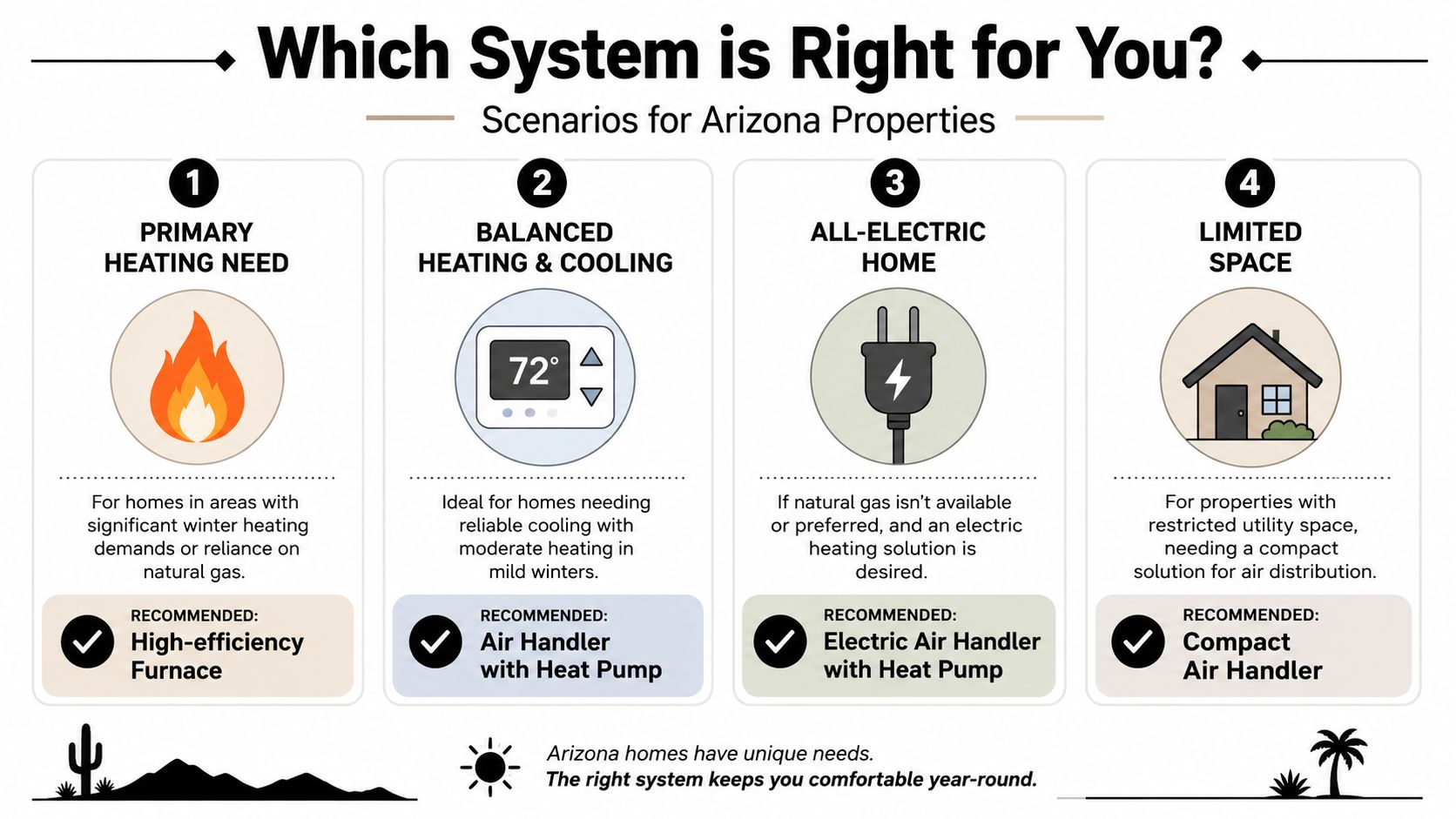
The homeowner with an older gas system
If your home already has a gas furnace, gas piping, and a duct system built around that layout, replacing the furnace with another furnace can be the most direct path. This is often the least disruptive option when the existing setup has worked well and the owner wants to keep the same kind of heating.
That said, “same as before” only works if the supporting pieces still make sense. An old return setup, a failing evaporator coil, or poor duct sealing can undermine a simple replacement. Keeping a furnace is not the same as keeping every old design decision.
This scenario usually fits homeowners who want familiar operation and don't want to rework the property around an all-electric design.
The efficiency-focused homeowner
For many Arizona homes, an air handler paired with a heat pump is the system that makes the most practical sense. Cooling is a long-season priority, and winters are often mild enough that a heat pump can cover heating needs well without leaning heavily on backup heat.
This type of setup is especially attractive when:
- The home is already all-electric
- There is no strong reason to keep gas
- The owner wants one matched system for both heating and cooling
- Comfort from room to room matters as much as the equipment label
In these projects, duct design matters just as much as equipment selection. A high-performing heat pump won't fix bad airflow.
Good equipment on bad ducts is still a bad system.
The all-electric remodel or new construction project
If you're building a new home, adding a major addition, or fully reworking an older house, this is the point where system type should be chosen intentionally. New construction is where a lot of long-term comfort is either won or lost.
Designing around a heat pump and air handler often makes sense in Arizona because the system can be planned around the load, the duct layout, and the return strategy from day one. That gives the installer more freedom to right-size the system and avoid patchwork fixes later.
For builders and general contractors, this is also where load calculations and airflow planning matter most. A clean install with correct duct routing beats a larger piece of equipment forced into a poor design.
One local option for that kind of work is Cobre Valley Air LLC, which handles HVAC installation, load calculations, duct evaluation, and new construction system design in the area.
The homeowner with limited utility space
Some homes don't have much room to work with. Tight closets, attic constraints, and retrofit conditions can all influence the equipment choice. In those cases, the physical footprint of the indoor unit, service access, drain routing, and filter access can steer the recommendation just as much as fuel type.
An air handler can be a good fit where compact all-electric design is the goal. But compact doesn't mean forgiving. Tight spaces make proper drainage, airflow clearance, and serviceability more important, not less.
The commercial or restaurant property
Commercial owners may not be choosing between a residential furnace and residential air handler in the same way a homeowner does. Many businesses use packaged rooftop units, and restaurants may have additional ventilation and refrigeration demands.
Still, the same basic idea applies. Some systems create heat internally, while others depend on broader system configuration for heating and cooling delivery. In commercial work, matching capacity, airflow, and duct distribution remains just as important as it does in homes.
When dual fuel deserves a look
A dual-fuel system combines a heat pump with a furnace. The heat pump handles much of the seasonal heating and cooling, while the furnace takes over when conditions call for it.
This isn't automatically necessary in Arizona, but it can make sense in select cases, especially when a homeowner wants to keep gas heat available while still gaining the flexibility of a heat pump. It's a more specialized conversation, and it only works well when controls, staging, and duct performance are set up correctly.
Installation Maintenance and Repair Considerations
The indoor unit you choose is only part of the story. Long-term comfort depends on installation quality, maintenance habits, and whether repairs are diagnosed correctly instead of guessed at.
Installation is where most future problems begin
A furnace can be perfectly good equipment and still short cycle, overheat, or move too little air if the static pressure is high. An air handler can have a capable blower and matched outdoor unit, yet still leave rooms uncomfortable if the return path is weak or the drain setup is poor.
That's why installation should include more than swapping equipment. A proper job looks at:
- Load and sizing so the new system matches the home
- Duct condition including leakage, restrictions, and layout issues
- Return air design because restricted return hurts airflow in every season
- Drainage and service access especially important with attic-mounted air handlers
For homeowners wanting a practical prep list, this HVAC maintenance checklist template is a useful starting point for understanding what should be reviewed during service.
Maintenance needs are different
A furnace and an air handler don't age in the same way, and they don't fail for the same reasons.
Furnace maintenance priorities
A furnace service visit usually focuses on the heating side of the equipment and the safety controls that go with it.
- Heat exchanger condition because cracks or damage create serious safety concerns
- Burner and ignition performance to make sure combustion starts and runs correctly
- Gas pressure and venting on fuel-fired equipment
- Blower operation since the same blower often supports cooling airflow too
Air handler maintenance priorities
Air handlers need attention on airflow, coil condition, and moisture management.
- Indoor coil cleanliness because dirt on the coil hurts airflow and heat transfer
- Condensate drain clearing to prevent overflow and water damage
- Blower wheel and motor inspection since weak airflow often starts there
- Electric heat strip and control check when backup heat is installed
If an attic air handler has a neglected drain line, the problem may show up as ceiling damage before the homeowner ever notices a cooling issue.
Common repair patterns
Furnaces often develop problems around ignition, flame sensing, blower operation, control boards, or wear tied to combustion components. When a furnace won't light or won't stay lit, the answer isn't always a bad part. Sequence and safety control diagnostics matter.
Air handlers often run into blower motor issues, capacitor problems, condensate-related shutdowns, control faults, or coil airflow restrictions. In Arizona, long cooling seasons can be hard on blower assemblies and indoor coils, especially when filter maintenance has been inconsistent.
What homeowners should not do
It's fine to replace a filter, keep return grilles clear, and watch for water around the indoor unit. But deeper repair work shouldn't turn into a trial-and-error parts swap.
Problems that look simple often aren't. Weak airflow may be a dirty wheel, a failing motor, excessive static pressure, a collapsed duct, or a thermostat setup issue. Safe diagnosis matters more than fast guessing.
Your Next Step to a Comfortable and Efficient Home
For most Arizona homeowners, the question isn't just furnace or air handler. It's which system design fits the climate, the home's utility setup, and the condition of the ductwork. In many cases, a modern heat pump paired with an air handler is a strong fit for year-round comfort because it lines up well with our long cooling season and generally moderate heating demand.
That doesn't make a furnace wrong. In some homes, especially those already built around gas heat, a furnace replacement remains the sensible path. What matters is choosing the system that matches the property instead of forcing the property to match the equipment.
The other piece is workmanship. Proper sizing, airflow planning, duct evaluation, and code-compliant installation have more impact than most homeowners realize. Brand matters. System matching matters more. Air delivery matters most because that's what you experience in the house.
If you're comparing replacement options, ask for a recommendation based on the house, not a one-size-fits-all sales script. Ask how the contractor is evaluating ducts, returns, equipment match, drainage, and service access. Ask what system type makes sense for your actual Arizona usage, not for somebody else's climate.
A solid decision now usually means fewer comfort complaints, fewer surprise repairs, and a system that feels right in both July and January.
If you want a no-pressure conversation about the right setup for your home or business, contact Cobre Valley Air LLC. They serve Globe, Miami, Superior, and surrounding Arizona communities with HVAC repair, installation, duct evaluation, new construction design, and ongoing maintenance. You can also call (928) 200-1740 to schedule service or discuss replacement options.