


Most homeowners in Globe, Miami, and Superior will pay between $3,000 and $8,000 per zone installed, and a single-zone system typically lands between $4,000 and $7,000 once electrical work and permits are included. If you're staring at a hot garage, a back bedroom that never cools off, or a room addition that your central system can't touch, that's the money range you should have in mind.
The number that matters most is not the sticker price on the outdoor unit. It's the total installed cost, because that's where equipment, labor, electrical work, and your home's layout all hit the invoice at once.
What You Are Actually Paying For
A lot of homeowners in Miami know the feeling. The garage workshop is pushing 105 degrees in July, the back bedroom still sits above comfort even with the thermostat cranked down, and the central system is already doing all it can. That's when a ductless mini split heat pump starts looking like the practical fix, because it gives one room, or a few rooms, their own cooling and heating without forcing you to add ducts.
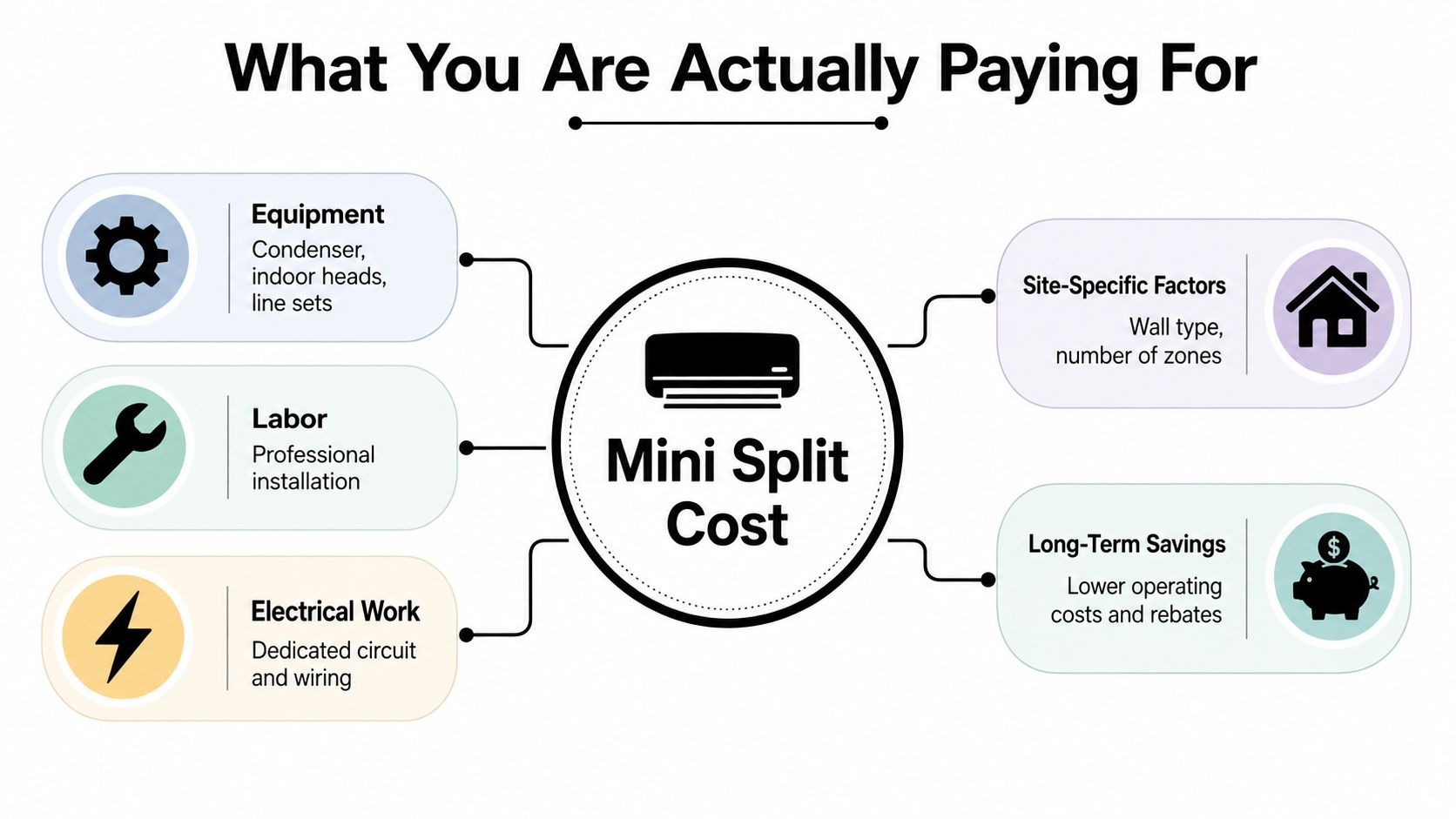
A ductless mini split heat pump is simple in concept. One outdoor condenser connects to one or more indoor heads through refrigerant lines, and there's no ductwork moving air through the house. That's why it's such a common answer for additions, garages, and rooms that never seem to match the rest of the house. If you want the plain-English version of the equipment itself, this local explanation of a ductless mini split system is the right place to start.
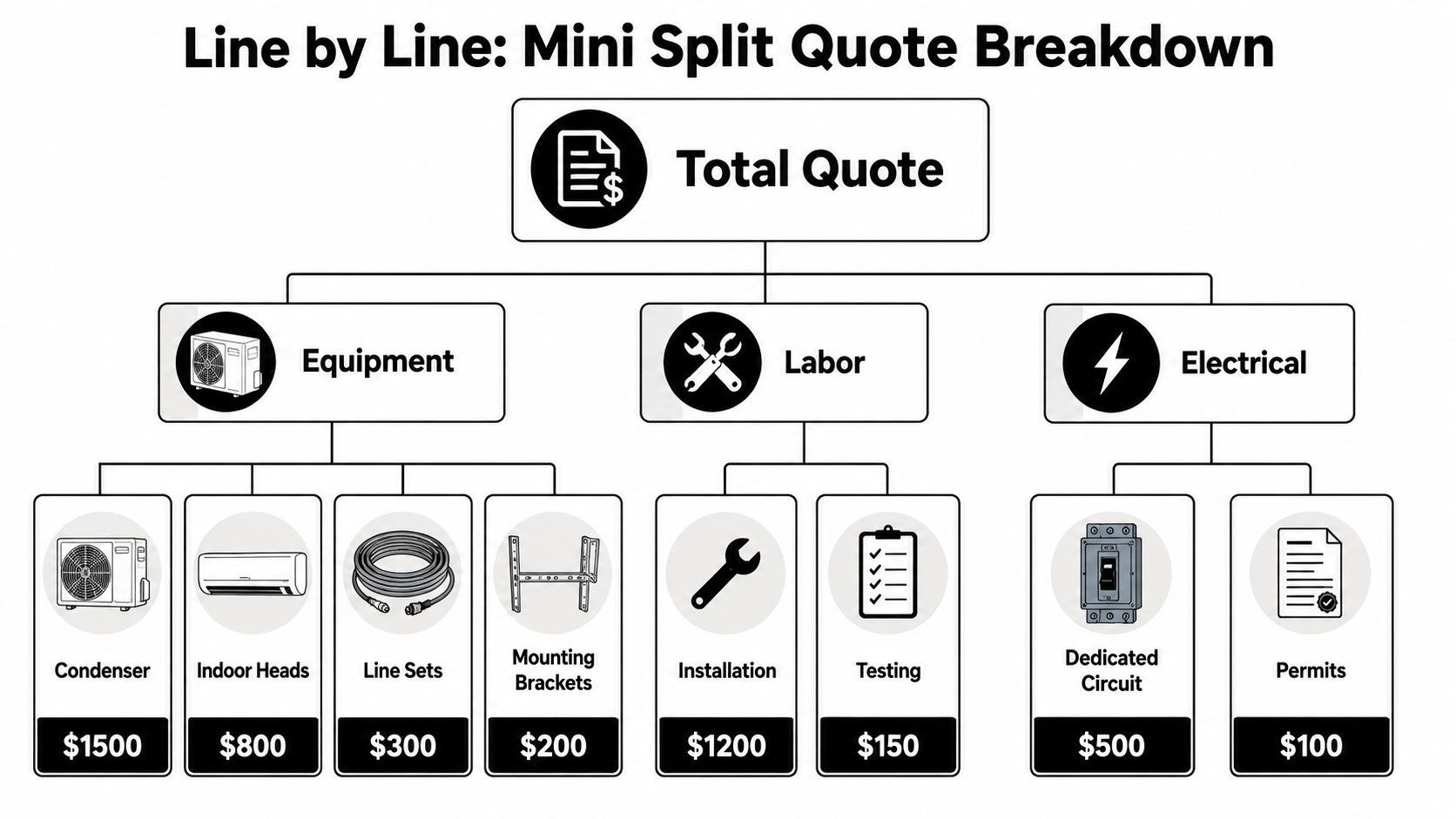
The quote you get should break into three buckets. Equipment is the condenser, indoor head or heads, line sets, and mounting hardware. Labor is the actual installation, mounting, vacuuming, and commissioning. Electrical and permit work covers the dedicated circuit, disconnect, and whatever the local code requires to make the job legal and safe.
Practical rule: if a quote doesn't separate those three lines, it's not a quote worth trusting.
The right system size doesn't come from square footage alone. It comes from a proper load calculation, because sun exposure, insulation, wall construction, and room use all change the answer. A garage workshop in Globe and a shaded bedroom in Superior are not the same job just because the rooms look similar on paper.
Mini split cost should always be treated as a stack of decisions, not one fixed number. Once you see the parts, you can spot when a contractor is pricing a real installation and when they're just tossing out a guess.
Equipment, Labor, and Electrical Line by Line
A clean mini split estimate should look more like a menu than a mystery. The hardware is only one piece, and in a lot of projects it's not even the biggest piece. The cost shows up when the contractor has to mount equipment cleanly, run lines in a tight space, and make the electrical side code-compliant.
Equipment is the visible part, but not the whole bill
The equipment line usually includes the outdoor condenser, indoor head or heads, line sets, and mounting brackets. In the historical Massachusetts EEAC study, the average full retail cost for equipment, materials, and labor was about $3,900, which lines up with earlier installed-cost estimates of $3,500 to $4,000 for 1-ton units Massachusetts EEAC cost study. That's useful context because it shows mini splits were never just an equipment purchase, they've always been an installed system.
For a homeowner, the question is not whether the condenser costs more than the indoor head. The question is whether the quote reflects the actual scope. A single-zone setup needs less hardware, fewer penetrations, and less refrigerant line than a multi-zone layout. That's why the equipment line rises as the room count rises.
Labor is where the job either gets easy or expensive
Labor covers drilling through the wall, hanging the indoor head, routing the line set, pulling vacuum, and commissioning the system. It scales with complexity, not just hours on site. A short, simple run on a single-story stucco wall is one thing. A multi-head install through an attic, around obstructions, or across a second-story wall is a different job entirely.
Electrical and permits are not optional
Electrical work usually means a dedicated circuit, a disconnect, and sometimes panel work if capacity is tight. Permits are usually a smaller line item, but they matter because the job has to be legal. In my book, a contractor who treats electrical and permits like an afterthought is already telling you where the corners will be cut.
The industry's own guidance supports this split. Carrier notes that single-zone ductless mini split installation generally runs about $3,000 to $8,000 depending on capacity, efficiency, and mounting style, and that cold-climate or high-performance units can add roughly 30% to 50% to system cost Carrier installation cost guidance. That's exactly why the cheapest quote is not always the smart one.
If one line on the bid looks suspiciously low, another line is usually bloated. Good contractors explain the spread instead of hiding it.
Per-Zone Pricing and Where the Multi-Zone Premium Comes From
Mini split pricing makes the most sense when you think in zones, because that's how the work gets built and billed. A single room needs one indoor head and one relatively simple route. Add a second room, and you're not just buying more cooling capacity, you're buying more hardware, more line set, more wiring, and more commissioning time.
| Zone Count | Typical Installed Range | Common Use Case in Arizona |
|---|---|---|
| 1 zone | $2,000 to $6,000 | Garage workshop, bedroom, enclosed patio, small addition |
| 1 zone, higher planning range | $3,000 to $8,000 | Single room with tougher routing or higher-efficiency equipment |
| 2 to 3 zones | $2,000 to $7,000 per zone | Primary suite plus office, or a couple of problem rooms |
| 3 to 5 zones | $8,000 to $18,000+ | Whole-home partial coverage, smaller homes with several independent rooms |
Those ranges line up with Bryant's per-zone pricing, which puts a ductless mini split at $2,000 to $7,000 per zone, with single-zone systems generally at $2,000 to $6,000 and multi-zone systems also ranging $2,000 to $7,000 per zone Bryant mini split cost guide. EnergySage reports that each indoor head adds a few thousand dollars and that costs can reach around $8,000 per zone depending on equipment and labor EnergySage zone pricing overview.
Why the premium grows fast
A one-zone install is usually the cleanest, cheapest path. There's one outdoor unit, one indoor head, one set of lines, and one control point. Once you move to two zones, you've added another head, another route, and more balancing work.
Three and four zones get expensive because the install stops being a room fix and starts becoming a system design problem. You may need longer runs, attic routing, distribution boxes, and more time commissioning the whole setup. That is where a lot of homeowners in Globe get talked into more capacity than they'll use.
My advice: don't pay for extra zones just because the outdoor unit can handle them. Pay for rooms you'll actually condition.
The quality issue here is simple. Every extra zone should earn its keep. If you're only trying to tame one hot bedroom or one garage conversion, a multi-zone package can turn a smart purchase into an overpriced one.
Site-Specific Factors That Move Your Quote by Thousands
The same mini split can be straightforward in Miami and a lot more involved on a hillside lot in Globe. That's not contractor drama, that's site reality. Your quote changes because homes are built differently, and the installer has to work with what's already there.
What changes the price fast
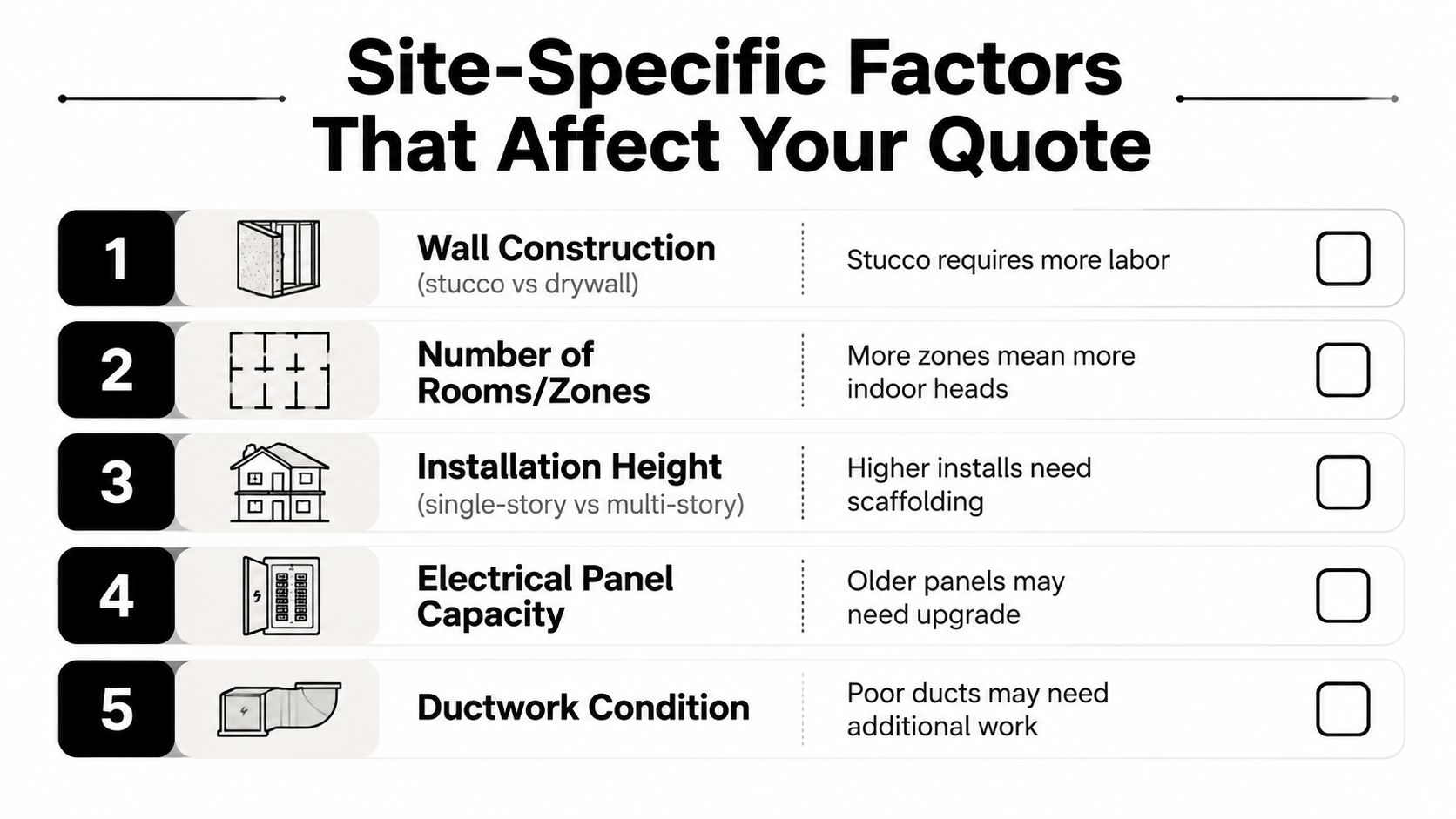
- Wall construction: Stucco, block, and adobe all take more effort than a clean drywall penetration. More labor means more cost.
- Line-set length: Contractors usually budget for a reasonable run, and longer routes add material, time, and pressure drop.
- Electrical panel capacity: Older panels may need a breaker or sub-panel upgrade before the new unit can be energized.
- Condensate routing: If there's no easy drain nearby, the installer has to solve drainage the right way.
- Installation height: A second-story exterior wall or a tricky roofline can push the job into more complex access work.
Wall type matters more here than most homeowners expect. Stucco takes more care to penetrate and seal, while block and adobe often slow the mounting work down. If the wall is thick or hard to access, the installer has to account for more labor and more finishing time.
Attic access versus slab routing changes the whole job. A simple attic crawl can keep the line set hidden and the install neat. A slab route or a home with tight framing can make the same project more labor intensive and more visible.
The electrical side is where surprises show up. If the existing panel is already crowded, the contractor may need to add a breaker or even a sub-panel. That's why a quote built on a quick walk-through can miss the cost by a lot.
Cobre Valley Air's manual J load calculation process is the kind of step that keeps those surprises from becoming your problem later. A real load check tells you what the house needs instead of guessing from square footage and hoping for the best.
A simple Miami install on a single-story stucco wall can stay tidy and predictable. Take that same equipment to a hillside Globe home with awkward wall access, a long refrigerant route, and an older panel, and the bill climbs fast. That's not a sales trick, that's the cost of doing the job correctly.
Arizona Pricing for Globe, Miami, and Superior
Local housing stock changes the number as much as the equipment does. In Globe, older homes and hillside lots often mean more labor, less forgiving access, and longer line-set runs. In Miami, a lot of mid-century homes are easier to work in, with more accessible attic space and shorter routing. In Superior, smaller homes and additions often fit a single-zone setup cleanly, which keeps both complexity and cost under control.
Modernize says ductless heat pumps typically cost $5,000 to $15,000 installed, averaging $8,500, and it gives a planning estimate of about $6 to $14 per square foot installed Modernize ductless heat pump pricing. That gives you a decent sanity check, but I would not let a square-foot estimate make the final call in Arizona. Two homes with the same footprint can still produce very different install realities.
What net cost really means here
The EnergySage marketplace average of $19,556 after state and local incentives is for a system averaging about 3.7 tons and $4,944 per ton EnergySage mini split cost data. That is a real-world net number, and it matters because incentives can move the final out-of-pocket cost quite a bit. The catch is simple, eligibility depends on the equipment and the paperwork.
Federal heat pump credits and utility programs can help, but they do not erase bad sizing. A right-sized single-zone system with the right efficiency rating often makes more sense than a larger multi-zone package that looks impressive on paper and never gets fully used. APS and other local utility programs can improve the math, but only after the project is correctly designed.
The quote you want starts with a load calculation and an airflow review, then shows you the incentive path after the equipment is selected.
That is the point of a local estimate in Globe, Miami, or Superior. You are not buying a national average. You are buying a system that fits your house, your panel, and the room you need fixed.
When a Mini Split Is Not the Cheapest Answer
A ductless system is not automatically the cheapest choice. It's the cleanest answer when you need targeted comfort without ductwork, but once a house already has usable ducts or only needs one small correction, ductless can become the expensive option fast.
If the existing ductwork is in decent shape, a sealed and right-sized central heat pump may beat a multi-zone ductless package on total cost and comfort. If one room is the only problem, a simple ducted supply run or a smaller targeted fix can be cheaper than hanging a whole head and outdoor unit on the house. And if you're replacing an old whole-home system, a central heat pump with a new air handler can sometimes deliver a better value per dollar than building a multi-zone layout from scratch.
The harder truth is that a lot of homeowners get upsold on capacity they don't need. They want one room fixed, and the estimate suddenly grows into three heads and more equipment than the house requires. That's how the lifecycle trap starts, because the upfront spend rises while the actual comfort gain stays small.
A contrarian but honest contractor will tell you when duct repair, duct sealing, or a simpler central replacement is the better spend. That's the practical standard I like, especially in Arizona where right-sizing matters more than the label on the equipment.
Operating Costs, Rebates, and Lifetime Spending
Sticker price gets your attention. Lifetime cost decides whether the system was a smart buy. For a properly sized single-zone mini split, operating costs can stay fairly modest because you are conditioning one room, not the whole house. In Arizona, that matters. Most homeowners feel the pain in one space during the hottest or coldest stretch, so paying to treat unused rooms only adds cost without adding comfort.
What owners forget to budget
- Filter cleaning: Easy to skip, but dirty filters cut airflow and make the unit work harder.
- Coil rinse: Dust and debris build up, especially in long cooling seasons.
- Annual check: A tech should inspect refrigerant levels and electrical connections.
- Repair exposure: Capacitors, refrigerant leaks, and indoor head replacements can happen.
The maintenance side is real. Ductless units collect dirt inside, and they need regular attention if you want them to stay efficient and dependable. A clean system runs better, and a neglected one starts losing value fast. For a practical breakdown of what ongoing care looks like, see ductless mini split maintenance.
If you are comparing operating cost to financing, keep those buckets separate. Wisetack and OPTIMUS help spread out the installation bill. They do nothing to reduce your electric use. A low monthly payment can hide a poor design, and a poor design keeps costing you every time the system runs.
Smart rule: buy the right size first, then think about payment plans.
Lifetime spending comes down to design quality, service access, and whether the house really needs more than one zone. A cheap install that is hard to maintain stops being cheap quickly. A clean, well-sized system with sensible maintenance usually gives the better value over time.
Your Decision Checklist and Next Step for a Real Quote
Start with the room, not the brochure. Decide whether you need one room, a couple of problem rooms, or true whole-home conditioning. Then check your electrical panel, look at whether the house already has usable ducts, and gather your latest utility bills so the installer can see how the home behaves.
If you want a quote that's worth using, ask for a load calculation, a duct evaluation if you already have ductwork, and a written breakdown of equipment, labor, and electrical work. That's the way to avoid paying for capacity you won't use.
Cobre Valley Air LLC handles HVAC repair and installation, duct design and repair, ductless mini split installs, and right-sized system planning for Globe, Miami, Superior, and nearby Arizona communities, with financing through Wisetack and OPTIMUS, 24/7 emergency response, and ROC 339078. If you want a real number instead of a square-foot guess, visit Cobre Valley Air LLC and schedule a quote based on your home, your load, and the room that needs fixing.