



You can ignore a filter for a while in a mild season and get away with it. Then the first real dust hit comes through the neighborhood, the return grille turns brown, the house starts feeling stuffy, and the system runs longer than it should. That's the moment you realize when to replace air filter isn't really about a date on the calendar, it's about what the filter is doing to the airflow right now.
In Arizona, that matters fast. Dust, pets, monsoon debris, and long run times all load a filter differently, and the same unit can be fine in one home and choked in another. If you care about quality AC repairs, AC installation, and AC maintenance, plus heat pumps, furnaces, and duct design, the key question is whether the filter is still letting the system breathe.
Why Your Air Filter Timing Actually Matters
A homeowner in Globe can clean the house, wipe the grille, and still see a thin brown film return a week later after a dust event. That points to a filter that is loading fast enough to matter right away. The filter is the first barrier between the return air and the parts you do not want coated, especially the evaporator coil, the blower wheel, and the duct interior.
When a filter loads up, three problems show up together. Airflow drops, indoor air quality slips, and the equipment has to work harder to move the same air. In Arizona, those problems arrive sooner because the filter is catching more than normal household lint, especially after dust, monsoon debris, and long run times.
Practical rule: if the return side is loading fast, the filter life is already shorter than the package's broad promise.
Carrier's replacement guidance for residential systems puts the common baseline at every 30 to 90 days for 1-inch HVAC air filters, with 1-inch fiberglass filters often needing replacement every 30 days, 1-inch pleated filters lasting 30 to 90 days, and 4-inch media filters commonly lasting 6 to 12 months or even a full 1 year in some designs, with the thickness jump extending the interval from roughly 1 month to about 6 months or more (Carrier). That spread is the field reality. Filter life changes a lot with media thickness, dust load, and how hard the system runs.
For homeowners in the Copper Basin, the right answer usually comes from condition plus usage, not a fixed date. If the system runs hard, the house has pets, or the dust outside is relentless, the filter can be done long before the calendar says so. For more indoor-air context, see how to reduce indoor air pollution.
How to Check an Air Filter the Right Way
Walk up to a return grille in an Arizona home after a windy week, and the filter usually tells the story before the thermostat does. The best habit is to check it every month, then replace it sooner if the face is packed with dust, the pleats are matted, or the system starts sounding strained. Consumer guidance points to that same routine, monthly inspection with replacement based on condition, not a failure after the airflow has already fallen off (Consumer Reports).
The 60-second inspection that actually works
Shut the system off first. Pull the filter from the return grille, the air handler cabinet, or the furnace door without shaking loose dust back into the opening. Then hold it up to a lamp or window.
If light does not pass through evenly, replace it. Home Depot's maintenance guidance uses the same light test, if the filter will not let light through, it is clogged and needs replacement (Home Depot).
What to look at while it's out
Check the size printed on the frame, because that is the size to buy again. Look at the dust pattern too. A filter that is loaded heavily on the return side and still looks “okay” on the clean side is already showing you the system is pulling in a lot of dirt.
A filter does not have to look filthy to be restrictive. In dry, dusty homes, the light test is only a rough proxy, not a guarantee that airflow is still healthy.
The arrow matters as well. American Standard says the arrow on the filter shows how it should be oriented, and it should point toward the air handler or furnace so particles are captured before air enters the HVAC unit (American Standard). In the field, a reversed filter is a fast way to let dust bypass the media and load the blower side faster than it should.
For homes that want tighter particle control, a HEPA-style HVAC filter setup needs careful system matching, because the filter choice and the blower have to work together instead of fighting each other.
Filter Types, MERV Ratings, and How Long Each Lasts
Filter choice changes how fast a filter loads up, and that is where the decision sits. A thin fiberglass panel, a pleated residential filter, and a deep media filter all handle dust differently, so the right replacement timing depends on how much restriction shows up in the system, not just what the package claims.
The practical trade-off
The trade-off starts with airflow. A lower-efficiency filter can stay in place longer if the home is light on dust and the return stays clean, but it gives up particle capture. A higher-efficiency filter catches more, yet it can also restrict airflow sooner if the blower, return, or ductwork is already working hard. That matters in Arizona homes and commercial rooftops where fine dust builds fast and a filter can look acceptable on one side while already starting to choke the system.
MERV is the other number to watch. MERV 8 is a common residential baseline. MERV 11 to 13 fits better when allergies, pets, or tighter indoor-air control matter. MERV 14 to 16 moves into commercial territory, where the blower and duct system need to be matched carefully so the extra resistance does not cut airflow enough to create other problems. A filter that is technically “better” on paper can be the wrong choice if the equipment cannot pull through it cleanly.
You also have to separate filter type from filter condition. A pleated filter may still be usable in a low-dust house, while the same style can load quickly after monsoon season, a windy stretch, or a dusty rooftop service call. In the field, I care less about the label and more about what the filter is telling me after it has been in the system for a while.
Consumer maintenance guidance puts disposable home filters in a wide range, because usage and conditions change the result (Consumer Reports). That is the part homeowners usually miss. The calendar does not show restriction, and restriction is what decides whether the filter is still doing its job without slowing the system down.
For homeowners comparing higher-efficiency options, HEPA-style HVAC filter setup is worth understanding before buying a filter that looks strong on the box but may not fit the system's airflow needs.
| Residential Air Filter Comparison | |||
|---|---|---|---|
| Filter Type | Typical MERV | Expected Life | Best Fit |
| Fiberglass | Lower-efficiency residential use | Basic service interval, depends heavily on dust load and runtime | Basic protection where the system sees light dust |
| Pleated | Mid-range residential use | Usually longer than fiberglass, but shorter when dust or runtime is high | Most homes, better particle capture |
| Media | Higher-capacity residential use | Long service interval when the system is matched correctly | Systems built for deeper filtration |
| HEPA-style or high-efficiency upgrades | Higher efficiency, system-dependent | Varies by system and load | Homes that need better IAQ and have compatible equipment |
Household Factors That Shorten Filter Life
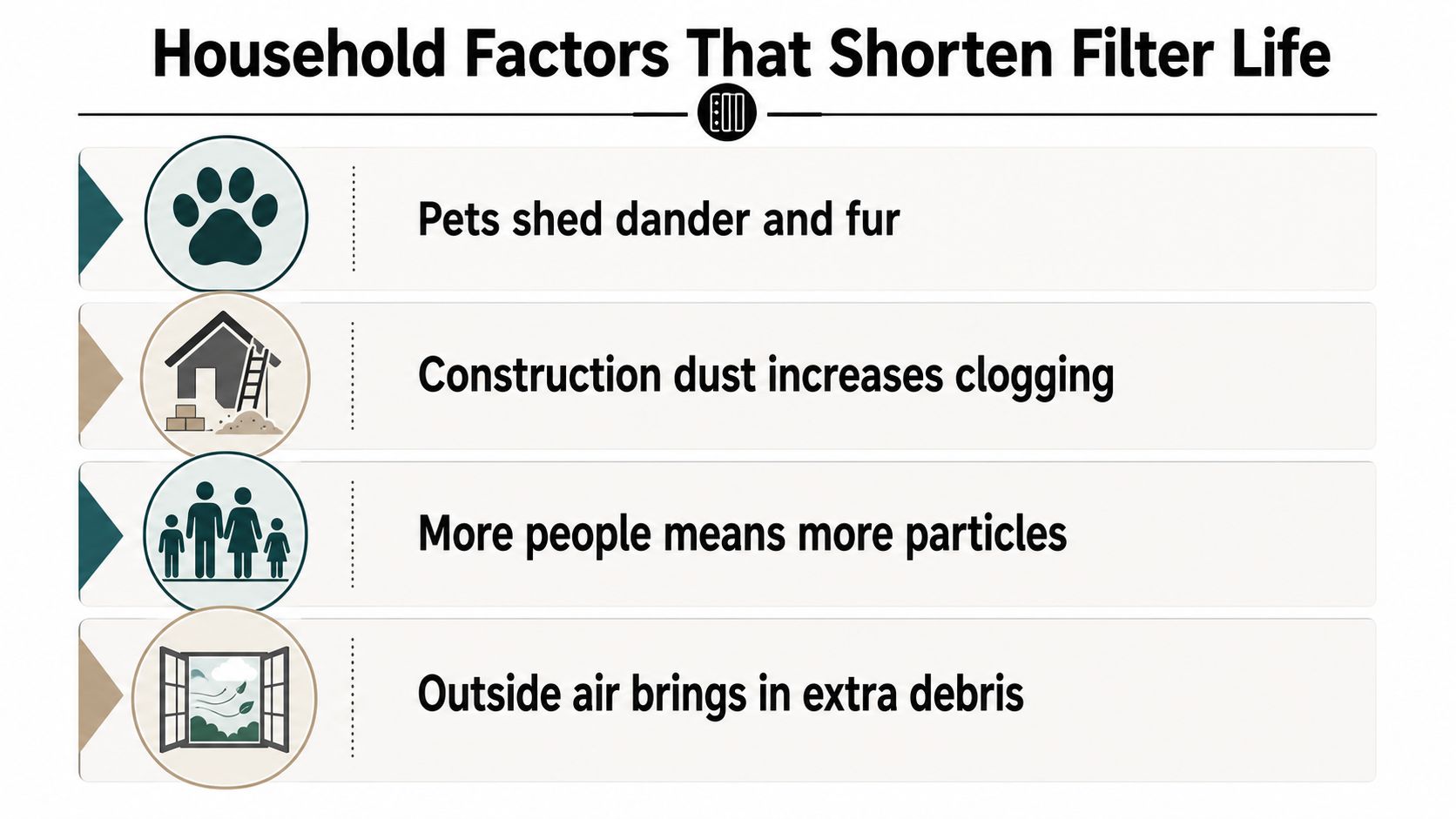
A normal house and a dusty house don't age filters the same way. Two dogs, a gravel driveway, a few weeks of open windows, and a blower that runs almost nonstop will pull a filter down faster than the package timing suggests.
The things that actually change the interval
Pets are the obvious one. Shedding adds hair and fine dander to the return, and that stuff mats the media faster than plain dust. Homes with allergy or asthma concerns also tend to benefit from more attention to filter choice, because the goal shifts from basic equipment protection to better indoor-air control.
Construction is another filter killer. A remodel, a nearby jobsite, or even a home that sits open to desert wind can load a filter in a way a normal suburban home never sees. Consumer guidance explicitly calls out pets, high-pollen conditions, construction, heavy cooking, and seasonal smoke as reasons filters saturate faster (Coway Mega).
For homes in the Cobre Valley area, the baseline rule often changes like this:
- One low-dust household: the standard 90-day pleated schedule may hold.
- Pets plus heavy system use: the filter usually needs attention sooner, often around the monthly mark.
- Allergy-sensitive occupants: a higher-efficiency filter can help, but only if the equipment can handle the resistance.
- Dust exposure from outside air or nearby construction: inspect monthly and be ready to shorten the interval.
The reason this matters is simple. A filter that still looks serviceable can already be restricting air enough to matter in a home with heavy use. The right answer is not “replace earlier just in case” for every house, it's matching the interval to the load the home creates.
The Pressure Drop Rule Behind Commercial Filter Changes
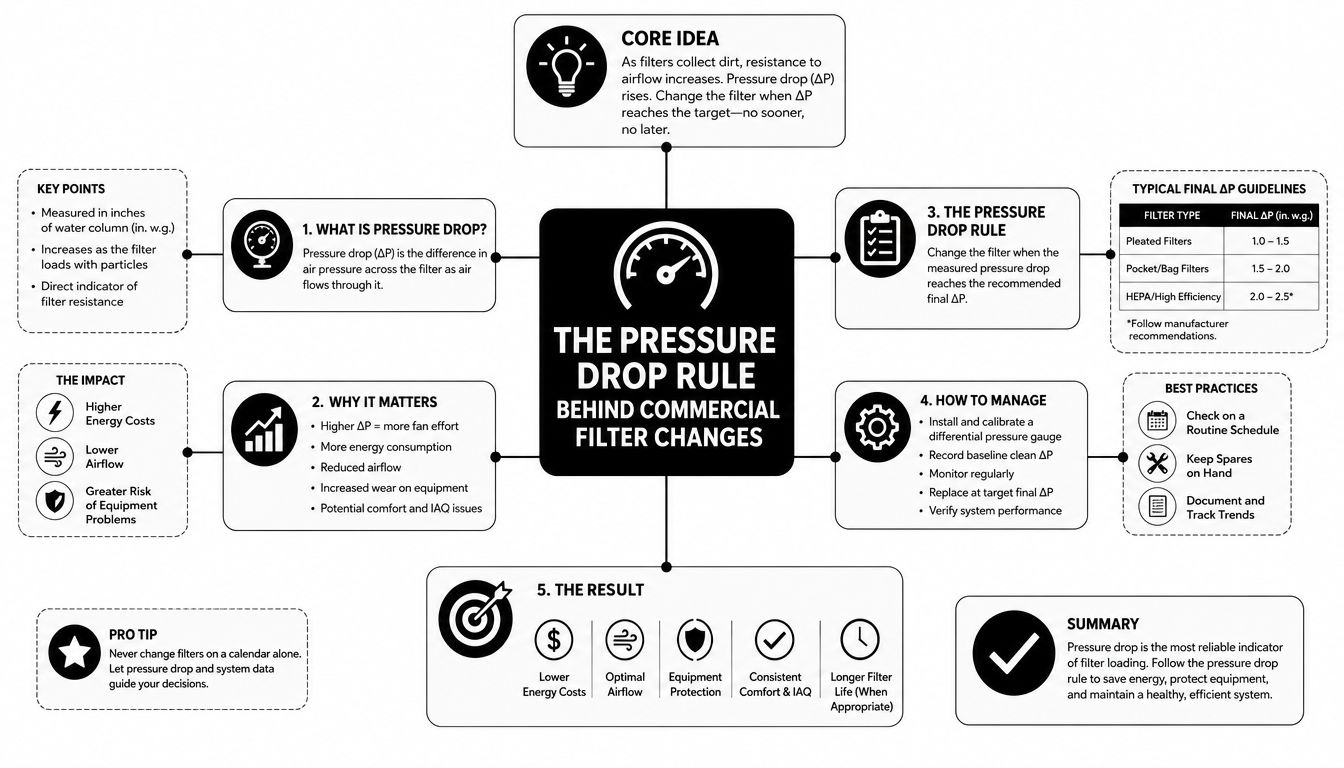
Commercial filters teach the lesson that appearance can fool you. On a rooftop unit, a filter might not look destroyed, but the blower can already be fighting higher resistance. That's why commercial practice often uses pressure drop instead of a calendar alone.
Why the gauge beats the guess
As dust loads the filter media, the resistance goes up. A common commercial trigger is replacement when the initial pressure drop has doubled, because that tells you the filter's airflow resistance has risen enough to affect fan performance and efficiency (Camfil). On a home system, that logic still applies even if most homeowners don't have a manometer in the garage.
What does restriction feel like? Longer cooling cycles. Weak supply air at the registers. A blower that sounds strained. In bad cases, the coil can start to ice or sweat because the unit isn't moving enough air across it. A visual check might say, “not terrible.” The system says otherwise.
The technical source from Donaldson makes the bigger point clearly, the accurate way to know replacement timing is to monitor airflow restriction rather than time or appearance alone (Donaldson). That's the part most homeowner advice skips.
For homeowners who want certainty, a technician can measure static pressure across the filter and the coil and turn a guess into a real reading. That's useful when the home has airflow complaints, when the duct design is questionable, or when the equipment keeps running longer than it should. In local service work, that kind of measurement is often the difference between “change the filter” and “the system needs a deeper airflow check.”
A Clean Filter Swap From Start to Finish
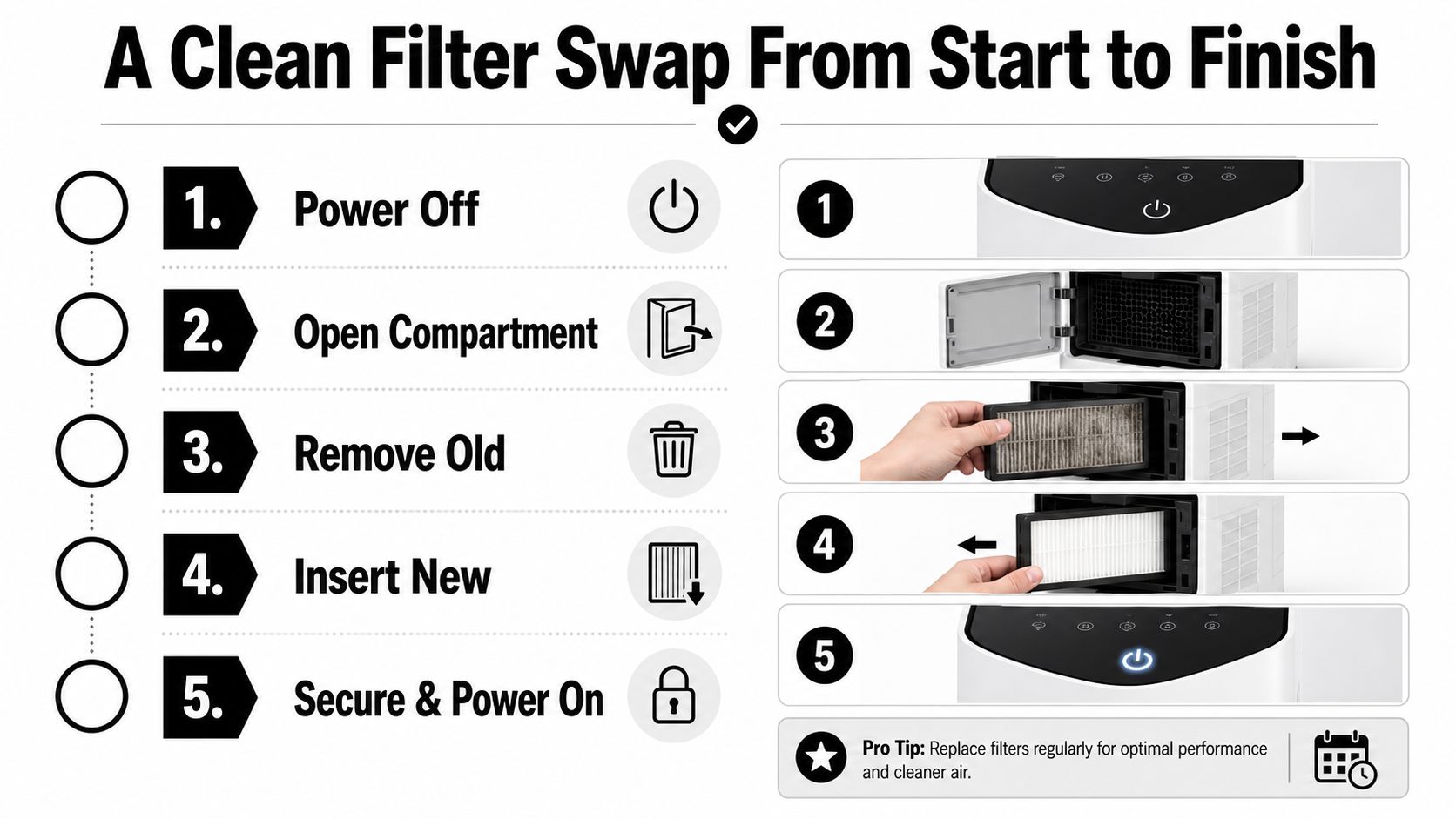
A good filter swap takes less than a minute once you've done it a few times. The mistakes happen when people rush, jam the wrong size into the slot, or put the arrow the wrong way and call it good.
The physical swap
Turn the system off at the thermostat first. Pull the old filter out carefully, then inspect the slot for dust, a loose door, or a collapsed rack. Match the new filter to the printed size on the old frame, not to what you think the system “probably” uses.
The arrow belongs toward the air handler or furnace, not toward the return grille. That direction matters because the filter is designed to catch debris before the air reaches the equipment. A backwards filter won't do its job the way it should, even if it fits physically.
The mistakes that create new problems
The classic field problems are easy to spot:
- Wrong size: a pinched filter or one that rattles in the slot lets air bypass around the edges.
- Two filters stacked together: this usually creates too much resistance and doesn't improve filtration the way people expect.
- Door not sealing: an aftermarket filter that keeps the panel from closing cleanly can leak dust straight past the media.
- Skipping the housing check: a dirty slot can dump debris into the new filter and shorten its useful life.
Bag the old filter before tossing it so the dust doesn't end up back in the garage or utility room. Then note the date on the frame or inside the cabinet if you want a simple replacement reference later. If the slot or return looks damaged, that's the point where a technician should inspect the assembly instead of forcing another filter into the same problem.
Arizona Conditions, Restaurant Rooftops, and When Rules Change
Standard timing advice gets loose fast in Arizona. Spring dust, monsoon outflow, and sudden wind events load a filter much faster than a milder climate does. A single haboob can turn a clean-looking filter into a restriction problem before the next reminder ever shows up.
What changes for homes
In Globe, Miami, Superior, and the surrounding communities, outside air is the big variable. A house near an active wash, a home with a dog door, or a casita with its own wall unit can all pull in more dust than a sealed suburban home. A monthly visual check matters here because the filter condition tells you more than a calendar entry does.
The old habit of waiting a clean 90 days can run too long in dust-heavy conditions. As noted earlier, heavier dust, pets, and frequent use can shorten replacement intervals in some homes. In Arizona, the useful answer is usually the shorter one, especially after a windy stretch or a stretch of heavy runtime.
What changes for businesses
Restaurant rooftops change the stakes fast. A clogged rooftop filter is not just a comfort problem. It affects airflow, uptime, and the steady conditions a kitchen needs to keep service moving. Rooftop units usually need a monthly visual cadence, with a media change considered when the filter loads up early, and Cobre Valley Air's HVAC filter replacement guidance becomes a service question, not a guess.
Grease, heat, and constant exhaust make the timing less predictable than it is in a house. A filter that looks fine on paper can still be too restricted for a rooftop unit that is pulling hard all day. In that setting, condition and pressure matter more than a simple date on the calendar.
Walk-in coolers and kitchen support equipment need the same discipline. If the system is pulling grease-laden or dusty air, the filter will not last on a pretty schedule, it will last on the load it sees. Scheduled service beats reactive replacement every time, because a filter swapped after the system is already struggling is already late.
RGF-certified indoor-air products also come into play in some commercial kitchens, especially when odor control and air quality are part of the maintenance plan. The point is not to throw more filtration at every problem. It is to match the equipment to the environment before a clogged filter slows the whole operation down.
Your Replacement Checklist and When to Call a Pro
A solid filter routine is easy to keep if you write it down once and follow it. Monthly inspection, replacement interval matched to the filter type, arrow pointed toward the air handler, size verified against the old frame, and the used filter bagged before disposal. That's the core checklist.
The common mistakes are just as predictable. People ignore the arrow. They buy the wrong size because the old frame was thrown away. They trust the package interval even after dust, pets, or long runtimes have shortened the service life. They stack filters together and accidentally make the system work harder, not better.
When DIY stops being enough
Call a licensed Arizona HVAC contractor when the home hasn't had an airflow or duct evaluation in years, when the system still feels weak after a fresh filter, or when you want a static pressure reading instead of a guess. That also applies when an allergy upgrade needs the filter choice matched to the equipment, because a higher-MERV product only works if the blower and duct design can handle it.
Cobre Valley Air LLC handles filter-related diagnostics as part of broader HVAC repair, AC maintenance, duct evaluation, and indoor air quality work for homes and businesses in Globe, Miami, Superior, and nearby Arizona communities. The team also services rooftop units, walk-in coolers, new-construction systems, and ductless installs with airflow and sizing in mind, not just equipment changes.
If your filter keeps clogging faster than you expect, or the system still feels restricted after a swap, reach out to Cobre Valley Air LLC. They can check airflow, inspect the duct path, and help you match the right filter timing to your home or rooftop unit instead of relying on a guess.