


A duct system can waste 25% to 40% of the heating or cooling energy your central equipment delivers, and leaky ducts can dump 20% to 30% of conditioned air before it ever reaches the rooms you pay to condition (U.S. Department of Energy guidance). That's why air duct repair and replacement isn't a side issue. It's a core HVAC decision, right alongside AC installation, AC maintenance, and the way heat pumps and furnaces move air through the house.
| Decision factor | Repair | Replacement |
|---|---|---|
| Scope of damage | Best for localized leaks, loose joints, or isolated failures | Best for widespread deterioration, collapse, or design problems |
| Cost | Usually lower upfront | Higher upfront, bigger project |
| Disruption | Less invasive | More labor, more disruption |
| Performance impact | Good when the system is otherwise sound | Stronger when the system is fundamentally failing |
| Best use case | Targeted fixes with measurable leakage | Whole-system correction when repair can't restore delivery |
Homeowners in Arizona need a hard-nosed approach here. Don't let anyone sell you on age alone, and don't let a quick visual inspection decide a major project. Ducts need to be judged by leakage, airflow, contamination, and repair economics, because a modern system can still perform badly if the duct design and sealing are weak.
Why Ductwork Matters More Than Most Homeowners Realize
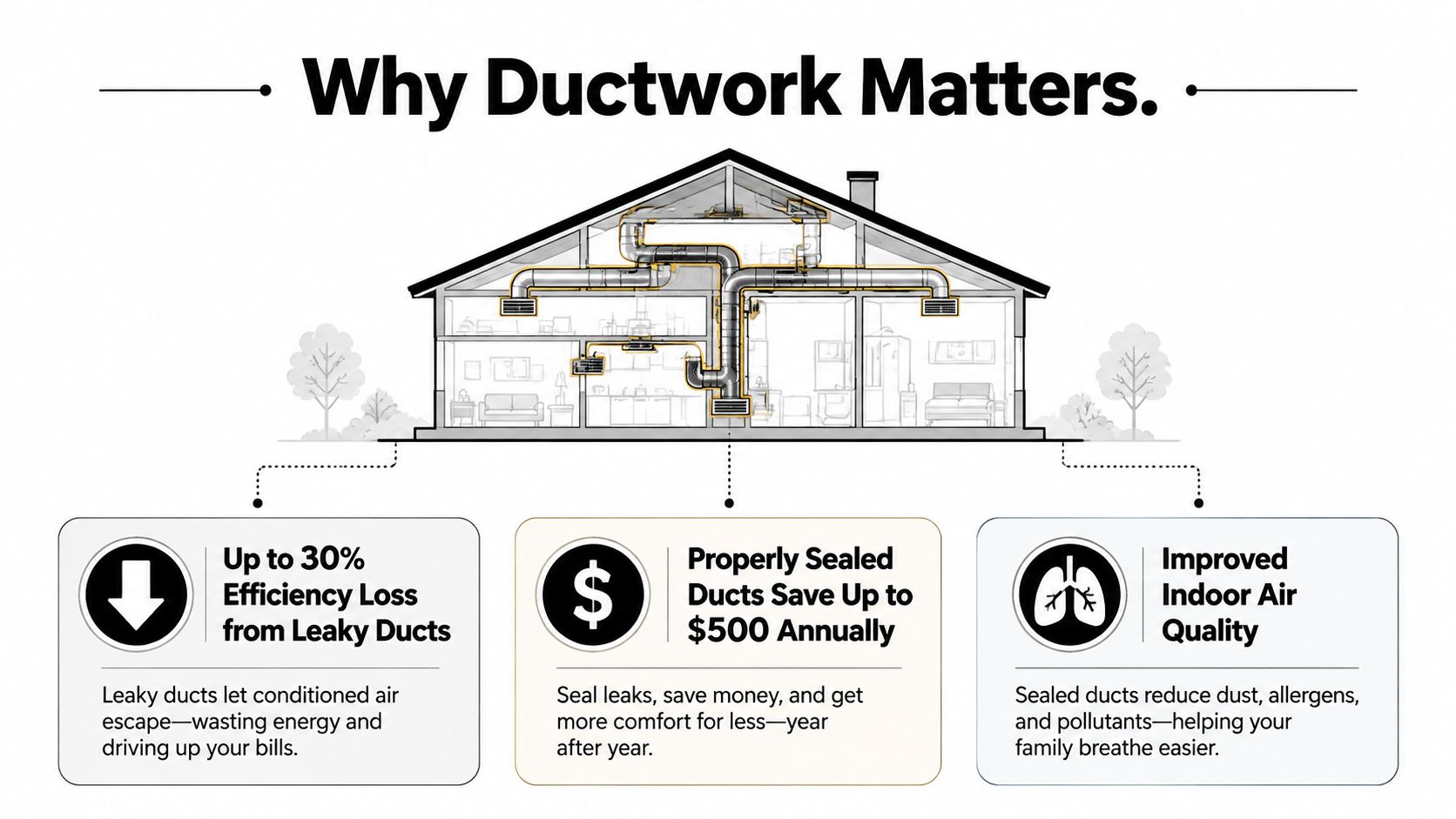
The biggest mistake I see is treating ductwork like a hidden accessory. It is the delivery system. If the ducts leak, the equipment works harder, rooms stay uneven, and the utility bill rises even when the AC unit itself is in decent shape.
Ducts control how much comfort actually reaches the room
A system can be properly charged, properly sized, and still disappoint the homeowner if the duct network is bleeding air. That is why duct repair often delivers a better return than people expect, especially in homes where the equipment is fine but the air path is not. In practical terms, the ducts are the delivery system, and a bad delivery system makes good equipment look bad.
Practical rule: If rooms feel different from each other, start by looking at airflow and leakage before you assume the thermostat or the equipment is the problem.
The U.S. Department of Energy has long treated duct losses as a major efficiency issue, not a minor comfort complaint, because the waste shows up in both temperature control and operating cost (DOE guidance). That is the mindset homeowners need. Duct evaluation belongs in the same conversation as AC repair, AC installation, and annual maintenance, because a good system cannot overcome bad distribution.
The real cost of ignoring ductwork
Ignoring ducts usually means paying twice. First, you pay in energy waste and comfort complaints. Then you pay again when the equipment is blamed for problems the duct system caused all along.
That is why serious contractors do not just look at the box in the closet or the outdoor unit. They inspect the air path, the sealing, and whether the duct design fits the home's actual layout. If the ducts are sound, you repair. If they are failing systemwide, you replace. Simple as that.
Signs Your Air Ducts Need Attention
What you can spot without tools
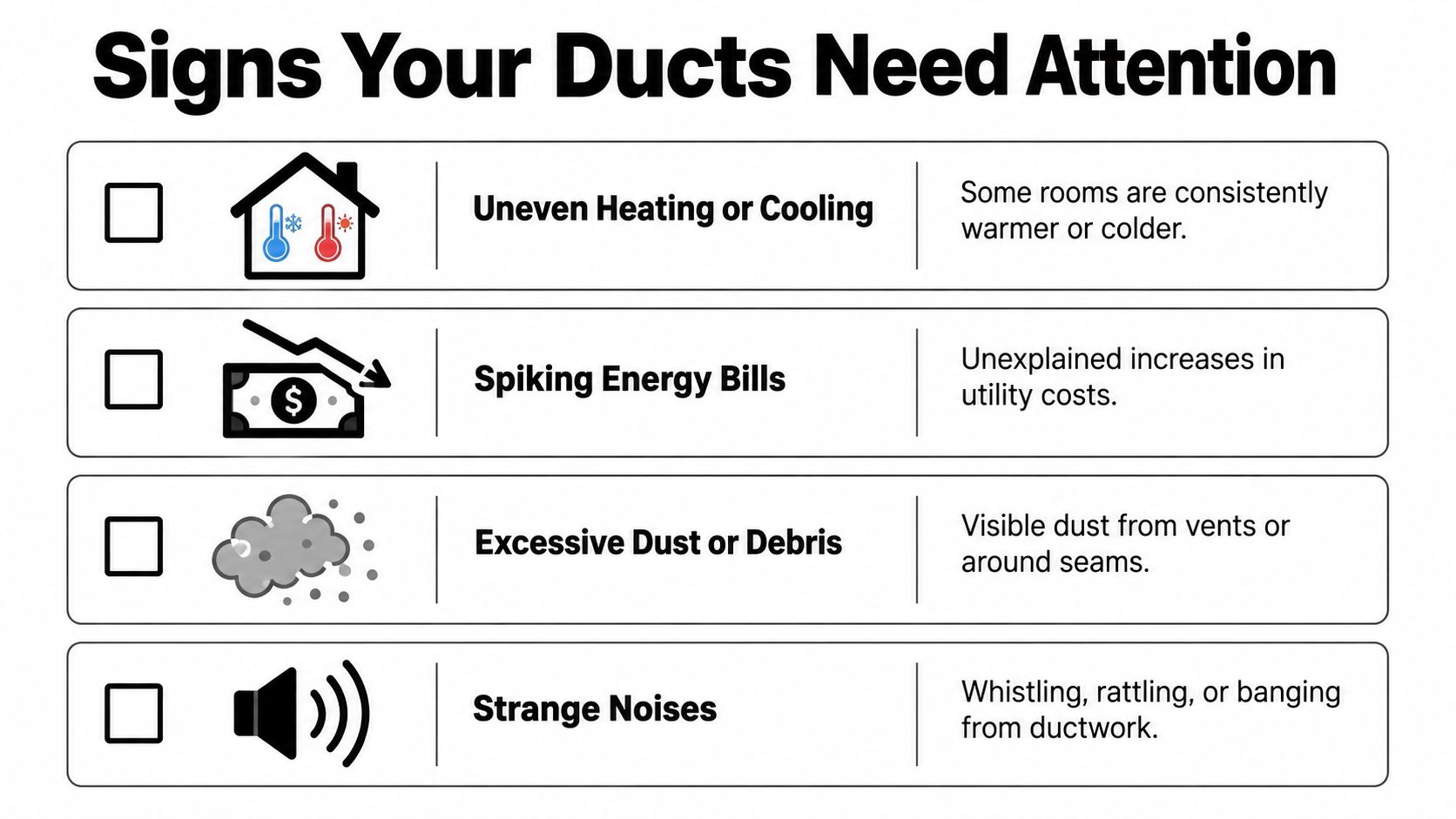
Uneven room temperatures are the first clue I trust. If one bedroom is always hot, a back hall is always cold, or the airflow at a register feels weak, the duct system is not moving air the way it should. Dust around seams, rattling, whistling, and disconnected boots are repair-level issues when they're isolated and the rest of the duct system still makes sense.
If the ductwork is physically accessible, look for torn insulation, crushed flex runs, loose tape, or open joints. Those are the kinds of problems a good sealing and repair job can usually solve without a full tear-out. Old-looking ducts are not the same thing as failed ducts. Age alone does not decide the job. Testing does.
What pushes the job toward replacement
Replacement becomes the stronger option when leakage is widespread, airflow cannot be balanced, or the layout itself is flawed. In ENERGY STAR-linked guidance, total duct leakage above 15% of system airflow is used as a replacement trigger, and measured register airflow is expected to stay within about ±10% of design airflow (replacement guidance). That gives homeowners a clear benchmark instead of a guess.
If a contractor won't measure leakage or check airflow at the registers, you're buying opinion, not diagnosis.
The hidden cost of ignoring ductwork shows up in places homeowners feel every day. Collapsed branches, disconnected trunks, contaminated duct interiors, or a system that never delivered balanced airflow to begin with usually point past simple repair. When the ducts fail as a system, patching one leak at a time wastes money. That is when I tell homeowners to stop guessing and make the case for a proper replacement plan.
Air Duct Repair vs Replacement Compared
Repair and replacement solve different problems. Repair is a surgical fix. Replacement is a reset. The right answer depends on scope, not emotion.
Side-by-side trade-offs
| Factor | Repair | Replacement |
|---|---|---|
| Upfront cost | Lower, especially for localized work | Higher because labor and materials are larger |
| Disruption | Less invasive, usually faster | More disruption, more demolition risk |
| Best for | Small leaks, loose connections, isolated damage | Systemic leakage, collapse, chronic underperformance |
| Longevity | Good when the rest of the system is sound | Better when the duct layout or material is no longer workable |
| Performance outcome | Strong when testing shows the problem is limited | Stronger when airflow and leakage problems are widespread |
Rigid ducts are often more durable than flex ducts, but they also have more seams to seal and take more labor to insulate, so targeted repair can be the better value when damage is localized (PNNL guidance). That's the part most sales pitches skip. Replacement sounds cleaner, but it isn't automatically smarter.
What each path really means on site
Repair usually means finding the leak, sealing the joint, correcting disconnected sections, and checking insulation. A good repair job should end with verification, not guesswork.
Replacement means removal of the old ducts, new routing or reconfiguration, connection sealing, insulation, balancing, and commissioning. If a contractor skips the balancing step, the job isn't finished. It's just installed.
One of the best options in the Arizona market is a contractor who evaluates ductwork as part of the HVAC system instead of as a separate add-on. Cobre Valley Air LLC does that kind of duct design, repair, and inspection work, along with airflow testing and pressure diagnostics, which is exactly the approach homeowners should demand.
Understanding the Costs of Each Option
Minor duct repairs usually land around $200 to $700, while full duct replacement commonly falls around $1,400 to $5,600, with a national average near $3,500 and per-linear-foot replacement costs of about $25 to $55 (cost guide). Those numbers are the reason repair stays attractive when the problem is isolated. They also show why replacement becomes a major decision once the duct system has moved past simple patchwork.
What pushes a quote up or down
Access drives a lot of the price. The amount of ductwork, the material type, the number of connections, and whether the contractor has to work through tight attic or crawl space routes all affect the bill. Poor access raises labor fast. A simple layout with limited damage usually keeps repair in a more manageable range.
Cost rule: If the quote keeps climbing because the contractor is chasing multiple failures in different areas, you're already drifting toward replacement territory.
The cleanest way to judge the cutoff is by comparing repair cost to replacement cost and by looking at what the system is doing. Once repairs start stacking up across several sections, the numbers stop favoring piecemeal fixes. That is the point where homeowners should ask whether they are paying to stabilize a bad layout instead of solving the problem.
For homeowners who want a local frame of reference, This local ductwork repair cost guide is useful before you approve any work. It helps you compare estimates line by line instead of reacting to a single bottom-line number.
How to read a contractor's estimate
A serious quote should break out diagnosis, materials, labor, sealing, insulation, and testing. If those parts are rolled into one vague price, you cannot tell whether you are paying for real correction or a quick cover-up. Ask for the scope in writing. That is how you separate a fair repair from an inflated one.
I would rather see a homeowner compare two detailed quotes than three vague ones. A detailed estimate tells you what is being fixed, what is being replaced, and what kind of verification comes after the work. That level of clarity matters more than a low starting number.
What to Expect During Repair and Replacement
How a proper repair should unfold
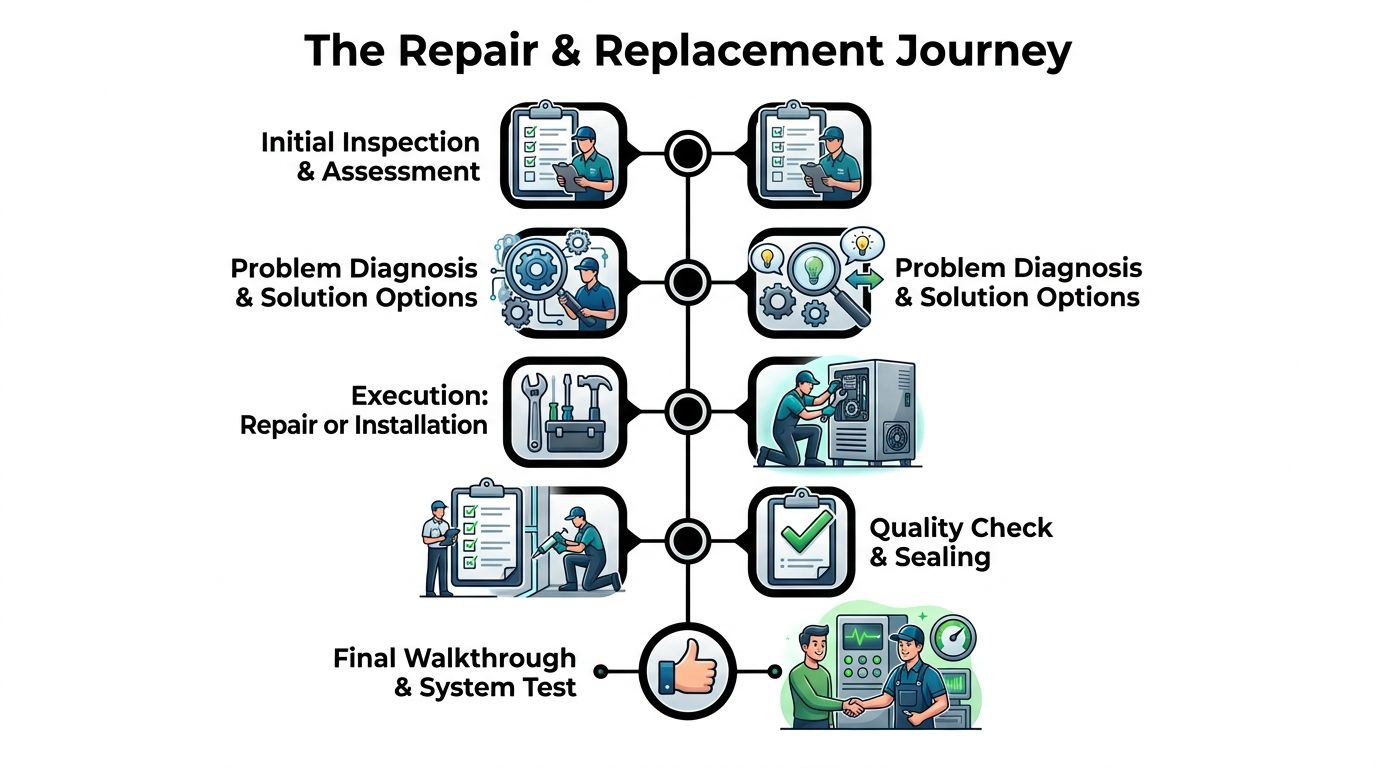
First comes inspection, and not just eyeballing the attic. A technician should check registers, ducts, supports, insulation, and pressure behavior to find the actual problem spots. Then the repair work should focus on sealing leaks, fixing disconnections, and restoring insulation where it has failed.
After that, the system needs to be tested again. If airflow hasn't improved or the leak symptoms are still there, the repair wasn't complete. That's not a debate. It's a missed step.
How replacement should be handled
Replacement is more involved. Old materials come out, new duct sections are installed or rerouted, connections are sealed, and airflow gets balanced so the new layout delivers air where it should. That balancing step matters as much as the duct material itself.
Field measurements back that up. An ACEEE study reported average delivery efficiency increasing from 64% to 76%, alongside an average 18% decrease in HVAC energy use after duct retrofits were implemented (ACEEE field study). That's why I'm strict about post-work testing. If you can't measure improvement, you can't claim the work paid off.
How to seal ductwork properly is a useful reference point for homeowners who want to understand the difference between a real sealing job and a cosmetic one. The technician should leave the system better balanced than it was before, not just prettier.
Code Compliance and Indoor Air Quality Implications
Ductwork affects more than temperature. It affects whether the HVAC system can move air cleanly, whether contaminants get distributed, and whether the finished job lines up with code-minded workmanship. In Arizona homes, where cooling runs hard for long stretches, sloppy ducts make humidity control and filtration work harder than they should.
When duct cleaning is actually justified
The U.S. EPA says duct cleaning isn't routine maintenance. It recommends considering cleaning when there is substantial visible mold growth inside hard-surface ducts, when ducts are infested with vermin or insects, or when excessive dust and debris are being released into the home (EPA guidance). That's the standard I respect, because it keeps homeowners from buying unnecessary cleaning.
Dirty ducts aren't the first thing I chase. I chase the source of the contamination, then decide whether cleaning is even worth it.
If the system components are dirty, those components should be inspected and cleaned first, or they can re-contaminate the ducts. That order matters. Cleaning the duct run while leaving the source untouched is a wasted service call.
Indoor air quality and HVAC are tied together more tightly than many might realize, especially when duct design is poor or the system has been modified over time. Good ductwork supports filtration and distribution. Bad ductwork undermines both.
What homeowners should ask about
Ask whether the duct system is sealed, insulated, and balanced to the equipment. Ask whether contamination is visible or assumed. Ask whether the cleaning recommendation is based on symptoms, or on a real source problem that needs to be fixed first.
When to Repair and When to Replace
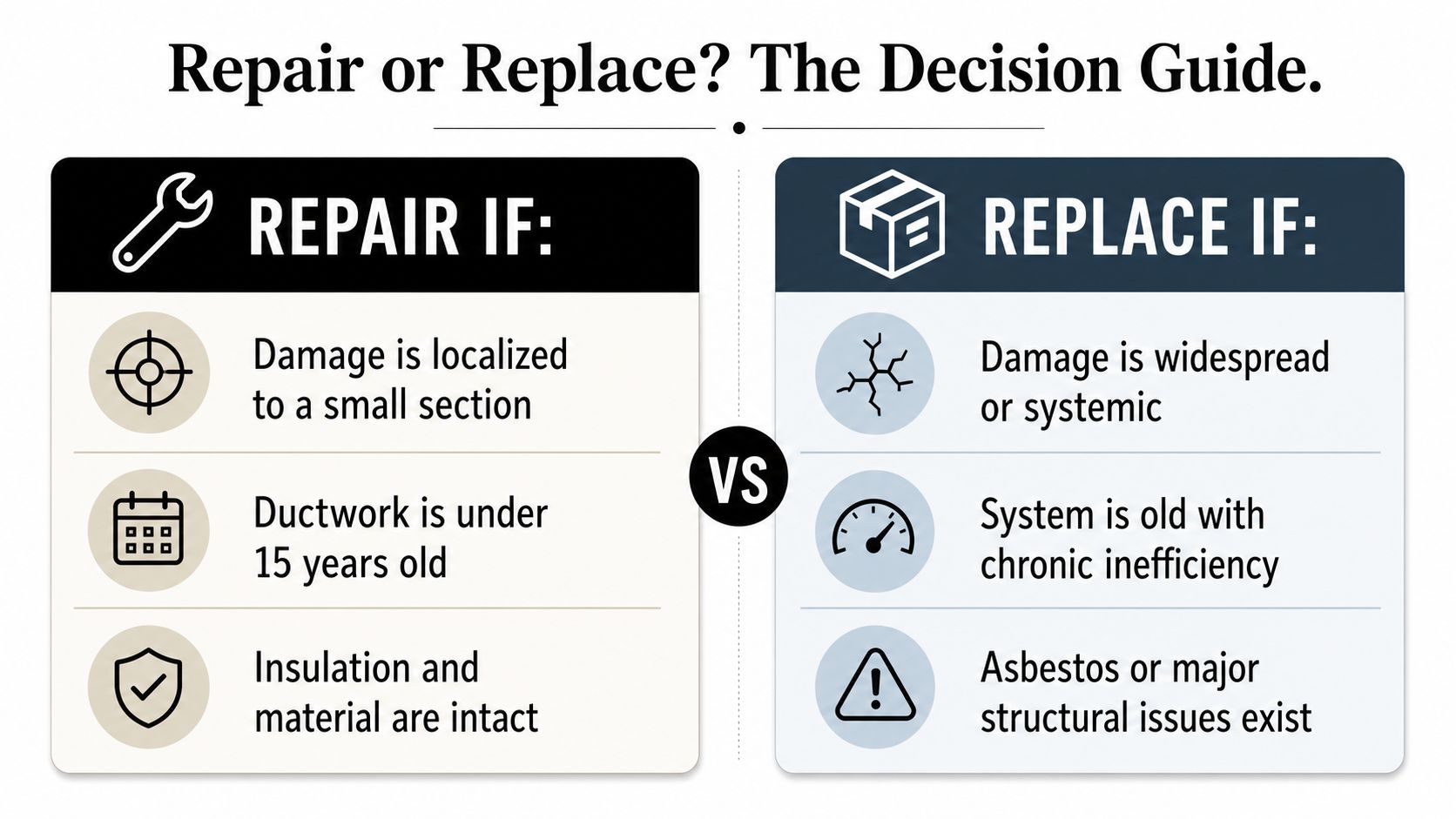
A duct system that is only leaking in one place usually belongs in the repair category. A loose joint, a small tear, a disconnected branch, or a section with damaged insulation can often be fixed without tearing out the whole run. If airflow testing still looks reasonable and the room balance can be restored, a targeted repair is the smart move.
Use the numbers, not the age
Age is a weak reason to replace ducts. What matters is whether the system is failing as a whole. Chronic leakage, poor layout, collapsed sections, widespread deterioration, or contamination that cannot be isolated point toward replacement. In guidance tied to ENERGY STAR, total duct leakage above 15% of system airflow leans toward replacement, and repair also stops making sense when the cost climbs past 30% of full replacement cost (replacement threshold guidance).
That is the framework I use in the field. Age does not decide it. Looks do not decide it. The previous owner's opinion does not decide it.
A practical decision rule
- Repair if the damage is limited, the materials are still sound, and sealing can bring airflow back where it belongs.
- Replace if the system leaks across multiple runs, the layout is weak, or the contractor cannot balance the registers without chasing the same problems room by room.
- Replace if the repair estimate keeps creeping up until it is basically a partial rebuild.
- Repair if the problem can be fixed, the improvement can be verified, and you avoid unnecessary demolition.
When duct cleaning is justified
Duct cleaning is justified when the problem is contamination, not as a default fix for weak ductwork. The U.S. EPA says cleaning should be considered when there is substantial visible mold growth inside hard-surface ducts, when ducts are infested with vermin or insects, or when excessive dust and debris are being released into the home (EPA guidance). That keeps homeowners from paying for a service that does not solve the underlying problem.
If the system components are dirty, those components need attention first. Otherwise the contamination comes back through the same duct run. Cleaning the ducts without fixing the source is money wasted.
Indoor air quality and HVAC are tied together more tightly than many homeowners realize, especially when duct design is poor or the system has been modified over time. Good ductwork supports filtration and distribution. Bad ductwork works against both.
What homeowners should ask about
Ask whether the duct system is sealed, insulated, and balanced to the equipment. Ask whether contamination is visible or only assumed. Ask whether the recommendation is based on symptoms, or on a real source problem that needs to be corrected first.
Choosing a Trusted HVAC Contractor in Arizona
In Globe, Miami, Superior, and the surrounding communities, you want a contractor who measures first and sells later. A good estimator checks airflow, asks about room comfort, looks at the duct path, and explains whether the fix is a seal, a reroute, or a full replacement. If they jump straight to a new system without testing the ducts, keep shopping.
What to ask before you approve work
- Ask for diagnostics: You want leakage, airflow, and pressure checks, not a glance at the attic and a guess.
- Ask how they'll verify the result: A contractor should explain how they'll confirm the repair or replacement improved delivery.
- Ask what the quote includes: Sealing, insulation, balancing, cleanup, and commissioning should be spelled out.
- Ask whether the solution fits the equipment: Duct design has to match the furnace, heat pump, or AC installation it serves.
Red flags that save you money by walking away
- Pushy replacement advice without testing means you're being sold, not evaluated.
- One-line quotes usually hide scope gaps.
- Cleanup promises without source control often lead to the same problem coming back.
- No discussion of airflow balance means the contractor is focused on installation, not performance.
Arizona homes also need local judgment. Attic heat, tight crawl spaces, remodels, and old patchwork duct runs change the economics fast. That's where a local contractor with real diagnostic habits beats a generic installer every time.
Cobre Valley Air LLC handles duct design, repair, inspection, and airflow diagnostics for homes in Globe, Miami, Superior, and nearby Arizona communities. If you need a straight answer on air duct repair and replacement, visit Cobre Valley Air LLC and ask for a diagnostic-focused estimate that puts comfort, efficiency, and long-term performance first.