


HVAC ductwork repair cost usually lands between $200 and $2,100, with an average around $660. That price swings hard because access and scope, not duct length alone, decide where your job falls in the band.
You're usually not staring at a clean, simple repair when you ask the question. You're looking at a back bedroom that won't cool, a register that barely moves air, or a utility bill that keeps climbing while the rest of the house feels fine. In Arizona homes, that often means someone is about to crawl into an attic, disappear into a crawl space, or start opening up duct runs to find out whether this is a patch job or a bigger rebuild.
Ducts are the circulatory system of the HVAC setup. When they're sound, you don't think about them. When they leak, sag, disconnect, or sweat, the whole system starts acting unevenly, and the bill for the fix can feel random until you know what the tech is looking at. If you're already dealing with weak airflow, start with a quick read on why no air may be coming out of your vents in the house.
The Moment You Notice Something Is Off With Your Ducts
A homeowner in a hot Arizona house usually notices ducts the same way, by living with a room that never feels right. The back bedroom stays hot, the front room overcools, and the supply register starts making a whistle that wasn't there last season. By the time a technician gets there, the conversation is already moving from comfort to damage.
The warning signs that matter
Weak airflow at one or more registers is the obvious one, but it's not the only clue. Dust streaks around vents, uneven temperatures between rooms, and rising utility costs all point to air leaving the system before it gets where it should. Sometimes the leak is small and accessible. Sometimes it's a disconnected run buried in the attic or a crushed section in a crawl space.
Practical rule: if one room is acting wrong and the rest of the house still seems balanced, start with inspection and sealing. If multiple rooms are off, the duct issue is probably bigger than a single patch.
That's why pricing feels messy from the outside. A “duct problem” can mean a fist-sized hole, a joint that needs sealing, a sagging flexible run, or a system-wide airflow failure that needs redesign. Homeowners usually call for “repair,” but the tech may find a replacement candidate instead. If you want the cost of that first visit to make more sense, a ductwork inspection cost guide is the right place to compare the diagnostic side of the bill with the repair side.
The big takeaway is simple. Ducts fail in different ways, and the final price follows the failure. A small, reachable leak is one thing. A house full of damaged runs, access problems, and restoration work is something else entirely.
What HVAC Ductwork Repair Actually Costs in 2026
The cleanest 2026 benchmark puts ductwork repair at $200 to $2,100, with an average of about $660 per project, while another independent estimate puts the average lower at $237 to $955. Full duct replacement sits much higher at $1,400 to $5,600 for many homes, which is why the repair versus replace decision matters so much from the start. If the system can be salvaged, repair usually saves real money. If it can't, patching just delays the larger bill.
A homeowner usually feels the price gap in the attic or crawl space, not on a spreadsheet. One straight leak with easy access stays on the cheap side. Multiple damaged sections, old material that has to come out, or a cramped attic in Arizona heat pushes labor up fast because every step takes longer and costs more to do cleanly.
| Job Type | Typical Range (2026) | Average |
|---|---|---|
| Duct repair | $200 to $2,100 | About $660 |
| Independent repair average | $237 to $955 | Not stated |
| Full duct replacement | $1,400 to $5,600 | Not stated |
The gap between repair and replacement is the whole decision. Stop asking only what the ductwork costs and start asking how much good material is left, how much of the system is damaged, and whether the fix will hold for more than a short season. A simple seal is one thing. Section swaps, access cuts, sealing, and cleanup are another.
For a clearer read on the first visit, a ductwork inspection cost breakdown helps separate the diagnostic charge from the actual repair scope. That matters because the inspection shows whether you are paying for a seal, a section replacement, or a system that is already close to rebuild territory.
Replacement numbers are a ceiling, not a floor
Consumer guides also place full-home replacement in wider bands, with some estimating $1,250 to $5,600+ and others showing $3,000 to $7,500+ depending on access, home size, and scope. In plain English, the more the ducts are buried, damaged, or undersized, the closer you get to replacement territory. Repair only makes sense when enough of the existing system is still worth saving.
Common Duct Repairs and What Each One Really Involves
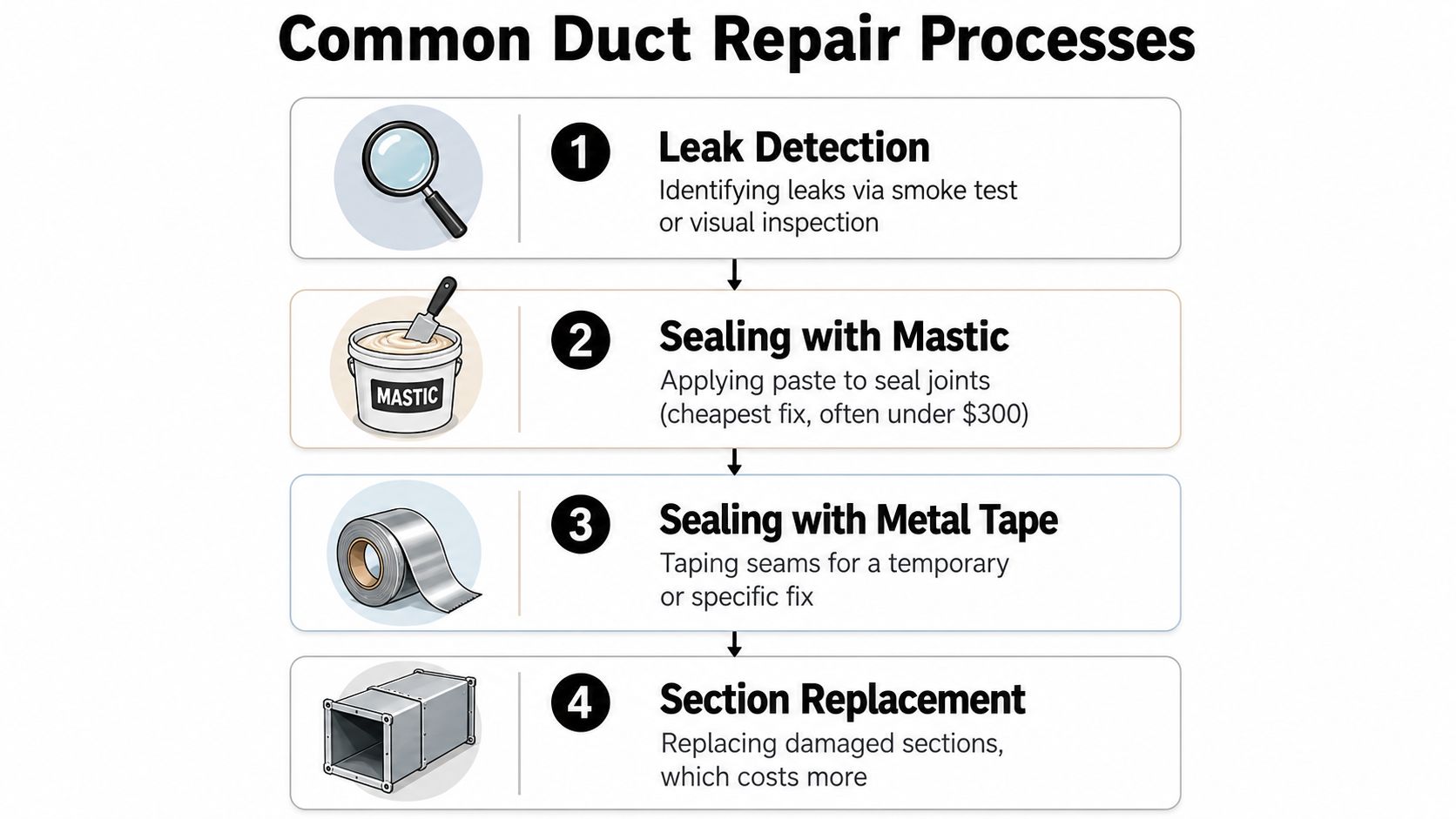
The cheapest fix is almost always sealing an accessible leak. A technician finds the gap with a smoke test, visual inspection, or airflow check, then applies mastic or metal tape to close it up. Minor accessible sealing can stay under $300, which is why I'm skeptical when people jump straight to “replace everything” without proving the system is failing.
Sealing, patching, and section replacement are not the same job
Patching a hole or reconnecting a loose joint is still a repair, but it's more labor than a quick seal. Once the damaged area stretches across multiple joints or a run has collapsed, the job shifts into section replacement. That's where cost starts climbing, especially in crawl spaces where every movement is slower and dirtier.
New ductwork is commonly priced at $10 to $25 per linear foot, while rigid sheet-metal replacement can run $25 to $55 per linear foot. Crawl-space repair is often roughly $450 to $2,400 because access drives labor time, so the same physical problem costs more when the tech has to work on hands and knees in cramped conditions. The material choice matters too, because flexible duct is cheaper to replace than metal, but it also isn't the right answer for every run.
A repair quote should tell you what failed, what was replaced, and what got sealed. If it doesn't, you're not getting a useful quote.
Insulation and full replacement
Adding or upgrading insulation around ducts is a separate line item when the problem is sweating, heat gain, or poor thermal performance. It won't fix a torn run by itself, but it can stop a good duct from losing efficiency in a hot attic. Full duct replacement is the last stop when the system is too deteriorated, too leaky, or too poorly laid out to save economically.
If you're trying to understand the sealing side of the job, how to seal ductwork is the right practical reference. It's a cleaner way to judge whether you need a real repair or just a better seal on an accessible problem.
The Hidden Factors That Push Your Bill Up or Down
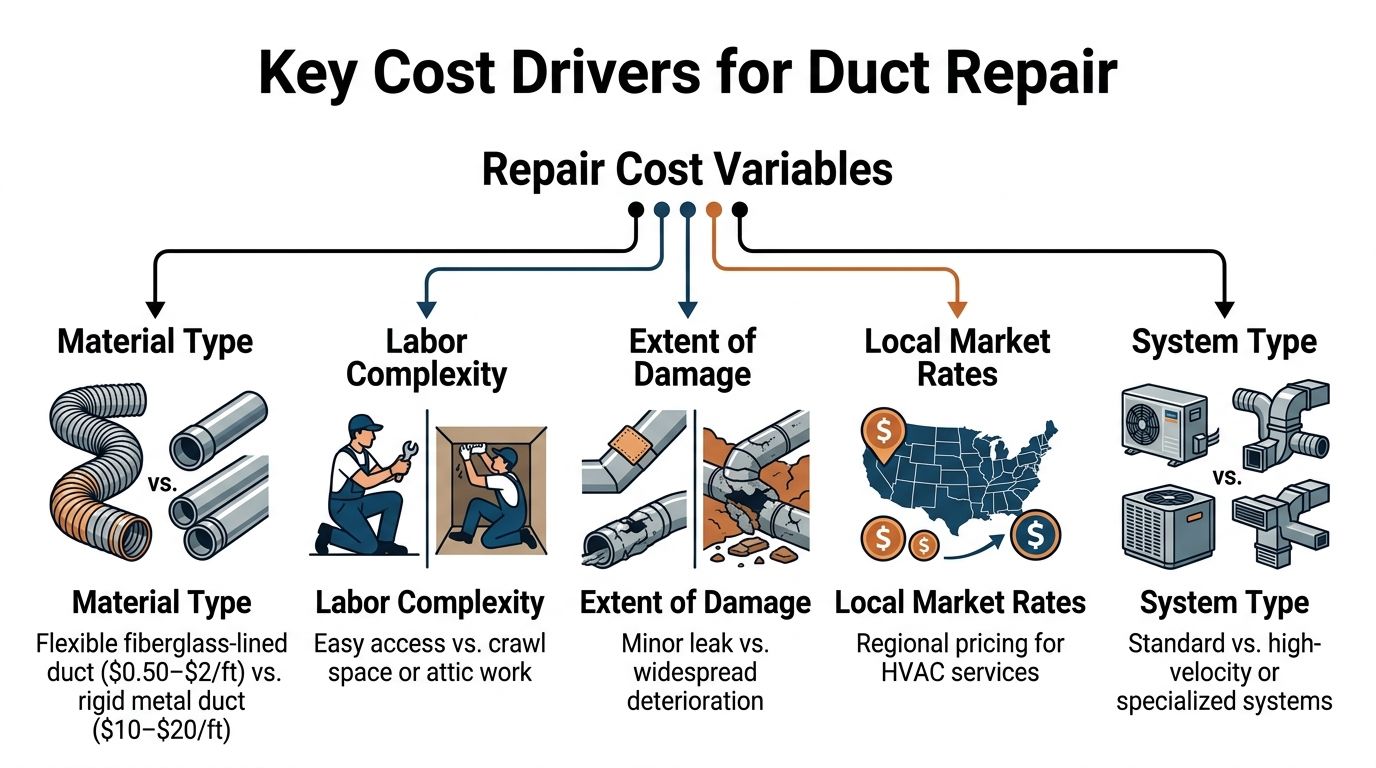
The bill doesn't move because the ducts exist. It moves because of what the installer has to fight through to reach them. Material type, labor complexity, extent of damage, local market rates, and system type all push the number up or down, and the worst surprises usually come from access.
Material and access are the biggest levers
Flexible duct replacement is estimated at $0.50 to $2 per foot, while metal duct runs around $3 to $5 per foot in crawl-space work. Labor in that same environment commonly runs $40 to $80 per hour, and that matters because a simple-looking repair can turn into a long job once the tech has to snake through tight framing, insulation, or debris. Crawl-space duct repair averages $450 to $2,400, which tells you how quickly access changes the economics.
Older systems add another layer. If the duct layout is outdated, undersized, or patched too many times, the tech may spend more time redesigning airflow than repairing one bad spot. That's where a quote starts to look like a partial rebuild instead of a repair.
The quiet costs people forget
Drywall repair after access cuts can add cleanup work. Mold remediation becomes relevant if ducts have been sweating or sitting in damp conditions. Disposal of old material also shows up on larger jobs, especially when damaged sections have to come out before new ones go in. In older Arizona homes, contractors may also have to think about testing around insulation or building materials before they start opening walls or ceilings.
The point is not that every job carries all of these costs. The point is that your quote should explain which ones apply. If it doesn't, you're the one absorbing the uncertainty.
Repair vs Replacement and the DIY Question
The smartest decision rule is blunt. If the repair is starting to approach half the cost of replacement, I'd stop patching and look hard at replacement. If the system has multiple failures in different sections, the odds are good that you're paying for repeated labor instead of a real fix.
Repair wins when the damage is isolated
A single accessible leak, a disconnected flex run, or one damaged joint is repair territory. In those cases, a tech can seal, reconnect, or replace one section without ripping up the whole system. That's the kind of job where targeted work makes sense, especially if the rest of the ducts are in decent shape.
Replacement wins when the system is tired
Once the ducts are old, mismatched, poorly laid out, or full of recurring leaks, replacement starts making more sense than another patch. Full-home duct replacement in 2026 commonly lands between $1,400 and $5,600, with some detailed estimates running $3,000 to $7,500+ depending on home size, accessibility, and scope. If the repair estimate keeps creeping toward that territory, you're probably paying twice.
DIY has a narrow lane
Sealing an accessible joint or adding insulation around easy-to-reach duct runs can be a reasonable DIY job. Anything involving a hot attic, a tight crawl space, sheet-metal fabrication, or code-compliant duct design should go to a professional. You don't want to learn duct layout the hard way while standing on joists with a flashlight in your teeth.
Leaky ducts can lose 20% to 30% of conditioned air, so the value of a repair depends on whether it stops meaningful leakage. If the leak is small and isolated, a targeted fix may be the right move. If the system is bleeding air in multiple places, patching one hole is just cosmetic work.
For homeowners who want the practical side of sealing done right, the process described in how to seal ductwork is a better guide than guessing in the attic.
Three Real Cost Scenarios Arizona Homeowners Actually Face
A homeowner in Globe hears whistling from one room and feels weak airflow at one register. The tech finds a disconnected flexible duct in the attic, reconnects it, and seals the joint. That kind of job can land around $250 to $450 because the damage is isolated and the repair doesn't require a rebuild.
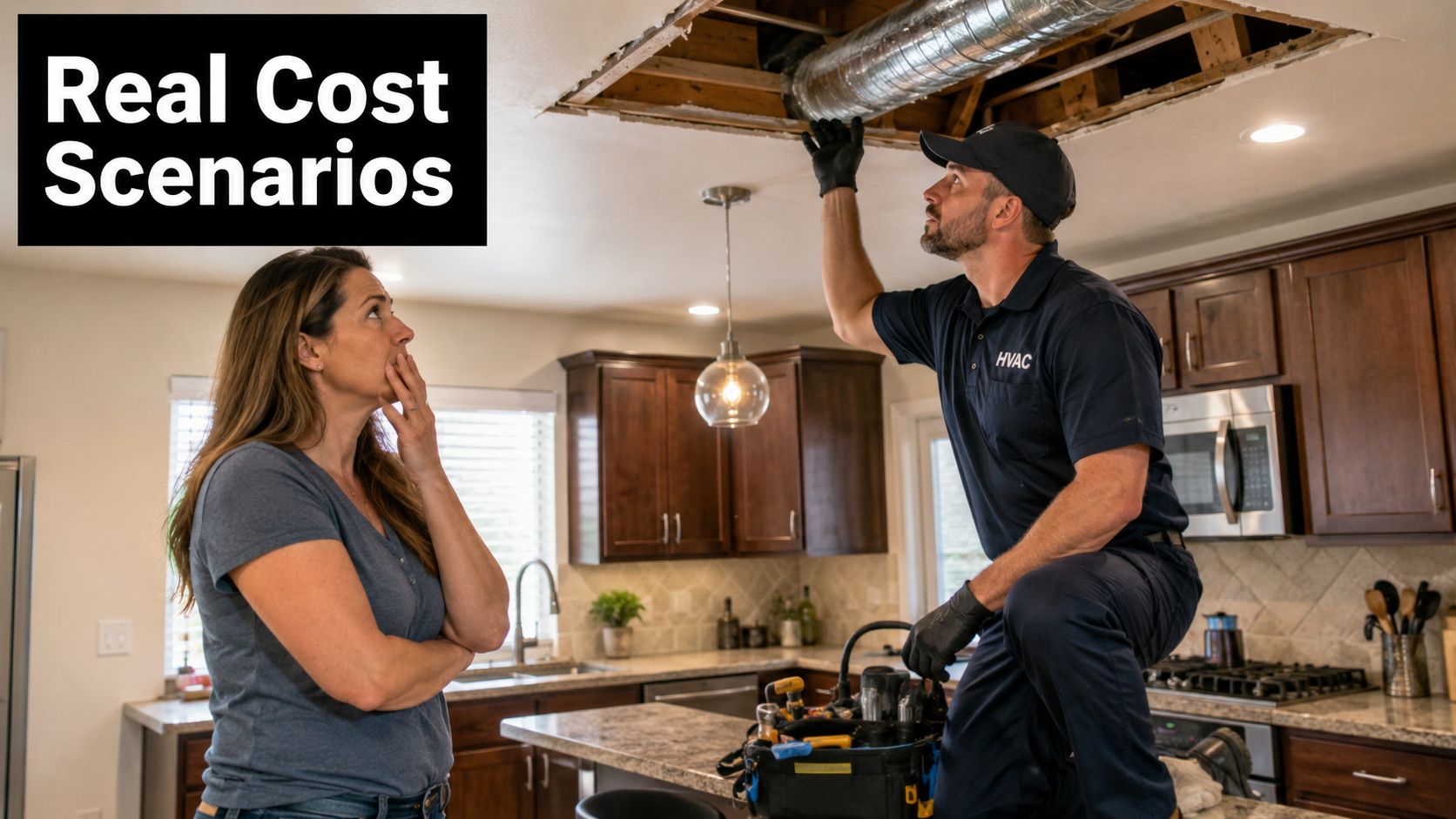
A crawl-space section swap in Miami
A 1990s home in Miami has sagging, mold-stained ducts under the floor. The technician removes two damaged runs, installs new rigid metal sections, and reseals the connections. That kind of partial replacement often falls around $1,800 to $2,800 because crawl-space access slows everything down and the work includes both removal and new materials.
A near-full replacement in Superior
A Superior homeowner has decades-old ducts, leakage in multiple branches, and rooms that won't balance no matter how the system is adjusted. That's a replacement case, not a patch case. Full-home duct replacement commonly lands between $1,400 and $5,600, with some detailed jobs running $3,000 to $7,500+ depending on access and scope, so a project in the $4,000 to $6,500 zone fits a house that needs new design as much as new material.
If the same home keeps needing different duct repairs in different places, the system is telling you it's tired.
The pattern is a key lesson. Isolated damage stays in the lower hundreds. Crawl-space work pushes into the low thousands. A system that needs redesign, resealing, and major section replacement belongs in replacement territory.
Ways to Lower the Bill and When to Call Cobre Valley Air
Get multiple written quotes, and make sure they show whether you're being charged per foot or as a flat project. Ask for a duct leakage test before and after the repair, because a good-looking patch doesn't matter if the system still leaks air. If you're already planning other HVAC work, bundling the duct job with it can save labor repetition.
Cobre Valley Air LLC handles ductwork repair, inspection, duct design, HVAC installation, AC maintenance, heat pumps, furnaces, ductless mini splits, rooftop units, and commercial refrigeration support for Globe, Miami, Superior, and nearby Arizona communities. The company works with licensed technicians under ROC 339078, offers financing through Wisetack and OPTIMUS, and provides 24/7 emergency response when a system quits at the wrong time.
If your ducts are leaking, noisy, or plainly not moving air the way they should, Cobre Valley Air LLC can inspect the system, explain the repair-versus-replacement call, and build the fix around real airflow instead of guesswork. Visit Cobre Valley Air LLC to schedule the ductwork help your home needs.