



A commercial walk-in cooler usually lands around $7,000 to $25,000 installed. That spread is real, and it's why two units that look almost identical on paper can come back with wildly different quotes.
If you're pricing one for a restaurant, market, or commissary in Arizona heat, don't make the rookie mistake of comparing only the sticker price. The number includes the box, refrigeration package, installation labor, electrical work, site prep, and the electricity you'll keep paying for every month.
What a Walk-In Cooler Really Costs in 2026
A restaurant owner in Miami, AZ can call three suppliers and get three answers that look like they're talking about different buildings. One quote comes in near $6,000, another jumps past $15,000, and a third pushes well beyond that for what seems like the same cold box. That spread is not confusion, it is what happens when vendors bundle different equipment, different install scopes, and different code requirements into one number.
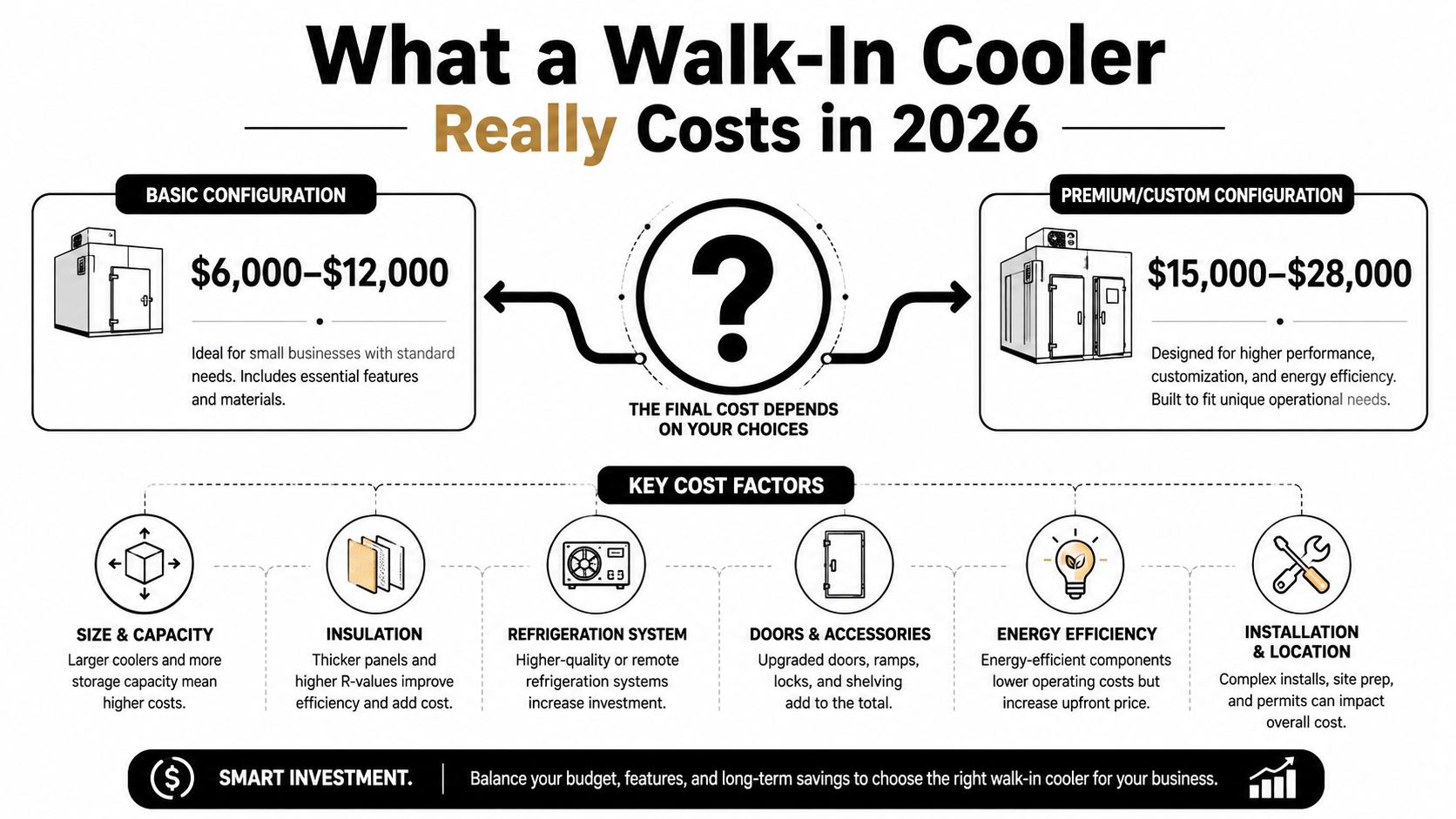
The right way to read walk in cooler cost is as a lifecycle budget, not a one-time purchase. You are paying for the structure, the refrigeration system, the installation, the power it will consume, the maintenance it will need, and the retrofit or replacement that eventually comes due. In hot places like Globe, Miami, and Superior, that long-term view matters even more because the cooler works harder against ambient heat and more frequent door openings.
A clean market benchmark puts installed pricing at roughly $7,000 to $25,000 for many commercial projects, with small-to-mid units around $4,000 to $12,000 and larger or custom systems reaching $12,000 to $40,000+ depending on the refrigeration package, insulation, and certification level. That spread is what you should expect when one job is a straightforward indoor cooler and another is a heavier, hotter, or more code-sensitive build.
Do not trust a quote just because it looks low. The missing pieces are usually the ones that get expensive later, especially in Arizona heat where a thin spec gets punished fast.
The simple box on the proposal hides the cost drivers. What matters is how hard the system has to work, how clean the installation is, and whether the quote reflects current code and efficiency expectations or yesterday's shortcuts.
Price Ranges by Size and Configuration
A cooler's footprint gives you the first filter, but it does not tell you what you are buying. A 10′×10′ cooler and a 12′×20′ cooler serve different operations, different storage patterns, and different installation demands. Square-foot pricing helps with planning, but only if you treat it as a budgeting tool, not a promise from the quote sheet.
Industry guidance puts installed pricing at about $100 to $150 per square foot for complete cooler projects Commercial HVAC load calculation guidance, which already reflects the insulated box, refrigeration package, and standard installation. On that basis, a 10′×10′ unit commonly lands around $10,000 to $20,000 installed, while a 12′×20′ unit can move into the high-$20,000s to $30,000+ when the spec grows and the site gets more complicated.
| Box Size | Typical Use | Installed Cost Range |
|---|---|---|
| 6′×6′ | Small cafés, low-volume storage, limited back-of-house space | Lower entry pricing, often the most compact commercial option |
| 8′×10′ | Full-service restaurants, small grocery, moderate inventory | Mid-range installed pricing |
| 8′×12′ | Heavier prep volume, more shelf space, tighter rotation needs | Mid-range to upper-mid pricing |
| 10′×10′ | Workhorse size for busy kitchens | Around $10,000 to $20,000 installed |
| 12′×20′ | Grocery, catering, commissary use | High-$20,000s to $30,000+ |
A proper load calculation should come before you chase a number. Commercial HVAC load calculation guidance matters because the wrong refrigeration load wastes money at install and keeps costing you in utility bills.
The point is plain. A low quote on an undersized cooler is not a bargain if you end up renting overflow storage, replacing equipment early, or forcing the compressor to work harder than it should.
The Line Items Hidden Inside Your Quote
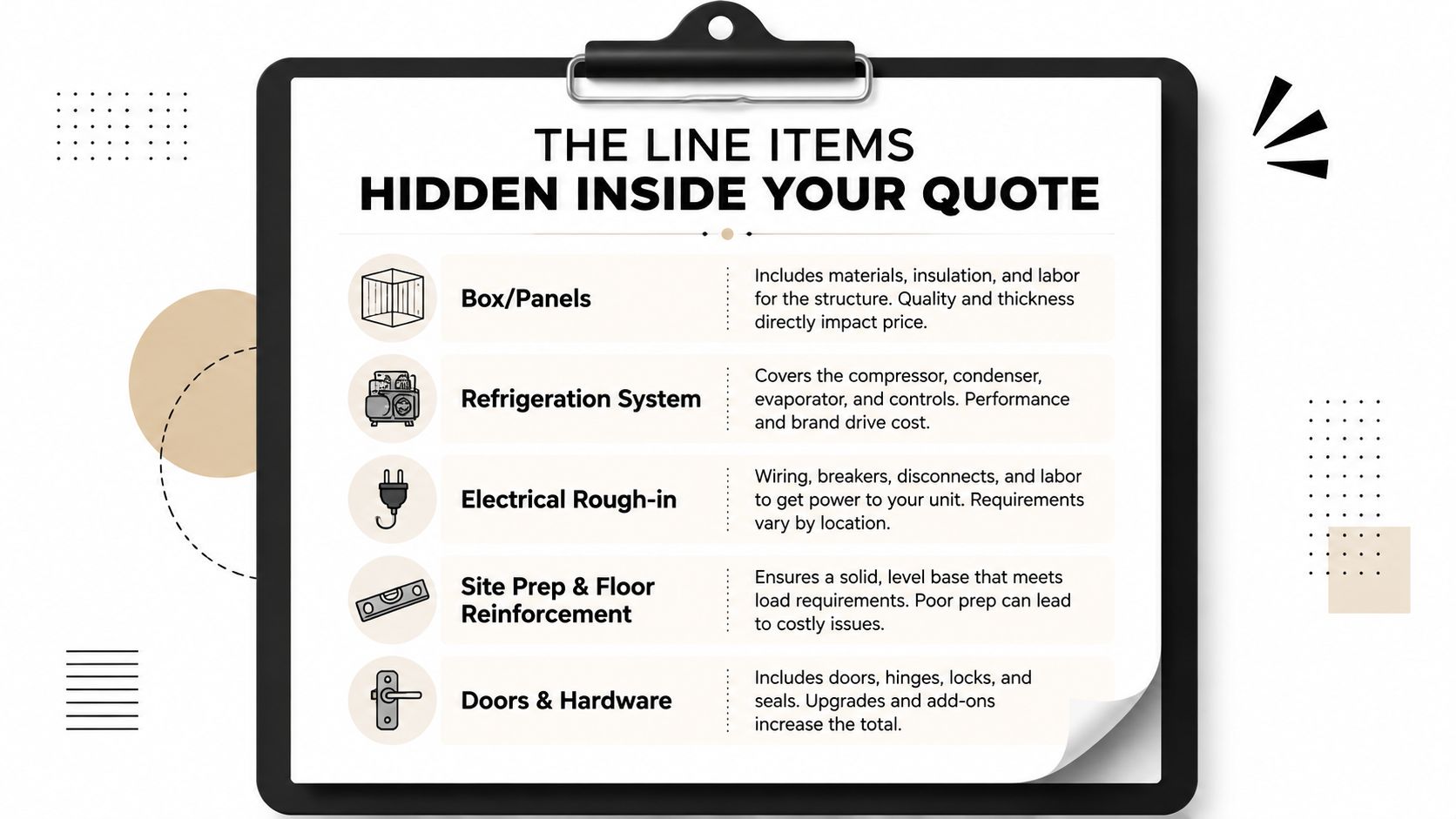
Most bad quotes fail because they compress ten decisions into one number. That number looks neat, but it doesn't tell you what got included, what got downgraded, or what the installer plans to bill later as a change order. If a contractor won't itemize the job, assume the quote is built to protect the seller, not the buyer.
What should be on the page
A serious quote should separate the box/panels, refrigeration system, electrical rough-in, site prep, floor reinforcement, doors and hardware, labor, and any permits or startup work. The $100 to $150 per square foot benchmark already covers the insulated box, refrigeration package, and standard installation, but larger or more customized systems move above that once electrical upgrades, floor reinforcement, and site-specific labor get added as outlined in the buying guide.
Here's how I read the line items on a job in Arizona:
- Box and panels: The shell. It should be clear whether the panels are standard or upgraded for higher insulation performance.
- Refrigeration package: A lot of price spread lives here. A quote that hides the brand or configuration is a quote that's asking for trouble.
- Electrical rough-in: If this line is vague, expect surprises. Older buildings in Globe or Miami often need more electrical work than the owner expected.
- Site prep and floor work: On slab, on grade, or in a tight back-of-house corner, labor can jump fast.
- Doors and hardware: Good sealing hardware isn't a luxury. It's part of the energy bill.
- Startup and commissioning: If this is missing, the installer may be handing you a cooler instead of a working system.
Red flag: “all-in installed price” sounds nice until the installer starts charging separately for the pieces that actually make the job complete.
Negotiable items usually include accessories, shelving, and some layout choices. Non-negotiables are the equipment that keeps the box cold, sealed, and code-compliant. If those are fuzzy, the quote isn't transparent enough to compare.
Prefab Modular Panels vs Custom-Built Walk-Ins
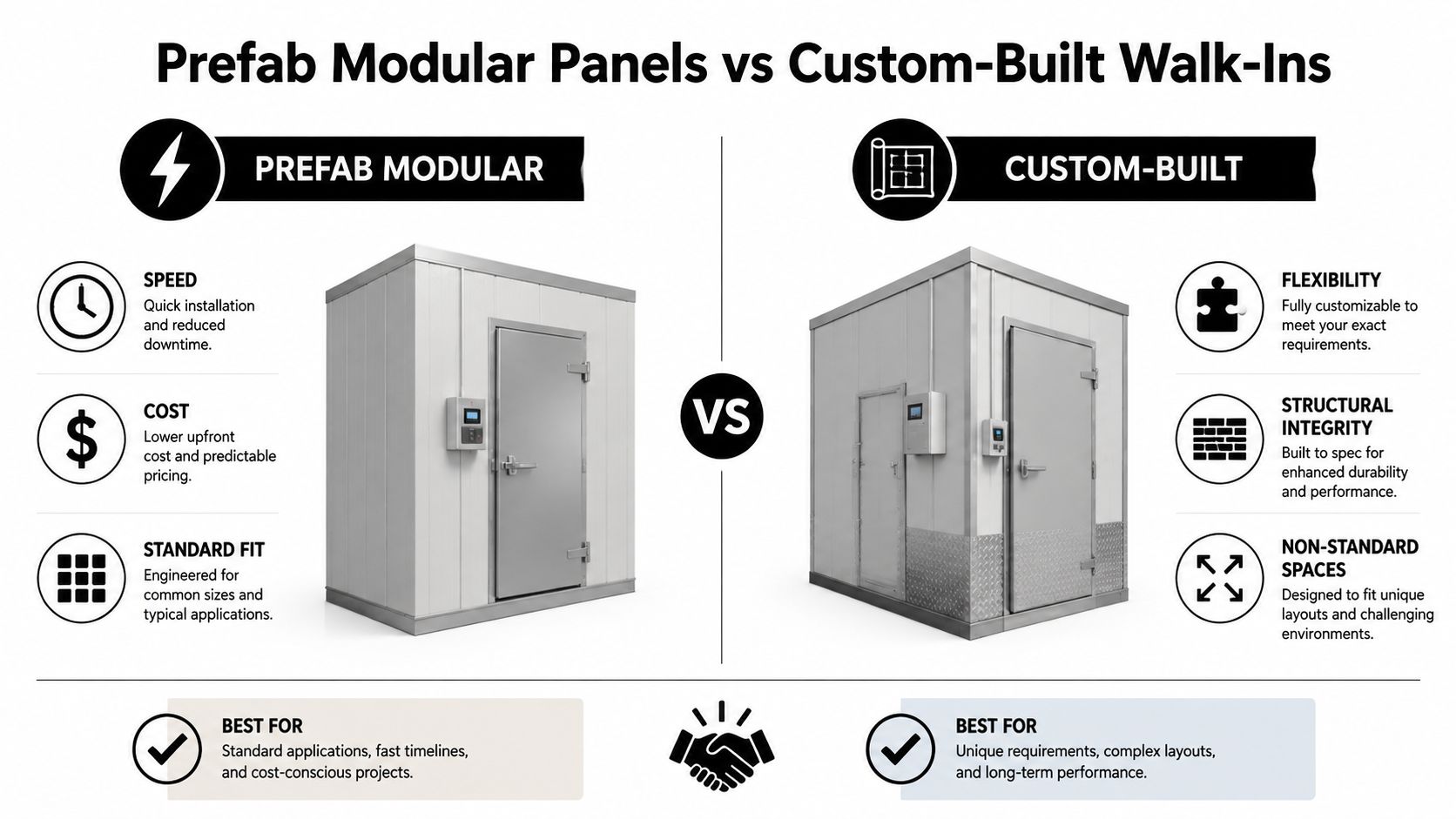
The cheapest route is not always the smartest route. Prefab modular panels fit standard footprints, go in faster, and usually cost less up front. Custom-built walk-ins cost more, take longer, and make sense when the building forces the issue, especially in older kitchens and odd-shaped spaces where standard dimensions do not fit cleanly.
A USDA small-farm guide puts a traditional walk-in cooler at $6,000 to $10,000, while a CoolBot-plus-window A/C approach starts at $888 in refrigeration-unit upfront cost and top-mount self-contained units run about $3,140 USDA small-farm guide. That spread tells you something important. Lower-cost builds exist, but they are not the same as a properly specified commercial walk-in built for heavy restaurant use.
Pick the path that fits the building
Prefab modular panels work well when the footprint is standard, the install is indoors, and the operation needs speed and predictable pricing. Custom-built walk-ins earn their keep when the room is odd, the ceiling height is awkward, the kitchen runs hot, or the owner needs outdoor weatherproofing and a layout that standard panels will not cover.
A cooler that fits the building beats a cheaper cooler that forces the building to adapt to it.
I have seen Arizona owners try to save money by forcing a standard box into a space that should have been custom from day one. They spend the savings on labor, workarounds, and future repairs. That is not a win. It is just moving the cost around.
What Drives the Price Up or Down
Two coolers can have the same outside dimensions and still price very differently. That's because the cost drivers live inside the spec, insulation, panel thickness, refrigeration load, and how much the building makes the installer work. If you're comparing quotes, compare the details, not just the footprint.
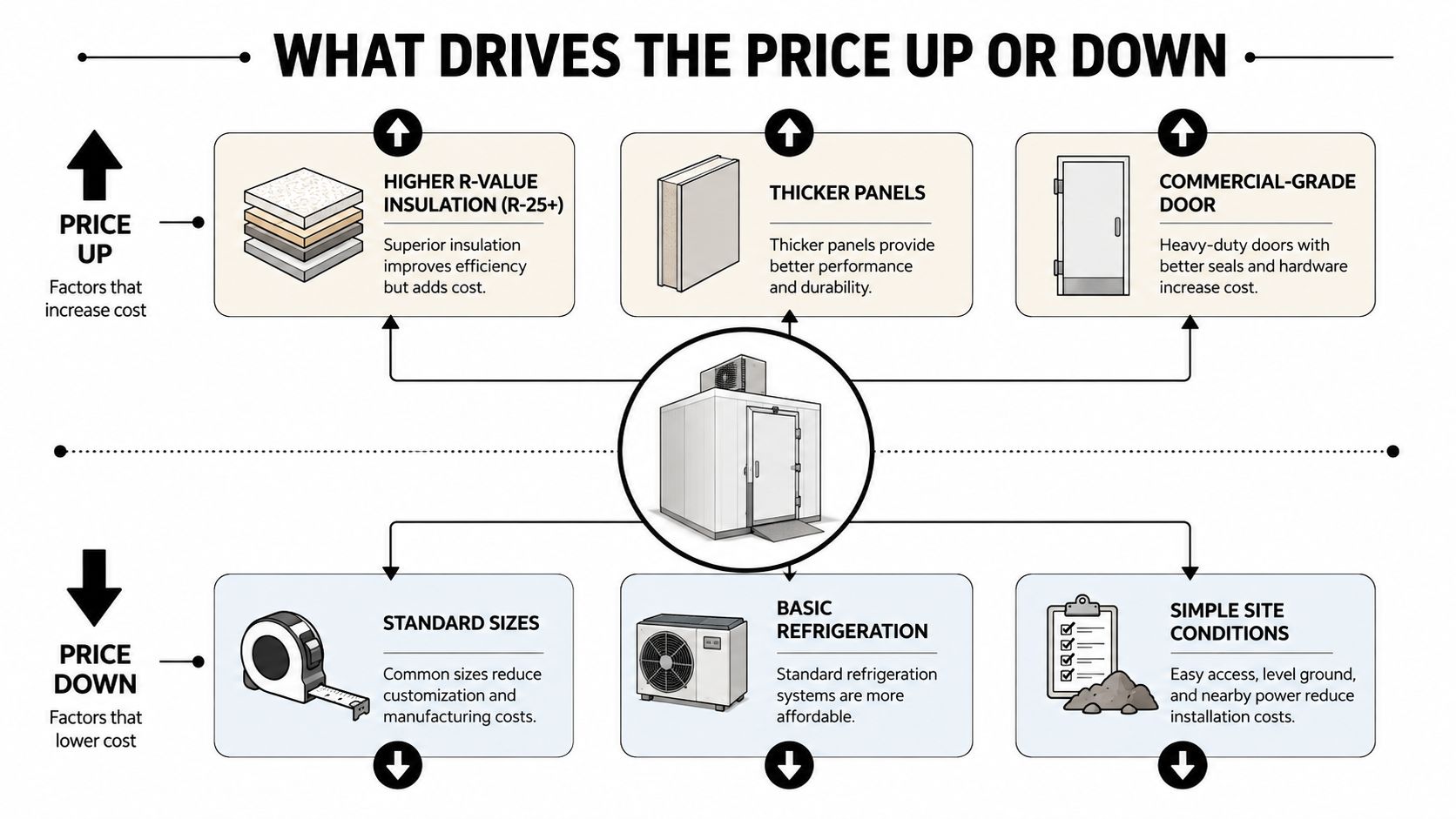
Federal code guidance cited by KPS Global says cooler walls, ceilings, and doors require a minimum R-25, and higher-performance walk-ins often use R-29 to R-32 panels. The U.S. Department of Energy finalized updated walk-in cooler and freezer energy-conservation standards in late 2024, so a quote that looked normal before may not reflect what counts as compliant now KPS Global guidance.
The parts that push the number higher
Thicker panels cost more, but they also lower heat gain. More door openings, hotter ambient conditions, and a tighter, hotter kitchen all make the refrigeration system work harder. A commercial-grade door that seals properly is worth paying for because weak sealing turns into wasted electricity every single day.
The cheapest quotes usually cut corners in the same places:
- Basic refrigeration: It gets the job done on paper, then struggles in a hot kitchen.
- Simple site conditions assumptions: These disappear the moment the crew sees the slab, access path, or electrical panel.
- Older compliant assumptions: If the bid was built on an outdated spec, the price may look better than it really is.
Hot Arizona kitchens punish weak equipment. That's why a quote that looks low on Monday can look expensive by the time the first summer hits and the compressor starts fighting a losing battle.
Operating Costs You Will Pay for Years
A walk-in cooler doesn't stop costing money when the install is done. Electricity, maintenance, repairs, and short equipment life are part of the bill whether the owner tracks them or not. If you ignore operating cost, you're only pricing the first month of ownership.
Industry operating-cost data puts average monthly electricity at about $70.74 for a 6×6 cooler, $119.30 for 8×10 and 8×12 units, and $151.07 for a 10×10 cooler under the calculator's assumptions US Cooler operating data. That's not scary by itself, but it adds up over time, especially when a kitchen runs hot and staff keep opening the door.
Why the monthly bill matters more than the brochure
A low-bid cooler that's poorly insulated or undersized can cost more over time than a mid-range unit that was built right. The monthly electric cost is only part of it. If the compressor runs longer, the door seal fails early, or the install skipped proper commissioning, you're paying again in service calls and product loss.
Use the monthly figures as a planning floor, not a ceiling. A busy restaurant in Globe or Miami with hot back-of-house conditions, frequent deliveries, and heavy staff traffic will usually work harder than the calculator's assumptions. That's why I tell owners to budget for real conditions, not ideal ones.
For energy-focused planning, use walk-in cooler efficiency guidance to sanity-check what the quote says about insulation, door sealing, and system setup.
Hard truth: the cheapest cooler on install day can become the most expensive cooler by year three if it leaks cold air and runs constantly.
The quote warnings I care about most
If I see a bid with vague line items, no refrigeration brand, no startup commissioning, or no post-install verification, I treat it as unfinished work. Those gaps usually mean the contractor expects the owner to discover problems later. In Arizona heat, later is too late.
A good installer thinks past the sale. A bad one hopes you never compare your utility bill to the brochure.
Getting an Accurate Quote From Cobre Valley Air
If you want a clean number, show up prepared. Measure the available space, photograph the panel location, send the door swing direction, and note whether the box is indoor or outdoor. Those basics save time, and they separate a real quote from a placeholder.
Arizona buyers should also ask the contractor direct questions about licensing, startup, and support. Verify the team is licensed, and ask who will handle the commissioning, not just the delivery. If you're talking to a company like Cobre Valley Air, ask whether they handle commercial refrigeration work, how they evaluate airflow and duct issues around the install, and what their service response looks like after startup.
Ask these questions before you sign
- What refrigeration brand are you quoting? A brandless quote is a vague quote.
- Does the price include startup commissioning? If not, you're not getting a complete install.
- Will you confirm electrical and site requirements before ordering? You want that done before material hits the driveway.
- What does the service warranty cover? If it's thin, the price is probably thin for a reason.
Cobre Valley Air lists licensed HVAC technician information for buyers who want to verify qualifications before they commit. That matters because a cooler install isn't just metal and foam, it's refrigeration, airflow, electrical coordination, and reliable service after the crew leaves.
The lowest bid often looks attractive until the unit is down, the product is at risk, and the installer is hard to reach. In Arizona heat, response time is part of the price.
Smart Next Steps for Arizona Buyers
Start with size, then move to operating cost, then force the quote to be itemized. If you do it in the opposite order, you'll chase the cheapest number and probably regret it. The better path is to define the box you need, then make the contractor prove the spec can survive your building and your summer.
A practical checklist for Globe, Miami, and Superior owners looks like this. First, confirm the storage volume you need and whether the box is a cooler or freezer. Second, ask for a line-item quote that separates the box, refrigeration, electrical, labor, and commissioning. Third, compare the monthly electricity expectation, not just the install price. Fourth, verify the installer is licensed for the work and has commercial refrigeration experience.
If the quote doesn't mention insulation performance, startup testing, or service support, keep shopping. The cheapest equipment is rarely the cheapest ownership experience.
For Arizona businesses, the right question isn't “what's the lowest price?” It's “what will this cooler cost me over the next five to ten years, in this climate, in this building, with this staff?”
Cobre Valley Air LLC handles commercial HVAC and walk-in cooler service for businesses that need dependable installation, repair, and maintenance in Globe, Miami, and Superior. If you want an itemized look at your cooler project and a contractor who treats the quote like a long-term service plan, visit Cobre Valley Air LLC and ask for a walkthrough before you sign anything.